The second round of inflation has become the biggest tail risk that institutions are worried about.
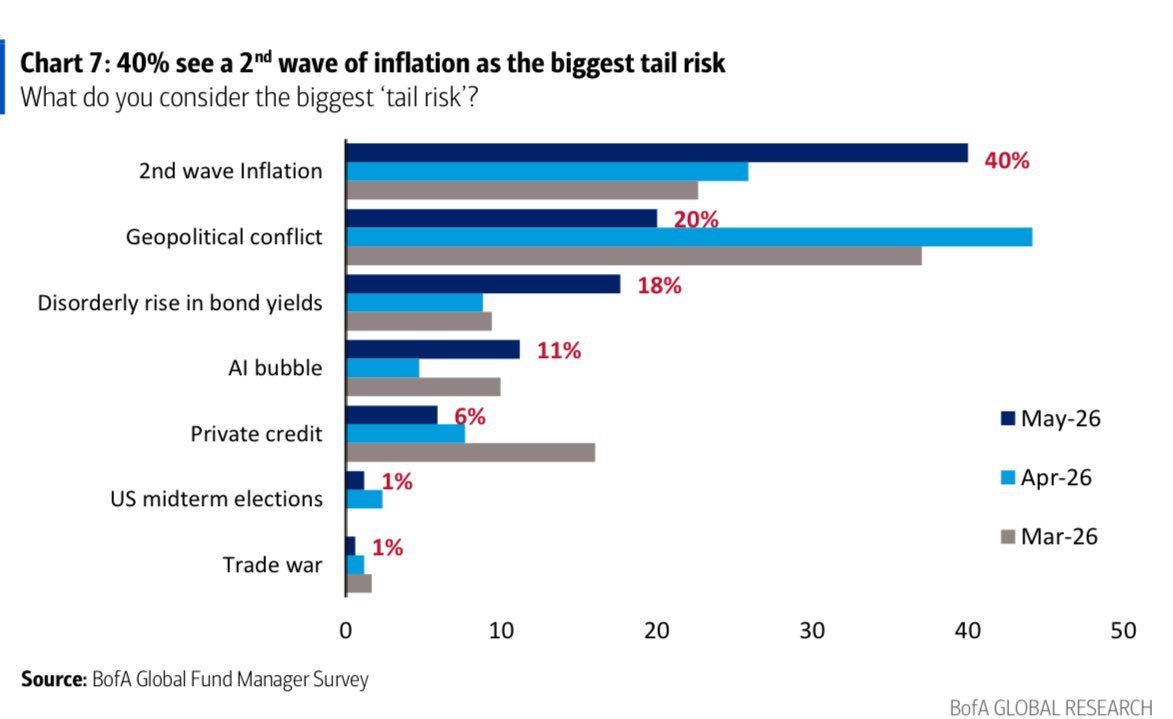
BofA's latest global fund manager survey shows that in May, 40% of fund managers believe that "second round inflation" is the current biggest tail risk, surpassing geopolitical conflicts, becoming the issue that institutions are most concerned about. Next is geopolitical conflict at 20%, disorderly bond yield rise at 18%, AI bubble at 11%, and private credit risk at 6%. This indicates that the main line of market risk has changed.
Last month, the market's biggest concern was geopolitical conflict, as war, straits, oil supply, and shipping security would directly impact risk appetite. But now institutions are worried that conflicts will push energy prices up again, and the rise in energy prices will re-enter inflation data. Rising inflation will force the Federal Reserve to maintain high interest rates, and may even lead to an increase in long-term U.S. Treasury yields.
Once the second round of inflation occurs, the Federal Reserve will have less space to cut interest rates, which could trigger a recession. High interest rates will make corporate financing difficult and worsen the U.S. fiscal deficit.
As inflation rises again, the Federal Reserve cannot quickly cut interest rates. If the Federal Reserve cannot cut rates, short-term rates will remain high. If the fiscal deficit continues to expand and the supply pressure of U.S. Treasuries continues to rise, it will be very difficult for long-term yields to come down. The end result is that the market faces a situation of high inflation, high interest rates, high financing costs, and high fiscal pressure simultaneously.
This is even more detrimental to an already scarce liquidity.
Furthermore, the current biggest issue for $BTC is liquidity. If the market re-enters a second round of inflation, Bitcoin is almost unlikely to experience an independent upward trend.
Currently, the main reason for the second round of inflation is the Strait of Hormuz.
免责声明:本文章仅代表作者个人观点,不代表本平台的立场和观点。本文章仅供信息分享,不构成对任何人的任何投资建议。用户与作者之间的任何争议,与本平台无关。如网页中刊载的文章或图片涉及侵权,请提供相关的权利证明和身份证明发送邮件到support@aicoin.com,本平台相关工作人员将会进行核查。


