On April 21, the ETH HK Hub, jointly operated by SNZ and ETHTAO, was officially launched in Hong Kong. Aya Miyaguchi, Chair of the Ethereum Foundation, Hong Kong Legislative Council member (Technology and Innovation Sector) Christopher Cheung, and Ethereum ecosystem partner QZ engaged in a dialogue at the opening event.
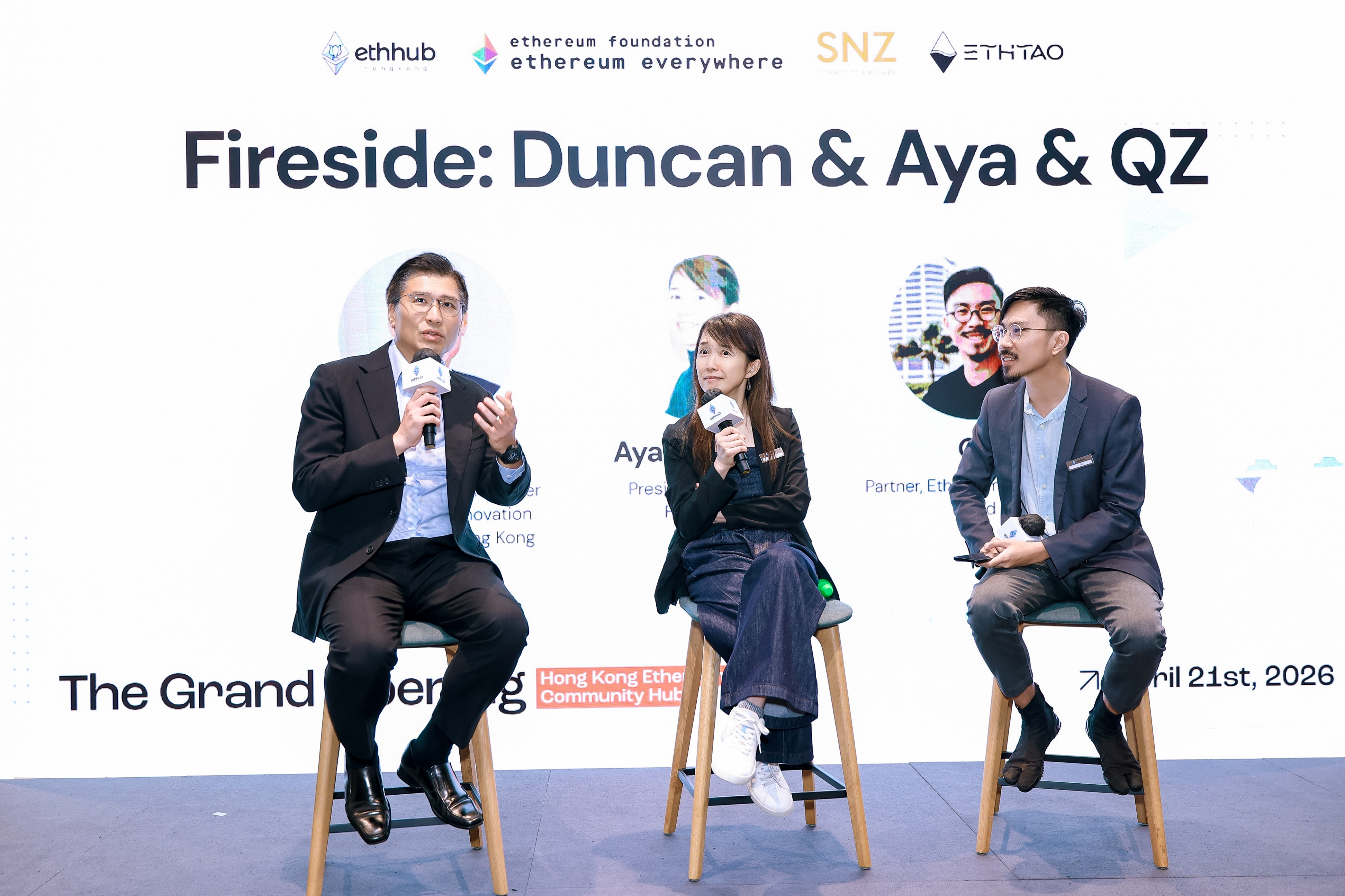
The conversation revolved around the Ethereum Foundation's long-termism, subtraction philosophy, Walk-away Test, the development of the digital asset ecosystem in Hong Kong, and the significance of ETH HK Hub to the Asian Ethereum community.
At this milestone of Ethereum's ten-year journey, Aya emphasized that the goal of the Ethereum Foundation is not to become the control center of the ecosystem, but to allow the system to ultimately operate continuously without the Foundation's involvement. Christopher Cheung shared Hong Kong's unique advantages as a node for digital asset development from the perspectives of policy, financial infrastructure, and talent mobility.
Below is the translated full text of the dialogue, edited and slightly modified.
Host QZ:
Hello everyone, I will host today's roundtable in English.
This year marks the tenth year of Ethereum's development. Seeing the ecosystem in Hong Kong grow from small gatherings and discussions to today’s physical community Hub is a significant signal of progress.
Ethereum represents the meaning beyond the technology itself—it embodies the possibility of building large-scale systems, even a new form of digital civilization. However, this path is not easy.
The Ethereum Foundation recently proposed an important concept: a system must not only operate effectively today but must also not become a bottleneck in the future. This reflects the core principle of the Foundation—choosing the more difficult but more sustainable long-term path even when a faster route to short-term growth exists.
Aya, from your perspective, have there been genuinely difficult moments in adhering to this principle?
Aya Miyaguchi:
This tension actually exists every day.
When I joined the Ethereum Foundation, it was during the ICO boom. At that time, the market had a strong growth momentum, accompanied by tremendous external pressure. Many suggested that the Foundation should expand quickly, hire aggressively, and operate like a traditional large company, such as setting up positions like CTO or CMO.
This sounded like a very natural choice, but we did not do that.
Because Ethereum must pass the so-called "Walk-away Test"—which means that even without the Ethereum Foundation, the whole system still operates normally. This is our long-term goal.
A typical example is The Merge in 2022. This was an extremely complex upgrade involving a large number of already running applications and collaboration from multiple client teams. It would have been much simpler to accomplish if it were done by a single team within the Foundation.
But we intentionally chose client diversity. Although this increased the difficulty, it strengthened the protocol's resilience in the long run. Therefore, in many cases, we choose the more difficult path for the sake of long-term sustainability.
QZ:
If the Foundation had chosen a centralized development path at that time, what would not exist today?
Aya Miyaguchi:
We have always emphasized the "subtraction philosophy."
If the Foundation builds everything for the entire ecosystem, participants will become dependent. In the long run, this undermines competition, and without competition, optimal solutions cannot emerge.
The potential of Ethereum is too vast to be controlled by a single organization. Many significant innovations in the ecosystem have occurred without direct participation from the Foundation.
This is precisely where Ethereum's advantage lies. Our role is to support and coordinate, not to overcontrol. And the community Hub we see today in Hong Kong is also a reflection of this philosophy.
QZ:
Duncan, from your perspective, how did you enter this field?
Duncan Chiu:
Before answering, I want to first welcome Aya to Hong Kong, and I hope this won't be your last visit.
I first encountered Ethereum around 2014, before the ICO. As a venture capitalist, we were also looking at some blockchain projects at that time, but due to limited understanding, we did not make significant investments, although we continued to follow the development of the field.
From 2021, as a Legislative Council member, I participated in technology trend analysis and policy research. By 2022, the Hong Kong government recognized that blockchain would have a profound impact on financial infrastructure, and as an international financial center, we must maintain our competitiveness.
Therefore, we began to promote a series of developments, including stablecoin legislation, tokenized financial products (such as bonds and deposits), and encouraging financial institutions to explore on-chain infrastructure. This was gradually advanced from products, ecosystems, infrastructure to regulation.
QZ:
In terms of adoption, what is the biggest challenge?
Duncan Chiu:
The development of any technology takes time. If we look at artificial intelligence, it has gone through decades of evolution, whereas blockchain is still in a relatively early stage.
Adoption cannot be forcibly pushed; it is the result of innovation. When products that meet real user needs emerge, adoption will naturally occur, and institutions will follow, as will regulation.
Regulation is always lagging. Therefore, it is crucial to have builders continuously pushing innovation and creating new products.
QZ:
Why is a "no-intermediary system" so important?
Aya Miyaguchi:
Because without this assurance, there is no reason for anyone to build upon it.
No intermediaries mean that no single entity can shut down the system. We have seen the vulnerabilities of centralized systems, for example, a global software failure in 2024 that led to massive system disruptions, flight cancellations, and caused billions of dollars in economic losses.
This shows that there are significant risks in relying on centralized systems. Therefore, this is not only a conceptual issue but a real necessity.
QZ:
Why should developers choose Ethereum?
Aya Miyaguchi:
It depends on the features that Ethereum offers. It has the world's largest developer ecosystem and is the most active development platform.
When developers join Ethereum, they are not just building products, but participating in a global exploration of systems.
Ultimately, the focus is not on Ethereum itself, but on the world it can create.
QZ:
What does the "success" of the Ethereum Foundation mean?
Aya Miyaguchi:
Success means the Foundation does less while Ethereum becomes stronger.
When the community can develop independently and innovation does not rely on the Foundation, the ecosystem is healthy.
In an ideal state, Ethereum would become an infrastructure that is naturally used, just like the internet.
QZ:
Duncan, what is Hong Kong's uniqueness in the development of digital assets?
Duncan Chiu:
Hong Kong possesses multiple advantages, including connecting East and West, attracting global talent, and having a mature financial system.
It is a place where connections, collaborations, and ideas can be established rapidly. In recent years, we have also seen an influx of talent, while global geopolitical changes have further highlighted Hong Kong's importance.
Ultimately, the development of technology relies on people, and Hong Kong is a place where people are willing to come and build.
QZ:
Thank you Duncan, thank you Aya, and thank you all for participating.
免责声明:本文章仅代表作者个人观点,不代表本平台的立场和观点。本文章仅供信息分享,不构成对任何人的任何投资建议。用户与作者之间的任何争议,与本平台无关。如网页中刊载的文章或图片涉及侵权,请提供相关的权利证明和身份证明发送邮件到support@aicoin.com,本平台相关工作人员将会进行核查。


