
Author: Nancy, PANews
In 2020, Bitcoin Cash (BCH) forked to give birth to eCash; more than five years later, Bitcoin has again seen a fork narrative, with another project of the same name attracting attention.
Recently, Bitcoin developer Paul Sztorc announced the launch of a new Bitcoin hard fork network called eCash, which will airdrop to Bitcoin holders. This news quickly sparked heated discussions in the community. However, eCash ran into controversy before its launch, especially since the new chain plans to pre-allocate some tokens corresponding to Satoshi Nakamoto’s addresses to early investors and the development team.
Another hard fork experiment, eCash will launch in August this year
On April 28, Paul Sztorc announced that he is promoting a Bitcoin hard fork project named eCash, expected to officially launch on August 21, 2026, at a Bitcoin block height of approximately 964,000.
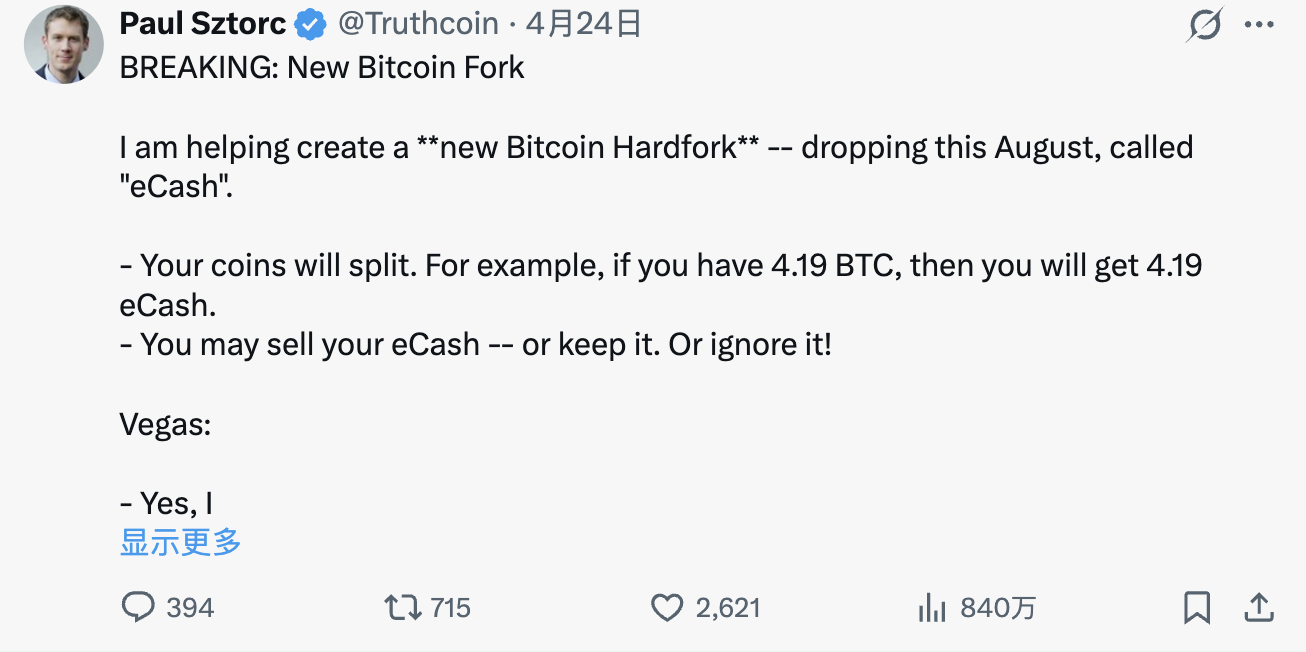
The project will fork from the Bitcoin main chain, and all Bitcoin holders on the chain will automatically receive an equivalent amount of eCash at a 1:1 ratio. It will be up to the platform to decide whether exchange users will receive the airdrop. Holders can freely choose to sell, retain, or disregard these new coins.
Sztorc is a long-term Bitcoin developer and the proposer of the Drivechains solution, currently serving as the CEO of LayerTwo Labs, a Bitcoin network sidechain development company.
eCash is positioned as a long-term solution to address Bitcoin's scalability, stalling innovation, and governance issues. According to the introduction, eCash’s Layer1 node software will be nearly a complete replica of Bitcoin Core, continuing to use the SHA-256 hashing algorithm and significantly lowering the initial mining difficulty to attract more miners to participate early. The client code will be frozen 30 days before the fork, and a multi-round bug bounty program is planned to launch in the summer.
The biggest highlight of eCash is the integration of seven Layer 2 Drivechains expansion networks, covering privacy chains (similar to Zcash), prediction market Truthcoin, decentralized exchange CoinShift, NFT asset platform Bitassets, identity system Bitnames, and quantum-resistant network Photon, among others. These Drivechains allow for high throughput, programmability, and diverse applications without modifying Layer 1 rules, aiming to support a global user scale of 8 billion. At the same time, they all support merged mining, allowing miners to gain additional rewards while maintaining the main chain.
Drivechains were first proposed by Sztorc in 2015 as a Bitcoin sidechain scaling solution, later evolving into BIP 300 and BIP 301 proposals. This technology allows miners to use existing computing power to maintain sidechains, tightly binding the security of sidechains to the Bitcoin mainnet, aiming to solve Bitcoin's scalability problems and functional expansion bottlenecks. Sztorc has promoted Drivechains since 2015 and previously tried to introduce them to the Bitcoin mainnet in a soft fork format, but this time he chose hard forks as an experimental platform.
Sztorc believes that a competitive ecosystem made up of multiple Layer 2 networks can effectively avoid excessive centralization of developer power and also give Bitcoin the potential to serve billions of users worldwide.
Unlike the Bitcoin Cash fork in 2017, eCash has not retained the Bitcoin brand name, sufficiently notifying the market in advance, and will provide a coin splitting tool to help users safely separate their assets.
Sztorc stated that this fork is not technically necessary but stems from the current situation of the Bitcoin community. He believes that Bitcoin Core developers have become conservative, self-interested, lazy, and corrupt, while miners have failed to fulfill their responsibility to maximize profits, and there are many deep-seated issues in Bitcoin's culture that are difficult to fix. Therefore, he chose to restart the experiment through a hard fork.
The name eCash was chosen to pay tribute to the cryptographer David Chaum. In the 1980s and 1990s, Chaum launched a project of the same name, eCash, exploring privacy electronic payments through blind signature technology. Although his company DigiCash eventually went bankrupt in 1998, this early experiment is regarded as one of the important inspirations for the evolution of cryptocurrencies.
Controversy over the allocation of Satoshi coins, criticized for hype marketing
eCash attempts to establish an experimental network that inherits the Bitcoin economic system while boldly promoting Layer 2 innovation through a Bitcoin hard fork. The project quickly attracted market attention following its announcement, but its token distribution mechanism also sparked intense controversy.
According to the current plan, the eCash chain will completely replicate the Bitcoin historical ledger, including the balance of approximately 1.1 million BTC corresponding to Satoshi Nakamoto’s long-dormant addresses. However, about half of these, 500,000 to 550,000 eCash, are planned to be reallocated to early investors and the development team for research and development incentives, ecological construction, and attracting contributors before the project launch, to avoid the new chain becoming a zombie project due to insufficient funding.
This arrangement has quickly met with opposition from some members of the Bitcoin community. Critics argue that this violates Bitcoin's core principle of "code is law," as it essentially reallocates the asset mapping rights of others without authorization.
Jameson Lopp, a well-known Bitcoin developer and chief security officer at Casa, stated that this is not Satoshi's Bitcoin, but rather those UTXOs believed to belong to Satoshi, replicated and modified onto another completely different network. This is a very clever provocative marketing. If there is a genuine need to reallocate Satoshi's assets on the Bitcoin main chain, it would require the entire Bitcoin ecosystem to collectively accept that hard fork.
In response, Paul Sztorc stated that this is a "decision that will undoubtedly spark controversy," but it is a realistic and necessary choice to effectively address the resource constraints at the start of the new project.
He also emphasized that eCash will not affect Satoshi or anyone's Bitcoin holdings on the Bitcoin main chain, and the original chain assets will be completely unaffected. On the contrary, this plan essentially gifts Satoshi approximately 600,000 eCash. At the same time, any transfer of Bitcoin will always require the private keys and software from the Bitcoin main chain to complete.
Currently, community attitudes are clearly polarized. Supporters believe that the pathways for Bitcoin expansion are limited to either large blocks or sidechains, and the Core team has long adopted a conservative stance on both. eCash at least provides a new experimental opportunity.
Opponents argue that Drivechains give miners too much power, which may lead to early block rewards being monopolized, or even posing a risk of a mining majority misappropriating funds in extreme cases. They believe this plan has been rejected multiple times by the community in the past and is now merely rebranded as a new token that might be emulated by other projects. A more immediate concern is that most Bitcoin hard fork projects in history ultimately failed to establish long-term value.
Overall, eCash is still in the early proposal stage. Whether it will successfully launch, gain market adoption, and create sustainable value remains highly uncertain.
免责声明:本文章仅代表作者个人观点,不代表本平台的立场和观点。本文章仅供信息分享,不构成对任何人的任何投资建议。用户与作者之间的任何争议,与本平台无关。如网页中刊载的文章或图片涉及侵权,请提供相关的权利证明和身份证明发送邮件到support@aicoin.com,本平台相关工作人员将会进行核查。


