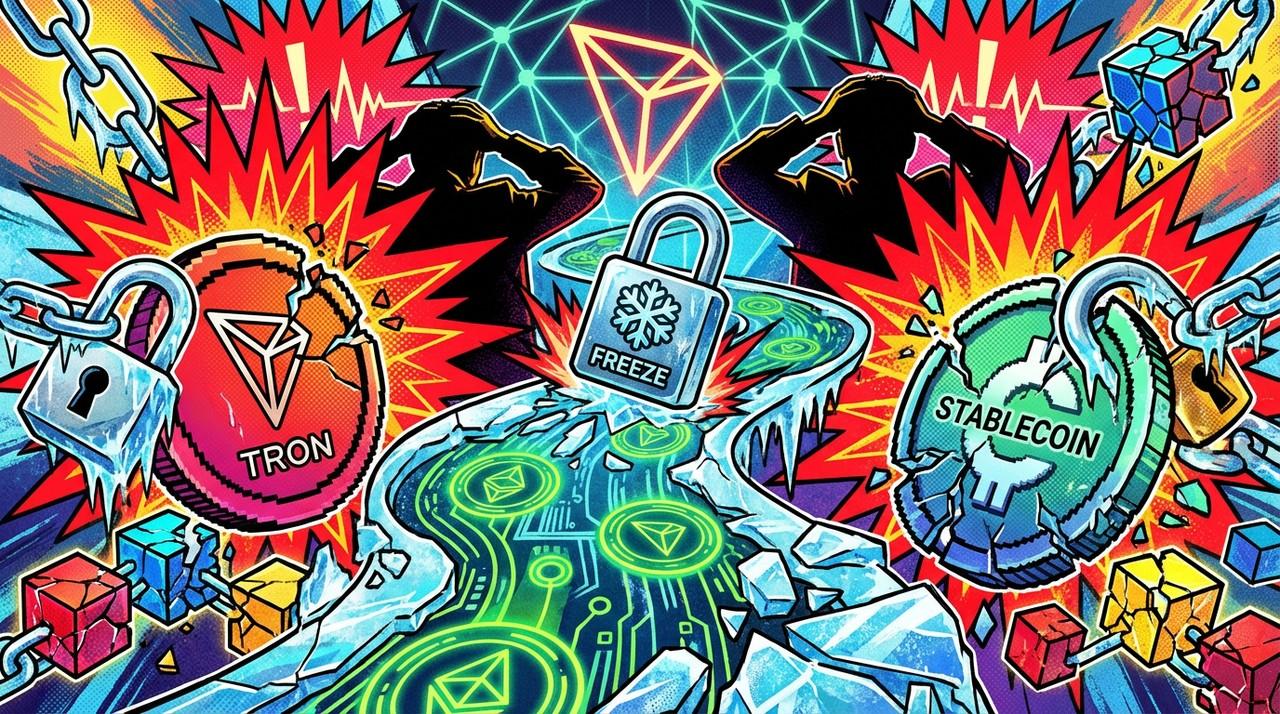
On April 23, 2026, Tether announced the freezing of over 344 million USDT in two wallet addresses in coordination with the U.S. government. The participants include the U.S. Department of the Treasury's Office of Foreign Assets Control (OFAC) and U.S. law enforcement agencies. The official reason given is merely "related to illegal activities," with the goal of preventing the further transfer of relevant funds. On the surface, this seems to be a major asset lockdown; more critically, the action was taken not by a specific on-chain protocol but by the issuer itself.
This is also the truly eye-catching aspect of the event: on-chain assets can typically flow rapidly, transfer across platforms, and appear to be unconstrained by geographical boundaries. However, at critical moments, the switch remains in the hands of centralized institutions. Thus, this freeze is no longer just a law enforcement collaboration but resembles an openly staged showdown—when compliance requirements meet privacy demands, and when the imagined "neutral tool" collides with the reality of funds that can be directly frozen, whoever has the authority to hit the pause button defines the true power structure of this system.
Over 300 Million Frozen Overnight
First, let's nail down the facts: what has been pressed on the pause button is not market fluctuations, not an automatic liquidation triggered by a specific protocol, nor assets out of control due to a user's lost private key. The confirmed information has only one main line—on April 23, 2026, Tether, in cooperation with the U.S. Department of the Treasury's OFAC and U.S. law enforcement, froze over 344 million USDT in two wallets. The public statement on the enforcement level also stops here: these funds have been identified as "related to illegal activities," and the direct purpose of the freeze is to prevent further transfers.
This distinction is crucial. Because it means the initiator of the action is not on-chain code, but the issuer itself; the execution logic is not public, pre-set, and automatically running protocol rules, but rather an invocation of human authority after collaborative law enforcement. In other words, what the outside world sees is not a "market clearing," but a clear, direct asset disposal that can be completed by a centralized entity.
Equally important, however, is that the boundary of information remains very narrow. The outside world can only confirm three levels: the two addresses, the scale of over 344 million USDT, and that the collaborative subjects are OFAC and U.S. law enforcement agencies. Beyond that, the full picture of the case has not been made public. Specifically, which two addresses, how much each address has been frozen, what the corresponding case names are, what the legal documents are, and more details of Tether's announcement currently fall outside the confirmed information.
This is why all on-chain speculation surrounding these two wallets must be viewed separately from "official confirmation." Risks can be discussed, and questions about the boundaries of power can be raised, but undisclosed address ownership or the path of funds cannot be directly written as established facts. What can truly be recorded now is not the full picture of the case story but a more direct, also more eye-opening reality: when the issuer decides to cooperate with law enforcement, large amounts of USDT in on-chain circulation can be neatly pressed down in a very short time.
The Ideal of Decentralization Hits the Compliance Iron Gate
The reason this incident is eye-catching is not only due to its large scale, but also because it brings a long-ignored premise back to the forefront: assets can circulate rapidly on-chain, but as long as the rights to issue and redeem remain concentrated in the hands of a few entities, ultimate control does not truly leave the scene. What has been pressed on the pause button are over 344 million USDT in two wallet addresses; and the one pressing this switch is not an automatic mechanism of a protocol, nor a spontaneous clearing completed by the market in panic, but a freezing action from the issuer.
This distinction is very important. On April 23, 2026, the confirmed collaborators are Tether, OFAC, and U.S. law enforcement, with the reason for the freeze stated as "related to illegal activities," aiming to prevent funds from being further transferred. In other words, this is not a passive remedy after a hacker attack, nor a technical result triggered by on-chain liquidation, and certainly not a chain reaction caused by a price crash; it is an active asset control completed in collaboration with law enforcement by the issuer. The on-chain ledger has not disappeared; the appearance of transfer functionality has not changed, but whether the assets can still be used is no longer completely in the hands of the holder.
This also clarifies Tether's role. It is certainly still one of the most important on-chain U.S. dollar tools, but from this action, it is clear that it is no longer merely a provider of liquidity, nor a neutral technological interface that exists outside of regulations. At least at critical moments, it can become a valve in the compliance system: when regulatory goals are clear and law enforcement demands are established, the issuer can directly intervene in the fate of on-chain assets. This very capability demonstrates that what USDT relies on is not purely the ideal of decentralization, but a dual structure that is embedded in market circulation and real-world law enforcement.
Therefore, what this freeze truly shatters is not a separate asset arrangement of a single address, but the simplistic imagination that "on-chain means freedom." On-chain indeed enhances liquidity efficiency and reduces transfer friction, but it does not inherently eliminate power; it merely redistributes power elsewhere. When the issuer has the ability to freeze, and clearly collaborates with OFAC and U.S. law enforcement, the "neutrality" of such assets is no longer an abstract slogan, but a reality that must be repeatedly examined: Is it a universally usable on-chain dollar tool, or a compliance gate that can be quickly invoked by the regulatory system when necessary? This event does not provide a final answer, but openly and clearly pushes this question back to the market.
On-chain Dark Money Cannot Outrun Law Enforcement's Spotlight
If the previous layer of controversy still lingered on "who holds the switch," then this layer poses a more practical question: once the switch is pressed, for what purpose? In this incident, the confirmed statement is actually quite restrained—two frozen addresses are deemed "related to illegal activities," and the direct purpose of the freeze is to prevent the further transfer of relevant funds. This wording is crucial as it indicates that law enforcement is not only focused on tracing the whereabouts of funds afterward, but aims to cut off the channels before the funds continue to split, jump, or flow out.
This is also the most noteworthy aspect of this action. The on-chain world used to give the impression that "funds will always leave traces," but leaving traces does not equate to being able to intercept the flow. What truly determines the outcome is often not whether something can be seen, but whether intervention can be completed before the transfer occurs. The freeze of over 344 million USDT brings this capacity to the forefront: when the issuer collaborates with OFAC and U.S. law enforcement, law enforcement can no longer merely track along addresses but can directly affect the mobility of the assets themselves.
From this perspective, "law enforcement capability on-chain" is not just an abstract judgment, but a very concrete demonstration of reality. The transfer paths on-chain can be public, and assets can superficially flow rapidly, but as long as the entry and exit still need to pass through a centralized gate that can be invoked, then certain funds cannot simply be moved as desired. For the market, this is more penetrating than any verbal statements: it reminds all participants that on-chain efficiency and issuer control coexist, rather than being an either-or situation.
> To be verified background
>
> ● There is a single-source claim that the wallets frozen this time are located on the Tron network.
> ● There is also a single-source claim that Tether previously assisted in handling related cases involving 61 million and 225 million dollars.
> ● Additionally, there is a single-source claim that Tether has cumulatively frozen assets exceeding 4.4 billion dollars globally and supported over 2,300 cases.
>
> These contents can only serve as background materials for understanding Tether's recent closer alignment with anti-money laundering and sanctions collaboration, and cannot be directly equated as confirmed facts of this case.
In other words, the background narrative and the facts of the case must be viewed separately. As for what can currently be confirmed in this case, the outside world only knows: On April 23, 2026, Tether coordinated with the U.S. government to undertake a large-scale freezing action involving over 344 million USDT in two wallet addresses, with the reason only reaching "related to illegal activities," and the purpose being to prevent further transfers. Regarding the network where the address is located, the scale of past collaborations, and details of historical cases, they cannot replace this event itself. What is truly worth being cautious about is not how complete the background materials are, but in the absence of publicly disclosed information, heedlessly writing "possible" as "already confirmed."
Holders of Funds Start Questioning Who Can Lock
Within this boundary, what truly changes the market's perception may not be a momentary price reaction, but a recalibration of cognition. The freeze disclosed on April 23 has been confirmed to only involve two wallet addresses, not all holders; however, the volume of over 344 million USDT is enough to suddenly make a topic that was previously lingering in debate feel concrete: on-chain circulation does not automatically imply being immune from freezing. For ordinary holders, the most painful aspect often lies not in the volatility on paper, but in having to re-answer the question—what they hold is ultimately an asset that relies solely on on-chain rules or a tool that can still be pressed by the issuer at crucial moments.
The reason this incident has such a strong symbolic effect is precisely because the freezing action did not come from an automatic mechanism of a decentralized protocol, but was completed in collaboration between Tether and the U.S. law enforcement system. Confirmed participants include Tether, OFAC, and U.S. law enforcement, with the publicly stated reasons only reaching "related to illegal activities," aimed at preventing further fund transfers. In other words, the risk point does not exist in the transfer step itself but in the upstream centralized issuance process. Many previously viewed such power as a gate that would only be dropped in extreme circumstances, but once the frozen amount is magnified to this scale, it no longer remains merely a possibility in legal texts but becomes a realistic condition that all users must factor into their judgments.
This will directly change the operational logic of intermediary institutions. For trading platforms, market makers, and users relying on USDT for cross-border transfers, the priority of address screening, source verification, and compliance risk control will only be further elevated. Although this freeze did not extend to all addresses, it has already clearly indicated: Once a certain amount of funds connects with a high-risk label, subsequent circulation is not just a matter of counterparty risk but may also evolve into an issue of asset availability. In the past, some people prioritized on-chain settlement efficiency and liquidity; now they must include "whether the funds can reach smoothly, and whether they can continue to be used after reaching" in the same risk checklist.
A deeper layer of divergence will also be reopened because of this. For regulators, such actions will reinforce an expectation: that these on-chain U.S. dollar tools are not completely unreachable, but "cooperative and freezeable"; for privacy advocates, this is more like yet another alarm regarding the expansion of censorship, reminding them that the so-called neutral infrastructure is, in fact, always controlled by a few centralized links. What needs to be cautious is that there are currently no verified public statements that can directly represent the entire market or official position, so any emotional reactions should not be written as consensus. However, one point has become sufficiently clear: after this incident, the debate surrounding USDT will no longer merely be about "whether it is convenient to use," but rather "who has the power to lock at the last moment."
The Closer Tether Gets to Washington, the Harder It Is to be Neutral
From this perspective, the significance of the collaborative action on April 23, 2026, is no longer just a freeze of over 344 million USDT. The publicly available information can only confirm that Tether collaborated with OFAC and U.S. law enforcement to freeze two addresses deemed "related to illegal activities," aiming to prevent the relevant funds from being transferred; however, details such as the case name, legal basis, specific addresses, precise amounts per address, and more full details from the announcement are still unpublished. Because of this, the currently public fact only supports a trend judgment and is far from sufficient to support an extended interpretation of the case's internal details.
However, the trend itself is already clear: the more an issuer wishes to enter mainstream financial and regulatory orders, the harder it is to maintain a long-term position as a "pure neutral tool." Freezing, collaboration, and account-level control capabilities are no longer just backup buttons for extreme situations; they will increasingly become part of their compliance framework. The convenience of on-chain circulation still exists, but at the same time, the issuer's power to directly hit the pause button has also been brought to the forefront again—these two matters do not cancel each other out but coexist within the same system.
This may not immediately shake the foundation of USDT's usage. The real operation of the market often doesn't pivot instantly due to a single event; trading habits, liquidity networks, platform support, and cross-regional settlement needs cannot be rewritten in a day. However, this event will continue to rewrite another deeper cognitive level: the market will find it increasingly difficult to fully imagine Tether as a neutral on-chain tool that is not biased toward any side and is responsible only for transmission. The closer it gets to the regulatory center, the more it needs to prove itself "controllable"; and once "controllable" is repeatedly verified, the narrative space for "neutrality" will consistently be compressed.
Therefore, what truly remains may not be this 344 million itself, but three more difficult-to-ignore questions: who has the authority to press the pause button, what the basis is, and where the transparent boundaries lie. As long as these issues still lack sufficiently complete public explanations, the discussions surrounding USDT will not revert to simple efficiency and convenience but will remain trapped in the repricing of power structures, execution standards, and trust costs.
Join our community to discuss and grow stronger together!
Official Telegram community: https://t.me/aicoincn
AiCoin Chinese Twitter: https://x.com/AiCoinzh
OKX Welfare Group: https://aicoin.com/link/chat?cid=l61eM4owQ
Binance Welfare Group: https://aicoin.com/link/chat?cid=ynr7d1P6Z
免责声明:本文章仅代表作者个人观点,不代表本平台的立场和观点。本文章仅供信息分享,不构成对任何人的任何投资建议。用户与作者之间的任何争议,与本平台无关。如网页中刊载的文章或图片涉及侵权,请提供相关的权利证明和身份证明发送邮件到support@aicoin.com,本平台相关工作人员将会进行核查。