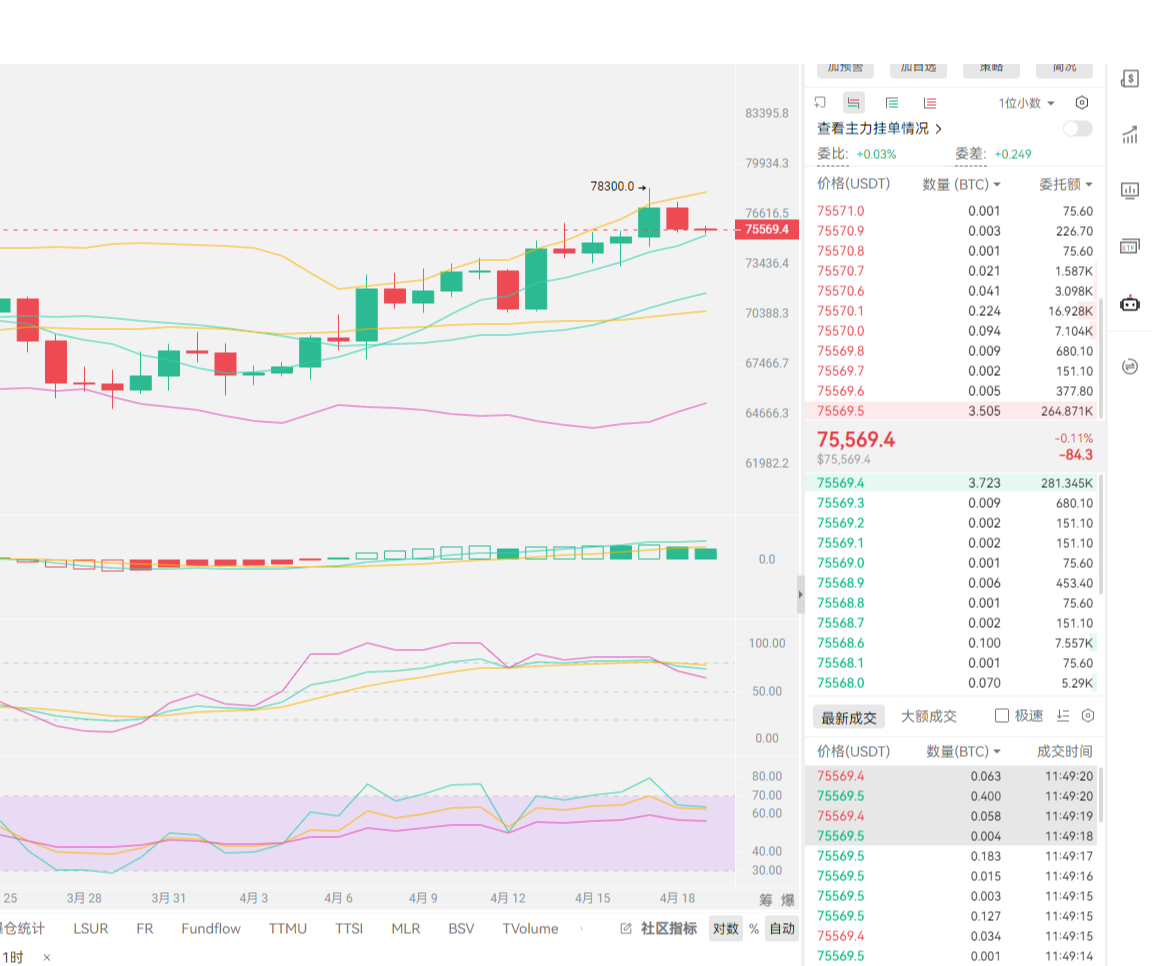
On April 19, 2026, the Aave Chan Initiative (ACI) suddenly announced the termination of staking services related to Frontier, releasing all ETH staked through this channel and transferring it to Aave DAO for unified allocation. This means that the underlying assets originally directed towards yield products will be completely redirected to the protocol's risk buffer pool, completing a sudden conversion in the use of funds. The driving forces behind this shift are the dual pressures surrounding rsETH collateral risk intensification and Aave V3 Core facing wETH shortages and potential bad debt concerns. This article will explore this decision, tracking how the DAO chooses to “sacrifice yield in favor of safety” in an uncertain environment and whether this emergency response can become a long-term safety paradigm for the DeFi industry.
Aave's Risk Curve Under the Shadow of rsETH
Previously incorporated into the collateral narrative relevant to the Aave system, rsETH was seen as a tool for expanding yields and enriching asset portfolios, but in the current environment, this role has been reassessed by the market. Since the briefing did not provide specific quantitative metrics, external observations have focused more on structural risk: once the price or liquidity of rsETH undergoes significant fluctuations, its value as collateral may face discounting, liquidation slippage, and the willingness of liquidators to take over, all of which could change in a short time frame. This uncertainty transmits from the collateral side to the borrowing side, amplifying the potential space for liquidation and bad debt.
Meanwhile, Aave V3 Core is reported to be facing wETH shortages and potential bad debt concerns. Under the architecture that highly relies on ETH/wETH as core assets on both lending and borrowing sides, once wETH positions tighten, the protocol’s ability to cushion against severe market volatility will weaken: it will become difficult to timely recover enough quality assets during liquidation, shifting bad debt risks from a “theoretical scenario” to a “real threat.” In this context, any structure tethered to ETH that indirectly exposes itself to rsETH fluctuations will be seen as a potential stress point.
If proactive measures are not taken to enrich the risk buffer pool, and if the protocol maintains a thin capital cushion while facing rsETH-related shocks, the risks could amplify along the following path: rsETH volatility—depreciation of collateral value—concentrated liquidation—tight liquidity and discounted selling—potential bad debt and erosion of confidence—more withdrawals and deleveraging, ultimately transforming a single asset's risk into systemic tension in the entire lending market. Against the backdrop of this potential path, converting idle or yield-directed ETH into a buffer appears both necessary and urgent, paving the way for subsequent actions by ACI to withdraw Frontier's staking yields and repurpose them into a safety cushion.
Risk Repricing in Withdrawing Frontier Chips
In this event, ACI's core action was to directly terminate Frontier staking services and release all ETH staked through this channel, handing it over to Aave DAO for unified management. The staked assets initially directed towards a single yield path are now managed by the DAO to enhance the overall risk buffer of the protocol, rather than continue to be locked into a specific product stream. This is akin to a “chip withdrawal,” switching individual yield scenarios into a system security scenario.
More critically, ACI stated in its announcement that it would waive all potential yields and fees prior to exiting the service and would no longer claim any economic interests in exchange for a higher safety margin. This action of “removing one's own yield from the table” essentially represents a governance posture: when clear tension arises between risk and yield, choosing to publicly stand on the side of safety and sacrificing one's own yield to create more space for risk buffering.
The released ETH is functionally more akin to an insurance pool: under extreme conditions, it could be used to offset gaps caused by wETH position shortages or buffer against potential bad debt shocks, ensuring that the protocol still has capital available to hedge losses when asset recovery and liquidation are insufficient. Although the briefing did not disclose specific scales, nor permit any inferences about the release rhythm and batch plans, directionally, this batch of ETH provided Aave with a “last line of defense” that it could actively call upon when facing risks related to rsETH and wETH.
For Frontier participants, the short-term impact is evident: the ongoing staking yields they previously anticipated have been interrupted, asset utilization has been rewritten as a buffer for the protocol layer, and the yield curve has been forced to reprice; for the overall liquidity pattern of Aave, this shift represents a prioritization of “safety over yield.” Some high-yield scenarios have been sacrificed, but what is gained is a thicker safety cushion for the protocol on the eve of potential storms, which may actually help maintain smoother fund flows in terms of long-term trust and the stability of existing funds.
A Hard Brake on WETH Freezing by Multi-Signature Guardians
In contrast to the “soft operations” of fund reallocation, there is the Aave multi-signature guardians' freezing of the borrowing market WETH. According to the briefing, this freezing pertains to WETH positions from a single source, meaning the protocol has specifically controlled the risks associated with certain influx channels. This is not a comprehensive halt for the entire market but rather a pause at the asset entry points viewed as concentration of risk.
The direct effect of freezing WETH is the immediate imposition of constraints on new leverage and borrowing activities, effectively applying a hard brake to the system. When certain risk assets or channels are cut off, arbitrage funds cannot indefinitely increase leverage along this path, and potential liquidation chains are limited to a smaller scope. While this approach may sacrifice some trading activity, it gains a more controllable pace of leverage expansion within an uncertain range.
Parallel to the release of Frontier-staked ETH, Aave has implemented a “complementary risk control strategy” consisting of both soft and hard measures: on one hand, releasing ETH to enrich the buffer and enhance the protocol's capital shield; on the other hand, freezing part of the WETH entry to slow down the pace of leverage and liquidity, bringing the potentially uncontrollable risk rhythm back to a more manageable frequency. Both actions point toward one goal—making every effort to compress the space for unfavorable scenarios “before something potentially goes wrong.”
For active traders and arbitrageurs, there is undoubtedly restraint in the short term: available leverage paths have decreased, certain strategies have been forced out, and funding efficiency has declined; yet from the perspective of the protocol’s safety margin, this round of “active deceleration” significantly enhances the system's capacity to withstand extreme scenarios, preemptively building a buffer against potential volatility.
The Game and Consensus Restructuring between DAO and ACI
In its public statement, ACI clearly positioned this series of actions as “proactive risk control measures to provide Aave users with additional safety margins in the current context of rsETH-related risks.” This wording conveys a transformation in its self-role positioning: no longer merely a designer or participant in yield schemes, but a governance actor that proactively exercises “braking rights” in times of heightened risk.
As an important governance participant in the Aave ecosystem, ACI’s choice to forfeit all potential yields and fees prior to service exit represents a governance signal itself—during periods of high volatility, sacrificing current cash flow is worthwhile to gain more reliable survival chances and a reputation moat. This safety-oriented choice is not only a judgment of the protocol's current state but also sends a clear action coordinate to other governance participants: when risk control and yield conflict, prioritize standing on the side of risk control.
After the release of ETH, the role of Aave DAO has also evolved subtly: shifting from focusing more on “yield distributors” (how to distribute returns among various yield products and incentive schemes) to gradually leaning toward being the “risk underwriter”—how to optimally utilize the uniformly managed ETH for important decisions, when and under what extreme scenarios to initiate buffers, has become the new governance focus. This means that the DAO needs to gradually introduce more mature risk budgeting thinking into motion design and voting logic, rather than merely discussing APR and incentive efficiency.
From a longer-term perspective, this incident is likely to elevate the narrative weight of “safety first” in future proposals and governance votes. Supporting higher-risk yield products will have to confront probing questions of “Is the capital buffer sufficient?” while advocating for a conservative camp will strengthen their position through this case: in on-chain finance, the ability to survive multiple cycles is more critical than the marginal difference in single yield rates. ACI's expressions and actions provide a vivid example for such a narrative.
The Evolution of DeFi Risk Control from Emergency to Normalcy
Considering the rapid cessation of staking services and multi-signature freezing of certain assets together, they form a representative case of emergency response implementation within a DeFi protocol: when risks spread from localized products to the protocol layer, but quantitative data remains incomplete, governance participants opt to prioritize rolling out a bundle of conservative measures instead of waiting for “more robust evidence” before taking action. This model of “braking first, then reviewing” is, in itself, a manifestation of risk control culture.
In the absence of precise quantitative data—like the specific figures for rsETH collateral risk, careful calculations of potential bad debt—harboring a slightly conservative, proactive approach to risk control is becoming a converging governance orientation among leading protocols. For projects still held back by “waiting until data is sufficient to adjust,” this incident will definitely serve as a contrast: in asymmetric risk environments, aligning time on one's side often proves more important than squeezing out the last bit of yield.
When placing Aave’s actions within a broader financial risk framework, one can see the resonance with traditional financial logic concerning capital buffers and liquidity management: banks ensure their capacity to absorb losses and respond to runs in extreme scenarios through regulatory capital and liquidity coverage ratios; Aave, on the other hand, adjusts leverage and liquidity rhythms by releasing ETH as a risk pool and freezing portions of the WETH entry, voluntarily constructing a similar “soft regulatory” mechanism within the still-incomplete institutional framework.
Looking further, it is highly probable that future DeFi in collateral selection and yield product design will introduce stronger concepts of “recoverable buffering”:
● On one hand, when determining if and how certain assets can be included in collateral or yield pools, it will no longer focus solely on yields and liquidity but will also design mechanisms for “if issues arise, can they be swiftly called back and managed centrally.”
● On the other hand, within yield product structures, “reverse channels” will be reserved for risk buffering, ensuring that once risks heat up, assets that were originally directed towards yields can rapidly flow back to the risk pool, confirming the reversibility of fund utilization.
The transition from emergency operations to institutional arrangements may become the consensus evolution direction for leading DeFi protocols in the coming cycles.
The New Profile of Aave After Yield Gives Way to Safety
Looking back at the entire event, ACI’s termination of Frontier staking services, release of ETH for DAO management, alongside the multi-signature freezing of certain WETH and tightening leverage entry, have collectively reshaped Aave's risk profile: evolving from a protocol that pursued product richness and yield curves towards one that emphasizes capital buffering and safety redundancy as a foundational financial infrastructure. Under the shadows of rsETH and wETH position pressures, this set of measures temporarily confines the narrative of “potential bad debts” to a more manageable range.
In the short term, users face visible trade-offs: certain yield paths are closed, expected returns shrink, and operational spaces are constrained, yet systemic risks are somewhat alleviated, enhancing the protocol's survival and repayment capacity under extreme scenarios. For those valuing long-term safety and sustainability, this adjustment might actually strengthen their willingness to remain within the Aave ecosystem.
Going forward, the DAO will engage in a new round of negotiation regarding how to utilize this released ETH and how to optimize collateral asset combinations: whether to reserve more funds as a passive buffer or reactivate some yield scenarios above safety thresholds; whether to raise the entry threshold for new collateral assets like rsETH, or continue to embrace innovation through more nuanced parameters and insurance mechanisms. These will all become focal points for proposals and voting.
The real open question is: before the next risk cycle arrives, can the DeFi industry solidify this somewhat hasty emergency response into a reusable, foreseeable, audit-friendly institutional safety net? If the answer is affirmative, then Aave's shift from “yield gives way to safety” may be written into future textbooks on DeFi risk management; if not, this event will merely be recorded as another instance of “seeking safety amid risk,” with the risk cycle continuing to unfold in unregulated soil.
Join our community to discuss and become stronger together!
Official Telegram community: https://t.me/aicoincn
AiCoin Chinese Twitter: https://x.com/AiCoinzh
OKX welfare group: https://aicoin.com/link/chat?cid=l61eM4owQ
Binance welfare group: https://aicoin.com/link/chat?cid=ynr7d1P6Z
免责声明:本文章仅代表作者个人观点,不代表本平台的立场和观点。本文章仅供信息分享,不构成对任何人的任何投资建议。用户与作者之间的任何争议,与本平台无关。如网页中刊载的文章或图片涉及侵权,请提供相关的权利证明和身份证明发送邮件到support@aicoin.com,本平台相关工作人员将会进行核查。