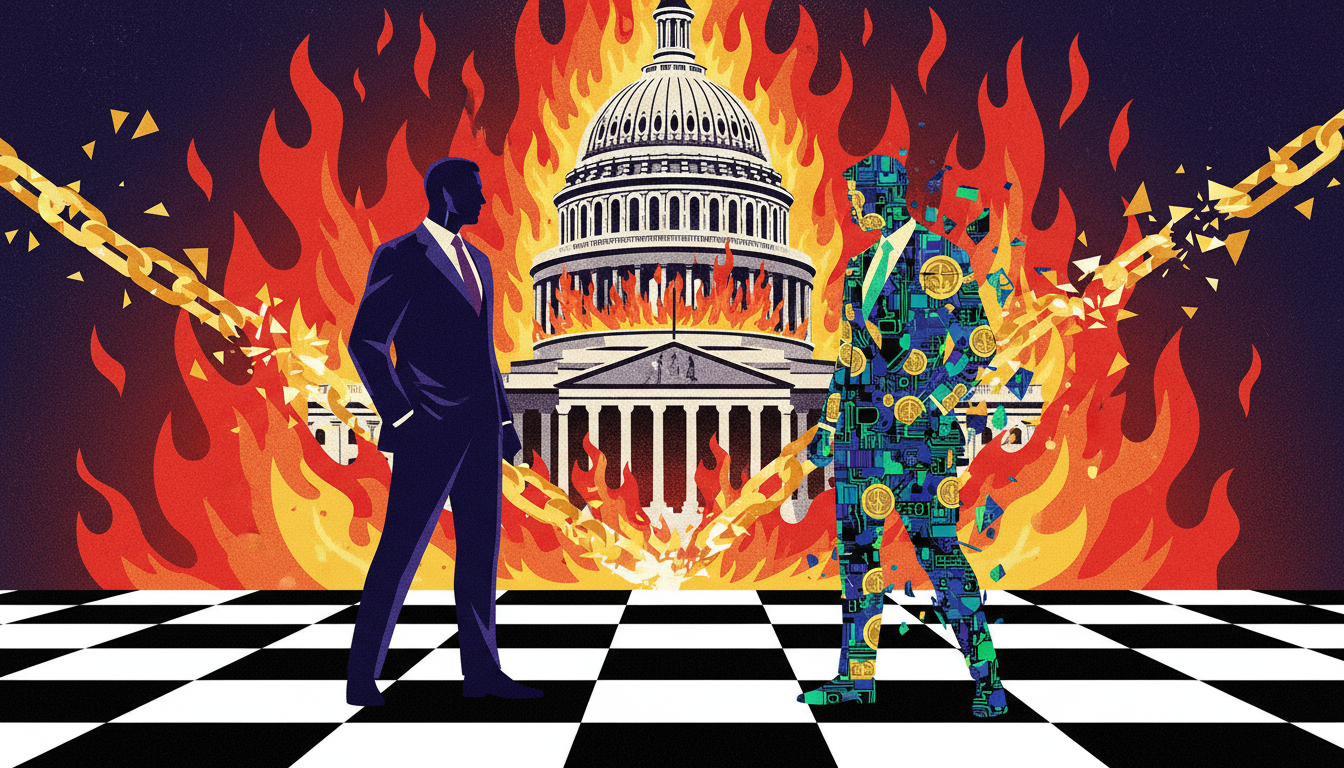
On April 17, 2026, the debate surrounding the second phase of the South Korean digital asset fundamental law was thoroughly ignited. Kim Sang-hoon, the chairman of the Digital Asset Special Committee of the People Power Party, publicly stated that regulatory rules concerning KRW-denominated tokens should be prioritized over repeatedly tugging at the restrictions on the ownership stakes of major shareholders in exchanges. At the same time, a KRW-denominated token KRWQ has been issued and circulated overseas (currently only available information is from a single source), making the picture of "the won being linked but not under Seoul's regulatory view" begin to materialize. This reality has escalated the abstract discussions surrounding digital asset legislation into hard confrontations on monetary sovereignty and capital visibility: within a limited time window, South Korea must choose whether to first address the regulatory gap for KRW's on-chain form or to reshape the power structure of local exchanges through ownership ratio controls.
Overseas KRWQ Emerges: The Invisible Export of the Won on the Chain
As an on-chain token denominated in won, KRWQ has been issued and started circulating overseas, but the market's understanding of it heavily relies on single source information, with a lack of transparent disclosure regarding the issuer, compliance path, and specific scale. Even so, it still constitutes a key signal: the on-chain version of the won has taken shape outside the South Korean regulatory system, quietly becoming an entry point for offshore market participants to access the credit of the won through "offshore tokenization."
From the perspective of capital flow and payment application scenarios, KRWQ inherently possesses multiple potential usage paths: on one hand, it can serve as a unit of account within crypto trading pairs, embedded in global exchanges' currency markets; on the other hand, it may also act as a "stand-in for the won" in cross-border payments, on-chain settlements, as well as in DeFi collateral and lending scenarios. Once these paths are verified on a large scale, the won will achieve effective circulation and pricing in the offshore financial system through KRWQ, yet may not simultaneously enter the monitoring purview of the Bank of Korea and financial regulators.
For the central bank, this form of offshore tokenization undermines the visibility of currency usage scenarios and cross-border capital flows: traditional statistical measures struggle to capture KRWQ's turnover, sedimentation, and leverage on the chain, nor can they quickly identify the resulting credit and liquidity risks. Meanwhile, in the absence of a complete regulatory framework domestically and lacking an officially recognized on-chain vehicle for the KRW, overseas KRWQ may first occupy the position of "entry point into the won's crypto ecosystem"—whoever first provides the market with usable products is more likely to dominate in pricing, user education, and infrastructure, which signifies an early loss of bargaining power for South Korea, which is exploring regulatory paths for digital assets.
Legislative Timing: The Priority Collision Between Stablecoin Framework and Ownership Restrictions
The second phase of South Korea's digital asset fundamental law is explicitly tasked with constructing a regulatory framework around KRW-denominated tokens, a political choice made against the backdrop of the global financial system's increasing sensitivity to tokenized currencies on the chain. Legislators aim to establish an executable standard for the issuance, redemption, reserve management, and information disclosure of the KRW on-chain, thereby avoiding South Korea passively accepting the technological realities dominated by other countries or markets in regional competition.
Alongside this, there is another fiercely conflicting regulatory mainline: regarding the concentration of major shareholders' ownership in local exchanges, internal discussions within the regulatory bodies have circulated the idea of a 15%-20% ownership limit (also stemming from single-channel information). This proposal directly targets exchange control rights and corporate governance structures, which are deeply intertwined with existing interests and boundaries of regulatory authority, naturally triggering intense battles among political circles, the industry, and regulatory agencies. Due to a lack of mature consensus, the design of relevant clauses, their applicability, and transitional arrangements have become focal points of recurring disputes.
In this context, Kim Sang-hoon has repeatedly voiced warnings, clearly stating that "the dispute over ownership restrictions may slow down the overall legislative process." His judgment is based on a reality: on such a highly sensitive topic as ownership ratios in exchanges, any detailed design may become the focal point of contention among stakeholders. If the core agenda of the second phase is tied to this "most difficult knot," the overall timetable may be indefinitely extended. In contrast, the fundamental regulations surrounding KRW-denominated tokens, while similarly fraught with technical route and interest divergences, are politically easier to package as a priority task of "maintaining monetary sovereignty."
As legislation enters "timing mode," time becomes a real constraint. Whether to first concentrate limited legislative resources to construct basic regulatory safeguards for the KRW's on-chain form, and then gradually address the ownership concentration issue in subsequent supporting measures; or to insist on resolving both the exchange ownership structure and token regulation together "including principal and interest" in the second phase, essentially presents a choice of legislative priorities. Different paths mean that over the next year or even several years in crypto finance competition, South Korea will either actively shape the rules of the game or be held back by internal disputes.
The Game of Monetary Sovereignty: Regulatory Gaps Being Filled by Technology
From the perspective of monetary sovereignty, the core sensitivity of KRWQ does not lie in compliance, but in the alternative role it plays in cross-border settlements and asset allocation. If overseas markets become accustomed to pricing and clearing assets related to South Korea using KRWQ instead of the domestically regulated KRW on-chain vehicles, certain payment functions and pricing capabilities of the won will be "migrated" onto contracts controlled by offshore issuers. The central bank’s dominant role in currency issuance and redemption begins to misalign with the logic of smart contracts and the balance sheets of custodians.
If there are no clear and enforceable domestic rules, the credit endorsement and risk management responsibilities of the KRW will effectively be outsourced to offshore issuers and their chosen custodians and auditing institutions. This means that once KRWQ forms a certain network effect in offshore financial systems, the impact of South Korean regulators on key aspects such as the authenticity of reserves, asset isolation, and liquidation arrangements in extreme scenarios will be significantly weakened, and any risk control failures or moral hazard events may be directly interpreted by the market as "issues with the won's credit," even if the Bank of Korea has never provided formal endorsement for this product.
At the same time, global regulatory concerns about the concentration of ownership in exchanges and anxieties over the uncontrol of sovereign currency tokenization are overlapping. High concentration of ownership may lead to imbalanced exchange governance and insufficient compliance incentives, while if the on-chain forms of sovereign currency circulate massively on such platforms, it will overlap with dual systemic risks of "single point failures in infrastructure + outsourcing of currency credit." For South Korea, if legislation remains in a long-term tug-of-war between ownership ratios and monetary tokenization regulation, without establishing a clear framework for the KRW’s on-chain form or truly reshaping the governance structure of exchanges, it may be forced to accept the technology and product frameworks already set by others, only to be left with passive regulation afterward.
The Anxiety of Legislators: Desiring Safety Barriers While Also Ensuring Operational Viability
In such an environment, Kim Sang-hoon has proposed that "laws should provide clear regulatory expectations and guidance for operators," reflecting the internal contradictions of legislators: on one hand, regulations must delineate clear red lines before risk events occur, particularly in fields involving monetary sovereignty and large amounts of public funds; on the other hand, overly fixating on high-sensitivity topics such as ownership restrictions may delay the overall framework's implementation and inadvertently amplify compliance uncertainty for a considerable time, harming institutions and projects that are willing to operate compliantly and invest long-term in South Korea.
For potential entrants, the repeated oscillation of ownership restriction proposals means that it is difficult to assess future corporate governance structures, capital operation space, and exit paths, which will directly affect their decisions to establish trading platforms, custody services, or even research and development centers in South Korea. Moreover, if the stablecoin (i.e., KRW-denominated token) chapter cannot take shape for an extended period, local institutions will also struggle to gain clear guidance on licensing thresholds, reserve ratios, asset composition, information disclosure frequency, and stress testing requirements, leaving them to cautiously observe in a gray area of "unclear regulatory expectations."
Ideally, stablecoin legislation should seek an operational balance among three goals: first, ensuring that the KRW's on-chain forms do not evolve into shadow banking through high but enforceable licensing thresholds and reserve requirements; second, enhancing market trust in KRW-denominated tokens through transparent, auditable information disclosure and risk isolation arrangements, rather than simply pushing demand offshore with vague prohibitions; third, allowing enough room in technical pathways for diverse entities to innovate and compete under unified rules. For regulators, "operable" rule boundaries must bear political pressure for accountability when problems arise, while also motivating compliant operators to invest long-term in essential infrastructure and products in South Korea.
What Comes Next: Priority Choices Will Decide the On-Chain Fate of the Won
Returning to the starting point, the essence of this dispute lies in whether South Korea will first safeguard the sovereign boundaries of the won on-chain or reshape the ownership structure of exchanges and address governance risks, given limited legislative resources and time windows. Both are important, but the sequence of time will profoundly impact South Korea's position in the crypto financial landscape in the coming years: if the foundational regulations for the KRW's on-chain form are delayed, technology and markets will provide answers ahead of products like KRWQ.
If South Korea prioritizes completing the stablecoin (KRW-denominated token) framework in the second phase of legislation, there is an opportunity to set unified standards for any on-chain products denominated in won, and through mechanisms such as licensing, cross-border cooperation, and information sharing, partially bring back the already circulating KRWQ into regulatory view—at least recovering regulatory initiative in the segments associated with financial transactions with South Korean entities and exposure to local users. Conversely, if legislation remains long entangled in the details of the 15%–20% ownership ratio disputes and the overall framework is slow to materialize, the pricing power and circulation rules of the won in the crypto world are very likely to be locked in first by products and platforms not currently incorporated into Seoul's regulatory system.
For investors and project parties, the next critical observations are: first, whether the drafting, public discussion, and passage pace of terms related to KRW-denominated tokens will accelerate, and whether there are signs of "phased approaches, first establishing the framework and then refining the text"; second, whether regulatory agencies' public statements shift from vague warnings about offshore products like KRWQ to institutional responses; third, whether disputes related to ownership restrictions are moderately "de-escalated" from the core agenda of the second phase of digital assets to be addressed in subsequent specialized or supporting regulations. These signals will directly determine whether South Korea is actively crafting a compliant on-chain ecosystem centered around the won or passively searching for limited regulatory space within established technological and product frameworks.
Join our community to discuss and become stronger together!
Official Telegram community: https://t.me/aicoincn
AiCoin Chinese Twitter: https://x.com/AiCoinzh
OKX benefit group: https://aicoin.com/link/chat?cid=l61eM4owQ
Binance benefit group: https://aicoin.com/link/chat?cid=ynr7d1P6Z
免责声明:本文章仅代表作者个人观点,不代表本平台的立场和观点。本文章仅供信息分享,不构成对任何人的任何投资建议。用户与作者之间的任何争议,与本平台无关。如网页中刊载的文章或图片涉及侵权,请提供相关的权利证明和身份证明发送邮件到support@aicoin.com,本平台相关工作人员将会进行核查。