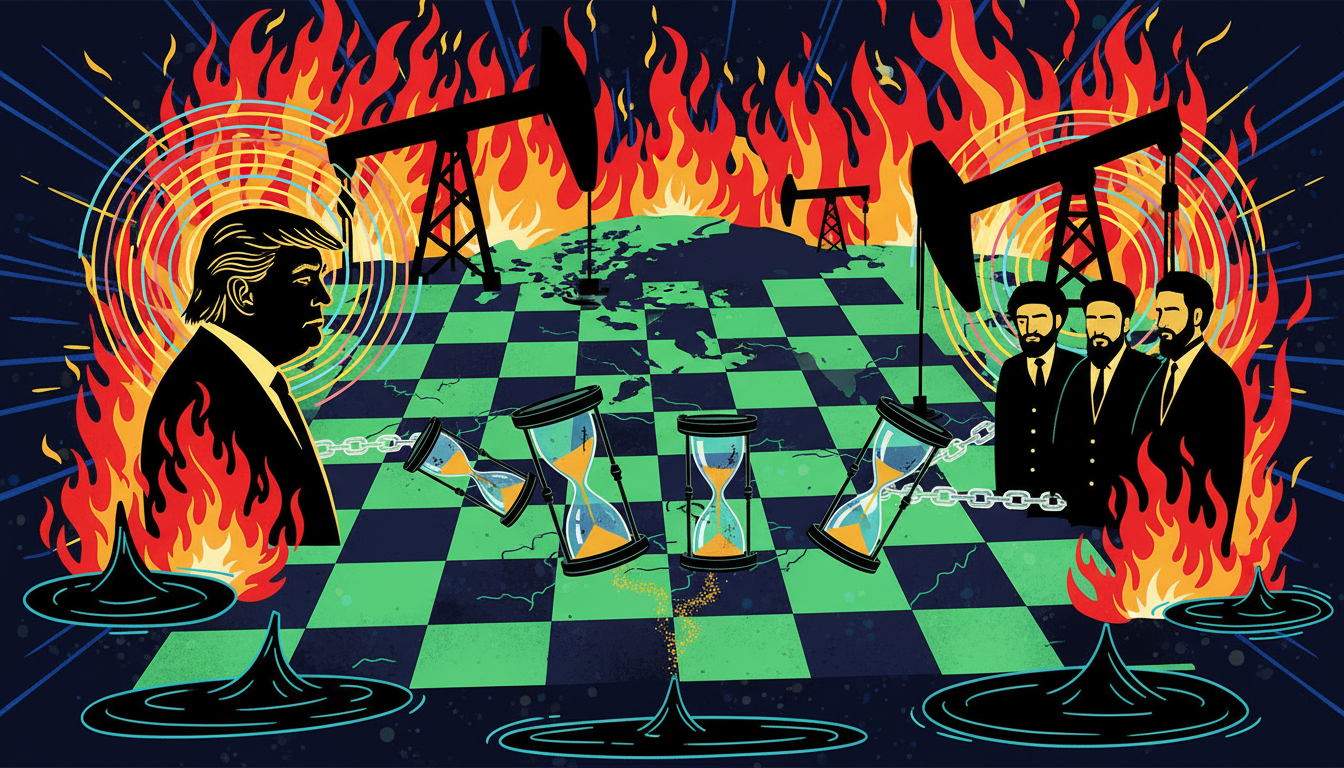
On the morning of April 17, East Eight Zone time, or April 16 local time in the United States, Trump suddenly claimed that the U.S.-Iran nuclear talks had made "significant progress," and that Iran had agreed not to possess nuclear weapons for a term "exceeding 20 years." This statement immediately stirred ripples in energy and geopolitical circles. However, as of now, the Iranian side has not provided any formal response, and the information comes entirely from a single U.S. source, naturally carrying a bias in narrative asymmetry and political rhetoric. In this unresolved state, the core questions of whether the promise of "no nuclear weapons" is genuine, whether it can be implemented, and further—whether Trump's depiction of "free oil" and "free access to the Strait of Hormuz" will become a reality, form the centerpiece of the current market debate.
A Unilateral Declaration of Victory: Trump at...
From the information already disclosed, the entire narrative of this round of "significant progress" almost exclusively originates from Trump himself. According to reports by several media outlets, he emphasized that the U.S.-Iran negotiations have made "significant progress," Iran has agreed to "not possess nuclear weapons," and that this commitment will "exceed 20 years." This time frame is much longer than typical political terms, deliberately packaged as a historic security arrangement, adding a sense of history and personal achievement to his external declaration.
In terms of wording, Trump has maintained his usual personal style. He has repeatedly described the prospects of reaching an agreement with Iran as "very optimistic," compressing the complex issues still under negotiation into simple and intuitive optimistic expectations. High-contrast phrases like "free oil" and "free access to the Strait of Hormuz" amplify the psychological anchor of "agreement = huge benefits for the U.S. and the world," sketching a story of immediate economic dividends for domestic audiences.
On the level of diplomatic actions, he also signaled that if the agreement is ultimately signed in Islamabad, he "might visit Pakistan." This statement itself did not come with a clear timetable or detailed arrangements but is sufficient to be seen as an external diplomatic posture—on one hand reinforcing the impression that "the agreement is close to completion," and on the other hand, by introducing Pakistan into the realm, shaping his image as establishing a new security framework in the South Asia-Middle East junction. For the market, these signals together resemble a "victory rehearsal" packaged through personal rhetoric.
Iran's Silence: What is the Agreement...
In stark contrast to the high-frequency output of information from the White House, Iran has remained silent, neither confirming the "significant progress" nor responding positively to the key statement of "not possessing nuclear weapons for over 20 years." This means that most of the ongoing external discussions are based on a single U.S. source, resulting in a high degree of information asymmetry, making it difficult to view this as a reliable reflection of bilateral consensus.
What is missing is not only Iran's attitude but also the specifics of the agreement itself. There is no way for the external world to know: how the so-called "not possessing nuclear weapons" is defined technically and legally; how the supervision and verification mechanisms are designed; whether there will be periodic evaluations and withdrawal clauses during the effective term that "exceeds 20 years." These seemingly trivial technical details precisely determine the binding force and execution costs of the commitments and also influence whether the market can regard this agreement as "hard information" sufficient to change the pricing of geopolitical risk.
Looking back, U.S.-Iran negotiations and agreements regarding the nuclear program have often featured situations where "political announcements come before technical implementation": one side first makes a high-profile announcement of a "breakthrough" to meet domestic and international political needs, followed by continuous refinement or even dilution of the text during complex technical negotiations. It is not uncommon for some commitments to be delayed, renegotiated, or even shelved during the execution process. Against this historical backdrop, even if this round of progress genuinely exists, it is difficult for the market not to question it—the path to a "substantive agreement" that can reprice Middle Eastern risk may still involve a long and tortuous process.
From "No Nuclear Weapons" to the 20-Year Commitment...
From the perspective of international security, "not possessing nuclear weapons" is a highly flexible political discourse. It is generally understood as not pursuing or holding assembled and usable nuclear weapons, but still differs significantly from "total nuclear disarmament" or "zero nuclear capability": the state may maintain civilian nuclear programs, nuclear technology bases, or even some sensitive capabilities, just establishing red lines before the threshold for weaponization. This is why external observers pay particular attention to the scope of verification linked to the relevant commitments and the technical definitions, rather than merely the verbal promise of "no nuclear weapons."
Trump's emphasis on the "effective term exceeding 20 years" extends the time dimension to a sufficiently long range. In past nuclear agreement practices, the effective term often determines external assessments of its "historical significance": a term of 10 years is seen as a strategic defusing window, while 20 years or more could reshape the security expectations of a generation. However, the length of time in itself does not automatically equate to the strength of the constraints; without sufficiently rigid execution and supervision mechanisms, the "20-year commitment" may resemble a political slogan rather than a hard constraint that can be invoked through international law and multilateral institutions.
In the absence of clear specifics at present, the market's interpretation of this long-term commitment is bound to be exceptionally cautious. Energy traders are more inclined to view it as a marginal easing of risk sentiment rather than an immediate reset of the supply curve; policy and security analysts would focus on whether Iran releases consistent signals over the following weeks and whether a multilateral framework emerges. Until these confirmations are realized, the time label of "exceeding 20 years" is more a bargaining chip and narrative tool in negotiations rather than a determinant variable that can be directly written into models.
"Free Oil" and the Strait of Hormuz:...
In the most eye-catching part of the statement, Trump claimed that the agreement would bring "free oil" and "free access to the Strait of Hormuz." Rhetorically, this is clearly exaggerated political language, intending to provide voters and the market with an extremely optimistic imagination: Iranian risks dissipating, security in the Strait assured, oil prices dropping sharply, as if energy costs were "not a problem anymore." However, in terms of realistic policy space, "free" is difficult to interpret literally; what really needs to be dissected is how market logic evolves if sanctions and security risks are relieved.
● If Iran's export restrictions are substantially eased, its oil returning to the market will increase global supply, especially in scenarios where baseline demand is stable or even slightly declining in the medium to long term context, the supply-demand curve may shift rightward, exerting downward pressure on oil prices. At the same time, the Strait of Hormuz, as one of the most critical chokepoints for global crude and refined oil transport, means that a decrease in its risk premium reduces shipping insurance, diversion costs, and safety precaution expenditures, further compressing end-user energy prices. These cumulative pathways could indeed allow some consuming countries to perceive a "near-free" marginal improvement.
● On the other hand, Trump's public bet on falling oil prices also reshapes the expectations of the rivalry between oil-producing and consuming countries. For major oil-producing countries, if the anticipated future price range is lowered, they might preemptively mitigate "price war" risks through production cuts and coordinated actions; for consuming countries and commodity trading institutions, they will evaluate the credibility of "policy-driven supply releases," adjusting their hedging strategies and inventory strategies. In this process, prices are determined not only by fundamental supply and demand but also influenced by the credibility of geopolitical commitments and the discount rate of political personas, making "free oil" more of a narrative game than a straightforward story of supply surges.
The Shadow of the Second Handshake: Previous Lessons...
This is not Trump's first attempt to shake hands with Iran over nuclear issues. During his prior term, the U.S. attempted to reshape the framework of the nuclear agreement with Iran but ultimately failed due to a combination of domestic politics, regional allies' concerns, and execution disputes. That experience not only led to doubts about the durability of a "Trump-version nuclear agreement," but also cast a historical burden over this round of negotiations—any promotion of a "significant breakthrough" is hard to separate from the memory of "how the last attempt collapsed."
For Iran, the repeated experiences of sanctions, pressure, and agreement violations over the past few years have profoundly altered its security perspective and negotiation strategy. On one hand, the real costs of economic and financial sanctions have made it well aware of what it means to be "excluded from the system"; on the other hand, previously reached arrangements being overturned by subsequent political changes have heightened its vigilance regarding "regime change risks" and "credibility of commitments." In such a psychological structure, even if there exists a technical consensus on "no nuclear weapons, exceeding 20 years," Iran is likely to propose stronger and more detailed guarantee requirements regarding security and sovereignty issues.
At the same time, the political divisions within the United States and the attitudes of allies will also deeply shape the text and execution prospects of the agreement. There has long been a divergence of views on Iran policy within the U.S., with different factions having their own precepts regarding sanction relief, security commitments, and regional power balances, while Israel and certain regional allies' high sensitivity to Iran's nuclear capabilities will also influence Washington's decision boundaries through lobbying and security cooperation mechanisms. As a result, even if a textual "commitment exceeding 20 years" appears on the negotiation table, its effectiveness cannot be simply regarded as a given before it truly translates into stable policies and bipartisan consensus.
Predictions on Oil Prices and Geopolitical Realities: Transactions...
Overall, Trump's sudden statement during this round can be seen as a high-decibel political signal more than a "hard clause" that can be immediately included in asset pricing models. The expressions of "not possessing nuclear weapons" and "exceeding 20 years" remain at the level of unilateral discourse; Iran has not formally responded, and the details and execution paths of the agreement are almost blank. Under these conditions, equating it directly with the conclusion that "Middle Eastern risk premiums fully retreat and oil prices trend downward" is evidently premature.
For investors and observers, a more pragmatic approach is to prioritize different types of information: Trump's public speech can serve as an upper narrative for managing sentiment and expectations, but what truly determines oil prices and the energy landscape will be whether Iran subsequently releases consistent statements, whether any multilateral or international institutional framework intervenes, and whether the agreement's specifics—especially the execution, verification, and sanction arrangements—can be realized. Only when these verifiable facts gradually piece together will the market have reason to translate the "free oil" story into a tradable pricing factor.
In the short term, similar statements may still provoke oil price fluctuations at the level of public opinion and sentiment, especially in environments with crowded positions or high volatility. But from a medium to long-term perspective, the evolution of the global energy landscape is more likely to be a series of "gradual marginal improvements" rather than a "one-off reversal": the potential return of Iranian supply, the easing of Strait risks, and the broader energy transition cycle intertwined will shape a more complex new normal for pricing and security. In this process, maintaining a discount on political rhetoric, tracking factual progress, and exercising patience with structural trends may be more important than betting on any single "prediction."
Join our community, come and discuss, and strengthen together!
Official Telegram community: https://t.me/aicoincn
AiCoin Chinese Twitter: https://x.com/AiCoinzh
OKX benefit group: https://aicoin.com/link/chat?cid=l61eM4owQ
Binance benefit group: https://aicoin.com/link/chat?cid=ynr7d1P6Z
免责声明:本文章仅代表作者个人观点,不代表本平台的立场和观点。本文章仅供信息分享,不构成对任何人的任何投资建议。用户与作者之间的任何争议,与本平台无关。如网页中刊载的文章或图片涉及侵权,请提供相关的权利证明和身份证明发送邮件到support@aicoin.com,本平台相关工作人员将会进行核查。