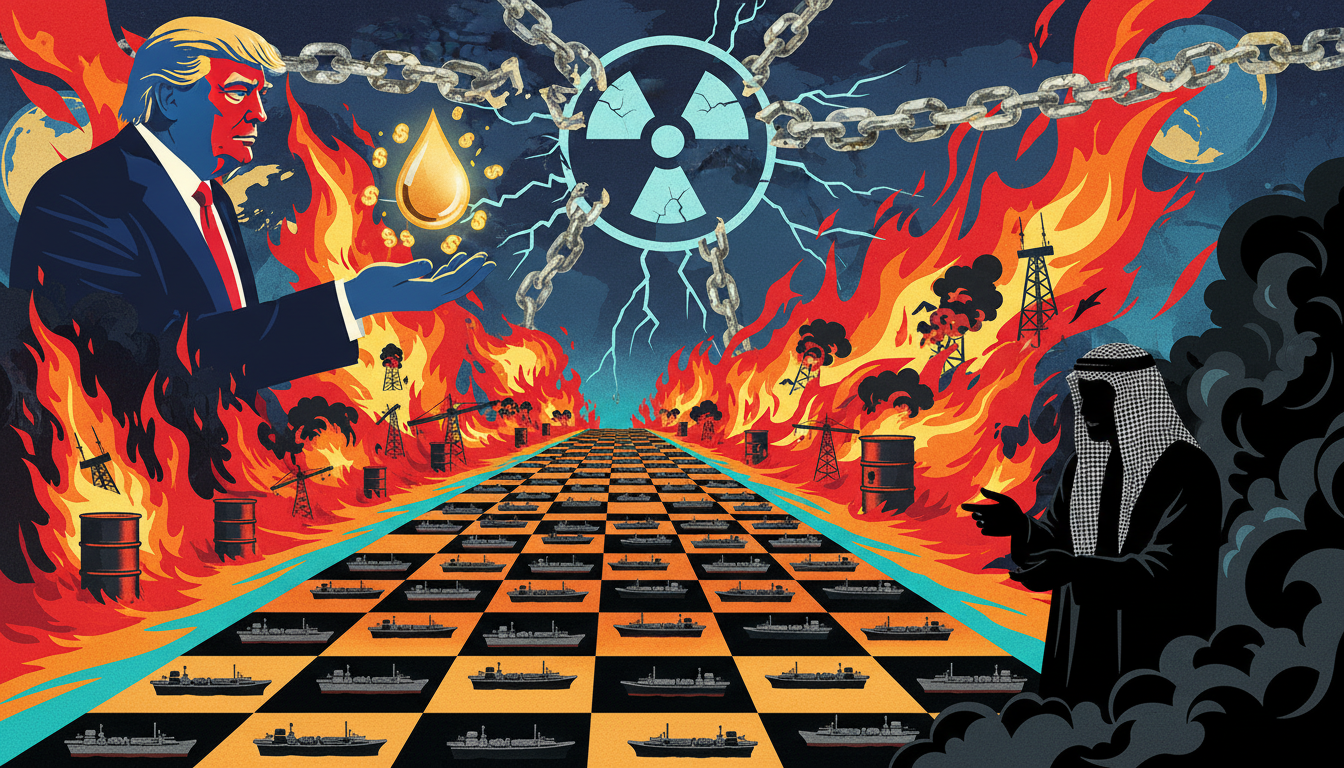
On April 16, 2026, the narrative of the U.S.-Iran nuclear deal negotiations was once again thrust into the spotlight by Trump. On that day, he publicly claimed that he had received a commitment from Iran not to acquire nuclear weapons, repeatedly emphasizing that the relationship between both sides was "very good" and the outlook was "very optimistic." Even more attention-grabbing was a claim from a single source that the so-called "commitment is valid for more than 20 years," yet lacking corroboration from additional channels. Meanwhile, Iran has yet to respond publicly, and key arrangements such as the agreement text and verification mechanisms remain entirely absent, making this "nuclear commitment" seem more like a discourse contest led by Washington rather than an established security framework.
Unilateral Announcement of Commitment: The Absence of Iranian Echo
What can currently be confirmed is the single narrative from the U.S. side: Trump publicly declared that Iran has committed to not acquiring nuclear weapons, coupled with high-profile optimistic rhetoric that paints the relationship as "very good." In his narrative, this is not only a diplomatic breakthrough but also packaged as a positive signal for regional security and the global market. However, from an information structure perspective, all of this remains at the level of "U.S. claims," representing unilateral political messaging rather than a multilateral agreement confirmed by various parties.
In stark contrast, Iran has yet to provide any public response regarding this so-called "commitment," nor disclosed related negotiations, texts, or procedural arrangements. The asymmetry in information between the U.S. and Iran allows Washington to temporarily occupy a dominant narrative position, but it also amplifies external doubts about the real progress: is this already an established framework or merely a preemptive positioning in public opinion? In the absence of an official statement from Tehran and corroboration of the signing timeline and enforcement mechanisms, any details regarding Iran's stance or internal decision-making processes can only remain in the "unknown" category.
For this reason, it is crucial to maintain a strict boundary: currently, only a narrative of a verbal commitment led by the U.S. can be discussed, not a formal agreement with clear signing dates, verification terms, and multilateral endorsements. Whether Iran has already made internal strategic adjustments or whether both sides have completed the written process at a specific point in time, the research brief explicitly marks these as missing information, leaving the outside world without a basis for further detail filling.
The 20-year Commitment Claim: The Suspense of a Single Source
In this uproar, the claim that the "commitment is valid for more than 20 years" is the most dramatic and uncertain detail. According to presently available information, this key number originates from a single source and has yet to be publicly corroborated by the U.S. government, Iran, or other authoritative multilateral institutions. In other words, the 20-year timeframe currently appears more like a figure suspended in mid-air, providing space for public imagination, but it cannot be described as having legal or institutional binding force.
If we assume that this timeframe is accurate, its potential impact on the regional security landscape and nuclear proliferation expectations is significant. A commitment exceeding 20 years theoretically could cover several U.S. administrations and various Iranian decision-making bodies, meaning that within a complete geopolitical cycle, the Iranian nuclear weapons issue would be locked in a state of "not to have." This could directly relate to neighboring countries reassessing their own security, from military planning by regional powers like Saudi Arabia to rebalancing Europe and Russia's positioning in the Middle East, all of which might be forced to recalculate risks based on the assumption of "long-term absence of Iranian nuclear weapons."
However, in the absence of multi-party confirmation, it is prudent to maintain caution regarding the number "20 years." On one hand, its singular origin means its reliability has not undergone cross-validation; on the other hand, prematurely treating it as an established fact can easily mislead the market and the public, introducing structural biases in policy expectations. A more reasonable approach is to regard the "20-year commitment" as information awaiting verification, focusing attention on whether subsequent multi-source confirmations will emerge, alongside the publication of formal texts or framework agreements, rather than overextending speculation around an unverified number.
Ceasefire and Allied Discontent: Israel's Fractures and Anxiety
Almost concurrently with the "nuclear commitment" narrative, complex signals emerged from the White House regarding the ceasefire issue. On one hand, the White House publicly denied claims related to the "extension of the ceasefire," emphasizing that there is no finalized new ceasefire timetable; on the other hand, it repeatedly used technical expressions such as "communication is very effective," creating an impression that the process is progressing in an orderly fashion, with channels remaining open. This simultaneous denial and affirmation make it challenging for external observers to glean a clear policy path while clearly exposing Washington's intent to retain maximum operational space.
Against this backdrop, Israel's stance is particularly striking. Research briefs indicate that Israel has expressed dissatisfaction with the U.S.'s unilateral announcement regarding the ceasefire, believing that its voice and rhythm on crucial security issues have been diminished by its ally. This dissatisfaction is not an isolated sentiment but rather an overflow of fractures between the U.S. and Israel regarding security priorities and diplomatic rhythm: Washington needs to balance broader regional stability and global public opinion pressure, while Israel is more concerned with tactical safety control and deterrence maintenance.
The ceasefire issue and nuclear commitment are not isolated from one another; they are overlapping and fermenting on the same geopolitical chessboard. If the U.S. endeavors to use "pushing Iran to make a nuclear commitment" as a framing explanation for overall tensions in the Middle East, that means that the ceasefire negotiations, sanctions against Iran, and regional security arrangements will be intertwined within the same political narrative. For Israel, this binding undoubtedly heightens anxiety: if the nuclear commitment is seen as the U.S.'s main bargaining chip to alleviate regional tensions and garner public opinion, then Israel's tactical needs may be marginalized, further complicating the game of priorities and political gains among the U.S., Israel, and Iran.
Pressure from Oil Prices: Trump's Real Calculations
Above all these strategic narratives, Trump personally brought forth a very pragmatic variable: oil prices. Research briefs indicate that he did not shy away from acknowledging the pressure regarding economic livelihoods, directly incorporating oil price factors into his discussions around the nuclear commitment and ceasefire topics. This publicly admits that the chain reaction between Middle Eastern security structures and energy prices has now been included in the White House's political decision-making considerations, rather than being isolated within professional diplomacy and security domains.
Logically, if the U.S. can ease tensions with Iran and reduce expectations of low-intensity conflicts, it may indirectly exert downward pressure on oil prices, thereby alleviating the political burden from domestic inflation and rising livelihood costs. For a president in an election cycle, pitching the narrative of "I am promoting a more controllable Middle East oil price" to voters is itself an essential political asset. The nuclear commitment, ceasefire dialogue, and oil price expectations are collectively packaged in a campaign narrative of "stability and prosperity," whose symbolic significance sometimes may even surpass the detailed degree of specific terms.
However, in the current situation where the details of the agreement are completely absent, the market's reaction to these narratives tends to lean toward using fluctuations in oil prices and risk appetite to tell a story: reassuring reconciliation messages are interpreted as signals of a decline in geopolitical risk premiums, while any dissatisfaction from Israel or fluctuations in the White House's narrative may be amplified into a prelude to a new round of uncertainty. In this context, oil prices serve both as a real constraint and as an emotional amplifier, giving this nuclear gamble a stronger market coloration.
Behind the Optimistic Statements: From "Very Good" to "Very Effective"
Within the entire information landscape, Trump's language remains characteristically high-profile. Research briefs cite that he repeatedly emphasized the "very good" relationship with Iran and expressed "very optimistic" prospects for the agreement, attempting to define this negotiation with strong positive emotions. Such expressions can comfort domestic supporters, shaping an image of personal capability in "I can handle my opponents," while externally transmitting a signal of "the process is under control" to allies and adversaries, even if actual negotiations may still be in a difficult tug-of-war.
In contrast, the White House adopts a more bureaucratic tone. When addressing ceasefire-related issues, official spokespersons emphasize that communication is "very effective" rather than directly admitting substantive agreements have been reached. These two types of expressions—one heated and one cool, one superficial and one substantial—highlight a focus on emotional shaping and political narrative packaging while appearing to retain room for maneuvering against potential future reversals. This subtle distinction in internal and external narratives reflects differing perceptions of risks and tolerances within the system itself.
From the perspective of political communication, optimistic packaging primarily serves domestic politics and international public opinion rather than being an accurate reflection of real progress. In phases characterized by a lack of details and silence from the counterpart, seizing the high ground in public opinion and shaping an impression of "actively advancing" and "approaching success" can retain a certain narrative capital regardless of future outcomes: success can lead to claims of "early arrangements," while setbacks can shift some blame onto uncooperative opponents or allies. This pre-designed narrative safety net also serves as a mechanism of political self-preservation.
The Shadow of the Agreement is Already Present: The Real Test is Still Ahead
Overall, based on currently available public information, this new round of contention surrounding Iran's nuclear issue presents more of "commitment rhetoric and optimistic expectations" than an institutional arrangement with hard constraints. Trump claims to have received a political promise of "not having nuclear weapons"; however, key technical issues such as how nuclear materials are to be disposed of, how verification mechanisms will be implemented, and how the cost of noncompliance is to be set are explicitly marked as missing details in the research brief, completely leaving external observers unable to determine whether substantive negotiations have indeed begun, let alone assess their executability.
Going forward, what will truly decide the direction of this nuclear negotiation are several outstanding pieces of the puzzle: whether the so-called "commitment for over 20 years" can be multi-sourced for verification and included in an operational framework; whether ceasefire arrangements can form a mutually supportive political combination with the nuclear issue rather than counteracting each other; and whether key allies like Israel will publicly contradict U.S. timelines when their security concerns are not fully met. These unresolved questions will continue to shape the regional landscape and market expectations over the coming weeks and even longer.
For observers, what is now more important is not to be led by emotional statements and single-source figures, but to continuously track three key signals: first, whether Iran provides any form of formal response, even if just a vague statement; second, whether there is any information about the agreement that has undergone multi-source cross-verification, particularly concerning deadlines and enforcement mechanisms; third, the actual responses of other regional actors, especially Israel, regarding the subsequent ceasefire and security arrangements. Only once these key pieces of information become clearer can we determine whether this time U.S.-Iran nuclear negotiations represent a historical turning point or merely another round of politically performative theatrics.
Join our community, let's discuss, and become stronger together!
Official Telegram community: https://t.me/aicoincn
AiCoin Chinese Twitter: https://x.com/AiCoinzh
OKX Welfare Group: https://aicoin.com/link/chat?cid=l61eM4owQ
Binance Welfare Group: https://aicoin.com/link/chat?cid=ynr7d1P6Z
免责声明:本文章仅代表作者个人观点,不代表本平台的立场和观点。本文章仅供信息分享,不构成对任何人的任何投资建议。用户与作者之间的任何争议,与本平台无关。如网页中刊载的文章或图片涉及侵权,请提供相关的权利证明和身份证明发送邮件到support@aicoin.com,本平台相关工作人员将会进行核查。