Since the beginning of this year, NAND flash prices have entered a new rapid increase cycle, with retail prices of consumer-grade storage products being the first to be affected. In October 2025, a SanDisk Extreme 128GB microSD card sold for $17 on Amazon. By February of this year, the price of the same card approached $40. In less than four months, it increased by 130%.
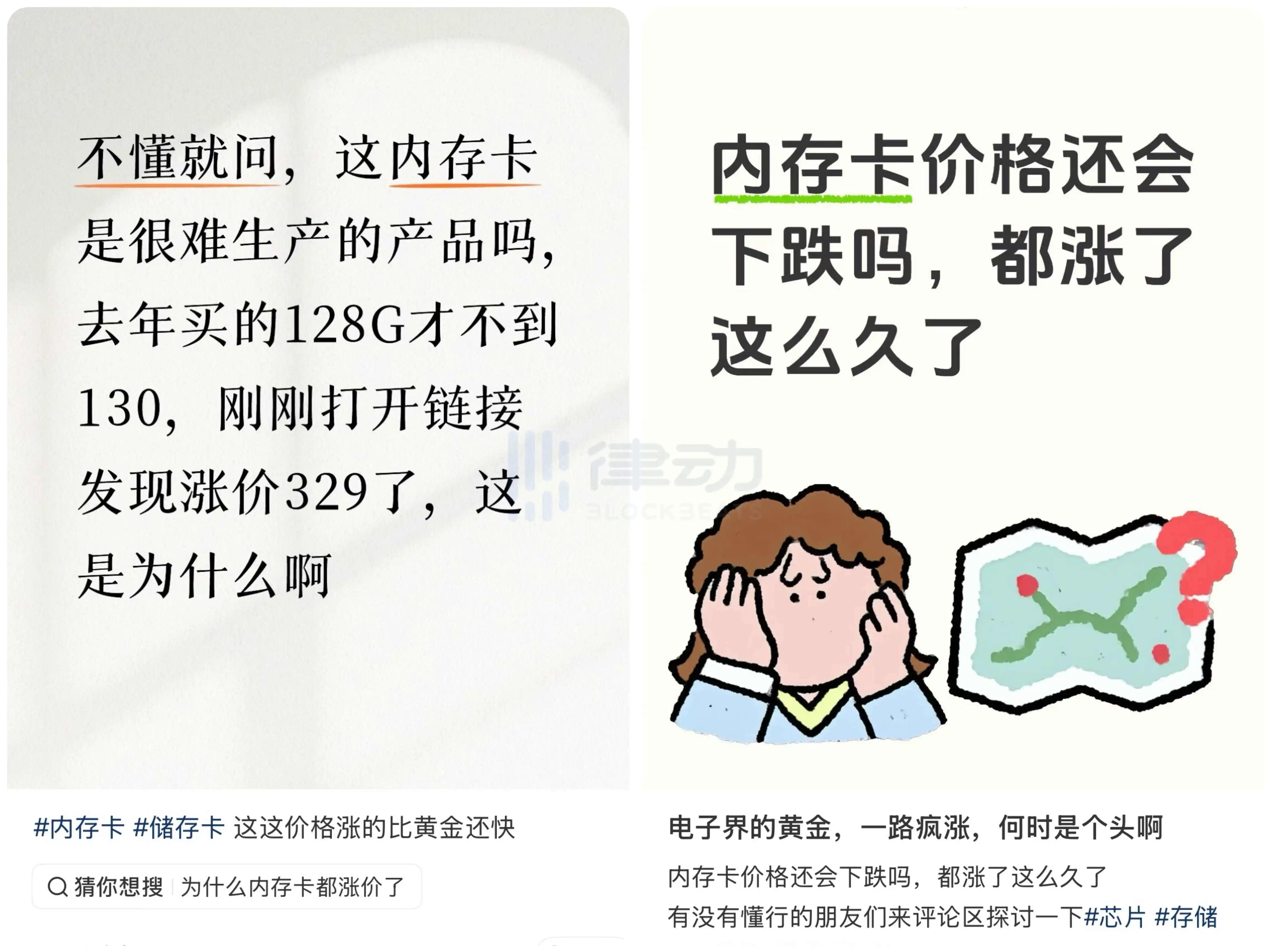
First, it is important to explain the difference between memory modules and memory cards, as they are not the same category of product. Memory modules (RAM) are temporary storage within a computer, used for data reading and writing while running programs, and the data disappears when the power is off. In contrast, memory cards (such as microSD cards) are external storage used for the long-term preservation of files such as photos and videos, and the data is not lost when the power is off. The price increase discussed in this article refers to the latter, the memory cards and the NAND flash chips behind them.
The continuous rise in memory card prices is backed by a systemic repricing in the entire NAND flash market, with the starting point of the repricing being AI data centers competing for the same batch of wafers.
Contract prices rose by 50%, but by the time it reached you, it increased by 130%
First, let's talk about what is happening.
Global NAND flash contract prices began to rise rapidly since the end of last year. According to a report released in February this year by market research firm TrendForce, overall NAND contract prices increased by about 55–60% in the first quarter of 2026 compared to the fourth quarter of last year, with enterprise SSD prices seeing an increase of 53–58%, setting a new record for quarterly price increases. TrendForce also predicts that overall NAND contract prices will rise another 70–75% in the second quarter.
These figures refer to the contract unit prices signed between major customers and do not directly equate to retail prices on e-commerce platforms. However, the retail prices at the consumer end have risen even more sharply than contract prices. The rightmost bar in Figure 1, which represents the 130%, reflects the price shock that ordinary consumers truly feel.
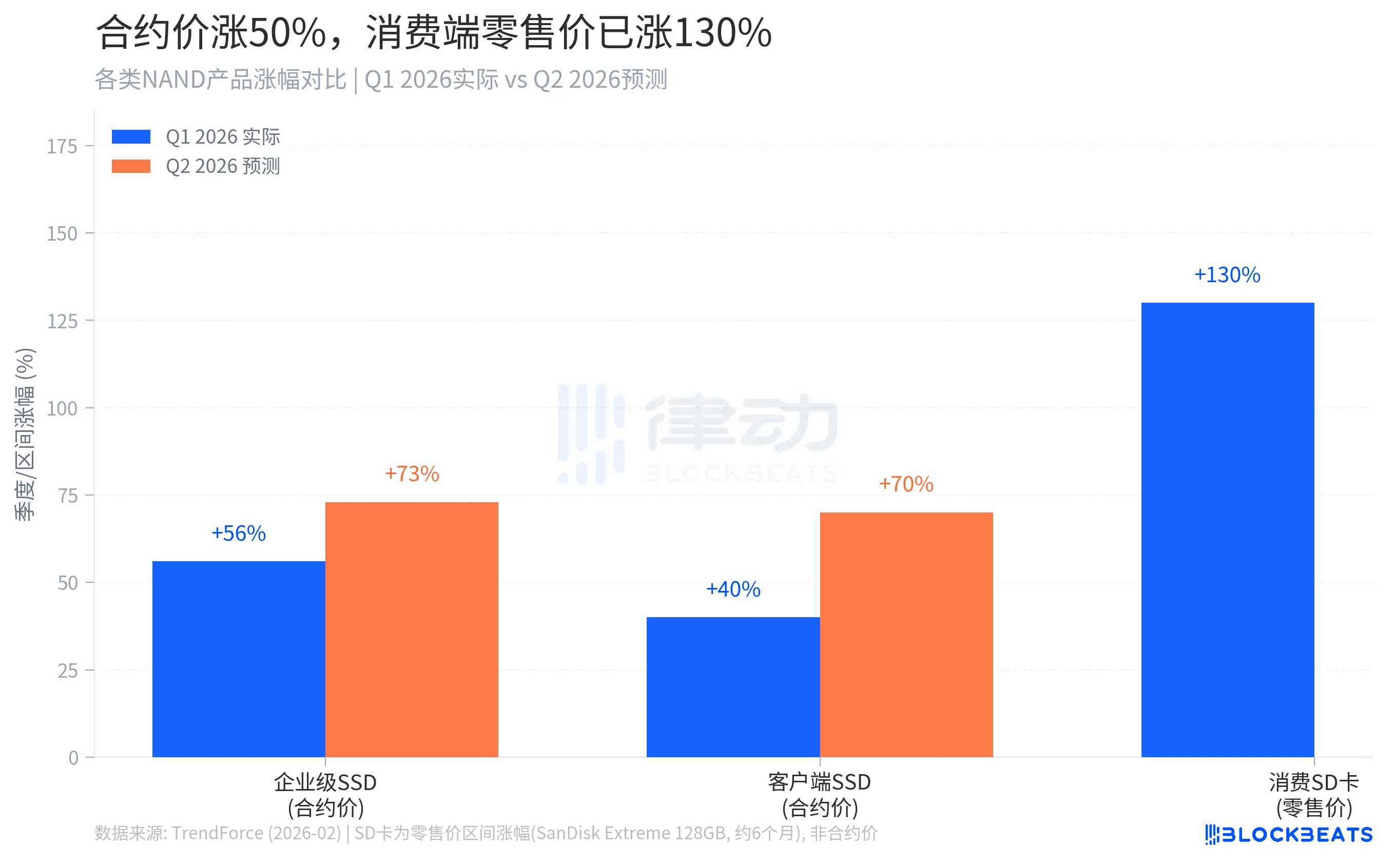
Why is the retail increase far exceeding the contract? Because the consumer end is a "residual allocation market." NAND manufacturers prioritize fulfilling delivery plans for significant customers who have signed long-term framework agreements, including AI data center operators and hyperscale cloud service providers. Once this batch of goods is delivered, the remaining inventory then enters the distribution channels for the consumer market. As the supply volume is compressed, the loose market's ability to buffer price increases is nearly zero, causing the rise in retail prices to be steeper than at the contract end.
Earlier this year, Kingston publicly confirmed that its procurement costs for NAND wafers have increased by 246% compared to a year ago. This is a cost shock at the raw material level, ultimately transmitted step by step to consumers through product prices.
How the price of a storage card was driven up by AI
This chart has two key points worth mentioning individually.
The first is around October 2025, when relatively low-priced storage cards could be bought on the market. This period was at the end of the previous supply surplus cycle. From 2023 to 2024, major storage manufacturers accumulated a substantial amount of inventory in an environment of weakening demand, with prices continuing to decline. Photographers, creators, and gamers took advantage of that window to stock up on a large number of storage cards at historically low prices.
The second point is the fourth quarter of 2025. Samsung, Kioxia, Micron, and SK Hynix successively announced production cuts and raised their quotes, completely reversing the situation in a short time. Samsung raised prices for enterprise customers by over 100%, while Kioxia clearly stated that its entire production capacity for 2026 had been pre-sold to major customers, directly cutting off the supply for the consumer market.
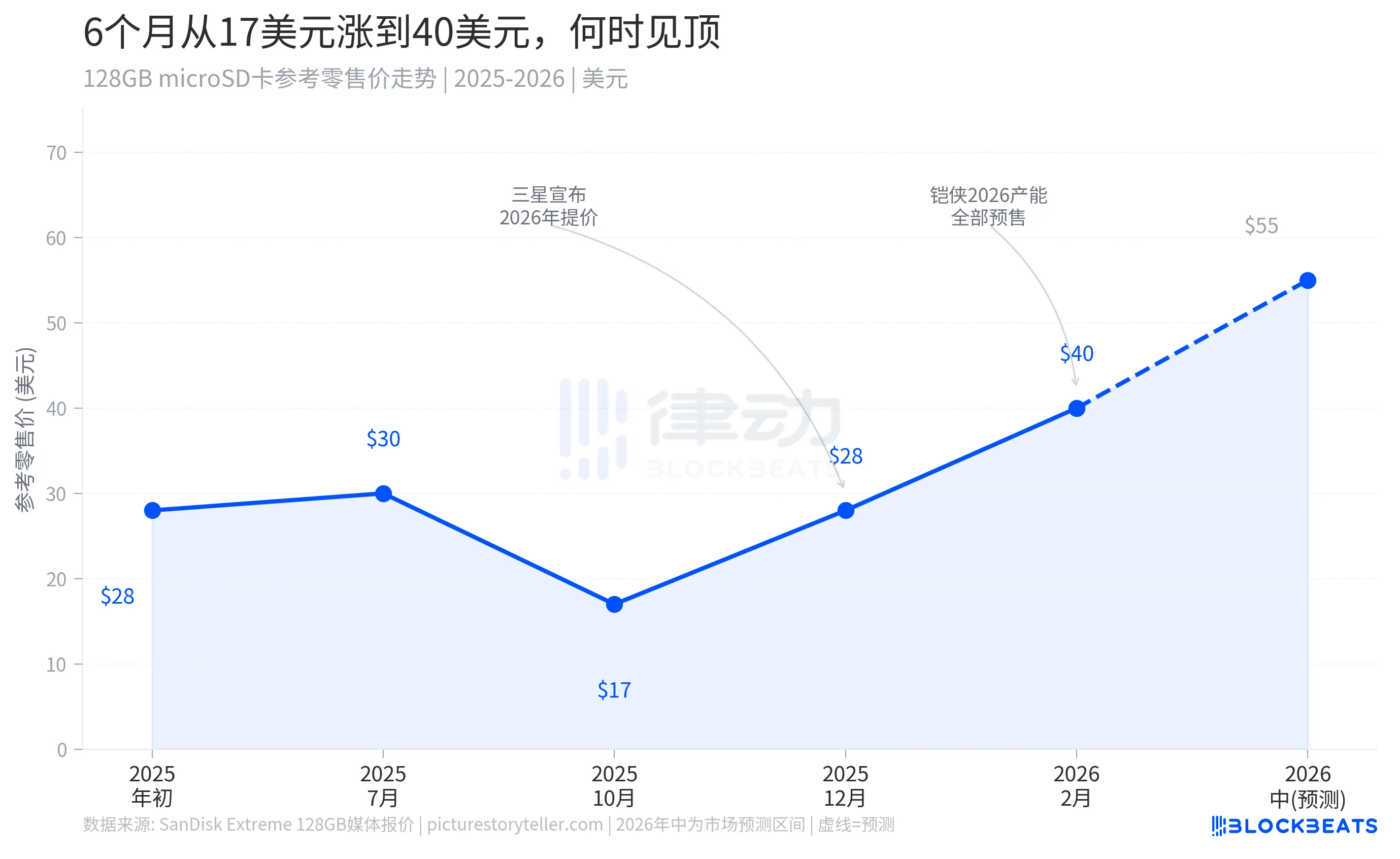
Since then, retail prices for storage cards have climbed, and it is expected to reach the $50–60 range by mid-2026 with no window for a pullback throughout the year. This is not market speculation, but a structural adjustment in the supply allocation mechanism. Before AI data centers became the top buyers in the NAND market, consumer products and enterprise products shared the production capacity distribution approximately equally. Now, the consumer end is the recipient at the very end of the allocation chain.
This time, it is completely different from 2017
The NAND industry typically experiences a price cycle every three to four years. The last typical price increase occurred from 2016 to 2017 and lasted nearly two years. That cycle was triggered by the transition from 2D NAND to 3D NAND technology. The new stacking process slowed effective output during the yield climbing phase, tightening supply and driving up prices. However, once manufacturers stabilized the yields of their 3D NAND production lines, Samsung, SK Hynix, and Micron significantly expanded production simultaneously, causing inventory to quickly shift from shortage to surplus, and prices dropped sharply in early 2018.
This time, the driving forces are completely different, leading to a distinctly different recovery path.
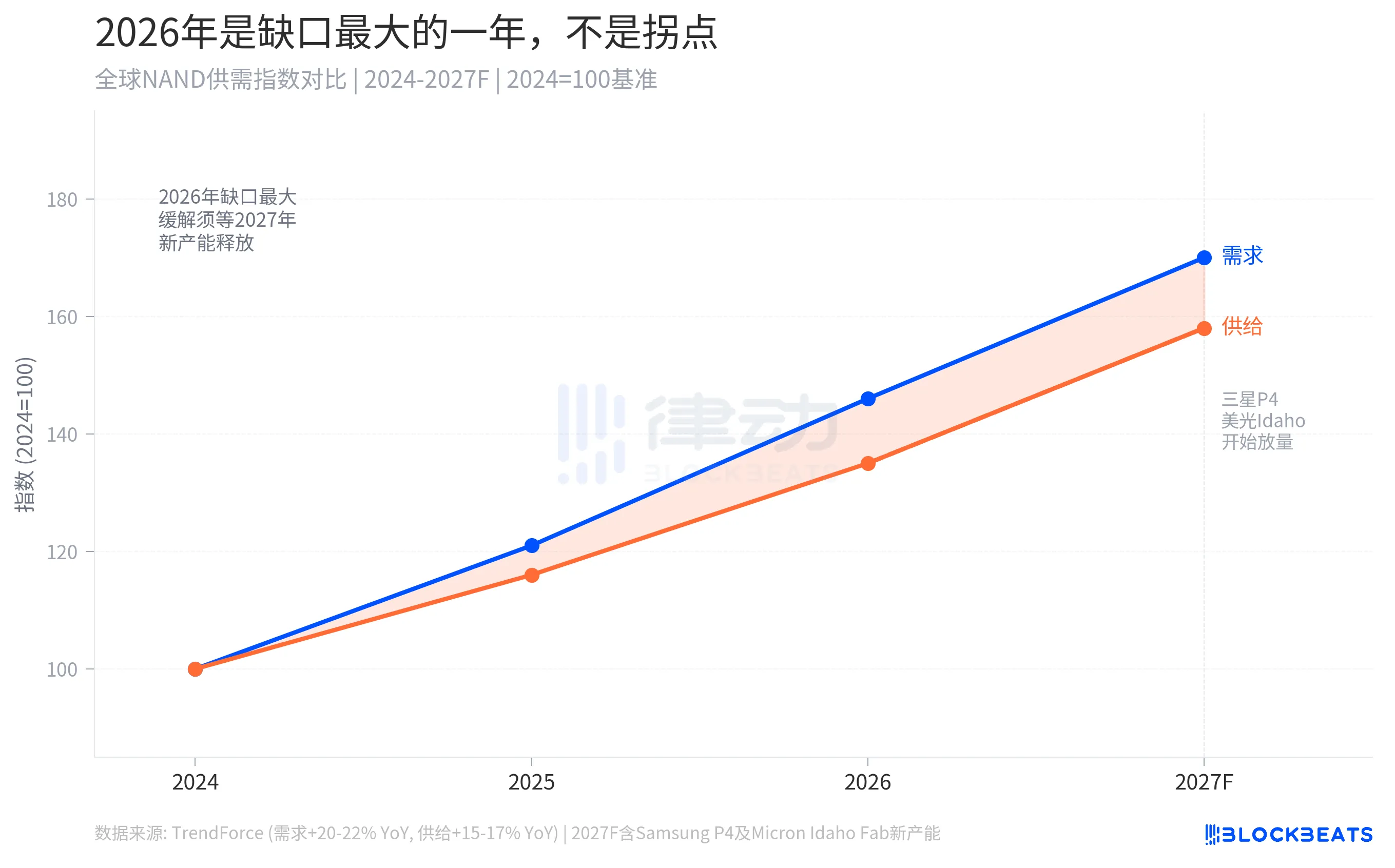
According to TrendForce data, global NAND demand growth is expected to reach 20–22% in 2026, while supply growth is only expected to be 15–17%. The absolute gap is not large, but in a vast market, a few percentage points of supply-demand difference can trigger an extremely intense price reaction. More importantly, this gap is not caused by technical issues, but by a structural shift in demand. AI data centers are consuming NAND production capacity in a continuous, large-scale, high-priority manner, and there is no ceiling to the scale of this demand.
Newly added capacity to ease supply tightness is not expected until the end of 2027 to 2028. Samsung's NAND production line in the P4 plant area of Gyeonggi Province, Micron's new wafer factory in Idaho, and Kioxia's expansion in Iwate all point to this time window. 2026 is the year with the largest supply-demand gap, not the turning point for prices.
Manufacturers are not lacking capacity; they are actively selling capacity to the highest bidder
The following chart illustrates the fundamental mechanism behind this price increase. In the revenue structure of the NAND industry, the share of enterprise-grade products (AI data center SSDs, general server storage) is rapidly expanding. According to comprehensive industry estimates, the share of enterprise products in overall NAND revenue has increased from about 45% in 2024 to about 62% in 2026, while the share of consumer and client markets has shrunk from 55% to around 38%.
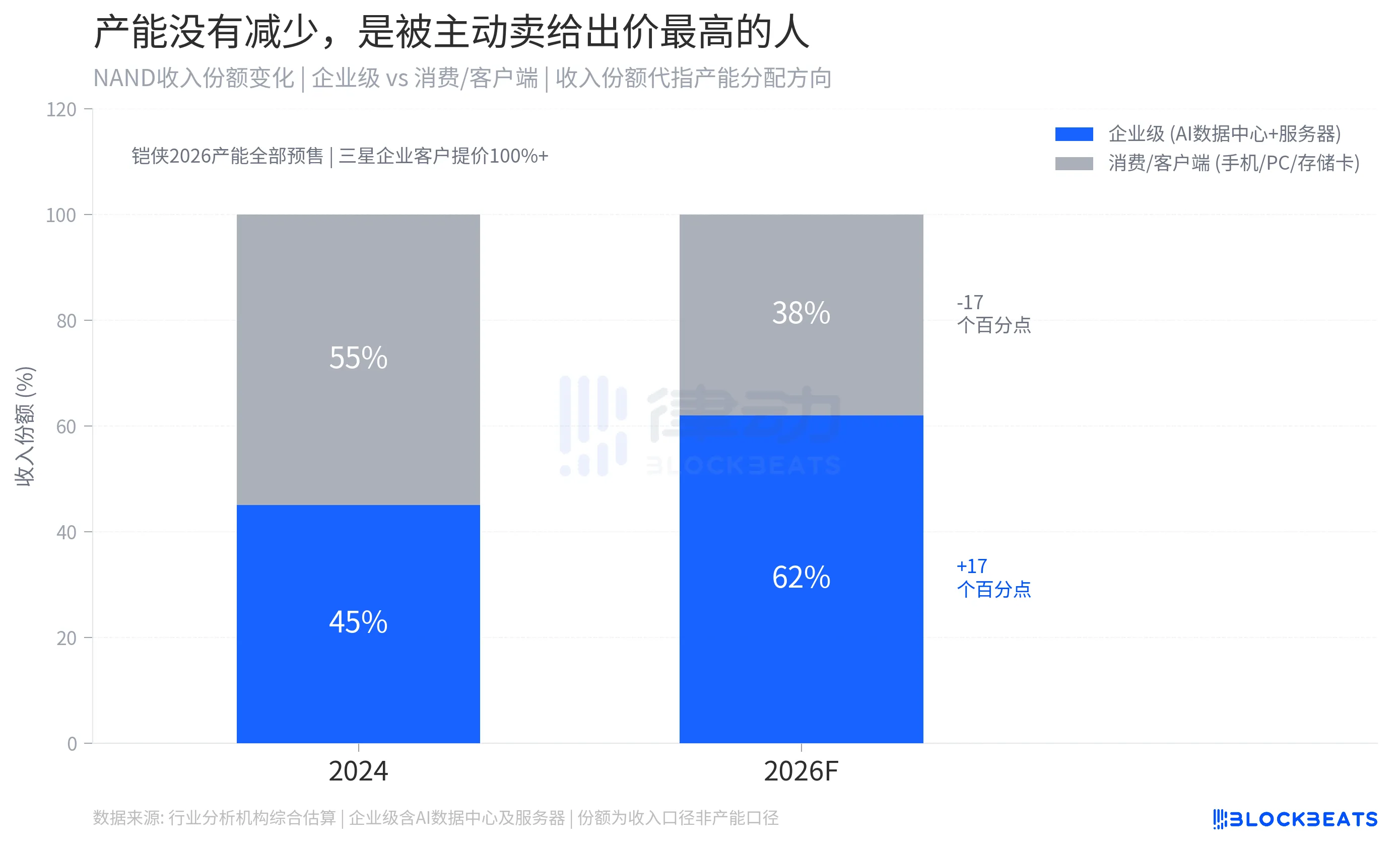
The logic driving this migration is very straightforward: for the same wafer area, the unit profit of producing high-density QLC SSDs for enterprise is 3–5 times higher than producing consumer-grade memory cards. Manufacturers like Kioxia and Samsung follow the principle of maximizing commercial interests in their capacity allocation, assigning the best wafers to the highest bidders.
This mechanism also has a layer of implicit effect. When the available inventory in the consumer market decreases, distributors and retailers accelerate their stocking speed to hedge against future price increases, further accelerating the depletion of inventory at the consumer end and forming a self-reinforcing cycle of price increase.
For consumers, the price of memory cards will remain high for quite a while, not because of insufficient wafer capacity, but because the allocation priority in the consumer market has been lowered at a systemic level. It will only be after the pace of AI computing infrastructure construction slows down that surplus wafer capacity will return to the consumer goods supply chain, but that will be after 2027.
The SD card in your camera is using the same wafer as the world's largest AI data center. Now you know who won.
免责声明:本文章仅代表作者个人观点,不代表本平台的立场和观点。本文章仅供信息分享,不构成对任何人的任何投资建议。用户与作者之间的任何争议,与本平台无关。如网页中刊载的文章或图片涉及侵权,请提供相关的权利证明和身份证明发送邮件到support@aicoin.com,本平台相关工作人员将会进行核查。


