Author: Claude, Deep Tide TechFlow
Deep Tide Guide: The US-Iran negotiations have collapsed, the blockade of the Strait of Hormuz has begun, and oil prices have returned above 100 USD. However, the S&P 500 rose 1% on Monday, erasing all losses since the outbreak of the Iran war to 6886 points. JPMorgan, Morgan Stanley, and BlackRock expressed bullish sentiments on the same day, with a consistent core logic: corporate earnings resilience far exceeds geopolitical shocks. The investment section on Reddit went into a frenzy, with retail investors declaring, "The market doesn't pay attention to the news at all."
On the first trading day following the US-Iran negotiations' collapse, US stocks followed a curve that confused everyone.
On April 13 (Monday), the S&P 500 rose 69 points, an increase of 1%, closing at 6886 points; the Dow Jones Industrial Average rose 302 points, an increase of 0.6%; the NASDAQ Composite increased by 1.2%. On the same day, Trump announced on social media that the US Navy would immediately initiate the blockade of the Strait of Hormuz. Brent crude oil briefly surpassed 100 USD/barrel before falling back to approximately 98.16 USD, while WTI crude oil closed at 97.82 USD.
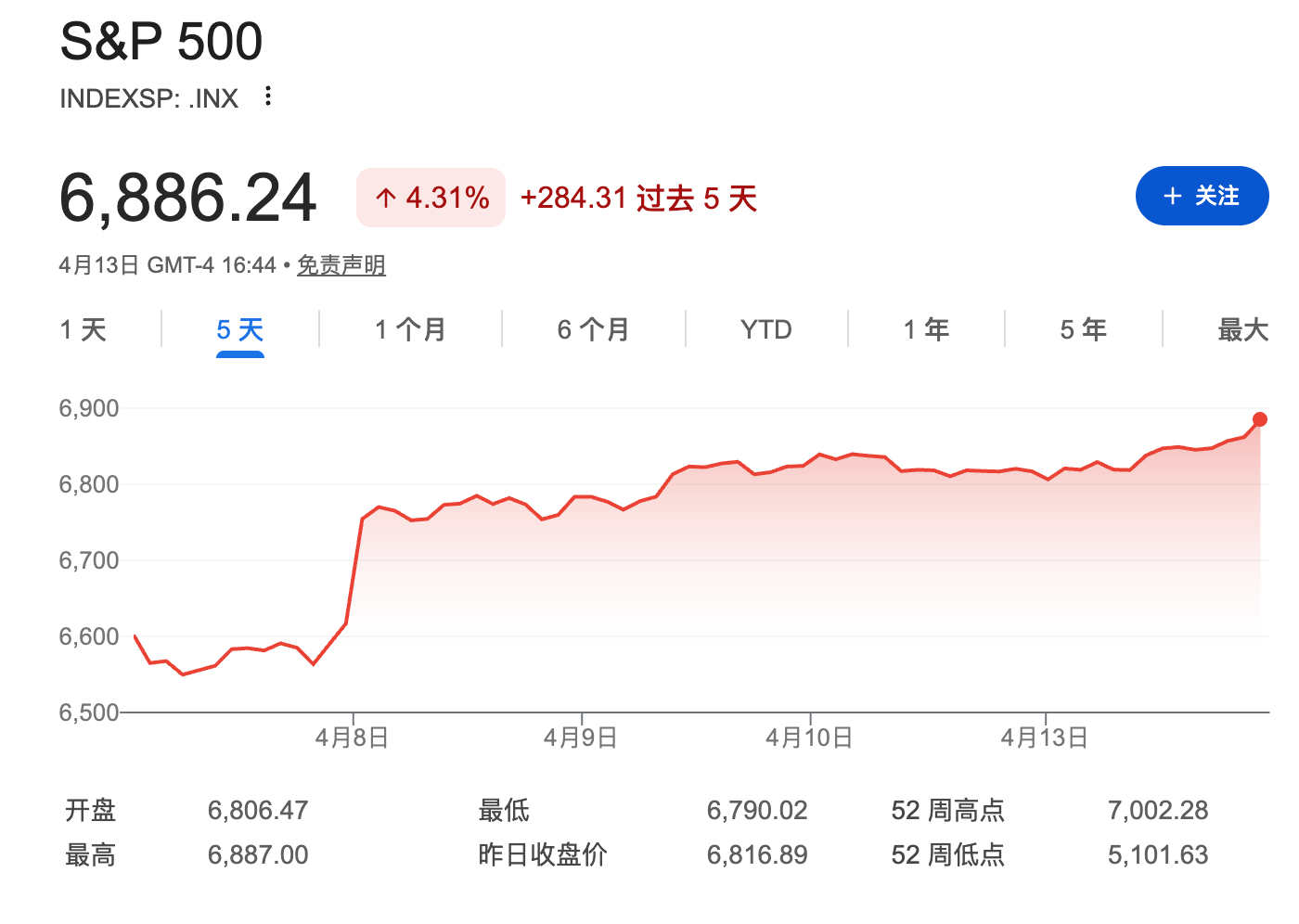
The S&P 500 reached its highest level since the end of February, fully recovering all losses since the outbreak of the Iran war. The surge in oil prices coincided with the rise in the stock market, which logically seemed contradictory. However, some of the largest institutions on Wall Street provided highly consistent explanations: corporate earnings remain strong, and the persistence of geopolitical shocks is limited, making it a window for buying on dips.
Three major institutions express bullish sentiments on the same day, core logic points to earnings resilience
JPMorgan stated in a report led by strategist Mislav Matejka that the decline driven by geopolitical shocks should ultimately prove to be a buying opportunity.
The team of strategist Michael Wilson at Morgan Stanley judged that the recent sell-off of the S&P 500 resembles a correction rather than the beginning of a sustained downturn, with supporting factors stemming from improved earnings growth and reasonable valuation recovery. Morgan Stanley continues to favor cyclical sectors such as finance, industrials, and consumer goods, as well as high-quality growth targets like AI super-scale computing.
BlackRock's Investment Research Institute raised its rating on US stocks from "neutral" to "overweight" on the same day, being the most aggressive of the three. Jean Boivin, head of BlackRock's Investment Research Institute, stated that the valuation premium of the technology sector has been eroded, while the expected earnings growth rate for this sector in 2026 has risen to 43%, up from 26% last year.
In its weekly market report, BlackRock pointed out that two milestones triggered its decision to increase holdings: first, there is substantial evidence that navigation in the Strait of Hormuz is resuming; second, the persistent damage to the macroeconomy from the conflict has proven to be controllable.
The three institutions referenced the same set of data: according to LSEG I/B/E/S data, by April 10, the expected earnings growth rate for the S&P 500 in the first quarter was 13.9%, higher than the pre-war forecast of 12.7%. In other words, nearly seven weeks since the outbreak of the conflict, analysts not only did not lower their earnings expectations but instead raised them.

Valuation contraction of the "Magnificent Seven" becomes a reason to buy
JPMorgan specifically mentioned in its report that the forward price-to-earnings ratio premium of the "Magnificent Seven" (NVIDIA, Apple, Microsoft, Meta, Google, Amazon, and Tesla) has dramatically narrowed from 1.7 times the S&P 500 level to 1.2 times.
This data provides a key argument for bulls on Wall Street: the concentration issue that suppressed market breadth over the past two years is beginning to alleviate due to valuation recovery.
BlackRock noted that the valuation premium of the technology sector relative to the other ten sectors has dropped to its lowest level since mid-2020. The company stated that in the context of robust corporate earnings expectations and limited global growth damage, it chooses to increase holdings in US stocks and emerging markets.
Historical data supports: Geopolitical shocks are usually digested within six weeks
The optimism among Wall Street institutions is not unfounded. Research from UBS shows that when the S&P 500 declines by 5% to 10% within three to four weeks, it historically typically returns to pre-conflict levels within six months.
LPL Research’s review of geopolitical shock events since World War II indicates that the average first-day response is a decline of about 1%, with an average peak-to-trough decline of about 5%, an average bottoming time of about 19 days, and an average recovery cycle of about 42 days.
UBS pointed out in a mid-March report that from the outbreak of the conflict on February 28 to March 13, global stock markets only fell by about 5%, while oil prices rose by about 40% during the same period. The stock market's degree of "insensitivity" to oil price shocks itself validates the aforementioned historical pattern.
On April 6, UBS lowered its end-of-year target price for the S&P 500 from 7700 to 7500, and its mid-term target from 7300 to 7000, but still maintains an overall judgment of "attractive" for US stocks, keeping the earnings per share forecast for 2026 at 310 USD unchanged.
Reddit investors' soul-searching question, "The market doesn't pay attention to the news at all"
The consensus among institutions can be explained with data, but the reaction from the retail community more intuitively reflects current market sentiment.
On Reddit's r/stocks section, a post titled "Do you believe it now? The market doesn't move because of the news" received 923 likes and 159 comments, with the core argument from the poster being: the market moves first, and then finds reasons. This blockade of Hormuz is arguably the most typical case they have experienced, with many comments expressing confusion over the disconnection between geopolitical risks and market pricing.
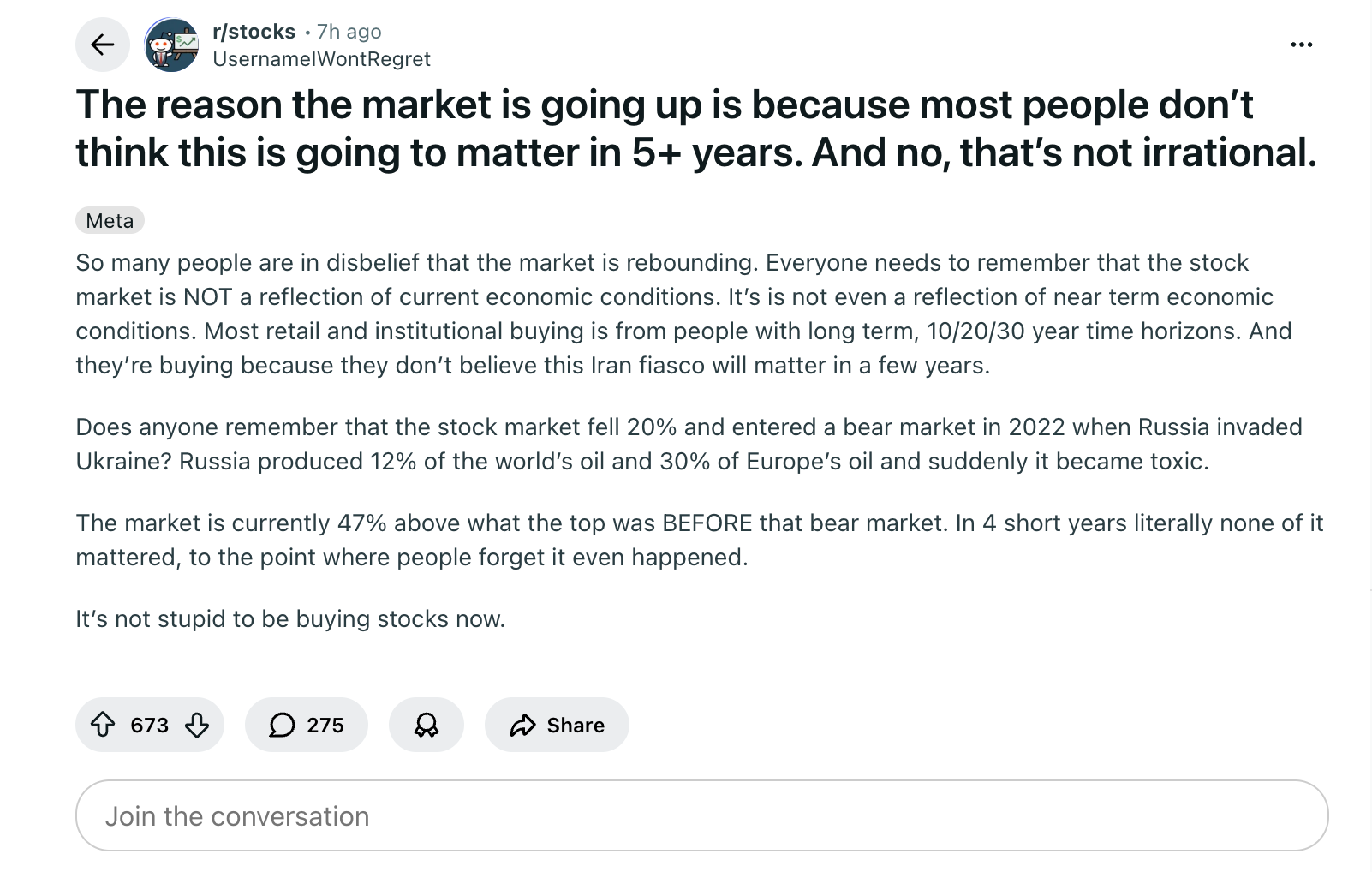
"The market rises because most people think this won't matter in five years; this is not irrational." The post received 344 likes and 199 comments, representing the typical stance of long-term investors.
In the r/wallstreetbets section, a post that received 504 likes pointed out that the physical oil market is "screaming supply shock," yet the stock market remains calm, creating contradictory signals between the two markets that leave traders at a loss.
The confusion of retail investors stands in stark contrast to the confidence of institutions, but the underlying logic is actually two sides of the same coin: institutions bet on earnings resilience and limited conflict, while retail investors are confused about why bad news hasn't translated into declines.
The answer may be simple: the market completed a pricing round in March and is currently in a "bad news has run its course" recovery phase.
免责声明:本文章仅代表作者个人观点,不代表本平台的立场和观点。本文章仅供信息分享,不构成对任何人的任何投资建议。用户与作者之间的任何争议,与本平台无关。如网页中刊载的文章或图片涉及侵权,请提供相关的权利证明和身份证明发送邮件到support@aicoin.com,本平台相关工作人员将会进行核查。


