With the rapid development of on-chain derivatives trading, the demand among Crypto traders for competitive and gamified trading products is continuously growing.
More and more traders not only hope to earn profits simply but also wish to verify their strategies and risk management abilities in a fair environment. However, the trading competition products currently on the market still show clear gaps—traditional trading competitions are naturally more biased towards large fund players, while the Prop Trading Challenge platforms usually require longer evaluation periods, making them challenging to meet the fast-paced needs of the Crypto market.
In this context, the decentralized contract trading platform DeriW officially launched Edge Hour on March 24— a competitive product centered around the "time-limited trading challenge", attempting to provide a new trading competition experience with shorter cycles and lower thresholds.
Practical Experience: Faster Pace, More Direct Trading Competition
From a product positioning perspective, Edge Hour can be viewed as the Crypto version of Prop Trading Challenge, but with design innovations closer to the Crypto market. The entire process has a lower threshold (minimum of 5 USD), a faster pace (1 - 8 hours), more controllable costs (losses limited to entry fees), and more considerable profits (2-10x rewards).
In the actual experience, users first select the challenge duration (options of 1, 2, 4, 8 hours), the entry fee (5 - 500 USD), and the reward level (2 -10 times); after selection is complete, the interface directly provides a profit target and a maximum drawdown limit; afterward, users can immediately start the challenge and trade perpetual contracts like BTC, ETH within the specified time. The challenge is deemed successful when the account position reaches the profit target without exceeding the drawdown line.
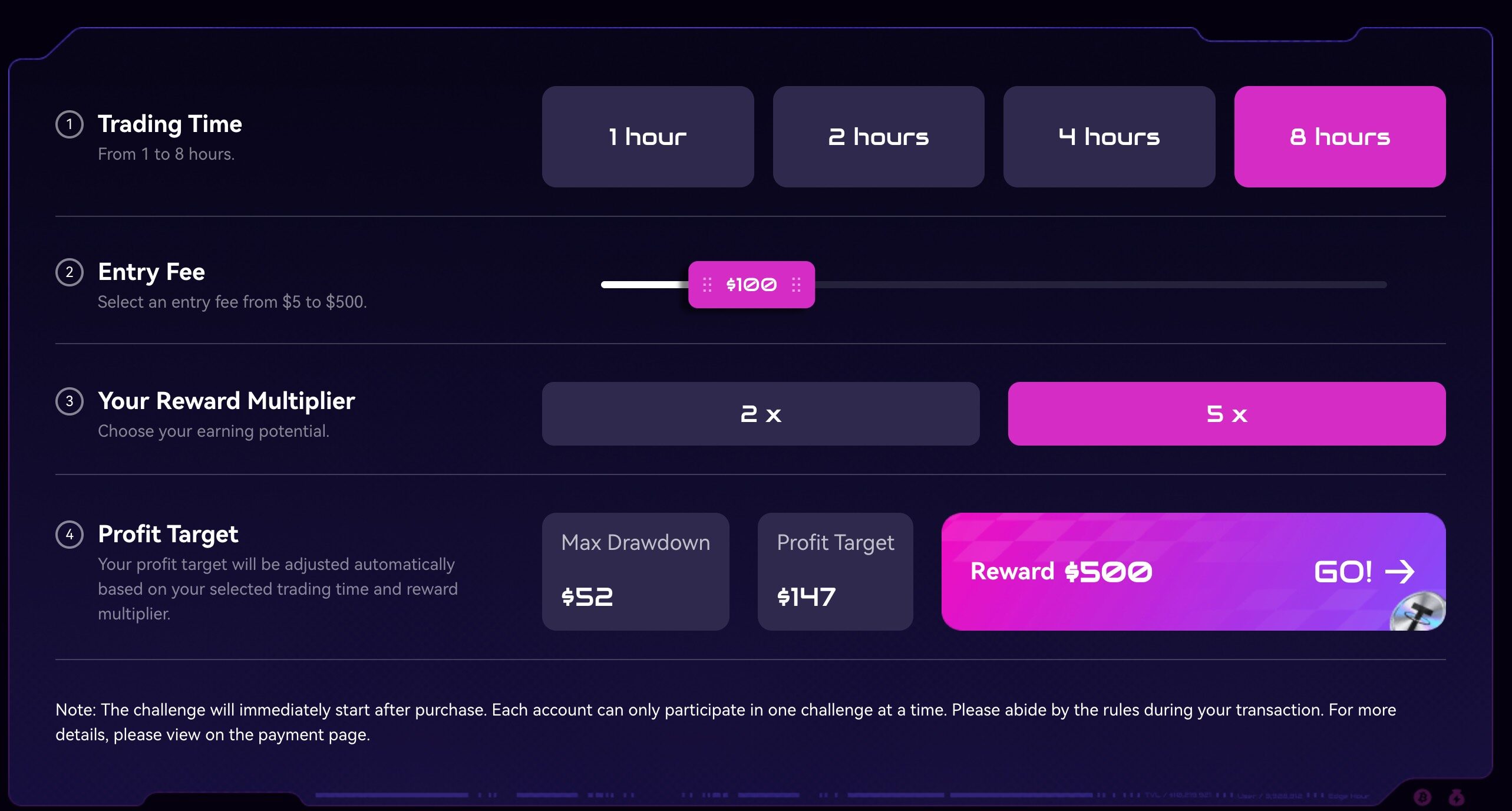
As shown in the image above, after I chose an 8-hour challenge period, a 100 USD entry fee, and a 5x reward, Edge Hour automatically set a profit target of 147 USD and a drawdown limit of 52 USD. This means that if I succeed in the challenge, I can obtain a reward of 500 USD, whereas if I fail, I will only lose the 100 USD entry fee.
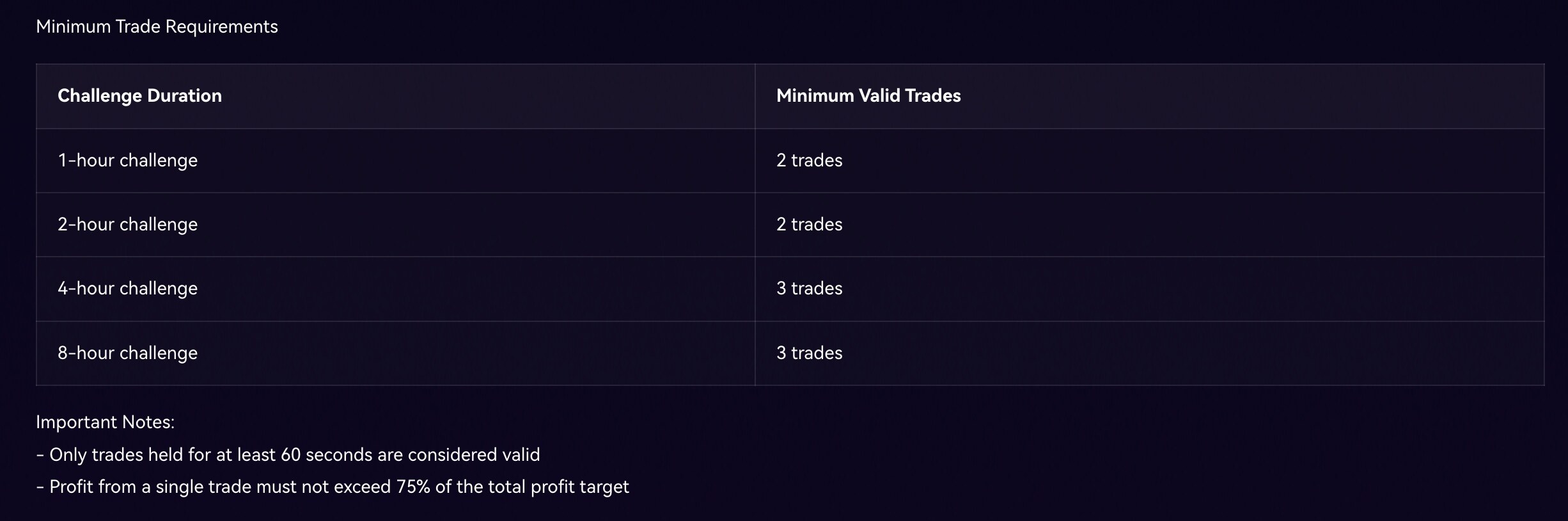
It is essential to note that to eliminate speculative users and those merely "testing their luck," Edge Hour requires users to maintain at least 60 seconds for each opening position, with different minimum trading numbers for different challenge durations (as shown in the image below). Additionally, the profit for a single trade must not exceed 75% of the total profit target.
Regarding the reward method, the challenges and settlements of Edge Hour are publicly and transparently executed on-chain, with rewards directly distributed to users' wallets after the challenge ends, and all trading records are verifiable.
Overall, the participation process and revenue structure of Edge Hour are very clear— "Invest ➡️ Challenge ➡️ Success ➡️ Multiple Returns," with an intuitive logic and a strong feeling of competitive enjoyment.
Six Core Advantages: Rewarding True Technical Players
Surrounding Edge Hour, DeriW has conducted multi-dimensional product design to provide traders with the competition environment that allows them to showcase their trading capabilities while ensuring fairness and openness, rewarding true "experts" with excess rewards.
Specifically, the core advantages of Edge Hour are reflected in the following six points.
- Fair Competitive Environment: Edge Hour provides all participants with the same 10,000 USDT virtual trading money, removing the unfair factors brought by differences in capital scales. Under this mechanism, the outcome is entirely determined by trading skills and risk control abilities. Compared with traditional leaderboard trading competitions, large fund users no longer have a natural advantage, and small fund traders also have fair competitive opportunities. At the same time, all trading data is recorded on-chain and can be verified, further ensuring the transparency and credibility of the results.
- Low Threshold, High Returns: Edge Hour has reduced the participation threshold to an extremely low level, with a minimum participation fee of only 5 USDT, and the user's risk ceiling is only the ticket loss, but they can obtain 2 - 10 times the reward multiples. This structure allows traders to test strategies at a very low cost while also having high profit potential, significantly lowering the barriers to trying.
- Shorter Competition Cycles: Traditional trading competitions often face issues of long cycles and prolonged wait times, whereas Edge Hour offers four challenge duration options of 1 hour, 2 hours, 4 hours, or 8 hours. Users can choose to participate based on their time arrangements and receive feedback on results within a few hours, greatly enhancing participation efficiency.
- Focusing on Real Trading Abilities: Edge Hour ensures that competition results are led by true trading skills through several rules: the minimum holding period for a single trade must be at least 60 seconds; single trading profits must not exceed 75% of the target; there are requirements for the minimum number of trades and maximum drawdown limits. These rules aim to avoid high-frequency trading and one-time gambling behaviors, ensuring that challenges reflect complete trading strategies.
- Social Viral Growth: Edge Hour allows participants to invite friends to join during the challenge. The inviter can receive extra rewards, while the invitees can gain time extensions and fee discounts, thus promoting ecological growth through social dissemination. This design combines trading competitions with social virality, increasing user engagement.
- Technical Guarantees: This is also DeriW's true trump card. Edge Hour operates on DeriW Chain (a Layer3 network based on Arbitrum Orbit), featuring millisecond-level matching speed, zero Gas fees, high concurrency processing capabilities (80,000 TPS), and on-chain transparent settlement, ensuring the challenge process is smooth and fair.
Meeting Diversified Trading Needs, Filling Market Gaps
From a more macro perspective, the launch of Edge Hour actually reflects the evolution of the Crypto trading ecosystem towards a more diversified direction.
In the early stages, Crypto trading primarily revolved around spot and long-term holdings; subsequently, perpetual contracts and other derivative tools gradually became popular, leading the market into a high-frequency and leveraged trading era. As the user structure changes, trading needs also begin to further diversify—some pursue long-term investments, some prefer short-term fluctuations, and others wish to validate their strategy capabilities through a fair competitive environment.
However, in the current market, there is still a significant gap for this type of "trading skill validation" product. On one hand, traditional trading competitions are more tilted toward "capital scale competition," and leaderboard mechanisms often lead to large fund users having inherent advantages, making it difficult for small fund traders to stand out in long-cycle competitions even if their strategies are excellent; on the other hand, although the Prop Trading Challenge emphasizes skill assessment, its long cycles and complex rules make it difficult to meet the fast-paced characteristics of the Crypto market.
Edge Hour opens a new path between the two. By using a unified starting point of 10,000 USDT virtual funds, Edge Hour eliminates differences in capital scales, making trading skills the only variable; through 1–8 hour challenge cycles, Edge Hour allows for rapid verification of trading results; and with an on-chain transparent settlement mechanism, the entire competition process is ensured to be publicly verifiable and immutable.
From this perspective, Edge Hour is not just a product function innovation; it also resembles introducing a whole new trading competition paradigm to the Crypto market—participate at a lower cost, complete challenges in a short time, and determine results through trading abilities rather than capital scales.
The emergence of this model also signifies that the form of trading products is upgrading from "pure trading tools" to a comprehensive experience of "trading + competition + social," and Edge Hour is a representative attempt under this trend.
A New Direction for Decentralized Trading
For DeriW, the launch of Edge Hour not only signifies the enrichment of the product matrix but also further strengthens the platform's differentiated positioning in the decentralized derivatives track.
Over the past few years, competition among decentralized trading platforms has primarily focused on liquidity, fees, and performance. As the market matures, user experience and product form innovation are becoming new competition dimensions. In other words, those who can provide a more engaging, fair, and entertaining trading environment are more likely to attract a new generation of trading users.
In this context, Edge Hour has emerged in response to the market—it integrates trading skill verification, risk control training, and competitive experience, making trading no longer just an isolated operational activity but a participatory, comparable, and shareable interactive experience. Industry trading needs will continue to become more segmented, and user structures will continually refine; short-cycle, skill-oriented trading competition products like Edge Hour may become an essential part of the next phase of the Crypto trading ecosystem, and DeriW will leverage Edge Hour to accelerate its evolution from a "trading platform" to a "trading ecosystem."
免责声明:本文章仅代表作者个人观点,不代表本平台的立场和观点。本文章仅供信息分享,不构成对任何人的任何投资建议。用户与作者之间的任何争议,与本平台无关。如网页中刊载的文章或图片涉及侵权,请提供相关的权利证明和身份证明发送邮件到support@aicoin.com,本平台相关工作人员将会进行核查。


