Author: Chloe, ChainCatcher
For years, tokenization has been positioned as the bridge for cryptocurrencies to Wall Street. Putting government bonds on-chain, issuing tokenized funds, and digitalizing stocks all point to a single logic: as long as the assets are on-chain, institutional funds will naturally follow.
However, tokenization itself has never been the end game. DWF Ventures believes that the key to unlocking the institutional market is not in digitalizing assets, but in financializing yields.
Since 2025, the total value locked (TVL) in DeFi surged from about $115 billion to over $237 billion, primarily driven not by pure speculation from retail investors but by real institutional capital and real-world assets (RWA). Today, institutions are no longer just observing; they are beginning to view DeFi as the infrastructure for deployable capital.
It can be said that what Wall Street truly wants to see in DeFi has shifted from "putting assets on-chain" to "programmable, reconfigurable, and hedging interest rate risk" fixed income infrastructure. We can now glimpse that this transformation has occurred through TVL and RWA data, examples of institutional protocols, theories of yield tokenization, and the implementation of privacy and compliance.
TVL and Institutional Data: Which Layer Are Institutions Filling?
In the third quarter of 2025, DeFi's TVL surged from about $115 billion at the beginning of the year to $237 billion. However, the number of active wallets on-chain decreased by 22% during the same period. DappRadar data clearly shows that this wave of increase has been driven not by retail investors but by "high-value, low-frequency" institutional capital.
In this structure, the key factor is RWA: as of the end of March 2026, the total value of RWA has reached $27.5 billion, growing more than 2.4 times from $8 billion in March 2025. These types of assets are mainly used as collateral for stablecoin loans through protocols like Aave Horizon, Maple Finance, and Centrifuge, forming a remortgaging flywheel of "on-chain repo (repurchase agreements)."
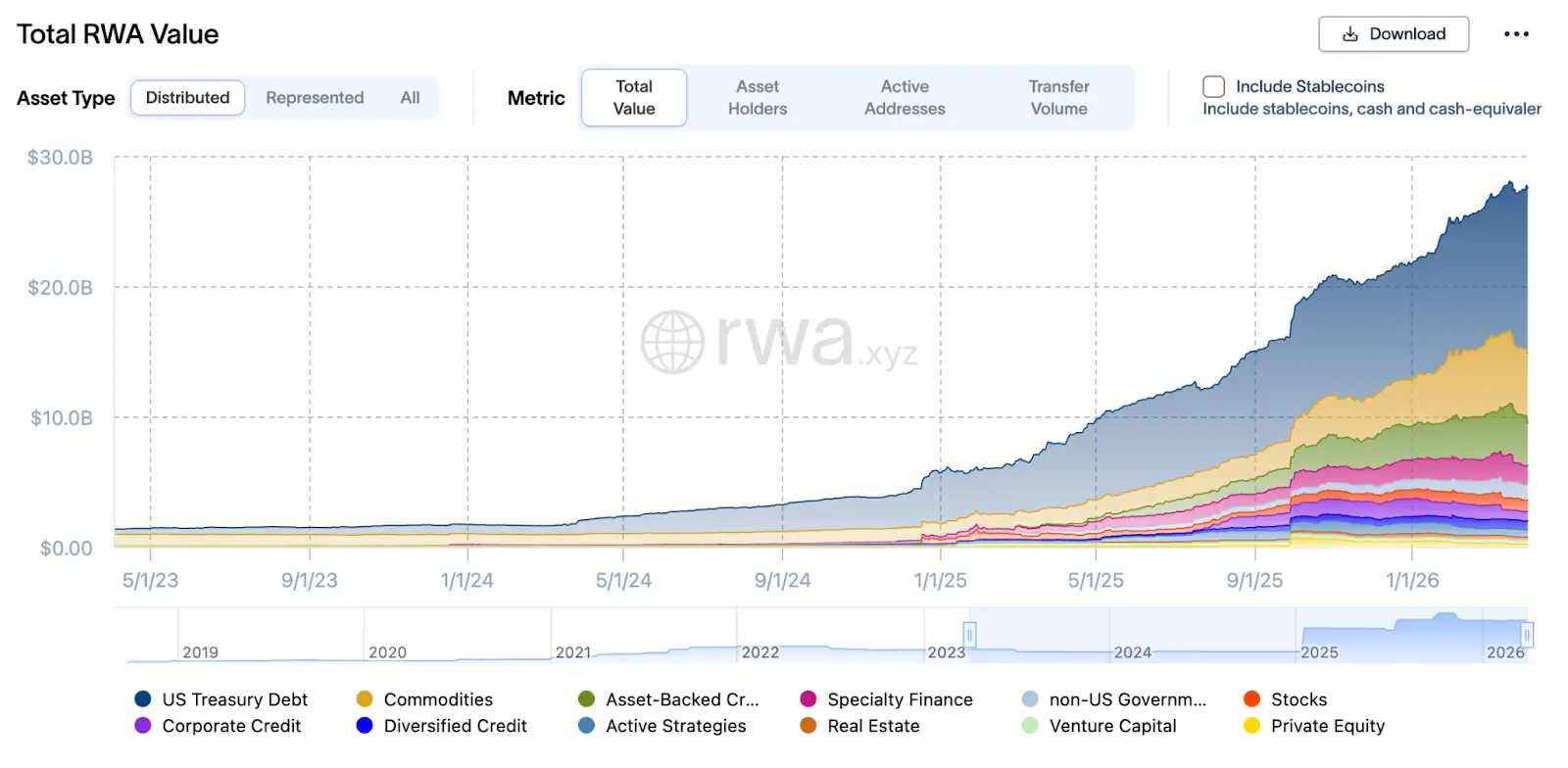
Taking Aave Horizon as an example, its RWA market had accumulated about $540 million in asset size by the end of 2025, including stablecoins like Superstate's USCC, RLUSD, and Aave's GHO, as well as various US Treasury assets (such as VBILL), with an annualized yield of approximately 4-6%. This structure essentially represents an "institutional version of a money market fund": the front end consists of tokenized government bonds and notes, while the back end is a stablecoin liquidity pool, with interests, refinancing, and liquidation automatically handled by smart contracts.
From "Holding" to "Operating": Are Institutions Engaging in On-chain Repo or Fixed Income?
In the traditional fixed income market, bonds are not just tools for holding and earning interest; they can be used in repo (repurchase agreements), remortgaged, split, and embedded into structured products, creating a flywheel of capital efficiency. DeFi in 2025 has begun to replicate this logic.
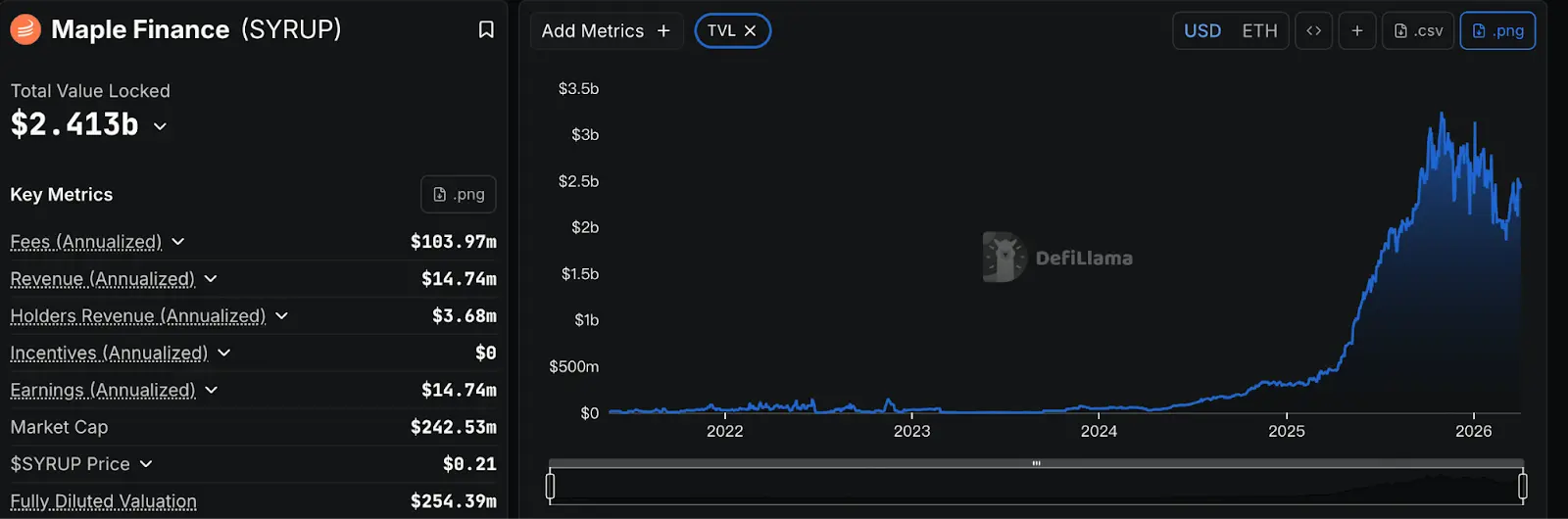
Maple Finance's TVL surged from $297 million to over $3.1 billion in 2025, with some periods reaching close to $3.3 billion. The main driver of this growth was institutions entering the RWA loan market, tokenizing private loans and corporate loans for the "over-the-counter" stablecoin lending and refinancing.
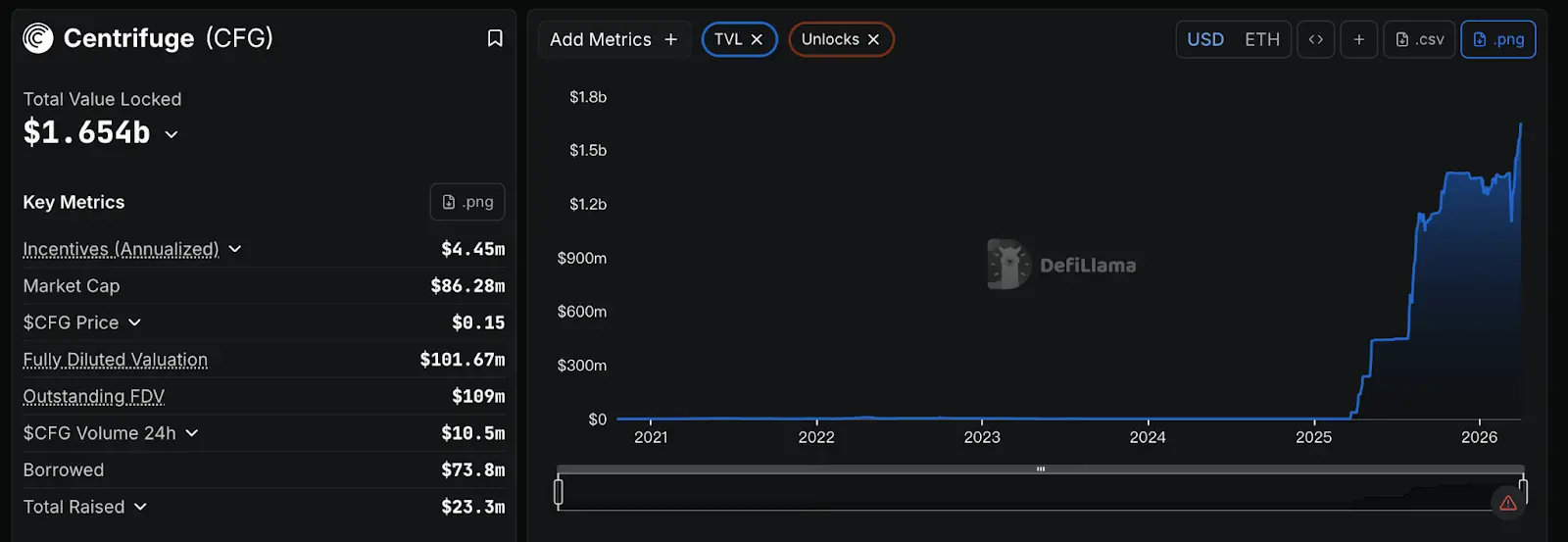
Centrifuge focuses on converting small and medium-sized enterprise (SME) loans, trade financing, and accounts receivable into on-chain assets. To date, its ecosystem has managed over $1 billion in TVL and successfully developed several diversified asset pools, extending from private credit to highly liquid US Treasury securities.
At the same time, Centrifuge has deeply integrated with top DeFi protocols, such as Sky (formerly MakerDAO). Through collaboration with Centrifuge, MakerDAO can invest its reserves in real enterprise loans, providing substantial yield support for the stablecoin DAI; and with Aave, they jointly created a dedicated RWA market allowing KYC-compliant institutional investors to use Centrifuge's asset certificates as collateral, enabling cross-protocol liquidity circulation.
Yield Tokenization and Yield Trading Markets: Can Interest Rate Risk Be Hedged?
If one were to draw a structural diagram of Wall Street's fixed income market, several key modules would be visible: principal and interest can be separated (e.g., zero-coupon bonds, stripped coupons), interest rate risk can be independently traded and hedged, and liquidity and compliance can be separated yet interconnected through middleware.
In May 2025, an arXiv paper titled "Split the Yield, Share the Risk: Pricing, Hedging and Fixed Rates in DeFi" formally proposed the framework of "yield tokenization": splitting yield assets into "Principal Tokens (PT)" and "Yield Tokens (YT)", and pricing and hedging interest rate risk using stochastic differential equations (SDE) and arbitrage-free frameworks.
This design has already been implemented in some protocols. For instance, Pendle Finance employs a specially designed Yield Automated Market Maker (AMM) whose price curve adjusts over time (time decay factor), ensuring PT's price returns to its redemption value at maturity. These mechanisms allow market participants to allocate liquidity according to risk preferences (for example: fixed-rate demanders buy PT, yield speculators buy YT).
For institutions, this means that yield structures can be "modularized," directly integrating into traditional asset allocation models (e.g., duration, DV01, interest rate risk contribution); interest rate risk can no longer only be hedged with off-chain futures or interest rate swaps (IRS), but can be directly traded on-chain as "yield tokens" to adjust, fulfilling interest rate risk hedging instantly and transparently, significantly improving capital efficiency.
Real-world Dilemmas: Privacy and Compliance
However, even though DeFi's TVL has broken through $10 billion, the large-scale inflow of institutional capital is still stuck in two key dilemmas: privacy and compliance.
First Dilemma: Public Chain Holdings Are Transparent, Liquidation Points Are Exposed
On mainstream public chains, every transaction and the holdings of addresses are visible to the public, which poses a severe risk for institutions. Trading strategies, leverage levels, and liquidation points can be fully grasped by counterparties, potentially being targeted for short-selling and liquidation. In case of a liquidity crunch or price volatility, malicious actors could place orders against specific addresses to amplify losses; this is one reason why institutional capital is reluctant to fully invest in DeFi.
Here, zero-knowledge proofs may provide a key solution, enabling institutions to demonstrate their legitimacy to regulators without disclosing information externally. Specifically, regulators could verify that institutions meet regulatory requirements, while other market participants cannot see institutions' complete holdings and liquidation points. This represents the privacy layer that Wall Street desires—not "complete anonymity," but rather "meeting compliance requirements without disclosing trade secrets."
Second Dilemma: KYC, Sanction Screening, and Auditing Must Be Embedded within Protocols
Another red line for institutions is that compliance should not be an afterthought but a native feature. In traditional finance, KYC, sanction screening, and auditing requirements have long been integrated into settlement systems and trading processes, but in many DeFi protocols, these checks still remain at the "front-end access" or "intermediary level," instead of being directly embedded into the protocol logic.
Institutions expect that KYC and sanction screenings will no longer be "user uploads identity proof, then simply rely on trust," but rather a module or middleware that can verify identities and sanction lists on-chain without exposing complete data; and further, that auditing and regulatory requirements can be directly written as "verifiable rules," such as: a certain transaction must be executed under specific compliance conditions or a certain address's exposure must not exceed a certain limit.
In its November 2025 report "Tokenization of Financial Assets," IOSCO emphasized the need to establish "verifiable compliance rules" and "transparent but controlled audit pathways" on distributed ledger technology (DLT). Some institutional DeFi platforms have begun experimenting with "compliance modules," allowing KYC, AML, sanction screening, and regulatory reporting to be directly embedded at the protocol level instead of relying on external tools or after-the-fact patches.
Conclusion: What Does Wall Street Want DeFi to Look Like?
Returning to the initial question, what does Wall Street want DeFi to look like? Firstly, a more advanced asset settlement and service system that can seamlessly integrate into global compliance infrastructure, building an institutional moat; secondly, on the yield structure, the ability to replicate the interest rate disaggregation and hedging logic of traditional fixed income markets precisely, achieving risk modularization; and thirdly, ensuring compliance and security through zero-knowledge proofs to embed "verifiable compliance" and "programmatic risk control" into the protocol's foundation, achieving a balance between privacy and regulation.
Replacing traditional finance has never been an option for Wall Street, but it can flexibly reorganize capital, risk, and returns in a programmable way in an alternative world.
免责声明:本文章仅代表作者个人观点,不代表本平台的立场和观点。本文章仅供信息分享,不构成对任何人的任何投资建议。用户与作者之间的任何争议,与本平台无关。如网页中刊载的文章或图片涉及侵权,请提供相关的权利证明和身份证明发送邮件到support@aicoin.com,本平台相关工作人员将会进行核查。


