On April 1, Iranian officials stated that the Strait of Hormuz would reopen, but it would not be open to the United States. Looking at this statement alone, it is difficult to say that the situation has clearly eased. However, when viewed in the market context, it carries significant weight. For more than a month, crude oil has been pricing in the worst-case scenario: shipping disruptions, supply rerouting, and decreased Gulf flow. Now, the market is beginning to do something different: downgrading the weight of the worst-case scenario.
This is also why I tend to define this round of oil price movements as a pulse rather than a new long bull market. The factors determining whether oil prices can remain elevated long-term are not the headlines themselves, but three specific items: how long supply losses can last, whether substitute supply can replace it, and whether monetary conditions will push commodities back into a trend. Currently, none of these three items are moving in the most extreme direction.

Image 1: The reopening of the Strait of Hormuz is seen by the market as one sign of easing tensions (AiCoin News)
1. The market first prices in the worst-case scenario, then begins to correct it
The recent surge in oil prices initially priced in the worst-case scenario. The symbolic significance of the Strait of Hormuz is too great. As long as the possibility of a prolonged blockade exists, oil prices will not only rise by a dollar or two. The question is whether the worst-case scenario will actually persist. At least according to the latest statements, the market no longer considers "indefinite blockade" as the sole script.
The ceasefire pricing on Polymarket proves this point. The probability of a ceasefire before April 7 is only 8%, before April 15 it's 17%, rising to 38% by the end of April, 53% by the end of May, 66% by the end of June, and reaching 74% by the end of the year. This curve does not mean "peace will come soon," but rather "the longer the situation drags on, the higher the probability of easing." This is key. Because as long as the market believes the risks have a time boundary, crude oil is more likely to manifest as a pulse rather than a long-term upward trend.
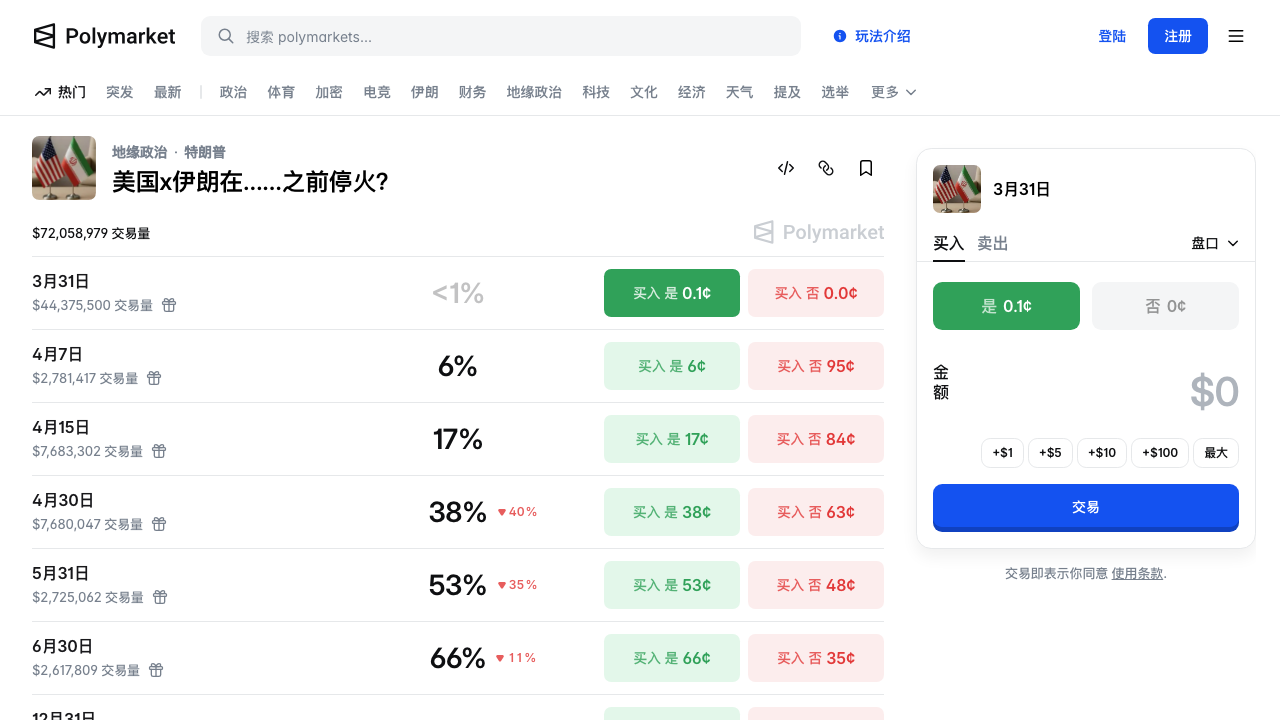
Image 2: Polymarket's pricing of ceasefire timings
This type of correction usually does not cause prices to drop immediately. The market does not wipe away all risks due to one statement. Its more common manifestation is to first compress extreme tail risks slightly. As a result, crude oil moves from a one-sided upward surge to gradual high-level fluctuations.
2. On the Federal Reserve’s side, there is also little room for a long bull market
If this round of oil prices is truly to evolve from geopolitical shocks into a long-term bull market, news about Middle Eastern shipping blockages alone is insufficient; there must also be accompanying loose financial conditions. At least for now, this aspect does not favor crude oil.
Polymarket's pricing for interest rate cuts in 2026 is as follows: 0 cuts 32%, 1 cut 28%, 2 cuts 19%, 3 cuts 10%, 4 cuts 6%. This means that the market's pricing for "at most only one cut" is already 60%; if you include 2 cuts as well, the total for 0 to 2 cuts is close to 80%. This is not a market indicating "the Fed will quickly pivot." It suggests that energy shocks will bring pressure, but inflation constraints remain, and policies will not easily revert to aggressive easing.
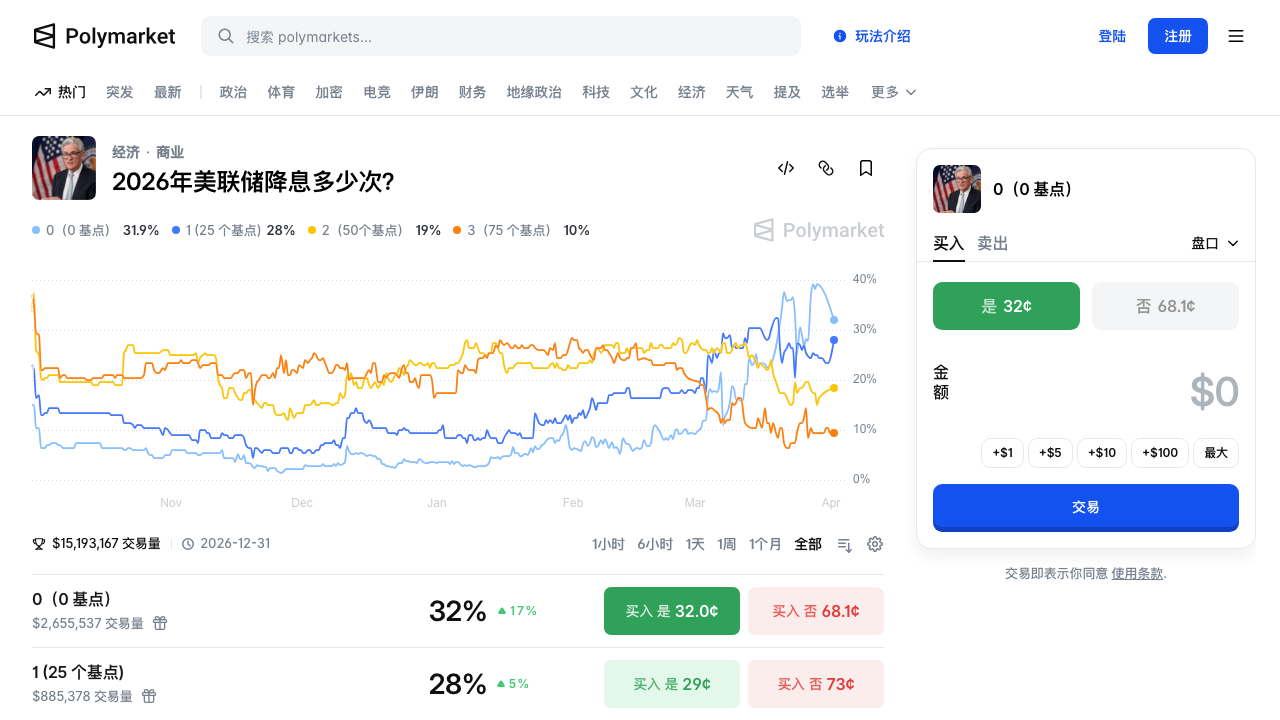
Image 3: Polymarket's pricing of interest rate cuts in 2026
The Federal Reserve meeting on March 18 also supports this interpretation. The target range for the federal funds rate remains unchanged at 3.50%-3.75%. In the economic forecast for the same period, the median federal funds rate at the end of 2026 is 3.4%, corresponding to just one 25 basis point rate cut. Inflation forecasts haven’t returned to a completely reassuring position, and policy rhetoric cannot be described as loose. If oil prices continue to climb, the Federal Reserve may not immediately step in to catch it.
In the context of heightened market fluctuations, data analysis is important, and efficient trading tools are equally crucial.
Register on OKX now, use the exclusive invitation channel, and you can permanently enjoy a 20% commission rebate (applicable to both spot and contracts, automatically settled).
Long-term trading saves costs, helping you better seize opportunities in BTC ETFs and commodity trading.
Click to register and enjoy the benefits:
https://jump.do/zh-Hans/xlink?checkProxy=true&proxyId=2
3. Historically, pulses are not uncommon, but true long bulls are rare
Crude oil can easily create an illusion: it surges sharply, as if it will rise for a long time. But a short-term sharp surge and a long-term bull market are not the same thing. The period that can truly be classified as a long bull market was from 2010 to 2015. During those years, global liquidity was loose, demand from emerging markets was strong, and geopolitical risks repeatedly disturbed supply, keeping oil prices elevated for a long time. That was a case of a central tendency rising, not a surge in emotions due to a sudden event.
More often, what the market actually sees is another trend: first pricing in the worst-case scenario, then slowly correcting it back. The invasion of Kuwait by Iraq in 1990 is an example. Oil prices surged quickly but then fell back just as fast because the market quickly confirmed that the worst-case scenario would not last indefinitely. The Russia-Ukraine conflict in 2022 also had similar characteristics. When Brent crude climbed back above $100, many were talking about a long-term energy crisis, but later the risk premium was significantly reduced. In 2008, it was even more extreme, as WTI surged from $122 to $145 but retracted about 25% two months later from the peak.
When these historical examples are gathered together, the patterns are not complex. What truly constitutes a long bull market is typically not a single conflict but rather a combination of persistently tight supply, long-term strong demand, and continuously loose financial conditions. If any of these conditions is lacking, crude oil is more likely to follow a different path: first up, then down.
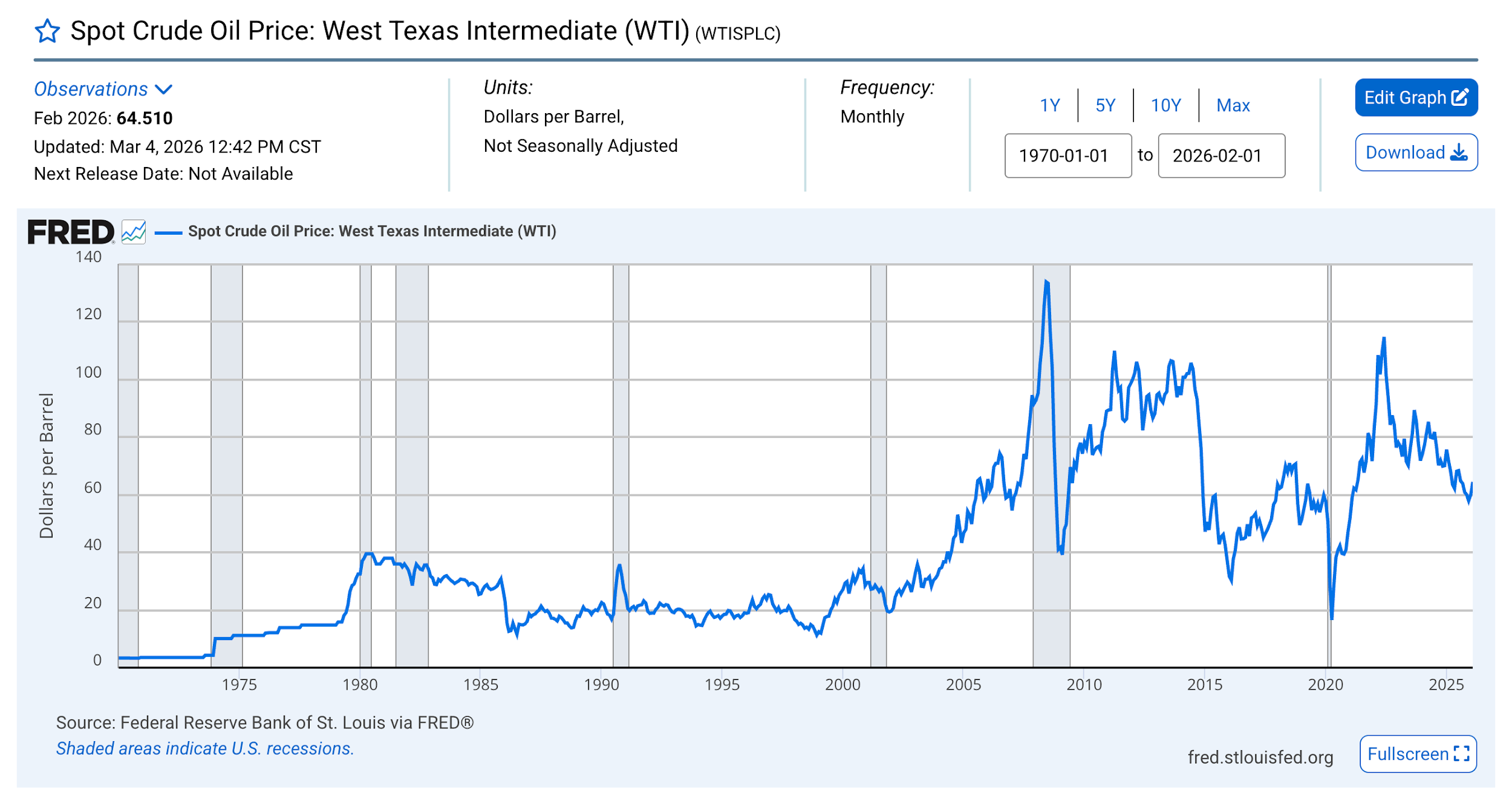
Image 4: Oil price trends since 1970
4. Why this time resembles a pulse rather than a long bull
Returning to this instance. The situation is certainly severe enough. The flow of crude oil and refined products related to the Strait of Hormuz was once significantly disrupted, and the supply losses of Gulf nations pushed near-term prices very high. However, high near-term prices do not necessarily mean that long-term central levels will also rise. The issue is not how much supply has been lost, but how long this loss can last and how much buffer remains in the system.
This time looks more like a pulse for four main reasons. First, the market has started to incorporate easing pricing, no longer only trading the tail risk of a long-term blockade. Second, the Fed has not provided expectations for significant easing, leaving oil without favorable financial conditions. Third, there is still a buffer in the system. Global crude oil and refined product inventories are approximately 8.21 billion barrels, with member countries agreeing to release 400 million barrels of emergency reserves, and OPEC+ still has about 3.8 million barrels per day of effective idle capacity, including approximately 1.71 million barrels per day from Saudi Arabia and about 640,000 barrels per day from the UAE. Fourth, high oil prices themselves can damage demand. The growth rate of global oil demand for 2026 has already been revised down to 640,000 barrels per day, with expectations for demand in March and April being over 1 million barrels per day lower than before.
In short, this round of oil price movements can surge rapidly, but it does not automatically equate to a long bull market. As long as ceasefire expectations continue to rise, the Fed remains cautious, and inventories and substitute supplies can keep up, the greater probability is that high oil prices will experience a surge followed by a correction of some risk premium.
5. What to watch for next
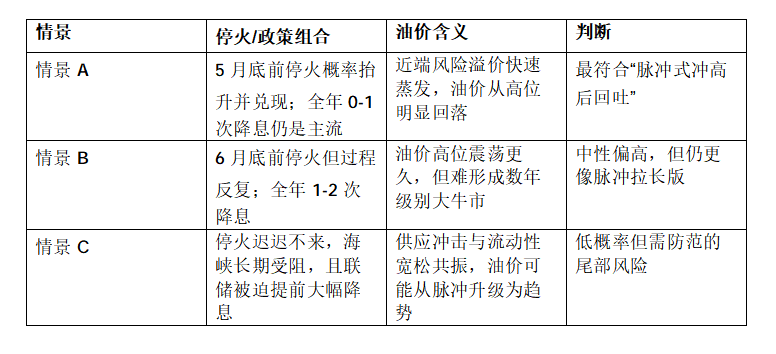
What truly deserves attention is not whether Brent crude will surge another $5 on a certain day, but three more structural matters. First, will ceasefire expectations continue to concentrate towards May and June; second, will the Fed's balance on inflation and growth clearly turn dovish; third, will transportation disruptions transition from trading-related risk premiums to physical shortages lasting for several months? If the first two hold and the third does not, then this round of oil prices is more likely to remain a pulse. Only if the third becomes long-term while the first two evolve towards looser, more uncontrolled conditions, can it potentially escalate into a true trend market. Looking at these signals collectively, we can outline three scenarios.
6. Conclusion
By examining historical samples, ceasefire odds, and interest rate cut odds together, the market now seems to be trading a sharp but potentially not lasting oil price shock. The ceasefire chart indicates that there are limits to the risks; the interest rate cut chart suggests that policies will not easily accommodate a new supercycle for commodities; and the Federal Reserve's March 18 meeting provides the final piece of the puzzle: inflation persists, and rates will not change easily. For crude oil, this represents a very typical pulse environment. It can rise quickly and also drop quickly. What truly determines whether it drops back or continues to elevate its central tendency is not the emotions themselves, but which of the three elements—ceasefire, policy, and supply loss—changes first.
7. If you want to keep tracking market predictions
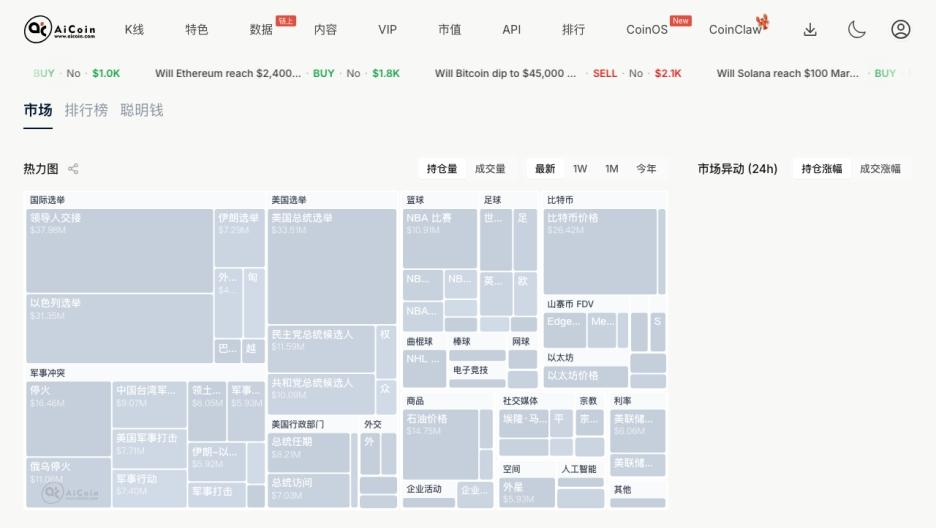
If you want to continue observing how these events are priced by the market, you can directly visit AiCoin's official prediction market page. Compared to monitoring a single piece of news, it is more suitable for observing hot events, sentiments in the crypto space, and funding heat among different themes. For topics influenced both by geopolitical situations and macro expectations, prediction markets often provide a very intuitive supplementary perspective.
AiCoin prediction market page:
https://www.aicoin.com/zh-Hans/polymarket?lang=cn
免责声明:本文章仅代表作者个人观点,不代表本平台的立场和观点。本文章仅供信息分享,不构成对任何人的任何投资建议。用户与作者之间的任何争议,与本平台无关。如网页中刊载的文章或图片涉及侵权,请提供相关的权利证明和身份证明发送邮件到support@aicoin.com,本平台相关工作人员将会进行核查。