Written by: Leo
Imagine this scenario: you are the CFO of a well-known consumer brand, and your company's products are sold at major retailers like Target, Walmart, and Amazon. Everything appears normal on the surface. However, when settling accounts each month, you notice a strange phenomenon: the amounts paid by these retailers are always about 20% less than the invoice. This is not a one-time occurrence; it happens every month. You want to prove they underpaid, but to do this, your team would need to sift through hundreds of pages of shipping records, log into dozens of different retailer portals, and cross-check thousands of detailed invoices. How massive is this workload? Your finance team can hardly keep up, and eventually, they have to choose to abandon the pursuit of those smaller deductions, watching millions of dollars slip through their fingers.
This is not a fictional plot; it is a real story happening every day in the consumer goods industry. I recently delved into a company called Glimpse, which has just raised $35 million in Series A funding led by Andreessen Horowitz. This Y Combinator-incubated company is using AI to tackle a multi-billion-dollar industry pain point: retail deduction disputes. When I saw their data, I was shocked: for a consumer goods company worth $1 billion, Glimpse's AI agent reviewed 17,000 deduction records in less than 24 hours, uncovering millions of dollars in recoverable revenue. If done manually, this workload would take nearly two years.
The Most Expensive Hidden Costs in Retail
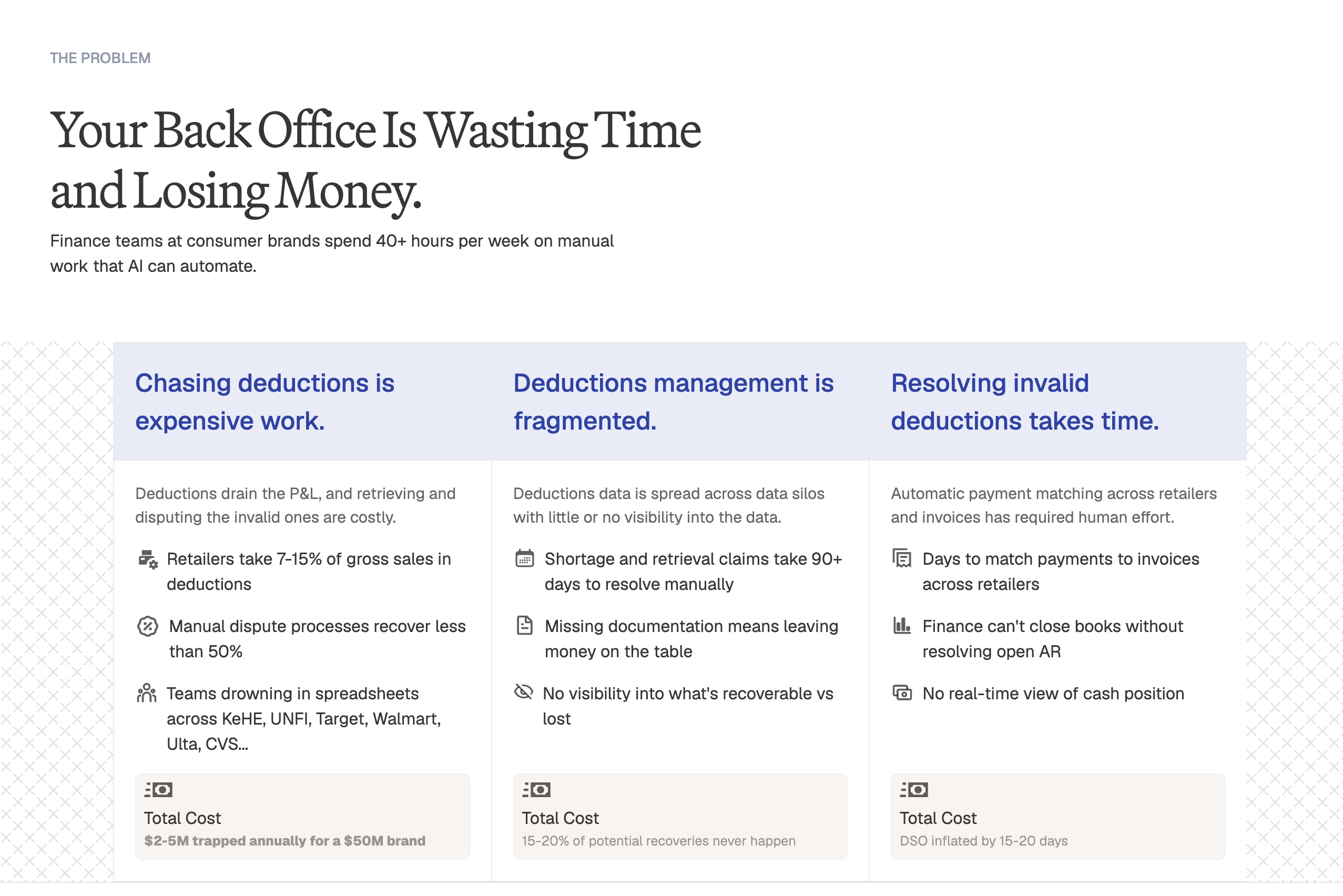
Before delving deeper into Glimpse's solution, I want to explain how serious the issue of retail deductions really is. Many people may not know that transactions between consumer brands and retailers are not as straightforward as most assume. Brands invoice retailers, who then make payments, which seems straightforward, but in reality, retailers almost always deduct a portion of the amount when making payments, providing a reason—such as damaged goods, shipping shortages, non-compliant packaging, and so on.
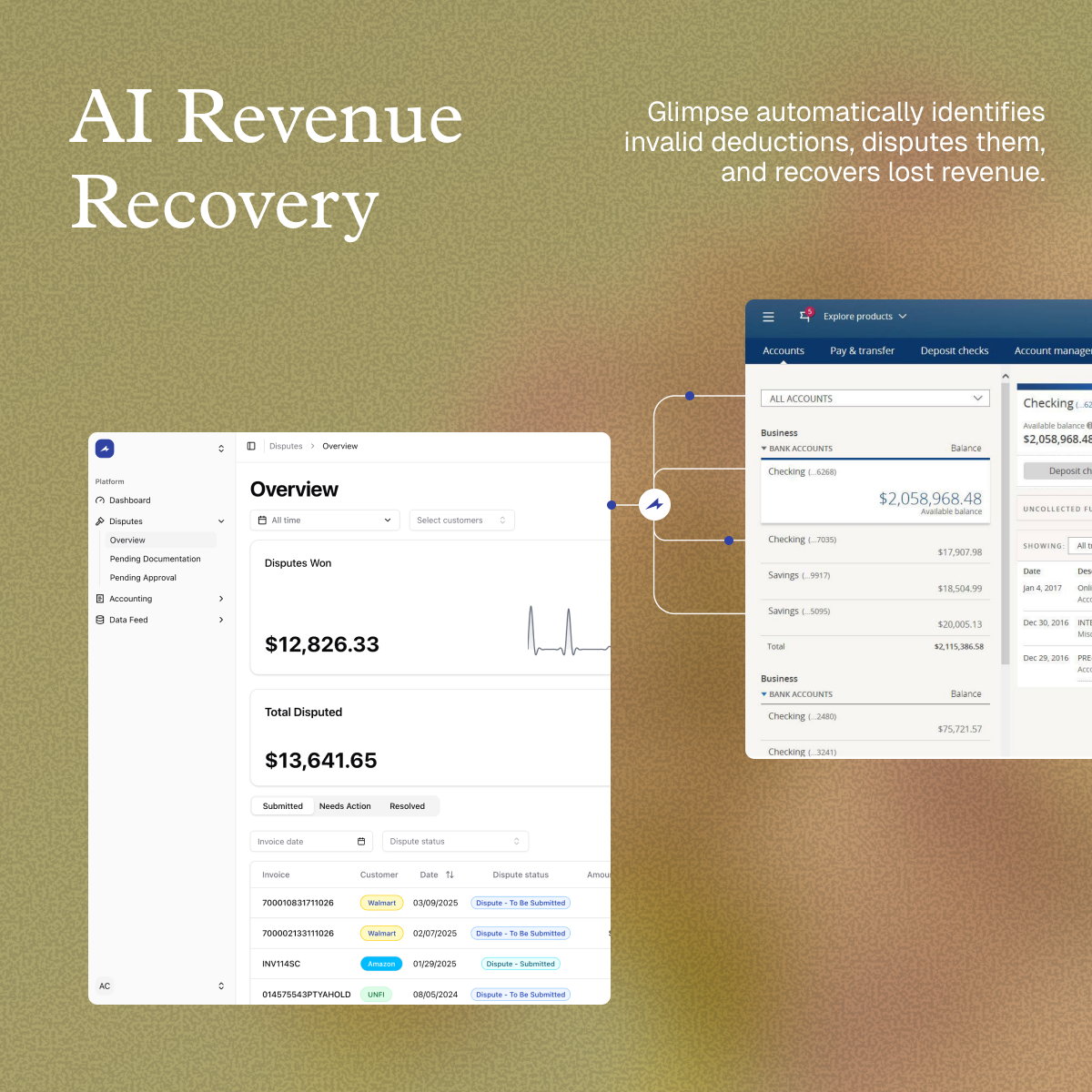
Some of these deductions are legitimate and indeed the brand's fault. However, a significant portion consists of invalid deductions, meaning that the brand actually did nothing wrong, yet the retailer still withheld money. The problem is that proving these deductions are invalid requires an extremely tedious process. The finance team must log into multiple retailer systems, extract scattered documents, review details line by line, verify against internal records, and then manage the entire dispute process. This process is so complex and time-consuming that most brands can only selectively handle the larger deductions, accepting the rest as cost losses.
I saw a stat that impressed me: industry analysts estimate that consumer goods companies miss out on a total of $8 billion in valid disputes each year due to inadequate operational capabilities. That’s no small amount. For a mid-sized consumer goods company, invalid deductions could account for 5% or more of retail revenue. Imagine that if your annual retail revenue is $100 million, $5 million evaporates in this process, and you can’t recover it due to insufficient manpower and systems to handle it.
Worse still, the complexity of this problem continues to increase. Take Amazon's Vendor Central as an example; it has over 30 different deduction categories, from shipping delays to packaging violations, each with different rules and dispute processes. The finance teams in mid-sized consumer goods companies usually consist of only a few people, who simply do not have enough manpower to deal with even half of the deduction disputes. This is why this issue has persisted for so long, until the maturity of AI technology made it possible to address it.
How Powerful Glimpse’s AI Solution Is
When I learned how Glimpse works, I realized they found a very clever entry point. They did not try to build a general financial software but focused on solving a specific yet impactful problem: automating the review and dispute process of retail deductions. Their platform uses AI agents to execute the entire process from data collection to dispute resolution, fully automated.
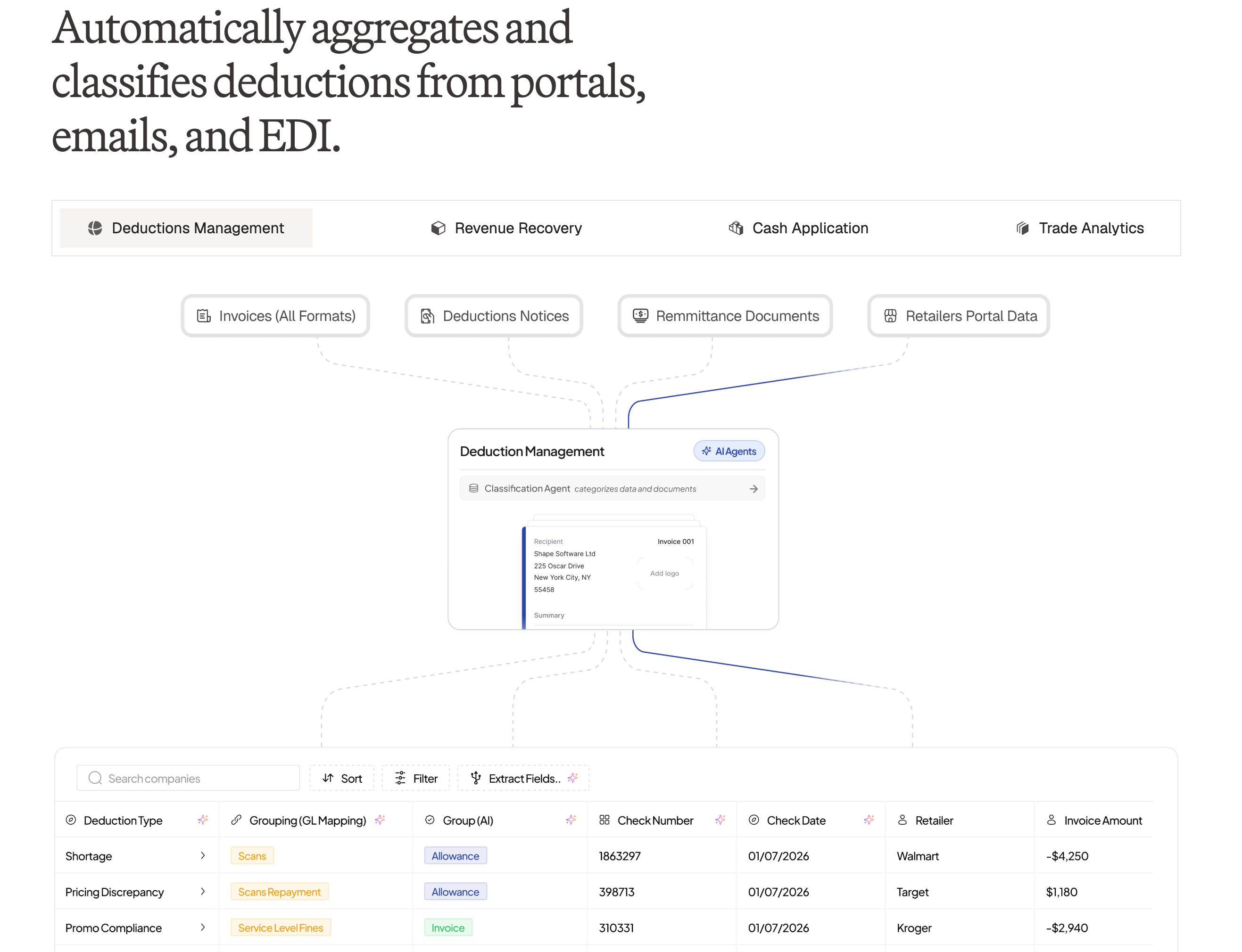
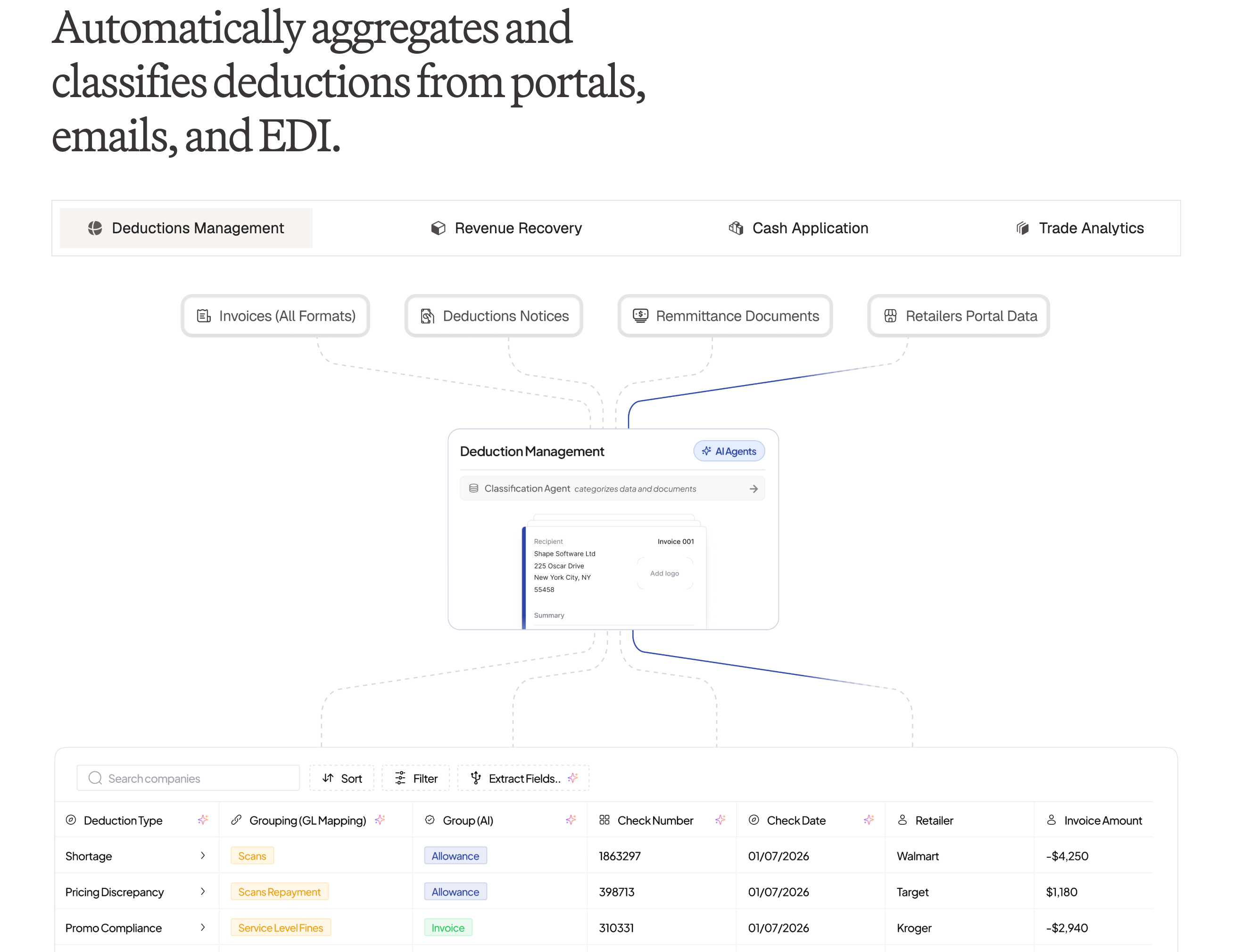
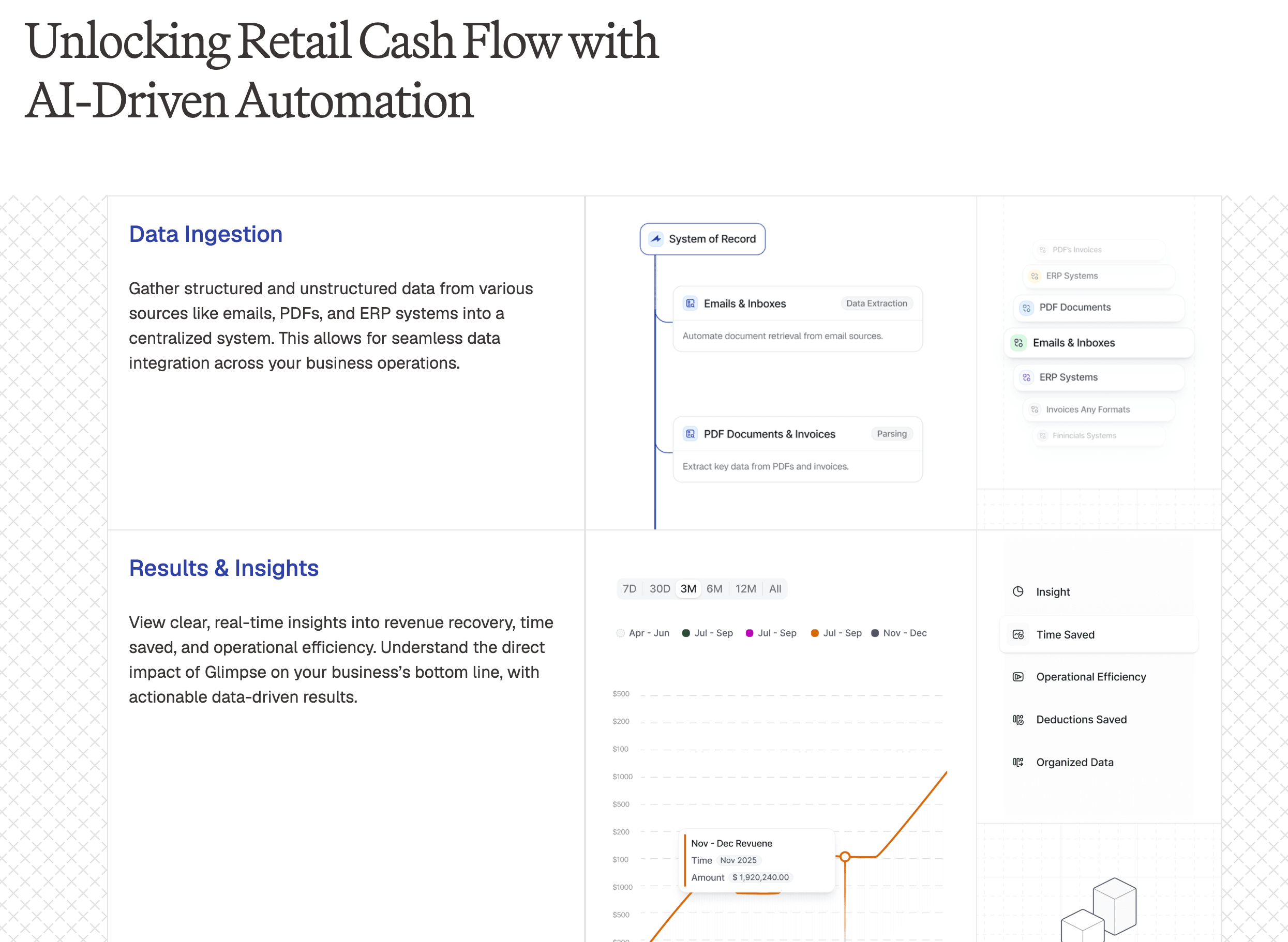
Specifically, Glimpse's system first automates login to various retailer portals, finds all relevant documents, and consolidates them. This sounds simple but is actually very complex, as each retailer's system is different, and data formats vary widely. Some are EDI (Electronic Data Interchange), some are PDF documents, some are emails, and some are buried deep within web pages. Glimpse's AI has to understand all these different data sources and integrate them into a unified view.
Next, the system categorizes each deduction. This step seems simple but actually requires a deep understanding of business logic. The AI needs to know what type of deduction it is, which products are involved, when it occurred, and which order it corresponds to. Then, it will validate these deductions against the brand's internal data—such as supply chain records, promotional calendars, shipping manifests, and more. Through this cross-validation, the AI can determine which deductions are valid and which are invalid.
The critical part is that when the system identifies an invalid deduction, it does not stop there; instead, it automatically submits a dispute application, follows up with the entire process, tracks the progress of cash recovery, and syncs all information back to the brand's ERP system. The entire process is automated from start to finish, requiring no human intervention. Of course, Glimpse also retains human involvement primarily to ensure the quality of the results, such as following up on disputes to push for resolution and cash recovery, as well as quality assurance during key steps like categorization and data extraction.
I think the most impressive aspect is that this system becomes smarter the more it is used. Each time it processes a deduction, it learns and improves, continuously optimizing its categorization, validation, and resolution capabilities. Over time, this will create a composite data advantage: every new integration, every new customer makes the entire network smarter and more efficient. This is why Glimpse has achieved a 91% dispute win rate while reducing manual labor time by up to 80%.
I saw one client case that particularly emphasized the point. Evermark, the parent company of the Suave brand and Chapstick, sees their FP&A Senior Director Sean Quinn saying, "Like most major consumer brands, Evermark used to have to set a minimum amount threshold for deductible disputes that could be reviewed because there simply wasn't enough time or manpower to review every single deduction. By using Glimpse's AI to automate the review and reconciliation processes, we not only eliminated this threshold but unlocked a new source of cash flow that will bring millions of dollars in revenue that had previously been considered 'write-offs' or costs of doing business." The key phrase here is "eliminating the threshold"—previously they could only handle deductions exceeding a certain amount, but now every deduction is reviewed, meaning a significant number of previously ignored small deductions can now be recovered.
From Failure to Success: The Transformation Story of Three Purdue Friends
The founding story of Glimpse itself is interesting, embodying the most important point in entrepreneurship: the ability to quickly iterate and decisively pivot. Founders Akash Raju, Anuj Mehta, and Kushal Negi are classmates from Purdue University, and the initial project they worked on was completely different from what they do now: a product placement company for Airbnb. The project launched in 2020, but by 2024, the founders realized that there was insufficient product-market fit and decided to transform completely.

In Akash Raju's own words, "We ultimately felt a lack of product-market fit and decided to do a hard pivot. In the process, we encountered the back office of brands and the chaotic situation in retail sales, which ultimately prompted us to create Glimpse as it exists today." This pivot required immense courage as it meant abandoning all previous work to start from scratch. But it was this decisiveness that led them to find a truly valuable problem.
What impressed me even more was that during the pivot, the founding team sometimes didn't even pay themselves, completely relying on their passion and belief in the product to sustain them. This "never give up until the goal is achieved" spirit infused everything they did. This spirit was also recognized by their investors. They met investors from Andreessen Horowitz through a mutual founder friend, building strong relationships as their business expanded, ultimately leading to this $35 million funding round.
Interestingly, this funding round also has a story behind its naming. Glimpse secured $10 million in funding led by 8VC after its business transformation last year, at that time referred to as Series A. Now this $35 million funding is also called Series A, while the earlier $10 million is redefined as the seed round. Adding up the funding before the pivot, the company has raised a total of $52 million. This flexible naming of funding rounds is not uncommon in the startup world, especially for companies that have undergone significant transformations.
The team's execution capability is evidenced by their performance in 2025. They set a clear strategy as they entered 2025: hiring great talent to work together, deeply embedding within customer workflows, and adopting face-to-face market strategies. Their internal motto is "Everywhere"—establishing trust by continuously showing up and providing help. This strategy worked. In 2025, they achieved 10x revenue growth, increased recovered revenue for clients 10-fold, processed invoice volumes grew 5-fold to reach $1 billion, and team size expanded 5 times to over 25 people, with the number of customers tripling to over 150 consumer brands.
The Real Value of AI Agents in Financial Automation
The Glimpse case deepened my understanding of the value of AI agents in enterprise applications. Over the past year, people have been discussing AI agents, but often it remains at a conceptual level or in the demo stage. Glimpse, however, demonstrates the actual value AI agents can create in real business scenarios: directly impacting profit margins.
I believe the key to Glimpse's success lies in their selection of a perfect entry point. The problem of deduction disputes has several characteristics that make it particularly suitable for AI solutions. It is a highly repetitive task that occurs thousands of times each month. It involves processing large amounts of unstructured data, from PDF documents to web data to emails. It requires data validation and matching across multiple systems. It has clear success criteria: whether the dispute is successful and whether the money is recovered. All these characteristics combined allow AI agents to maximize their advantages.
More importantly, this problem has immediate investment returns. One of Glimpse's investors previously said they are looking for "software that can recoup costs in the first quarter"—and a deduction recovery tool fits this standard perfectly. When a brand can recover millions of dollars annually through Glimpse, the subscription cost of the software becomes negligible in comparison. This clear value proposition enables Glimpse to acquire customers swiftly and maintain an extremely high retention rate.
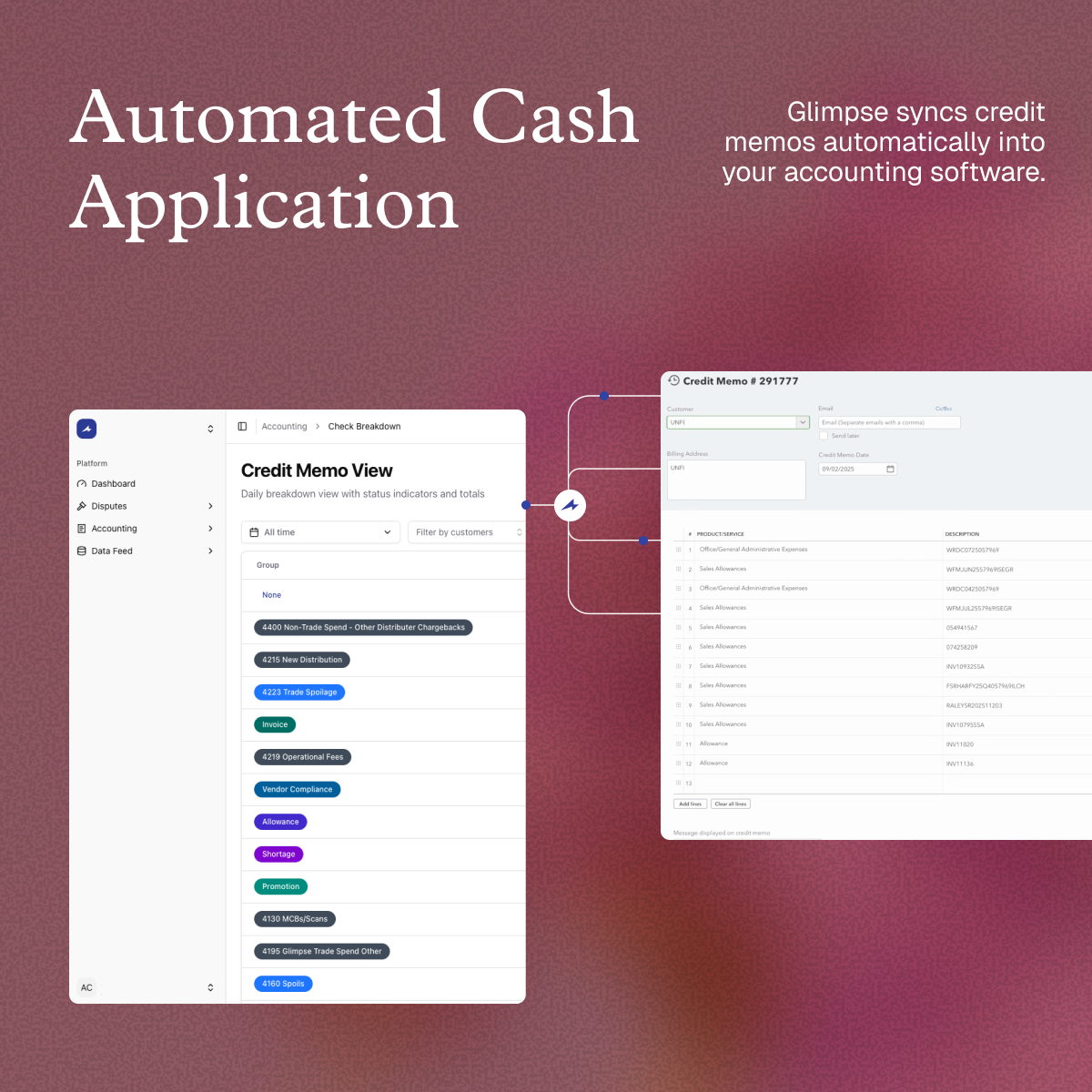
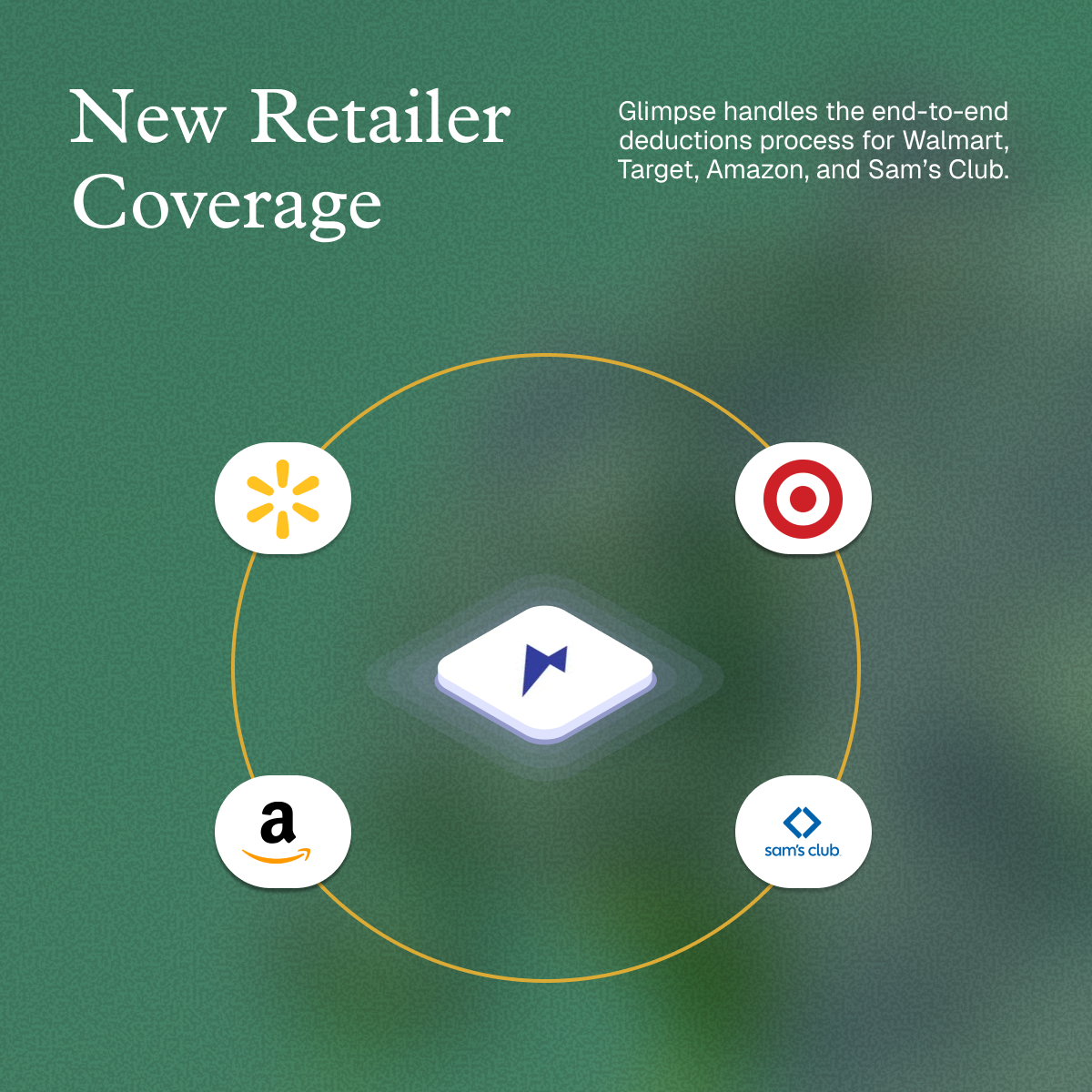
I also noticed that Glimpse is not stopping at deduction disputes. They have launched several significant platform capability expansions in 2025. In addition to the original KeHE and UNFI, they now support multiple retailers including Target, Walmart, Amazon, and Sam's Club. They introduced end-to-end AI revenue recovery agents that can manage the full process of deduction retrieval, coding, validation, and claims submission. They also developed automated cash application features to automate one of the finance team’s most painful workflows at the month-end closing.
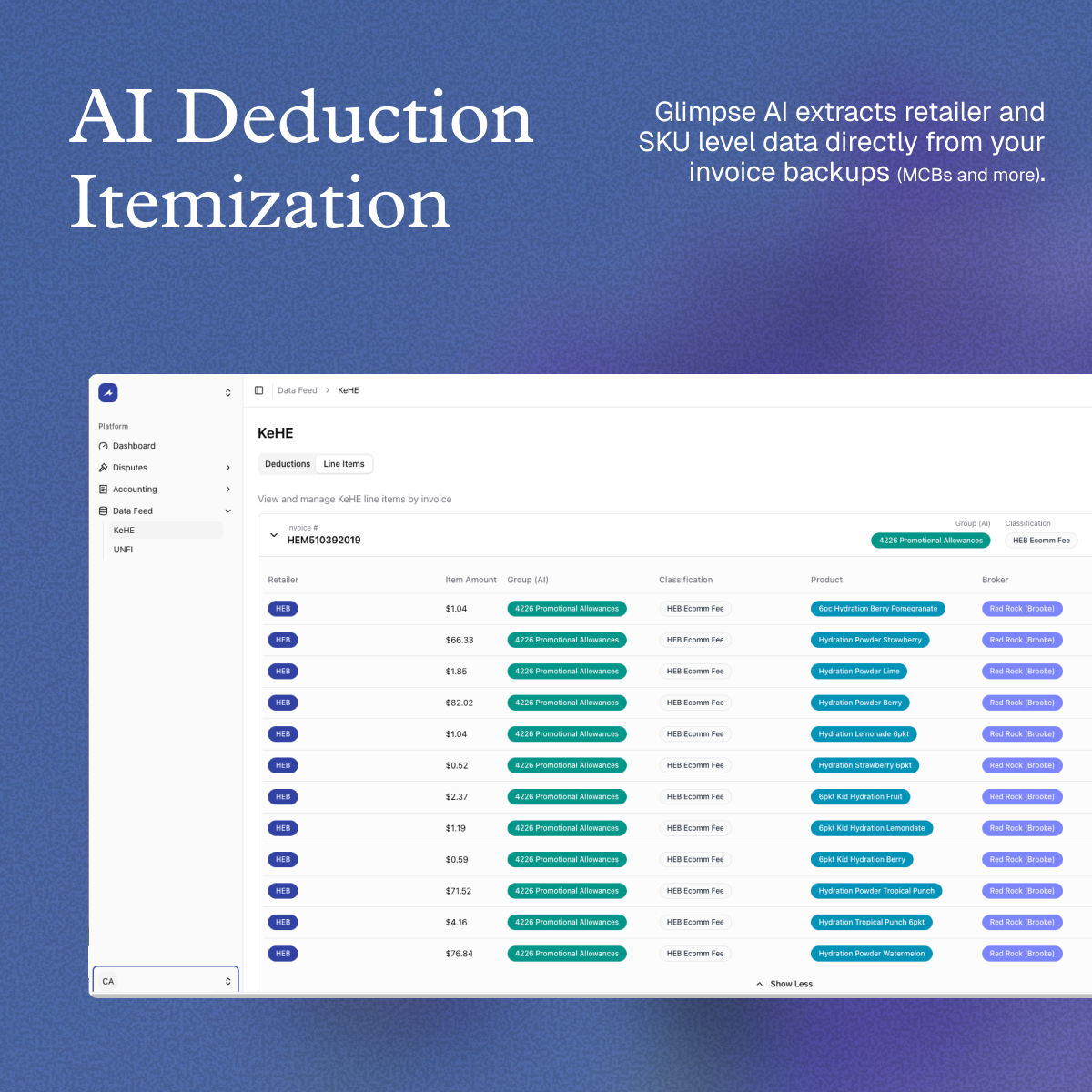
Notably, they launched an AI deduction itemization feature. Each deduction comes with backup documents, which usually exceed 100 pages, filled with mixed retailers, SKUs, agents, and unstructured details. Most brands do not utilize this data, not because it lacks value but because manually processing this data at scale is virtually impossible. Glimpse’s AI can extract every relevant detail into a structured tabular format, unlocking a new level of intelligence: accurate broker commission calculations, profitability analysis by retailer, trade analysis, promotional performance assessments, margin improvement strategies, and more.
This makes me ponder a deeper question: What exactly is Glimpse building? On the surface, they are an automation tool for deduction disputes. But in reality, they are building the AI infrastructure for CPG brands. Their CEO Akash Raju said, "Our vision is to become the AI infrastructure for CPG and retail brands." This positioning is very clever. Deduction disputes are merely an entry point, a wedge that can quickly prove value. But by solving this problem, Glimpse gains deep access to brand retail operations data, allowing them to expand into a broader retail compliance automation field.
Reports suggest their roadmap includes modules for promotional reconciliation, trade spend optimization, and analysis of retailer payment behavior. An investor close to the deal indicated that the company may ultimately build a comprehensive "retail financial operations platform," situated between ERP systems and retailer portals, automating the entire order-to-cash cycle for CPG brands. If this vision is realized, Glimpse will become not just a tool but the core infrastructure for CPG brand operations.
What This Means for the Entire Industry
Glimpse's rapid rise and successful financing signify, in my opinion, a new phase in corporate AI applications. In 2025, consumer AI applications dominated all headlines, but investors are now heavily betting on AI tools that can solve overlooked yet costly business issues. Deduction tracking, invoicing reconciliation, compliance monitoring—none of these will produce flashy demos but they directly impact EBITDA. This is precisely the type of value proposition needed to survive during economic downturns and the reason Andreessen Horowitz is willing to pay top enterprise SaaS multiples.
I have observed an interesting trend: the competitive landscape is heating up quickly. Claimify raised $12 million in Series A funding last year for similar retail dispute automation, while traditional players like HighRadius and Billtrust are adding AI modules to their accounts receivable platforms. However, Glimpse's Y Combinator background and early traction in the mid-market CPG segment has given it an edge during the funding process. Reports indicate the company's revenue has grown 14 times year-over-year, although specific ARR figures have not been disclosed.
The continued involvement of 8VC also speaks volumes. This company led Glimpse's seed round in 2024 and continued to invest in this A round. 8VC has a track record of investing in vertical SaaS that automates manual finance processes. Partner Alex Kolicich previously told Forbes that 8VC looks for "software that recoups costs in the first quarter"—when brands can recover six or seven figures each year, deduction recovery tools perfectly fit this ROI model.
From a broader perspective, Glimpse's success validates a simple argument: there is big business in automating those overlooked middle-office tasks that cost CPG brands millions of dollars every year. With the backing of Andreessen Horowitz and a product that can measure ROI from day one, the company is well-positioned to dominate the retail dispute resolution category.

The real test will come over the next 12 months, seeing if Glimpse can scale beyond its initial customer base and prove that the platform can handle the operational complexities of enterprise-level CPG brand management of thousands of SKUs across dozens of retail partners. If the product delivers on its margin recovery promise, this A round funding could look like a bargain in the company’s next fundraising round.
I particularly agree with the viewpoint of Andreessen Horowitz partner Joe Schmidt: "For decades, retail back-office operations have relied on spreadsheets and fragmented workflows. What impresses us is the customer endorsements—Glimpse is delivering clear, measurable returns on investment. By embedding AI directly into core finance and operational workflows, they are transforming this market from incremental tools into infrastructure for modern brands." This statement accurately summarizes why Glimpse is important: it is not just improving existing processes at the margins but is redefining how these processes should operate using AI.
My Thoughts on How AI Transforms Traditional Industries
The story of Glimpse has deepened my understanding of how AI can transform traditional industries. The consumer goods industry is one of the largest markets in the world, yet it has remained largely untouched by modern software. When brands sell to major retailers, they often deal with fragmented, unstructured data scattered across dozens of retailer portals and legacy systems. Analysts spend countless hours pulling data from portals, extracting line items from documents, and working in spreadsheets to drive workflows like reconciling deductions, disputing invalid charges, and manually applying cash—tasks that directly affect profit margins but offer almost no strategic leverage.
The entire industry spends over $100 billion annually on back-office labor, yet the productivity gains from previous waves of enterprise software have been limited. AI is making end-to-end automation of this complexity possible for the first time. I believe this is the key insight: not all problems can be solved with traditional software; some problems need to wait until technology advances to a critical point to be effectively addressed.
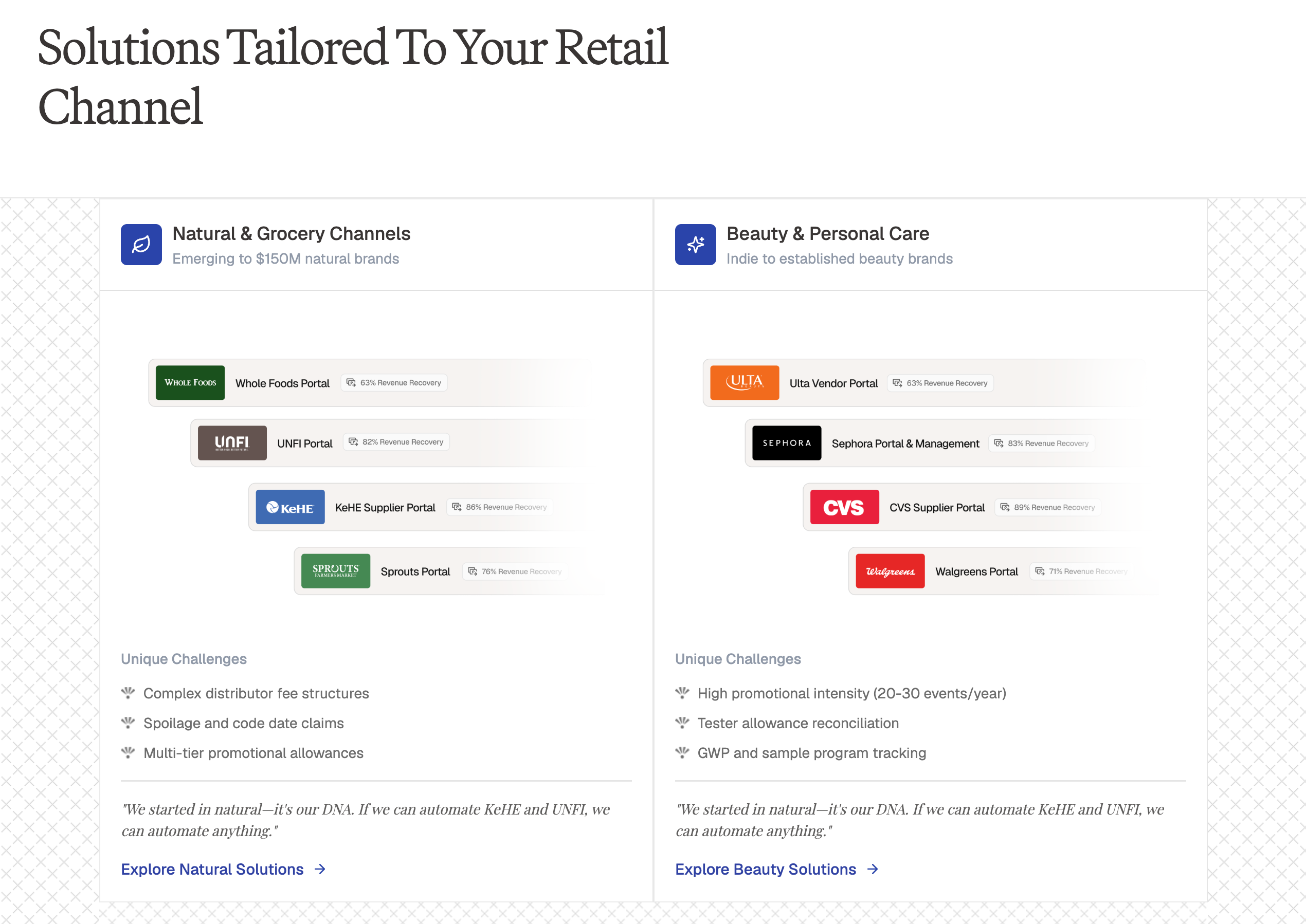
I am also reflecting on why now is the best time for AI to transform these traditional industries. Technologically, large language models are now powerful enough to understand and process unstructured data. Commercially, companies are facing profit pressures and need to protect margins, especially in light of the heightened compliance demands from consolidating retailers. Just within Amazon Vendor Central, there are over 30 different deduction categories, from shipping delays to packaging violations. Finance teams in mid-sized CPG companies often lack the manpower to dispute even half of them. This is why AI-powered platforms like Glimpse are becoming essential infrastructure rather than optional tools.
I believe we will see more companies like Glimpse emerge, focusing on using AI to solve specific pain points in specific industries. These companies will not attempt to build general AI; rather, they will delve deeply into vertical sectors, truly understanding business processes, then redesigning these processes using AI. This approach is harder than building general tools since it requires deep industry knowledge, but once successful, the barriers become higher, and the value becomes greater.
The $35 million Series A funding for Glimpse is just the beginning. I anticipate a significant inflow of capital in the coming years to drive the application of AI in traditional back-office operations. Companies that can find high-value entry points like Glimpse, quickly prove ROI, and then expand platform capabilities will have the opportunity to become infrastructure-level players in their respective fields. For CPG brands, embracing these AI tools is no longer an option; it is a necessity for survival. Brands that can adopt and effectively leverage AI to optimize operations early on will gain a significant advantage in competition.
免责声明:本文章仅代表作者个人观点,不代表本平台的立场和观点。本文章仅供信息分享,不构成对任何人的任何投资建议。用户与作者之间的任何争议,与本平台无关。如网页中刊载的文章或图片涉及侵权,请提供相关的权利证明和身份证明发送邮件到support@aicoin.com,本平台相关工作人员将会进行核查。


