Written by: Xiao Za Legal Team
Partners in the cryptocurrency circle generally believe that perpetual contracts are a type of virtual currency derivative, a financial product in the cryptocurrency area, which uses blockchain technology and is very similar in trading rules to traditional futures contracts.
The Xiao Jie team has noticed that with the price fluctuations of precious metals in 2026, and the ongoing energy crisis caused by geopolitical conflicts driving up oil prices, various exchanges are actively creating innovative products for cryptocurrency perpetual contracts that benchmark the prices of gold, silver, crude oil, etc., attracting a significant amount of capital for trading.
So, compared to traditional methods that benchmark BTC and ETH prices, is there a legal distinction for these innovative perpetual contracts? Are they closer to or further from the criminal red line? Today, the Xiao Jie team will discuss this issue in detail with everyone.
1. Legal Qualification of Cryptocurrency Perpetual Contracts in China
From the perspective of trading rules and methods, cryptocurrency perpetual contracts are similar to traditional futures contracts, as shown in the specific characteristics comparison below:
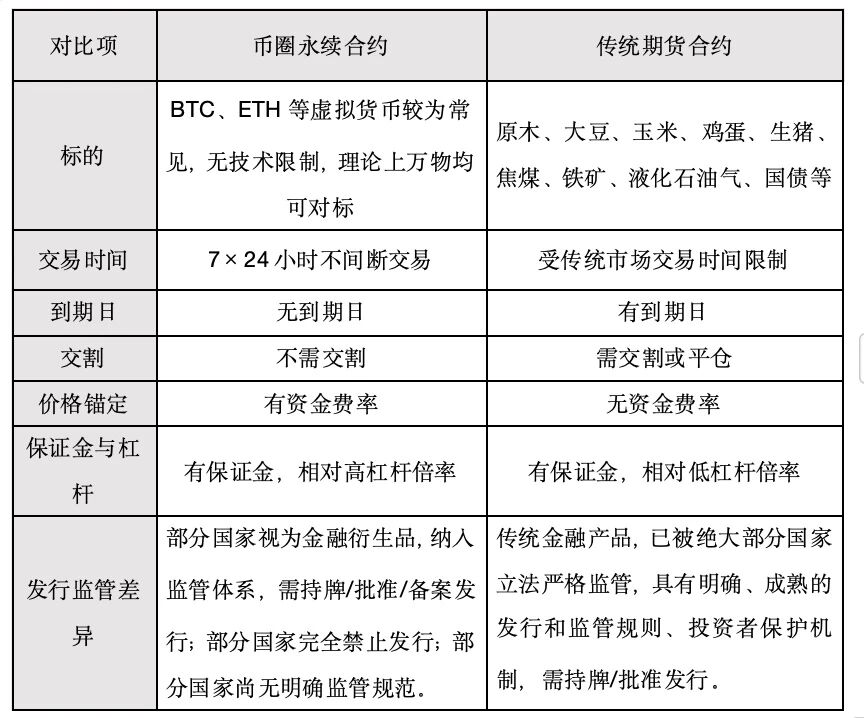
It must be clarified that under Chinese law, traditional cryptocurrency perpetual contracts are not financial futures contracts in the traditional sense, and BTC and ETH are not any legally recognized types of futures or options.
According to Article 17 of the "Futures and Derivatives Law of the People's Republic of China": "The listing of futures contract varieties and standardized options contract varieties must comply with the regulations of the State Council's futures supervision and administration authority, and must be registered by the futures trading venues in accordance with the law." According to information released by the China Futures Market Monitoring Center in 2025, as of October 31, 2025, a total of 160 futures options varieties have been legally listed in China's futures market, including 80 commodity futures, 59 commodity options, 8 financial futures (4 stock index futures + 4 government bond futures), 3 stock index options, 9 ETF options, and 1 index futures (European line for consolidated shipping). BTC, ETH, and other virtual currencies are not included in any allowed futures or options varieties in China.
In 2021, after the ten ministries issued the "Notice on Further Preventing and Dealing with Risks of Virtual Currency Trading and Speculation" (referred to as the "9.24 Notice") 【Note: This normative document has been replaced by the 2026 "Notice on Further Preventing and Dealing with Risks Related to Virtual Currencies" (referred to as the "2.6 Notice")】, judicial authorities have clearly categorized cryptocurrency futures contracts as part of the category of "trading in financial products related to virtual currencies" and defined them as illegal financial activities.
2. Criminal Red Line Risk of Cryptocurrency Perpetual Contracts
To conclude, current judicial practice in China has clearly categorized the act of offering cryptocurrency perpetual contracts that benchmark BTC and ETH prices as gambling operations.
(1) Typical Case
The most well-known and influential case is the series of cases of B.X gambling operation opened by a company in Chengdu, Sichuan, judged in the second instance in 2025.
Initially, B.X was just an ordinary cryptocurrency exchange, only providing cryptocurrency exchanges, spot trading, and other services. In the first half of 2021, individuals including Ji, launched the perpetual contract trading feature on B.X, allowing users to bet using USDT as collateral, amplifying their investment with high leverage based on the trading price fluctuations of cryptocurrencies such as BTC and ETH. In practice, users could choose contracts for different cryptocurrencies like BTC and ETH after topping up with USDT, and they could select "long" or "short." Ordinary perpetual contracts on B.X could add up to 100 times leverage, while aggressive trading options could add 125 to 1000 times leverage, and once the positions were opened, the terms could not be changed; perpetual contracts had no expiration time.
B.X featured market reference data, forced liquidation, matching transactions, platform betting, and commission returns, among other functions. By the time of the case, B.X had more than 270,000 users engaging in contract trading, with over 60,000 active users. The platform gained around 300 million RMB in net profit from collecting fees during the withdrawal and betting process, as well as from forced liquidation and betting profits.
(2) Reasons for the Qualification of Cryptocurrency Perpetual Contracts as Gambling Operations
The reason for categorizing this case as a gambling operation lies in the belief of Chinese judicial authorities that trading in virtual currency perpetual contracts is, in the sense of criminal law, a gambling behavior.
What is gambling in the sense of criminal law? Article 303 of China's Criminal Law【Gambling Crime】 stipulates: "Anyone who organizes gambling for profit or engages in gambling as a business shall be sentenced to imprisonment of not more than three years, criminal detention or surveillance, and shall be fined." The Supreme People's Court, the Supreme People's Procuratorate, and the Ministry of Public Security have jointly or separately issued key judicial interpretations and normative documents, such as the "Interpretation on Several Issues Concerning the Application of Law in Handling Criminal Cases Related to Gambling" and the "Notice on Several Issues Concerning the Application of Law in Handling Illegal Gambling Cases," but they have not defined the concept of gambling itself, as if it were a self-evident concept that requires no explanation.
Only through guiding cases can we find a clearer answer to this question. In the Guiding Case No. 752 from the 84th collection of criminal trial references, the judge referenced the definition of "gambling" from the "Modern Chinese Dictionary," stating that gambling is using methods like card games or dice to place bets with money based on win or loss. The earliest gambling games emerged in China's Xia Dynasty 3,500 years ago—six bo. Since then, with social development, gambling forms have continued to innovate, and the variety has gradually increased, and the harms have also grown. New forms of gambling are no longer limited to using cards or dice as carriers; hence, considering this trend, we believe that any form that uses a certain medium for betting with money on win or loss constitutes gambling. The defendant's activity in this case used "六合彩" information for betting, placing stakes on win or loss, and was defined as gambling, consistent with the long-standing public understanding of the essence of gambling.
As can be seen, gambling behavior in the sense of China's criminal law is quite broad; as long as it can be categorized as substantially "betting big or small, gambling on win or loss," there is no obstacle to defining it as gambling.
Returning to the cryptocurrency perpetual contract context, cryptocurrency perpetual contracts are indeed very similar to the Supreme People's Court case guiding case No. 146 regarding the gambling operation case of Chen Qinghao, Chen Shujuan, and Zhao Yanhai. In this case, the mode of behavior of the suspects was relatively similar. The defendants were engaged in "binary options" trading, soliciting "investors" via the internet outside of legally designated trading places, using currency price movements as the trading object, and determining profits and losses based on "buying up" or "buying down"; investors who bought correctly gained benefits, while those who bought incorrectly lost their funds to the website (the house). The judge in this case believed that because the results of profits and losses for users in this trading model are not tied to the actual price fluctuations, but only whether the reference commodity price goes up or down, its essence still falls within the realm of "betting big or small, gambling on win or loss", and thus is a gambling behavior masquerading as options trading.
(3) Whether Cryptocurrency Perpetual Contracts Constitute Illegal Business Operations
With the increase in cryptocurrency perpetual contract cases, there are some opinions in practice suggesting that cryptocurrency perpetual contracts should not be classified as gambling operations but rather as illegal business operations.
Scholars and legal practitioners holding this opinion mainly argue that the gambling behavior in China's "gambling crime" and "establishing gambling operations" definitions should be a purely "chance-based behavior," and must be similar to randomly rolling dice, completely unpredictable. From this perspective, trading in cryptocurrency futures contracts is certainly not a purely "chance-based behavior": the rise and fall of prices is greatly influenced by traditional financial market conditions, policy directions, and sudden events, meaning there are often patterns to their fluctuations.
However, this opinion faces a significant obstacle in China's judicial practice: cryptocurrency perpetual contracts do not fall within the types of futures contracts stipulated by Chinese law. Article 225 of China's Criminal Law defines illegal business operations as "illegally operating securities, futures, or insurance businesses without approval from the relevant national authority or illegally engaging in payment settlement business."
If cryptocurrency perpetual contracts do not legally qualify as futures contracts, then strictly speaking, they also should not be treated under illegal business operations.
Final Thoughts
In summary, cryptocurrency perpetual contracts that benchmark the prices of gold, silver, crude oil, and other commodities still face severe legal risks under the legal framework in China. Although their underlying asset shifts from virtual currencies to traditional bulk commodities, the core trading mode still embodies the gambling nature of "betting assets against price fluctuations," with no significant legal qualification differences from BTC and ETH perpetual contracts, which have been firmly established as gambling operations in judicial practice.
China takes a "complete ban across the board" approach toward financial activities related to virtual currencies targeting residents in mainland China, and the 2026 "2.6 Notice" further strengthened the regulatory stance. Historical legal cases have clearly indicated that regardless of how the underlying assets change, as long as the trading mechanism fits the characteristics of "betting big or small, gambling on win or loss," platform operators may face criminal liability for establishing gambling operations; parties must take extra caution.
免责声明:本文章仅代表作者个人观点,不代表本平台的立场和观点。本文章仅供信息分享,不构成对任何人的任何投资建议。用户与作者之间的任何争议,与本平台无关。如网页中刊载的文章或图片涉及侵权,请提供相关的权利证明和身份证明发送邮件到support@aicoin.com,本平台相关工作人员将会进行核查。


