Original |Odaily Planet Daily (@OdailyChina)
Author|Golem (@web3_golem)

Hyperliquid is one of the few projects still worthy of attention in the cryptocurrency bear market.
In the first two months of 2026, the cryptocurrency market cooled down, with Bitcoin plummeting from $95,000 to $60,000. Market sentiment was low, and Hyperliquid's activity and liquidity declined accordingly. However, as March arrived, the platform’s daily open interest (OI) began to show signs of recovery. Although the increase was not significant, it released a positive signal that user activity was rising.
From the performance of coin prices, HYPE has significantly outperformed the market. According to OKX data, over the past month, BTC rose only 0.6% and ETH increased by 2.7%, whereas SOL and BNB dropped by 4% and 2.4% respectively; in contrast, HYPE rose 20% against the market fluctuations.
What is the logic behind this round of HYPE increase? Odaily Planet Daily will analyze this in this article for readers' reference.
HIP-3—— Hyperliquid's RWA Trading Market
On October 13, 2025, Hyperliquid launched HIP-3 on its mainnet, which allows anyone to create a new trading market on Hyperliquid after staking 500,000 HYPE. One month later, the open interest of HIP-3 surpassed $100 million; by January 29, 2026, HIP-3's OI reached $1.06 billion, marking the first time HIP-3's daily OI broke $1 billion, but one day later the OI fell back below $1 billion.
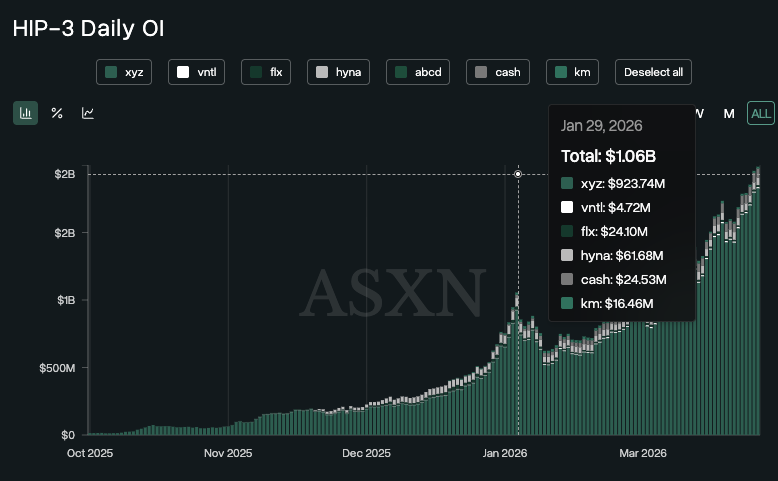
Daily OI of HIP-3
As shown in the above figure, the OI of HIP-3 is mainly contributed by trade.xyz, and whether calculated by OI holdings or market trading volume, the top 10 markets of trade.xyz consist of traditional assets, with the first and second tracking crude oil contracts, while the third tracks the NASDAQ 100. Therefore, we can conclude that HIP-3 has become Hyperliquid's RWA trading market.
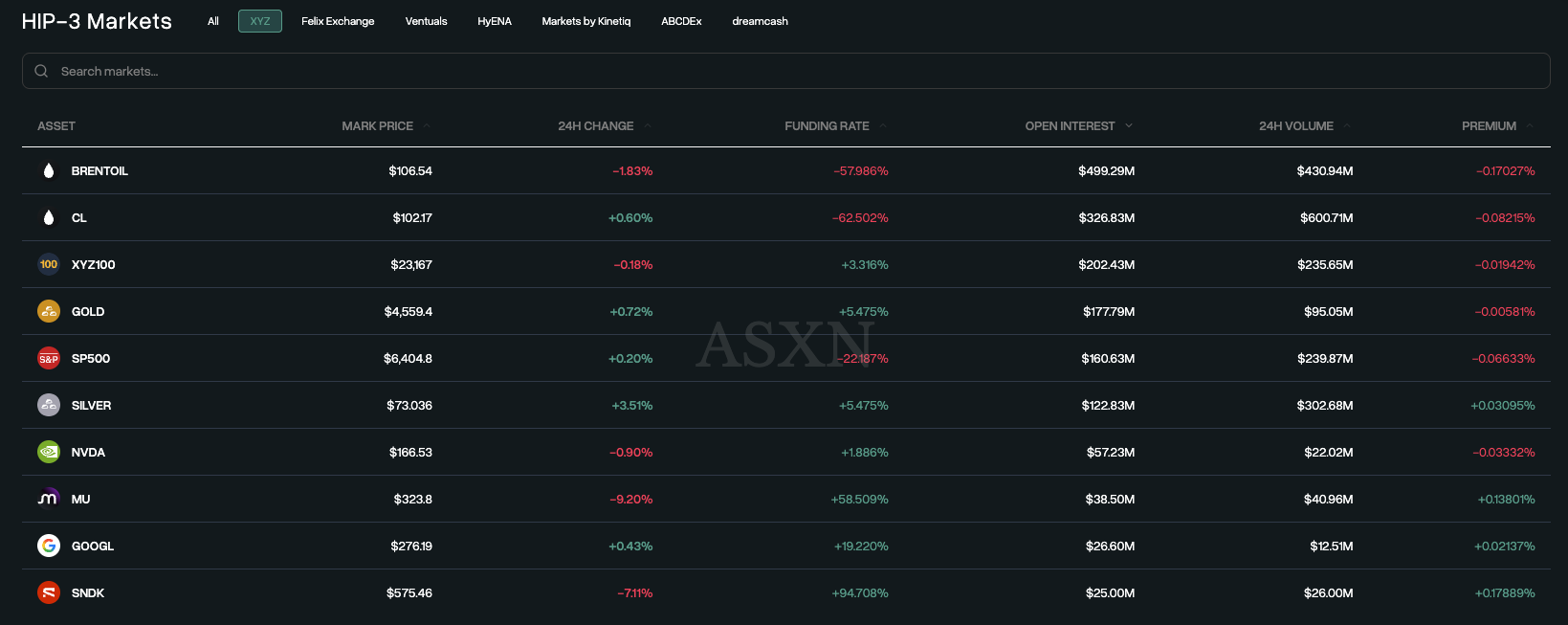
Top 10 markets on trade.xyz
As of January 2026, in just 3 months, HIP-3's daily OI can steadily remain in hundreds of millions, proving that HIP-3 is developing rapidly and attracting the attention of traditional commodity traders. However, for Hyperliquid, it is still not the main source of income and trading segment. On January 29, for example, HIP-3's OI was $1.06 billion, while Hyperliquid's total OI and trading volume that day were $6.05 billion, meaning HIP-3 accounted for only 17%, and even the OI of all markets in HIP-3 that day was less than that of BTC.
HIP-3 is destined not to be a supporting role on Hyperliquid forever; it is ready and just waiting for an opportunity.
The US-Iran Conflict as an Important Catalyst for HIP-3 Development
On February 28, the catalyst emerged. On that day, the US-Iran conflict erupted, causing tremors in the global financial markets, especially with international oil prices continuously rising due to the war. However, the first day of the war coincided with the weekend, and the traditional markets (like CME) were closed, forcing traders who needed to adjust positions and operations to seek new tradable markets, making the HIP-3 market on Hyperliquid the preferred choice.
On January 6, trade.xyz launched contracts tracking WTI crude oil prices on the HIP-3 market, but the trading volume was not large in the first two months, averaging only several million dollars, with a daily peak exceeding $2,000. Following the outbreak of the US-Iran conflict, the trading volume of the crude oil contracts launched by trade.xyz quickly broke $100 million in a single day. On March 5, trade.xyz subsequently launched contracts tracking Brent crude oil prices, and on March 23, the combined daily trading volume of these two crude oil contracts reached $2.38 billion, while the trading volume of ETH on Hyperliquid that day was only $1.51 billion.
Increasing trading volumes of crude oil contracts are only the surface effect of this catalyst. Essentially, the geopolitical tension in the Middle East for over a month has propelled the RWA/commodity contract market led by HIP-3 to become the new core narrative of Hyperliquid.
After the outbreak of the US-Iran conflict, HIP-3's OI continued to rise, surpassing $1 billion again on March 1, and then constantly setting new highs. By March 31, HIP-3's OI had reached $2 billion, a monthly increase of over 100%. The OI of HIP-3 has surpassed that of mainstream coins like BTC, with BTC contract OI on Hyperliquid on March 31 being $1.8 billion and ETH contract OI being $1.19 billion, thus from the perspective of total OI holdings, HIP-3 has captured over 50%, effectively contributing half of the platform's activity.
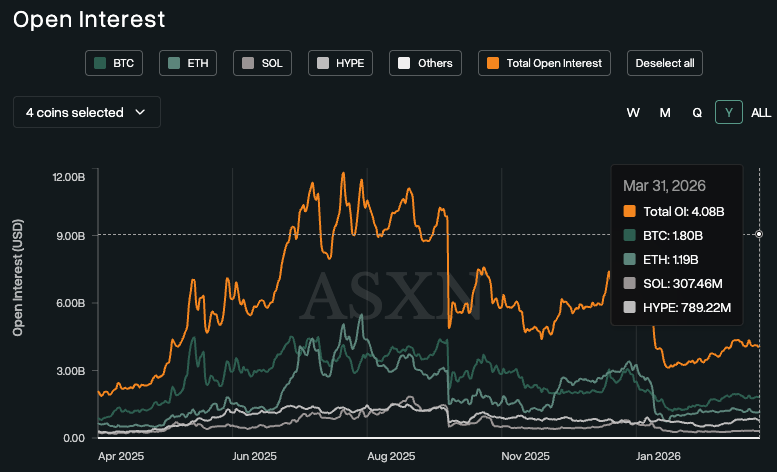
New Value Support for Hyperliquid
In the context of a sluggish cryptocurrency market, HIP-3 has found new value support for Hyperliquid. Hyperliquid has successfully transformed from a single-function DEX that only trades crypto assets to an on-chain exchange that can also trade RWA assets, extending its reach to traditional finance.
Hyperliquid has several evident advantages compared to traditional trading markets, such as 24/7 uninterrupted trading and support for higher leverage. Although these advantages are also present in many exchanges and DEXs regarding market competition, Hyperliquid’s market advantages still lead ahead of them.
Taking silver contracts as an example, as of now, the 24-hour trading volume of the XAG/USDT contract on Binance is $1.864 billion, while the 24-hour trading volume of silver contracts in the HIP-3 market is approximately $300 million, only 16% of Binance’s volume. At face value, the gap between them seems vast, but considering user volume, the conclusion would be different.
Binance is the world’s largest CEX with over 300 million users, while Hyperliquid is the world's most well-known DEX but has only 1.18 million users, making it 0.39% of Binance's user base. Additionally, according to official data, the cumulative number of independent traders on HIP-3 is merely 2.42 million. With such a stark difference in user base, the fact that the silver contracts on Hyperliquid can still achieve over $100 million in trading volume demonstrates that the RWA traders on Hyperliquid are primarily large whales and professional traders/institutions.
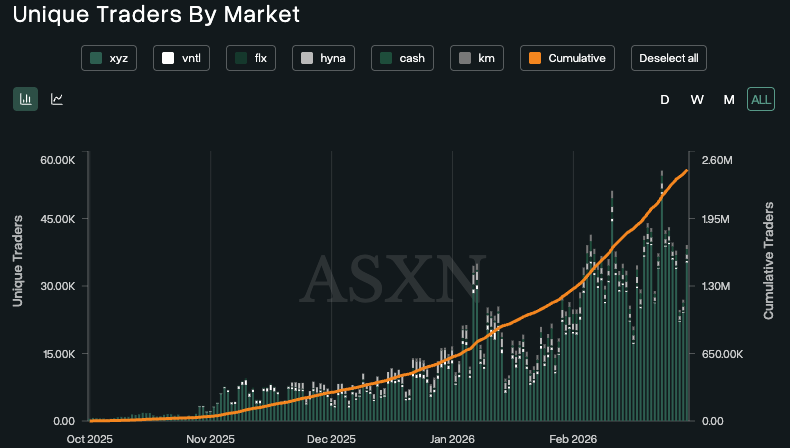
Otherwise, a user base of just one million cannot generate tens of billions of dollars in trading volume (Note: On February 9, the silver contracts on Hyperliquid set a peak with a daily trading volume of $4 billion). These users are among Hyperliquid's most valuable moats; they are not general traffic users, but a group of whales and professional traders with significant capital, high trading frequency, and extreme sensitivity to volatility. The "output efficiency" per unit user is sufficient to compensate for the lack of total user numbers.
Moreover, compared to centralized exchanges, Hyperliquid’s appeal to traditional financial traders is becoming increasingly strong.
The core reason is that Hyperliquid is a DEX with strong privacy and no KYC, providing a quality user experience and liquidity depth, alongside a well-established brand image that enhances traders' trust in Hyperliquid. For traditional financial traders, especially commodity, macro, and event-driven players, the temptation is even more direct.
These traders are not unable to trade on CME, brokerage firms, or CEXs, but are unwilling to expose their position intentions, trading rhythm, and capital paths to platforms, brokers, or regulatory interfaces. CEX’s KYC, risk control stratification, and account review mechanisms fundamentally increase visibility; what Hyperliquid offers is a faster, less scrutinized trading entry, without tedious account openings, without waiting for approvals, and without experiencing the risk of centralized platforms tightening permissions at any time, yet still obtaining sufficient liquidity and a mature trading experience.
On March 18, S&P Dow Jones Indices authorized the S&P 500 Index to trade.xyz, allowing it to issue the S&P500/USDC contract market on Hyperliquid. S&P’s choice of Hyperliquid and trade.xyz undoubtedly reflects their recognition of its vast trading volume and user advantages, but the most important thing it brings to Hyperliquid is compliance recognition.
For those traditional traders who were originally hesitant due to compliance concerns, this is a shot in the arm, dispelling worries such as “can it operate, how big can it get, how long can it last?” If even S&P directly authorized it, then what is there to worry about Hyperliquid or trade.xyz running away?
In summary, the US-Iran conflict has enabled the market to see Hyperliquid's potential in the RWA trading market, and with the growth of trading volume and the building of user trust, Hyperliquid will no longer be a temporary substitute for traditional financial markets during CME closures, but will become an important participant in traditional financial markets, helping traders better discover prices of traditional assets and even seizing the pricing power from traditional financial markets.
This is one of the core reasons why investors have a long-term optimistic view on HYPE over the past month and into the future.
It is also worth mentioning that the latest HIP-4 proposed by Hyperliquid (Note: similar to Polymarket, enabling players to trade event outcomes on Hyperliquid) may also create new growth momentum for Hyperliquid. HIP-3 allows Hyperliquid to trade traditional assets, while HIP-4 may allow Hyperliquid to trade everything.
Related Reading
免责声明:本文章仅代表作者个人观点,不代表本平台的立场和观点。本文章仅供信息分享,不构成对任何人的任何投资建议。用户与作者之间的任何争议,与本平台无关。如网页中刊载的文章或图片涉及侵权,请提供相关的权利证明和身份证明发送邮件到support@aicoin.com,本平台相关工作人员将会进行核查。


