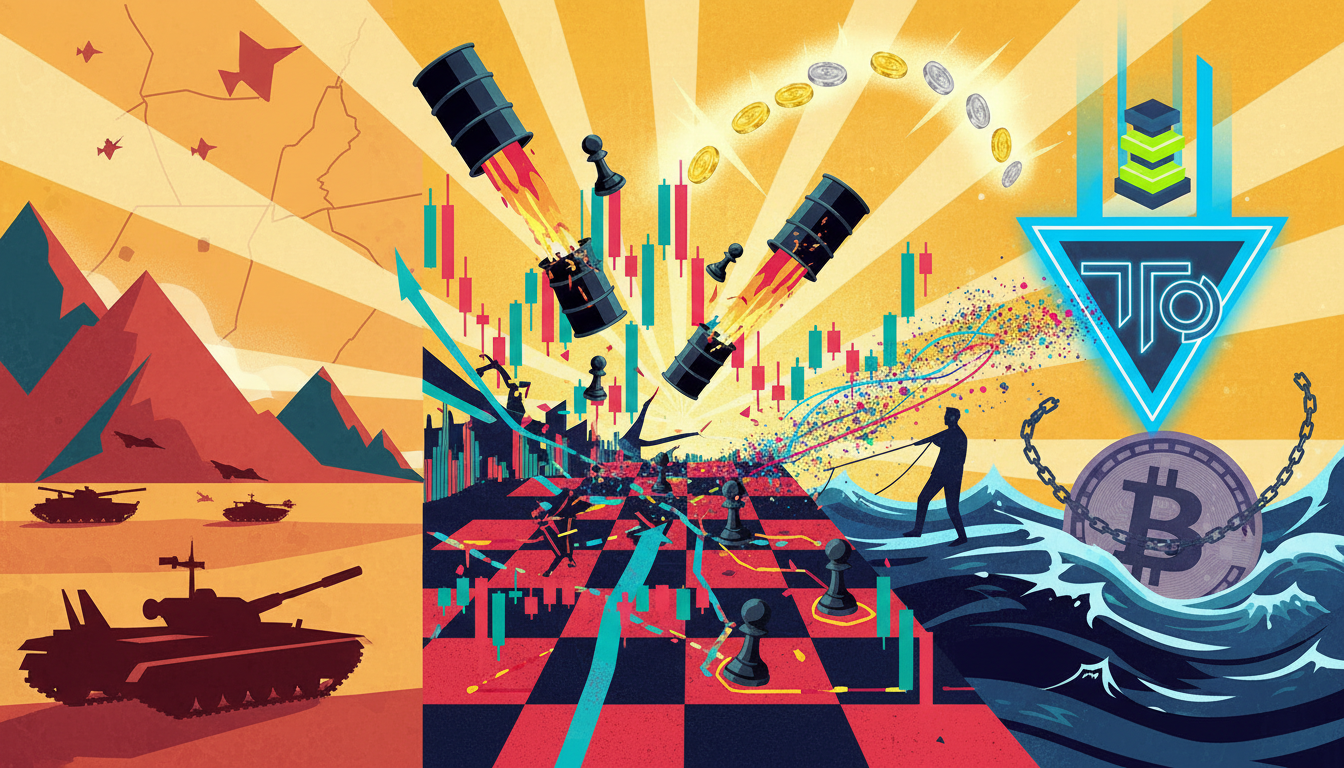
On April 1, 2026, the stock markets of South Korea and Japan experienced an extreme reversal. The South Korean KOSPI index surged approximately 9% in a single day, closing at 5507.50 points; the Japanese Nikkei 225 index also rose about 5%, finishing at 53625.91 points, marking a shift from deep panic to collective buying within a single trading day. This violent rebound occurred against a backdrop of a series of rare declines and extremely pessimistic market sentiment, resembling a technical correction based on previous excessive declines, as well as a collective correction of "overly pessimistic pricing." The real question remains: is this merely a brief emotional repair window opened in the shadows of geopolitical risks, or an event that quickly fizzles out in a still high-pressure environment?
From Crash to Surge: A Day of Emotional Rollercoaster
Prior to April 1, the stock markets of South Korea and Japan had gone through a drastic adjustment referred to by the media as a “record decline” and a “systematic devaluation.” The escalation of tensions between the U.S. and Iran, along with a rise in global risk aversion, became key external variables that weighed heavily on sentiment, as continued selling pressure reflected fears of geopolitical uncertainty onto index levels. For many participants, it was a phase where “risk-averse talk prevailed, with no mention of risk”: any bounce was seen as an opportunity to exit rather than a signal to increase positions.
This accumulation of sentiment laid the groundwork for a sharp technical reversal. By the trading day on April 1, suppressed emotions suddenly turned around: KOSPI quickly spiked after the selling momentum waned, rising about 9% at one point, ultimately closing at 5507.50 points; the Nikkei 225 also surged about 5% under the boost of buying pressure, finishing at 53625.91 points. The shift in sentiment from a limit-down mood to collectively chasing gains saw a complete 180-degree turn in funding behavior within a short period.
Media narratives quickly adjusted from prior “panic selling” and “record crashes” to “technical rebound” and “correction of previous excessively pessimistic expectations.” Under this narrative, the surge on April 1 was portrayed as a result of prior excessive declines and severe overselling technically, compounded by short-covering and influxes of short-term bottom-fishing, triggering a typical “emotional rollercoaster” market, where fear was transmuted into a buying rebound at extreme levels.
U.S.-Iran Situation Cools: Emotional Leverage from Ceasefire
One of the external backdrops driving this rebound was the temporary easing of tensions between the U.S. and Iran. Previously, market concerns about potential escalation of the conflict significantly amplified global risk aversion, leading to collective devaluation of Asian stock markets and other risky assets under such expectations, especially calling the Japanese and Korean indices as major outlets for regional risk sentiment during peak pressures.
On April 1, multiple media outlets linked the concurrent upward movement of the South Korean and Japanese stock markets to the “temporary easing” of U.S.-Iran tensions, though they did not provide further confirming details, nor was there a finely verified timeline from authoritative sources. From the reporting angle, it seemed more like an “emotional benchmark,” suggesting that a slight reduction in geopolitical tension → marginal retreat in global risk aversion → slowing of selling pressure on high Beta risky assets, with even some reverse buying behavior emerging.
In this chain, the “slight downward curve” of geopolitical risk became an emotional accelerator amplifying the market's spontaneous technical rebounds. The Japanese and Korean stock markets, as some of the most sensitive assets to regional risk preference, gave an immediate severe price response the moment risk aversion began to loosen: short-term funds no longer just considered avoiding shocks, but began to evaluate whether “the drop was too much” and “if it could be betted on for a repair.” Thus, from the index performance, April 1 turned into the most striking “emotional turning day” for Asian risky assets.
Technical Correction or Trend Reversal: Divergence Accumulates Over Gains
For this violent rebound, most media initially labeled it as a “technical rebound.” Within this framework, the logic is quite typical: the consecutive large drops led to technical indicators being oversold, and panic emotions being overdrawn, leading some shorts to choose to cover positions when signals of risk retreat appeared, while systemic bottom-buying players adept at left-side speculation jumped in with extreme discounts to set up short-term positions. The accumulation of these three forces often triggers an “urgent surge” in the index at a certain moment, forming what seems like a vigorous upturn, yet may not alter the trend.
At the same time, another mainstream narrative is that “regional risk preference warms in the short term.” Some viewpoints point out that the simultaneous surge of the South Korean and Japanese stock markets reflects Asian investors’ emotional repair due to marginal easing of geopolitical risks, as well as the excessive previous sell-off, rather than a sudden optimism about the regional economy or corporate fundamentals. From this perspective, the movement on April 1 resembles a repricing of emotions, rather than a rewriting of fundamental logic.
This also explains the significant internal division within the market: one part of the funds bets that “the rebound is not over,” believing that policy and geopolitical pressures are unlikely to return to extremes in the short term, providing room for the index to continue repairing the discount; another portion of participants views this uptrend as a “window for reducing positions at highs,” opting to gradually lower risk exposure during improved liquidity and warming buying sentiment. The long and short divergence was distinctly etched into that day’s K-line: the same long bullish candlestick means completely different things to different participants.
Linkage of Asian Risk Assets and Reflection in Crypto Markets
By pulling the perspective away from the South Korean and Japanese stock markets, it’s clear that the synchronized surge on April 1 provided a common reference for a short-term emotional repair across all Asian risk assets. Despite the lack of detailed regional market capitalization data, at least one can confirm from the major index performances that risk preference had not been permanently damaged in the preceding crash, but rather has the elasticity to rebound quickly when geopolitical pressures ease.
In such an environment, the sentiment improvement in traditional stock markets often transmits through the links of risk preference and fund preference to the pricing of cryptocurrencies within the region. On one hand, when investors’ fears regarding macro and geopolitical risks slightly ease, they are more willing to reassess the cost-benefit ratio of high-volatility assets and reduce passive de-risking behaviors; on the other hand, the sharp rebound of the stock market will also psychologically reshape the risk-return judgments, guiding some funds to shift from purely risk-averse allocations back towards high Beta assets.
For participants in the crypto market, what needs to be focused on is not a single day’s sharp rise, but rather how long this “window of emotion” will last: will it be a technical correction lasting a few days or a pull-back that could keep the risk premium in check for weeks? Simultaneously, during this window, the rotation rhythm between traditionally understood safe-haven assets and high Beta assets will profoundly impact the difficulty of managing portfolios—at moments of severe stock market rebounds, an excessive concentration in one direction often signifies the risks of mismatch or inverse exposure.
Funds Remain on the Sidelines: Missing Data and Exaggerated Narratives
It is crucial to emphasize that many current assertions regarding this rebound are constrained by a lack of data. Specifically regarding the South Korean and Japanese stock markets, there is still a lack of public statistics on the segmentation of institutional fund inflows, distribution of active vs passive funding, and behaviors of various types of funds during intraday trading on April 1, making it challenging to confidently determine whether this was a “retail sentiment-driven buying rebound,” or an “organized, rhythmic reallocation by institutions.”
The status of the sidecar mechanism being triggered on the Korean exchange, the specific scales of overall Asian market capitalization changes during downturns and rebounds, as well as precise data related to energy prices, are also still at a “to be verified” status. Since this crucial information has yet to be confirmed or disclosed by authoritative channels, it is currently inappropriate to treat them as established facts or use them as a foundation for amplified extrapolations.
In this environment of information asymmetry, mainstream media narratives—whether “the easing of U.S.-Iran tensions brings opportunities” or “technical rebounds demonstrate market resilience”—need to be strictly distinguished from data-validated conclusions. Regarding the sustainability of this surge, a more rational attitude would be to acknowledge that technical and emotional repairs have occurred, while also retaining cautious observation on fund structure, transaction quality, and subsequent follow-up strength, rather than being hastily convinced by a single day’s extreme market behavior, declaring a “trend reversal.”
Next Steps After Panic Repair: Opportunities and Constraints Coexist
Overall, the violent surge of the South Korean KOSPI and the Japanese Nikkei 225 on April 1 is a result of multiple resonating factors: on one hand, the previous consecutive sharp declines incorporated the most pessimistic expectations of geopolitical risk into the indices ahead of time, creating space for technical rebounds; on the other hand, the phase of easing tensions between the U.S. and Iran weakened global risk aversion, providing psychological support for short-term funds to take on risk again, coupled with serious technical overselling and concentrated short-covering, collectively shaping this dramatic market movement from the bottom.
Based on the currently visible information, this resembles a concentrated repair of sentiment and technical levels rather than the confirmed start of a new bull market. Without observing sustained net inflows from institutional funds, as well as not seeing a decisive fundamental positive land before interpreting a violent rebound directly as a “V-shaped reversal,” the risks clearly outweigh the opportunities. Sentiment can flip in hours, but the formation of trends requires more solid support from fundamentals and fund structure.
For participants in the crypto market and broader risky assets, April 1 provides an excellent sample for observing the elasticity of the “geopolitical risk—risky asset” chain. A more rational approach is to conduct disciplined trading and risk hedging using volatility, predicated on ongoing tracking of geopolitical progression, regional fund flows, and changes in volatility structures, rather than blindly following heights in a single day’s sharp rise, misinterpreting emotional repair as a trend restart.
Join our community to discuss together and become stronger!
Official Telegram community: https://t.me/aicoincn
AiCoin Chinese Twitter: https://x.com/AiCoinzh
OKX Welfare Group: https://aicoin.com/link/chat?cid=l61eM4owQ
Binance Welfare Group: https://aicoin.com/link/chat?cid=ynr7d1P6Z
免责声明:本文章仅代表作者个人观点,不代表本平台的立场和观点。本文章仅供信息分享,不构成对任何人的任何投资建议。用户与作者之间的任何争议,与本平台无关。如网页中刊载的文章或图片涉及侵权,请提供相关的权利证明和身份证明发送邮件到support@aicoin.com,本平台相关工作人员将会进行核查。