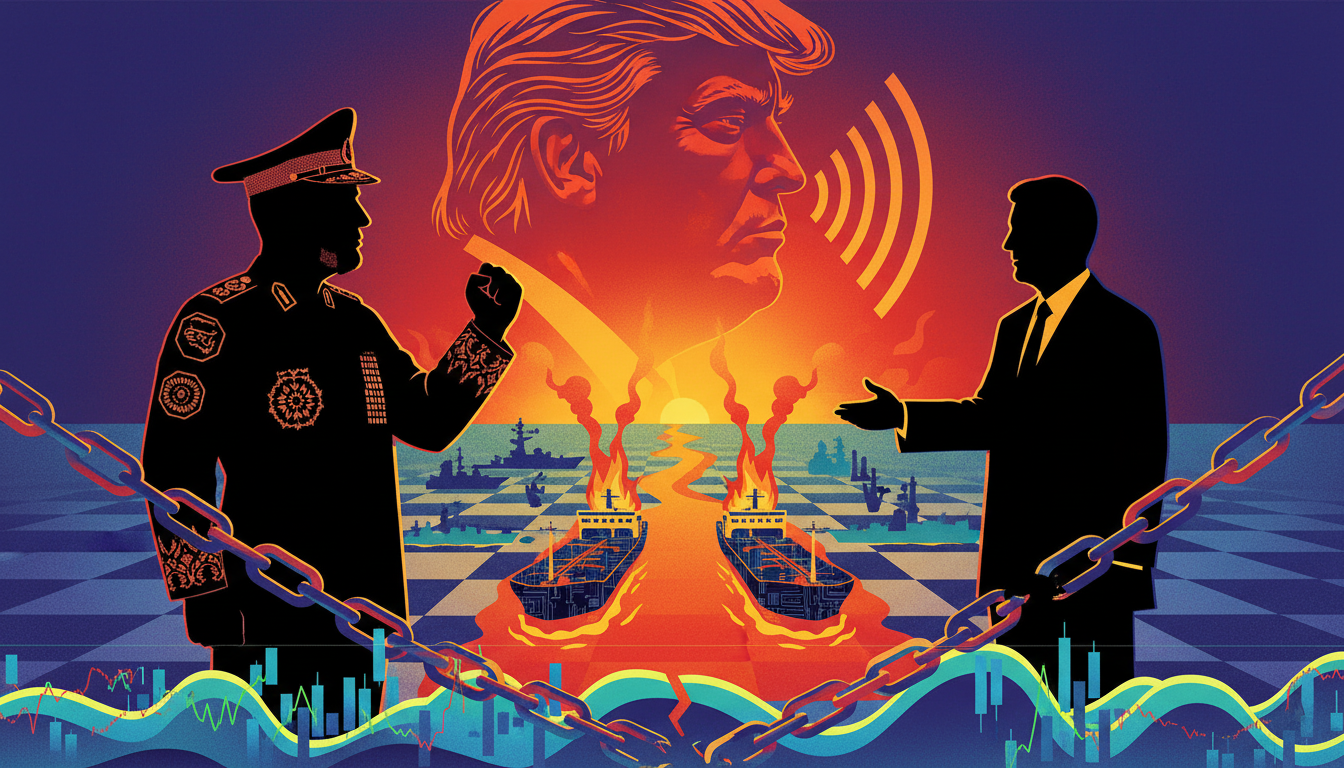
On April 1, 2026, Eastern Daylight Time, a whale address holding 211,335 BRENTOIL contracts on the decentralized contract platform Hyperliquid was fully liquidated by the system, with a nominal value of approximately $21.37 million in long positions evaporating within hours. According to on-chain monitoring and public information aggregation, this single liquidation loss was about $1 million, occurring almost simultaneously with an international crude oil drop of more than 3% that day. The catalyst for this chain reaction, which never appeared on-chain, was former President Trump's latest remarks on Iran and the U.S. military withdrawal, igniting a geopolitical pre-price adjustment that jolted the commodity markets, ultimately impacting high-leverage players on-chain, creating a high-energy resonance between traditional geopolitical games and crypto finance.
Trump's Statement Disrupts Oil Market, Sparking 3% Drop
On April 1, Trump released a new round of hardline statements regarding the Iranian situation, U.S. troop withdrawals, and the prospects of war, leading the market to swiftly shift from betting on “escalation of conflict” to “possible period of cooling in the situation,” forcing a recalculation of geopolitical risk premium. The "war premium" that had accumulated around the Middle East conflict was collectively cashed out during the trading session, with funds beginning to reverse corrections on the previously rising oil prices.
Against this backdrop of emotion reversal, WTI crude oil fell below $98 per barrel, with a maximum intraday decline of 3.78%; as one of the global pricing anchors, Brent crude oil also weakened, dropping approximately 3.3% during the day. For funds that had built long positions based on the logic of “war escalation - supply constraints - continued rise in oil prices,” such a reversal exceeding 3% in a single day was sufficient to trigger chain reactions within the leverage system.
Traditionally, war risks are usually seen as the upward driving force for oil prices: escalation of conflict, disruption of shipping lanes, tightening of supplies, constitute the classic path for price increases. However, this time, Trump's signal of “possible withdrawal, avoiding a larger war” was interpreted by the market as a marginal easing of conflict, thereby compressing the risk premium already factored into prices, resulting in short-term sell pressure contrary to textbook narratives. Thomas Mathews of Capital Economics warned that even if the war quickly ends, its impact will still persist in many cases, meaning that the retreat of geopolitical risk premiums is not linear; the current sharp drop appears more like a violent repricing of prior unilateral increases rather than a complete disappearance of risk.
Hyperliquid Oil Long Whale Instantly Wiped Out
In this market reversal catalyzed by rhetoric, a major participant in the on-chain derivatives market became one of the first victims with the most severe losses. On-chain data shows that the address 0xc278…b4bfc, which had long-held 211,335 BRENTOIL contracts on Hyperliquid, corresponding to a nominal value of approximately $21.37 million, effectively simulated a gigantic oil long ledger in a decentralized environment. Such a scale was extraordinarily large within the platform's overall structure, inherently exposed to high volatility risk.
As WTI fell below $98 and Brent simultaneously dropped, the short-term decline in oil prices quickly eroded the margin buffer of this large position. Given that BRENTOIL essentially anchors to traditional crude oil prices, a sudden drop in the underlying price by around 3% could multiply under high leverage, leading to a severe shrinkage of the margin. Once losses reached the liquidation threshold, Hyperliquid's liquidation engine began taking over positions in batches, selling them on the market to prevent further losses, ultimately triggering full liquidation.
Based on the cross-verification of on-chain monitoring and public information, the industry generally places the direct loss magnitude of this liquidation at around $1 million. For most DeFi users, such a scale of forced liquidation is exceedingly rare in day-to-day fluctuations, and regardless of the transaction depth on Hyperliquid or cross-platform liquidation records, it can be regarded as an “anomaly-level” event. This also enabled the liquidation to quickly go viral, becoming a typical example of the day’s crude oil flash crash combined with the on-chain leverage fragility.
On-Chain Transparency Exposes High-Risk Leverage Under Spotlight
The reason this liquidation was captured and analyzed by the market within hours is largely due to real-time “spectating” provided by on-chain data monitoring tools. Tracking accounts, including Lookonchain and Onchain Lens, identified the abnormal traffic of the BRENTOIL position liquidation on the 0xc278 address through continuous scanning of interactions related to Hyperliquid, publicly sharing key data (contract quantity, nominal value, estimated losses).
This almost “second-level” transparency provides a new observation window for external risk control, research institutions, and media: they can reconstruct the timeline and funding path of the liquidation without relying on platform disclosures after the fact; on the other hand, it also lays bare any high-risk leveraged position in front of the market, amplifying individual risks within public narratives, easily fitting into the frames of “excessive speculation” and “out-of-control leverage,” subject to repeated interpretations and amplifications.
In contrast, within traditional brokerage systems and centralized trading platforms, similar scale liquidation events are often only disclosed sporadically after quarterly reports, regulatory investigations, or media deep dives, showing a distinct lag in information disclosure. Investors find it difficult to see who was liquidated at what prices, due to what variables at the moment of event occurrence. However, on-chain, liquidation transactions themselves are public records, and anyone can restore details on block explorers.
However, transparency does not mean that all information has been confirmed. The current alleged fund exchanges between the newly created wallet 0x9d3…aff5 and the liquidation address lack reliable evidence; on-chain, they simply appear as ordinary new address activities. Because the briefing has clearly indicated that this correlation is still pending verification, this event can only confirm the positions held by 0xc278 and the liquidation itself; for subsequent fund movements and identity speculations, readers should be cautious of over-interpretation and emotional conspiracy theories.
U.S. Stock Futures Rise as Oil and On-Chain Derivatives Come Under Pressure
Interestingly, while crude oil and crypto oil derivatives encountered collective sell pressure on the same day, U.S. stock index futures climbed on another track. According to market data from the same day, on the day of liquidation, Nasdaq futures rose by about 1.08% and Dow futures rose by about 0.68%, with both growth stocks and blue-chips favored amid an increasing risk appetite narrative.
This divergence forms a clear asset rotation picture: on one side, crude oil, with its geopolitical risk premium squeezed, and on-chain contracts linked to it face flash-crash-style repricing; on the other side, an optimistic interpretation of “war may not escalate further” drives U.S. stock risk assets higher. The passive deleveraging of crude oil longs and the proactive accumulation of U.S. stock longs played out simultaneously, further confirming the differential choices of cross-market funds pricing various risk factors.
In this environment, clues to major fund allocation are gradually emerging: a portion of assets extremely sensitive to geopolitical uncertainty — such as crude oil and its derivatives — were first to be reduced when expectations shifted from “escalation of conflict” to “possible easing of the situation”; whereas U.S. stocks, viewed as “growth + dollar assets,” attracted liquidity anew due to the short-term risk-off demand receding.
Hedge and speculative demands also found another outlet at this moment. Joseph Chai, an analyst at RHB Retail Research, suggested that gold prices could challenge the important resistance level of $4,800 per ounce in the future, reflecting the market’s continued hedging demand against medium to long-term uncertainties: even if the war premium in oil retreats temporarily, concerns about the monetary system and inflation expectations remain, leading funds to seek more stable hedging vehicles in precious metals. This migration from oil to U.S. stocks and then to gold also indirectly adds pressure to the liquidity of on-chain oil derivatives.
How Leverage Trading Turns from Risk Control Tool to Self-Destruct Button in Extreme Markets
Returning to the whale that was liquidated on Hyperliquid, we can see more intuitively how commodity volume volatility can deal a fatal blow to high-leverage longs. Assets like crude oil, which are highly volatile and driven by both geopolitical and macro factors, are inherently non-linear: any unexpected political statements, military actions, or negotiation shifts can trigger extreme amplitudes in a short time. When this volatility is multiplied by high leverage on-chain, a tool originally used to amplify returns can suddenly backfire on the principal.
Under the margin mechanism, traders must maintain a certain ratio of funds as risk buffers, and once the net value falls below the maintenance margin, the system will initiate the forced liquidation process to prevent position losses exceeding the platform's tolerable threshold. In this event, a daily reversal of more than 3% in oil prices, under the influence of high leverage, was sufficient to rapidly deplete the margin coverage space; before prices reached peak emotional extremes, the liquidation engine began gradually cutting positions, ultimately evolving into a full passive liquidation, erasing millions in principal within just a few candlesticks.
What’s more concerning is that this is not just a failure of risk management for an individual account, but also a stress test of the overall structure of crypto derivatives. On-chain crude oil, stock indices, interest rates, and other cross-market contracts are increasingly deeply tied to traditional macro and geopolitical variables; should an “unexpected political characterization” occur in the external world, the pricing of these contracts could undergo drastic adjustments within a very short timeframe. For positions overly reliant on single narratives (like “war will surely drive up oil prices”), when the narrative shifts, leverage can amplify manageable losses into irreversible liquidations.
For regular investors, this event serves as a stark reminder: betting on a single asset, single direction, single narrative is extremely fragile in the face of geopolitical and macro shocks. The more “logically consistent” a trend appears, the more susceptible it can suddenly become to exogenous variables; leverage acts as an “amplifier” in such narrative failures, swiftly converting cognitive biases into capital losses.
Seeing the Mute Button on AI and RWA Narratives from One Liquidation
Interestingly, aside from the narrative dominated by the oil flash crash and whale liquidation, another storyline on the same timeline was almost overlooked by the market. The RWA Summit held in Cannes, France, and Pharos announcing the advancement of AI + RWA cooperation should have represented significant progress in connecting on-chain financial infrastructure with real-world assets but was forced into the background amid the uproar over oil and liquidation. This phenomenon of “technical and institutional narratives being overshadowed by short-term risk events” itself mirrors the current market structure.
If we zoom out from the individual liquidation, we can see that this event drew several originally parallel threads into the same frame: on one end, Trump's geopolitical statements regarding Iran and troop withdrawal drove a dramatic reconstruction of the commodity pricing system within a day; on the other end, the leverage sensitivity exposed in on-chain oil derivatives during this reconstruction, while at the same time, traditional market assets like U.S. stock futures and gold completed fund rotation and risk redistribution. Macro, geopolitical, commodities, on-chain leverage, and cross-asset allocation were interconnected in a single day.
Looking ahead, as more on-chain derivatives linked to crude oil, stock indices, and treasury yields emerge, similar extreme liquidation scenes are likely to repeat frequently under macro and geopolitical event drives. Any “unexpected speeches” or “surprising ceasefire or escalation” could become the trigger signal for liquidation engines, rather than just staying within news headlines.
In such an environment, what investors need to do is not avoid all volatility, but consciously price for volatility: during high-volatility periods, actively reduce leverage ratios to leave sufficient margin buffers for positions; through cross-asset and cross-market diversifying risk exposures to avoid concentrated exposure to single assets and single narratives; at the same time, make good use of on-chain transparency, leveraging block explorers and various monitoring tools to periodically check your own leverage and liquidation prices, transforming perspectives that originally belonged to platform risk control into everyday habits for oneself.
When a liquidation of approximately $1 million can be seen on-chain by everyone, risk education turns from mere hindsight into a real-time classroom behind every high-volatility candlestick.
Join our community to discuss and grow stronger together!
Official Telegram community: https://t.me/aicoincn
AiCoin Chinese Twitter: https://x.com/AiCoinzh
OKX Welfare Group: https://aicoin.com/link/chat?cid=l61eM4owQ
Binance Welfare Group: https://aicoin.com/link/chat?cid=ynr7d1P6Z
免责声明:本文章仅代表作者个人观点,不代表本平台的立场和观点。本文章仅供信息分享,不构成对任何人的任何投资建议。用户与作者之间的任何争议,与本平台无关。如网页中刊载的文章或图片涉及侵权,请提供相关的权利证明和身份证明发送邮件到support@aicoin.com,本平台相关工作人员将会进行核查。