Original author: Chloe, ChainCatcher
Recently, Solana Foundation President Lily Liu posted on X stating that "games on the blockchain will not return" and declared that blockchain games are dead.
Her judgment comes from a Polymarket post, stating "Mark Zuckerberg's Meta is gradually abandoning its metaverse vision after spending $80 billion." Although Meta's blueprint does not explicitly involve blockchain or crypto assets, its strategy highly overlaps with the future depicted by Web3 chain games in recent years: virtual worlds, digital asset ownership, and immersive online economies.
If even the wealthiest players are withdrawing, has the blockchain gaming industry's once-promising narrative of transcending boundaries reached a dead end?
Collapse of the entire track: Are chain game projects shutting down one after another?
In August last year, Proof of Play released an announcement that seemed like a confession to the market, stating that their chain-based pirate RPG "Pirate Nation" would close in 30 days. Two exclusive blockchains would go offline, token rewards would be zeroed, and community players could only burn their assets in exchange for a so-called "certificate," which may one day be useful but is highly unlikely. This game studio had raised $33 million two years ago, vowing to shape the future of on-chain gaming.
After the announcement, the PIRATE token plummeted 92% in a few days. Co-founder Adam Fern admitted, "Shutting down Pirate Nation was one of the hardest decisions I've ever made. But the fact is, it could never have become a groundbreaking mass-market product."
Pirate Nation is not an isolated case; it is just a small part of the great collapse of chain games in 2025.
Now, let’s unveil last year’s list of blockchain games that announced their shutdown. The Ethereum game "Ember Sword," which attracted $203 million through NFT land purchases, announced its closure in May last year, with developer Bright Star Studios citing a lack of funding.
The third-person shooter battle royale game "Nyan Heroes," built on Solana, which was once on the wish list of over 250,000 PC platform players, also ended its operations in May last year due to funding ruptures, its token NYAN dropping over 99% from its peak. The Ethereum chain game "Symbiogenesis," created by Final Fantasy creators Square Enix, also reached its end in July.
Additionally, Gala Games' MMORPG, officially licensed by "The Walking Dead," went offline in July. The NFT-based mechanized combat game "MetalCore" closed its servers in March and has since gone dark; the developers have quietly shifted to launching a new game on Steam unrelated to blockchain.
Recently, one of the most lamentable projects in the market is "Wildcard," which saw its highest market value only reach $1.1 million after its TGE in March this year, leading the community to widely question the project's irresponsibility and soft rug. According to crypto asset data platform RootData, Wildcard had raised $46 million, led by Paradigm.
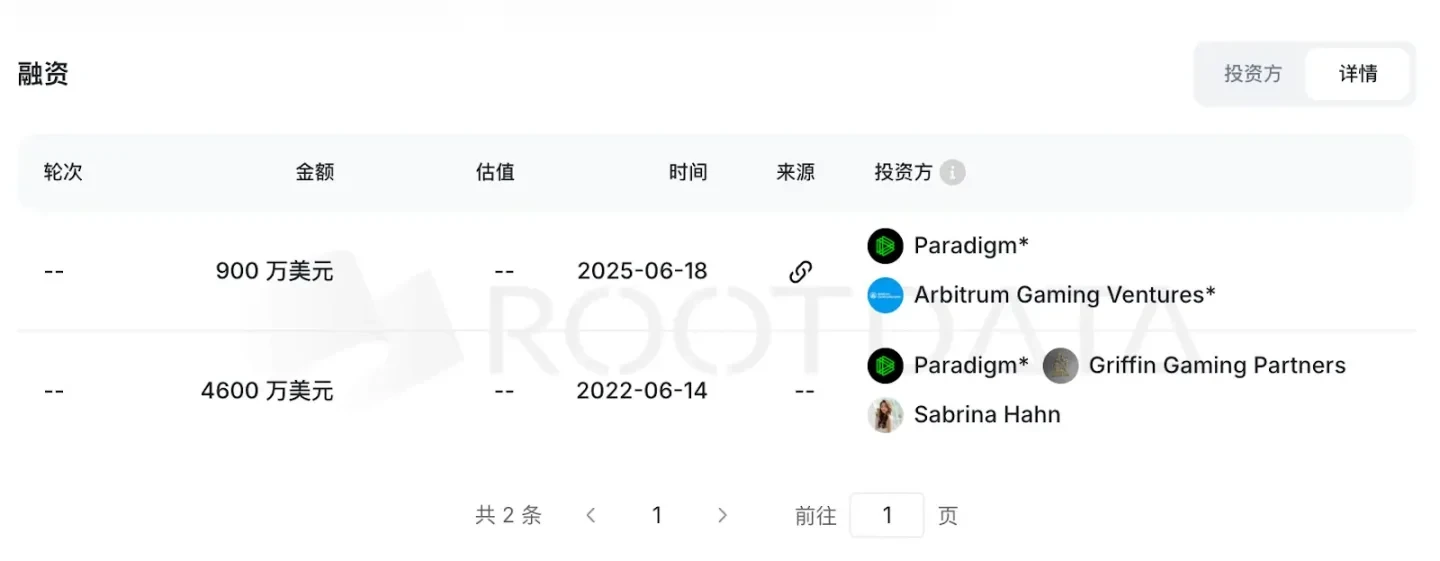
Its founder Paul Bettner had previously participated in the development of well-known games like "Words With Friends" and "Lucky’s Tale," but now, even with backing from top VCs and seasoned game professionals, it cannot prevent the collapse of the entire chain game track.
Furthermore, there are "Deadrop," "Blast Royale," "Mojo Melee," "Tokyo Beast," "OpenSeason," "Captain Tsubasa Rivals," each project backed by millions or even tens of millions of dollars in investments, a multitude of game users, and commitments that ultimately turned to nothing.
Web2 players want a good game, while Web3 players only want returns
Most founders have genuine backgrounds in game development, and their visions for on-chain games during fundraising were not entirely empty talk. So why did they ultimately end up with project shutdowns or a return to Web2?
"Web3 games built an entire investor-driven capital structure through tokens and NFTs before verifying player demand," in other words, the people providing funding for these games were not the same group that ultimately needed to remain in the games from the very beginning.
When developers found that the on-chain player base was smaller and more inclined toward short-term speculation than expected, and as token prices continued to decline while development costs kept rising, the studio's choices boiled down to closing down or abandoning their blockchain identity and switching to the traditional market. Regardless of the path taken, early Web3 investors and NFT holders always end up being the ones left holding the bag.
The farm simulation game "Moonfrost" is a typical case. Developer Oxalis Games raised $6.5 million and ran a Play-to-Airdrop campaign for over a year, selling 1,833 NFT boxes at $150 each. Then in November 2025, the team announced that they would leave Web3 and relaunch on Steam as a paid PC game, without NFTs, tokens, or blockchain.
Just one day before the announcement, CEO Ric Moore was speaking publicly about how to create "slow and meaningful Web3 games." The team's reasoning was that "Web3 players want to make money, while Web2 players just want a good game." They spent three years and millions of real dollars before realizing the true rules.
The 2025 Blockchain Game Alliance (BGA) industry report also confirmed the retreat of chain games: annual investment in blockchain games has dropped to about $293 million, a staggering decrease compared to $4 billion in 2021 and a peak of $10 billion in 2022. DWF Labs described the current stage as "a necessary reset." The greatest legacy left by the failures in this track may be a crisis of credibility for the entire chain gaming sector.
The BGA report shows that 36% of respondents listed "scams, fraud, or rug pulls" as the biggest threat to the industry. Even though the shutdowns of most projects were not intentional scams, from an external perspective, the repeated cycle of "raising funds, issuing tokens, and closing down" is almost indistinguishable from rug pulls. "This industry needs real game developers and real users who want to play games; both are indispensable."
Infrastructure and market conditions create advantages, stablecoins and AI bring new opportunities
The collapse of the chain gaming narrative does not mean that consumer-level applications in the crypto industry have come to an end. The BGA report shows that 65.8% of industry practitioners remain optimistic about the next 12 months. This optimism is based on deliverable products and sustainable revenue models. Meanwhile, the massive transfer volumes handled by stablecoins, the ability of AI tools to compress game development costs to a fraction of their previous levels, and infrastructure and market conditions have never disappeared; indeed, from the perspectives of many developers, several possible paths can be seen.
NEXPACE CEO Sunyoung Hwang proposed a core principle regarding their "MapleStory Universe": wallets, gas fees, and token economics are obstacles for most players, not assets. The blockchain layer should do meaningful work behind the scenes, such as realizing real asset ownership and driving an open economy, while players should simply focus on the game itself. "If the operation of the infrastructure seeps into the gaming experience, the game design is a failure."
Animoca Brands CEO Robby Yung and PLAY Network CEO Christina Macedo believe that retention rates are the only truth. The retention data for D1, D7, and D30 applies in the console era, in the mobile gaming era, and remains true in the crypto industry. Macedo pointed out that the standard benchmark for mobile games is a D1 retention of 35-45%, D7 of 15-25%, and D30 of 5-10%, while most Web3 games have not even reached these basic health metrics.
Yield Guild Games co-founder Gabby Dizon argues that the reason for the industry's failure is that it "spent too long measuring the wrong things," including outdated metrics like VC fundraising amounts, token prices, and NFT sales. The only real metric is whether players are willing to pay because they see value in the gaming experience.
Finally, there are the opportunities presented by stablecoins and AI.
The BGA report indicates that over a quarter of respondents view stablecoins as key to the industry's success. Compared to the volatility of game tokens, stablecoins are friendlier and easier to understand for new users, and they are increasingly being used for tournament prizes, in-game rewards, and cross-border payments. Sequence further pointed out that smart game developers are focusing on stablecoin payments, whether for on-chain assets or other scenarios; lower transaction fees, instant settlement, and simpler revenue sharing have significant situational advantages.
Moreover, AI is changing the cost structure. Simon Davis of Mighty Bear Games pointed out that native AI teams are outperforming traditional studios at a fraction of the cost and workforce. Animoca Brands also believes that the key to sustainability in 2026 lies in AI-driven or AI-assisted development practices, which will fundamentally alter the economic model for producing quality game content.
Blockchain games are not dead; is this stage a necessary reset?
The core contradiction of the previous cycle in chain games has always remained unchanged: the investor-driven capital structure has run ahead of player demand verification. When retention rates cannot sustain the token economy, and development costs consume financing numbers, the only outcome for the project teams is closure or a shift away from blockchain, with the early holders always left paying the price.
However, this reshuffling is also allowing game developers to reach a more pragmatic consensus: to make blockchain invisible, measure success by retention rates instead of token prices, use stablecoins instead of highly volatile tokens as the payment layer, and leverage AI to reconstruct development costs. The commonality of these directions is to first create a game that can withstand traditional market metric evaluations, and then let blockchain play its true value at the underlying level.
Blockchain games may not be dead as Lily Liu stated, but the market is indeed bidding farewell to the old cycle driven by tokens that exhaust development funds, leaving only a return to Web2.
免责声明:本文章仅代表作者个人观点,不代表本平台的立场和观点。本文章仅供信息分享,不构成对任何人的任何投资建议。用户与作者之间的任何争议,与本平台无关。如网页中刊载的文章或图片涉及侵权,请提供相关的权利证明和身份证明发送邮件到support@aicoin.com,本平台相关工作人员将会进行核查。


