Source: APPSO

While everyone was still immersed in the Claude Code source code leak incident, OpenAI once again made headlines. Just now, OpenAI officially announced the completion of a round of financing totaling $122 billion.
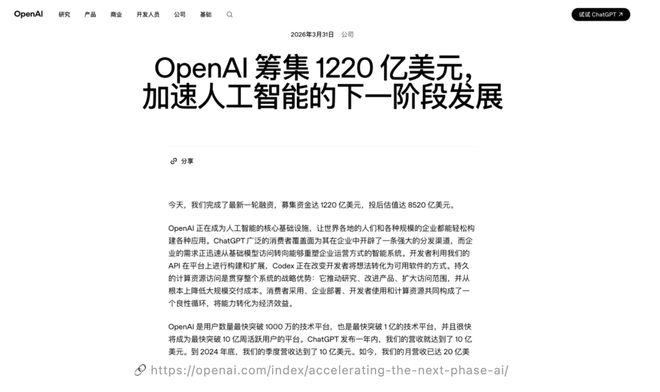
In human business history, there has never been a single round private placement of $122 billion. After the financing was completed, OpenAI's valuation stood at $852 billion, just one step away from a trillion, and this company has only been established for ten years.
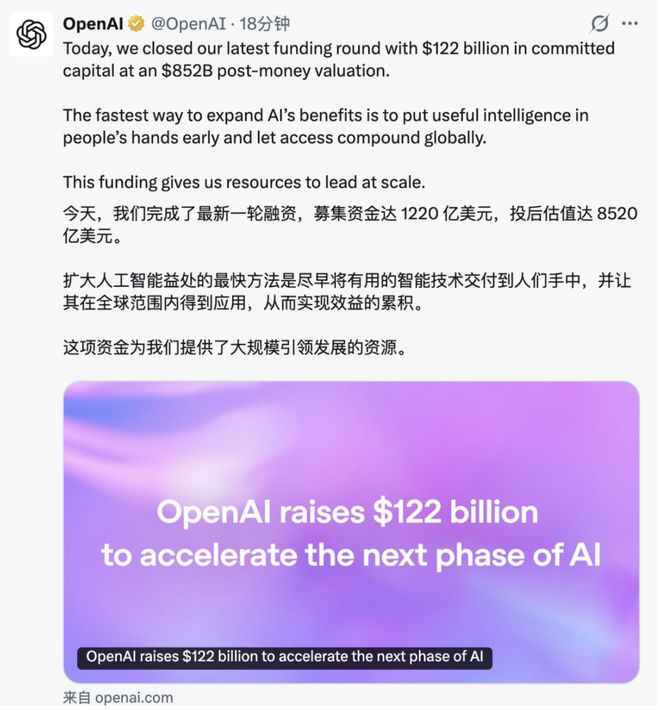
It is worth mentioning that when this round of financing was announced in February this year, the promised amount was still $110 billion, but by the time it closed, it increased by $12 billion, indicating that more institutions followed up than expected.
The outside world generally believes that this is OpenAI's last large-scale private placement before its IPO at the end of the year, and the rhythm of the listing is becoming increasingly clear.
Where the Money Comes From
The main investors in this round of financing are Amazon ($50 billion), Nvidia ($30 billion), and SoftBank ($30 billion). SoftBank, along with a16z, D.E. Shaw, and other institutions, jointly led the investment.
Microsoft, as a long-time partner, continued to follow the investment, but this time did not disclose specific amounts; it is known that by the end of last year, Microsoft's cumulative investment in OpenAI had exceeded $13 billion.
In addition, OpenAI also opened fundraising to wealthy individual investors through banking channels for the first time, raising approximately $3 billion. ARK Invest's flagship innovation ETF, with a scale of $6 billion, also announced the inclusion of OpenAI, with a holding ratio of about 3%, marking the first time the fund invested in a non-public company.
In fact, some funds managed by T. Rowe Price and Fidelity have already held a small amount of OpenAI shares. The addition of ARK further opened channels for ordinary people to participate.
In short, almost the entire tech circle is supporting OpenAI.
But upon closer consideration, the logic is actually quite simple: OpenAI takes this money and still needs to buy Nvidia chips and rent Amazon and Microsoft's servers. The giants investing money essentially lock in the world's largest computing power customer in advance. This round of financing is less about being optimistic about OpenAI and more about a surefire business.
For OpenAI, this money resembles the last major inventory replenishment before the IPO.
The financial data is indeed impressive: the number of weekly active users is nearly 900 million, the number of paying users exceeds 50 million, last year's total revenue was $13.1 billion, with the highest monthly income reaching $2 billion, and the growth rate is four times that of internet giants like Google and Meta during the same period.
However, OpenAI has not yet turned a profit, and the rate of cash burn has not decreased at all.
Why Sora Was Shut Down
Throughout this round of financing, the product cadence of OpenAI has not stagnated.
They released the currently strongest GPT-5.4, with significant improvements in multitasking and workflow performance. The code generation tool Codex has also evolved from a function into an independent programming agent, with more than 2 million weekly active users, a fivefold increase in the past three months, and a monthly growth rate maintaining around 70%.
The performance on the enterprise side is also noteworthy. Currently, enterprise services account for more than 40% of OpenAI's total revenue, and it is expected to be on par with the consumer side by the end of 2026.
The number of tokens processed by the API per minute exceeds 15 billion, the usage of the search function has nearly tripled in the past year, and the advertisement pilot project broke through $100 million in annualized revenue in less than six weeks after launch. This is also a signal OpenAI hopes to convey to the outside world: revenue sources are becoming increasingly diversified, and the subscription fees for ChatGPT are just one part of it.
However, right next to the vibrant data, Sora has quietly gone offline.
When Sora was first released, it indeed caused quite a stir in the film and creative industries. A phrase generates video, and the visual quality feels quite realistic, making many people think this was the kind of AI technology that was most exciting.
However, the computational power consumption for video generation is much higher than for text generation. Every inference, every segment of text generation, every frame of video rendering, is consuming expensive GPU processing cycles and electricity in reality. There is no free intelligence; every call incurs real financial losses.
On the user side, although it is fun, not many are willing to pay high prices for it.
According to the Wall Street Journal, one reason OpenAI chose to shut down Sora was because it was burning about $1 million a day, while the user count plummeted from 1 million at launch to less than 500,000.
When the retention data looks bad, and the commercialization path is unclear, there is no reason for this money-burning business to continue. Thus, before reality could be overturned, Sora was already gone.
Shutting down Sora is just the beginning; OpenAI is also examining other areas that are costly and slow to return, preparing for further contractions; concentrating computing power on text models, code generation, and enterprise services, which have stable cash flow, is also OpenAI's way of indicating to Wall Street: we know and need to figure out how to make money.
From "Changing the World" to "Utilities"
OpenAI was founded in 2015, with the initial vision of ensuring that general artificial intelligence benefits all humanity.
In 2019, in order to raise sufficient R&D funds, the company transitioned to a "limited-profit" model and established a for-profit subsidiary, receiving a $1 billion investment from Microsoft. Although the operating entity has commercialized, the non-profit OpenAI Foundation still holds about 26% of the equity, nominally continuing its original public service mission.
There is a noteworthy statement in OpenAI's official financing announcement: "Building the infrastructure layer for intelligence itself."
In just a few words, it actually reveals the shift in OpenAI's self-positioning. They used to care more about刷新外界对 AI 的认知 with stunning demos, but now they want to step back and become the fundamental tools that enterprises and individuals cannot do without.
They call this direction "super applications," planning to integrate capabilities like ChatGPT, Codex, search, and browsing into a unified entry point, primarily for developers and enterprise users, so people do not need to jump back and forth between a bunch of tools.
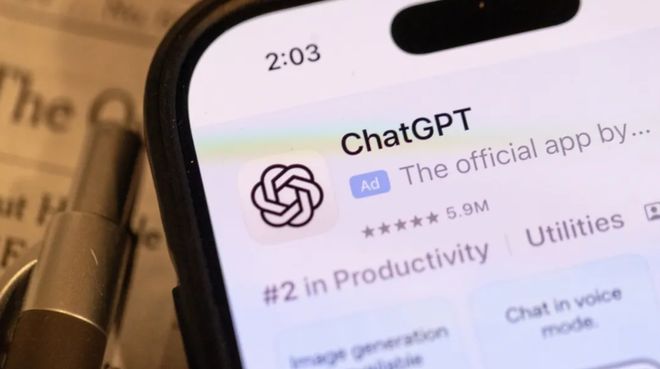
The logic behind this is to let consumer habits naturally drive enterprise procurement, with the two business segments reinforcing each other.
An ordinary user may find it fresh today and cancel their subscription tomorrow, but an enterprise running its core business on OpenAI’s model is unlikely to sever ties abruptly; the latter is the type of customer loyalty that Wall Street truly wants to see.
In the past few years, the AI industry has consistently presented eye-catching innovations, with new models, products, and possibilities emerging one after another.
However, from this round of financing and the shutdown of Sora, that phase filled with surprises may truly be coming to an end. What comes next may resemble a mature business: someone manages computing power, someone manages data, someone manages sales, and everyone focuses on their piece while emphasizing cost control and commercial implementation.
OpenAI can no longer return to the past, but perhaps it never intended to go back.
免责声明:本文章仅代表作者个人观点,不代表本平台的立场和观点。本文章仅供信息分享,不构成对任何人的任何投资建议。用户与作者之间的任何争议,与本平台无关。如网页中刊载的文章或图片涉及侵权,请提供相关的权利证明和身份证明发送邮件到support@aicoin.com,本平台相关工作人员将会进行核查。


