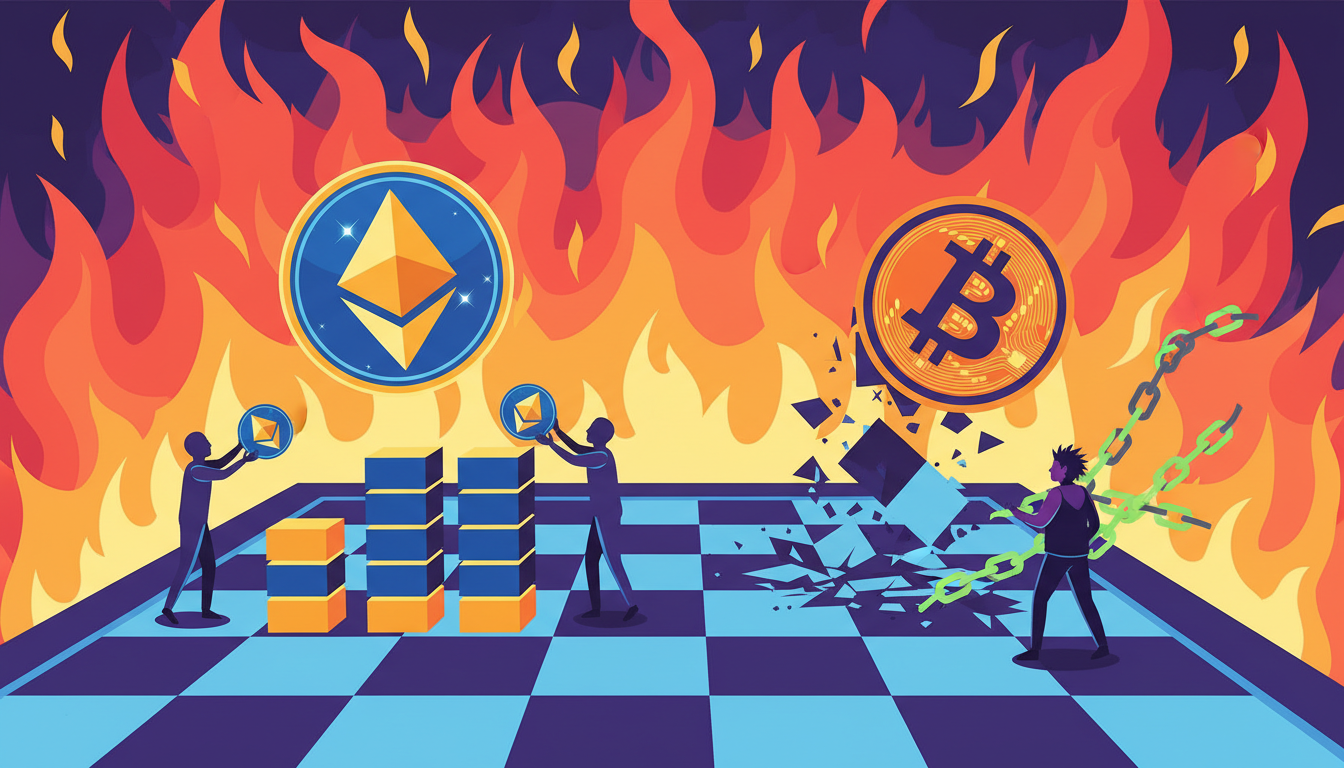
On March 23, 2026, East Eight Time, the Ethereum Foundation Platform team (members include Josh Rudolf, Julian Ma, Josh Stark) released a strategic framework document regarding the cooperative development of L1-L2, attempting to redefine the relationship between the Ethereum mainnet and various rollups using a more systematic language. The most notable focus of the document is the repositioning of L1 and L2 roles and the proposed baseline requirement that L2 should at least meet Stage 1 security standards. This is a phased answer after years of Ethereum being pulled back and forth between its decentralized ideals and large-scale application implementation. Rather than being called a "scaling roadmap," it is more about rewriting the entire ecological division of labor—who is responsible for security, who is responsible for execution, and who bears the intermediate gray compromises.
From Temporary Scaling Patch to Long-term Division Blueprint
In recent years, mainstream narratives have always regarded L2 as Ethereum's "scaling tool": transactions that cannot fit on the mainnet are moved to rollups, and data is returned to L1 for settlement. This positioning was effective in the early days but has trapped L2 in a "patch role"—it seems that as long as TPS increases and fees decrease, the task is complete. However, as the number of L2s surged and architectural differentiation increased, this single-layer scaling perspective became increasingly insufficient to explain their differences in governance, assets, and application ecosystems, nor could it guide developers and funds in making more nuanced choices.
A key shift in the new framework is that L2 is no longer seen as a subordinate to L1 and a mere TPS outsourcing factory, but rather as a first-class citizen providing differentiated services. In the foundation's narrative, L2 is not just a channel for "moving transactions out," but an execution environment that can make its own trade-offs in privacy, compliance, performance, and application verticals. L1 is no longer expected to "dominate with one chain," but rather to support diverse demands through a whole lineage composed of different L2s.
Correspondingly, the role of L1 has been further narrowed and strengthened to be the core of security and settlement: responsible for consensus, safety, and final settlement semantics, while leaving specific execution logic, user experience optimization, and niche features aimed at specific populations or regions to diverse L2s to play out. This division of labor thinking allows "Ethereum" to transform from a single chain into a consensus-centered network operating system, with its execution layer composed of multiple rollups.
At the market level, voices have already summarized this structure as "The L1-L2 continuum is an ecological advantage of Ethereum that is hard to replicate". This continuum means that from the high-security, high-decentralization L2 closest to L1 to the more aggressive adoption of alternative data availability and differentiated governance L2s, they are all arranged on the same settlement backbone, providing choices for different risk preferences and performance needs. Compared to the simple splicing of a single L1 and "external scaling chains," this division blueprint endorsed by the official framework itself constitutes a competitive moat.
Stage 1 Threshold: Security
In terms of security narrative, the new framework continues and strengthens the community's previous consensus on Stage 0 → Stage 1 → Stage 2 security evolution: Stage 0 represents the early, heavily reliant phase of human governance with multi-signatures or security committees; Stage 1 signifies a degree of trust minimization, such as stricter upgrade processes and clearer fault response paths; Stage 2 points toward a more highly automated and less subjectively trust-dependent ideal state. The foundation particularly emphasizes that the currently recommended minimum threshold is Stage 1, which effectively draws a safety red line for the ecosystem.
The document specifies that in the future, to be regarded as a "standard Ethereum L2," it must at least meet Stage 1 security standards. This poses substantive pressure and a selection effect on existing L2 projects: those that remain at Stage 0, with ambiguous safety assumptions and governance power highly centralized in a few multi-signers, will be marginalized in the narrative; whereas projects actively benchmarking Stage 1, making transparent commitments on upgrade permissions, fault handling, and data availability paths, are more likely to gain ecological recognition. This is not only a technical grading system but also an accountability of governance structure and power boundaries.
At the same time, whether Stage 1 constitutes "true trust minimization" is still an open dispute awaiting verification within the community. On one hand, the framework provides an operational safety baseline for the market; on the other hand, how to quantify subjective judgment that still relies on Stage 1 and how to assess the power boundaries of the security committee under extreme circumstances still lack unified answers. This uncertainty is precisely the focus of the discussion.
Following this path, the foundation once again reiterated Ethereum's long-term vision: to gradually diminish dependence on the security committee through the native rollup mechanism, evolving toward a more automated, rule-first system. However, the document deliberately avoids any specific timelines or rigid roadmaps, only describing this as a directional goal. This caution is itself an acknowledgment of the complexity of technology and governance: in the short term, the security committee remains a practical necessity, while in the long term its influence should be protocolized and marginalized as much as possible.
Blob Expansion and AltDA
In the scalability tech stack, the new framework makes it clear that L1 scaling and Blob expansion are positioned to "serve rollup data availability," rather than reverting to single-chain TPS competition. By providing rollups with cheaper, higher-bandwidth data storage channels, L1 can allow more execution loads to migrate to L2 without sacrificing its consensus security while ensuring that data is still anchored within the security boundaries of the Ethereum mainnet. The upgrade path for Blob is seen as a key fundamental transformation to expand the scale of rollups in the coming years.
However, the foundation also recognizes that many L2s have already considered or are contemplating connecting to Alternative Data Availability solutions (AltDA). On this point, the new framework does not adopt an exclusionary stance but rather introduces the AltDA phase framework proposed by L2Beat as a reference, acknowledging the objective need for L2s to make different trade-offs between cost, performance, and safety assumptions. AltDA is not defined as "heresy" but is included as a clear coordinate within Ethereum's overall security lineage.
This results in a game relationship of parallel development between L1 native Blob and AltDA:
● From a cost perspective, AltDA solutions can offer lower data costs in certain scenarios, attracting L2s pursuing extreme performance or specific business models, but this often comes with a weakening of protection from the Ethereum consensus layer, requiring users to accept additional risk assumptions.
● From the degree of decentralization and security assumptions, L1 Blob relies on Ethereum's own node distribution and consensus security; AltDA might introduce more centralized operators or new committee structures that pay for performance. How to balance between the two will directly affect the positioning and narrative of different L2s in the security lineage.
It is important to emphasize that the specific technical thresholds and evaluation standards for each Stage of AltDA have not yet been fully disclosed. Therefore, this article will only discuss at the directional and framework level, without making any speculations on specific parameters or thresholds. Similarly, details such as "the specific calculation method for Blob utilization at 30%" and "the current actual Blob utilization rate of the mainnet" will also not be used as arguments before the information has been sufficiently verified. This restraint is, in itself, a response to the call for information transparency and rigor under the new security narrative.
Alliance with L2Beat: Security
Another underlying theme of this framework is the further alignment between the Ethereum Foundation and L2Beat on security and transparency. As a highly credible third-party evaluation platform in the industry, L2Beat has long provided safety assumption analysis, risk alerts, and data dashboards for various L2s, seen as "translating black-box architectures into user-understandable languages." The foundation's choice to actively integrate L2Beat's grading and terminology into the framework effectively semi-officializes this grassroots standard.
The significance of this collaboration lies in: security attributes are no longer just self-statements from the project parties but are converted into quantifiable, comparable public indicators. Who ultimately holds the upgrade permissions of an L2, how emergency shutdown mechanisms are triggered, and to what extent data relies on the Ethereum mainnet can all be presented through a unified framework. For the overall Ethereum ecosystem, this represents a shift from "trusting the character of the project team" to "trusting the openly compared structure."
For various L2 projects, the new game rules have thus become clearer: those willing to fully expose their security assumptions and governance structures are more likely to gain legitimacy within the Ethereum context. Conversely, projects that deliberately obscure security boundaries and refuse to accept graded evaluations are likely to be labeled as "side chains" or even "gray infrastructure" in the eyes of users and institutions. This subtle legitimacy difference will feedback into asset migration, developer choices, and the ease of regulatory interfaces in the long run.
For users and institutional funds, a more transparent security grading will directly change their path to choosing L2: no longer just looking at TVL, transaction fees, and promotions, but needing to make decisions based on "the position of this L2 within the L1-L2 continuum." This continuum narrative is being continuously reinforced: on one end are high-fidelity L2s fully anchored to Ethereum data and security, while on the other end are high-performance L2s adopting AltDA and introducing more aggressive governance structures. Different funds and applications will find their balance on this lineage, rather than thinking "any L2 is the same."
Sequel to Vitalik's Old Articles
In community discourse, this framework is widely seen as a continuation and systematic organization of Vitalik's previous series of articles on L2. The early rollup blueprint leaned more toward idealism: it assumed rollups would rapidly advance toward a highly automated security model, maintaining a strong vigilance against committees and human governance factors, and leaning more toward the purity of native Ethereum solutions for data availability. However, reality has shown that project teams inevitably made numerous "gray compromises" in the processes of financing, going global, and implementation.
The change in the new framework is that it officially acknowledges the existence of compromises such as security committees and AltDA, and provides a more structured language for their roles during the transitional period. It no longer evaluates what constitutes "orthodox L2" solely on a singular dimension but rather allows projects to find different points along the axes of security, costs, and performance, as long as the precondition is—these compromises must be disclosed, categorized, and accepted by users with informed consent. Ideals are no longer treated as immediately achievable hard metrics but are placed within long-term goals like Stage 2.
Without giving up the ultimate goal of decentralization, this framework provides legitimacy for a "gray safety zone" in the ecosystem: projects can rely on security committees or adopt AltDA or more centralized governance structures within certain limits, as long as they are clearly marked, allowing users and upper applications to make choices based on information symmetry. This coexistence of inclusion and regulation for the transitional period is difficult to describe with a blanket term of "relaxation" or "tightening."
From this perspective, this document resembles an ecological political manifesto: it tells developers and infrastructure teams which compromises are permitted, the conditions under which they can be seen as part of the Ethereum L2 continuum, and which directions (such as completely closed black-box security models) will gradually be marginalized. The political aspect is not about "who is forbidden," but about "who is included in the discourse system and gains a formal position."
Winners and Suspense in the New Ethereum Order
Overall, this framework essentially completes the redefinition of L1-L2 division of labor: Ethereum's mainnet brings security and settlement to the forefront of its ecological narrative, while systematically outsourcing execution logic, performance differentiation, and user experience innovation to diverse L2s. The L1-L2 continuum is not just a natural evolution of the tech stack, but is explicitly stated as one of Ethereum's core competitive advantages.
In this new order, the projects most likely to emerge as winners are those willing to sprint toward Stage 1 and above security levels, proactively embrace transparency, and deeply collaborate with L1. They will occupy positions closer to the backbone in the security lineage, catering to more security-sensitive assets and applications; whereas L2s that make different compromises in dimensions like AltDA, privacy, compliance, etc., will occupy other levels within the continuum, collectively weaving Ethereum's "execution cloud."
But a series of key questions remain unresolved: the boundaries and evaluation methods of Stage standards are still debated; what balance Blob and AltDA will achieve in the long term, and whether new compromise forms will arise; how the pace of native rollups' progression in weakening security committees will synchronize with market cycles and regulatory pressures. These issues will not be thoroughly resolved in one framework but will shape the winners and losers of L2 in the coming years.
For investors, this means shifting the focus from a simple "scaling narrative" to re-pricing "security levels and ecological positions": no longer just asking "how high is this chain's TPS," but also asking "what is its layer in the L1-L2 continuum, what are its safety assumptions, and how well does it coordinate with the Ethereum mainnet." For developers, the choice of which layer to build on and what kind of data availability and governance structure to adopt will not just be an engineering decision but also a strategic bet on their ecological role.
Join our community to discuss and become stronger together!
Official Telegram community: https://t.me/aicoincn
AiCoin Chinese Twitter: https://x.com/AiCoinzh
OKX welfare group: https://aicoin.com/link/chat?cid=l61eM4owQ
Binance welfare group: https://aicoin.com/link/chat?cid=ynr7d1P6Z
免责声明:本文章仅代表作者个人观点,不代表本平台的立场和观点。本文章仅供信息分享,不构成对任何人的任何投资建议。用户与作者之间的任何争议,与本平台无关。如网页中刊载的文章或图片涉及侵权,请提供相关的权利证明和身份证明发送邮件到support@aicoin.com,本平台相关工作人员将会进行核查。