Aster has officially launched the mainnet of Aster Chain, positioning the network as a purpose-built Layer 1 blockchain tailored for derivatives trading, one that challenges the long-held assumption that blockchains must be fully transparent.
Backed by YZi Labs, Aster Chain introduces a privacy-by-default architecture that combines zero-knowledge cryptography with stealth address technology. The result is a system where transactions are verifiable onchain, yet shielded from public visibility unless selectively disclosed.
At a technical level, the network is engineered for speed. With block times as low as 50 milliseconds and throughput reaching up to 100,000 transactions per second, Aster aims to rival centralized exchanges in execution performance. Notably, it also eliminates gas fees, an aggressive move in a sector where cost efficiency often dictates user adoption.
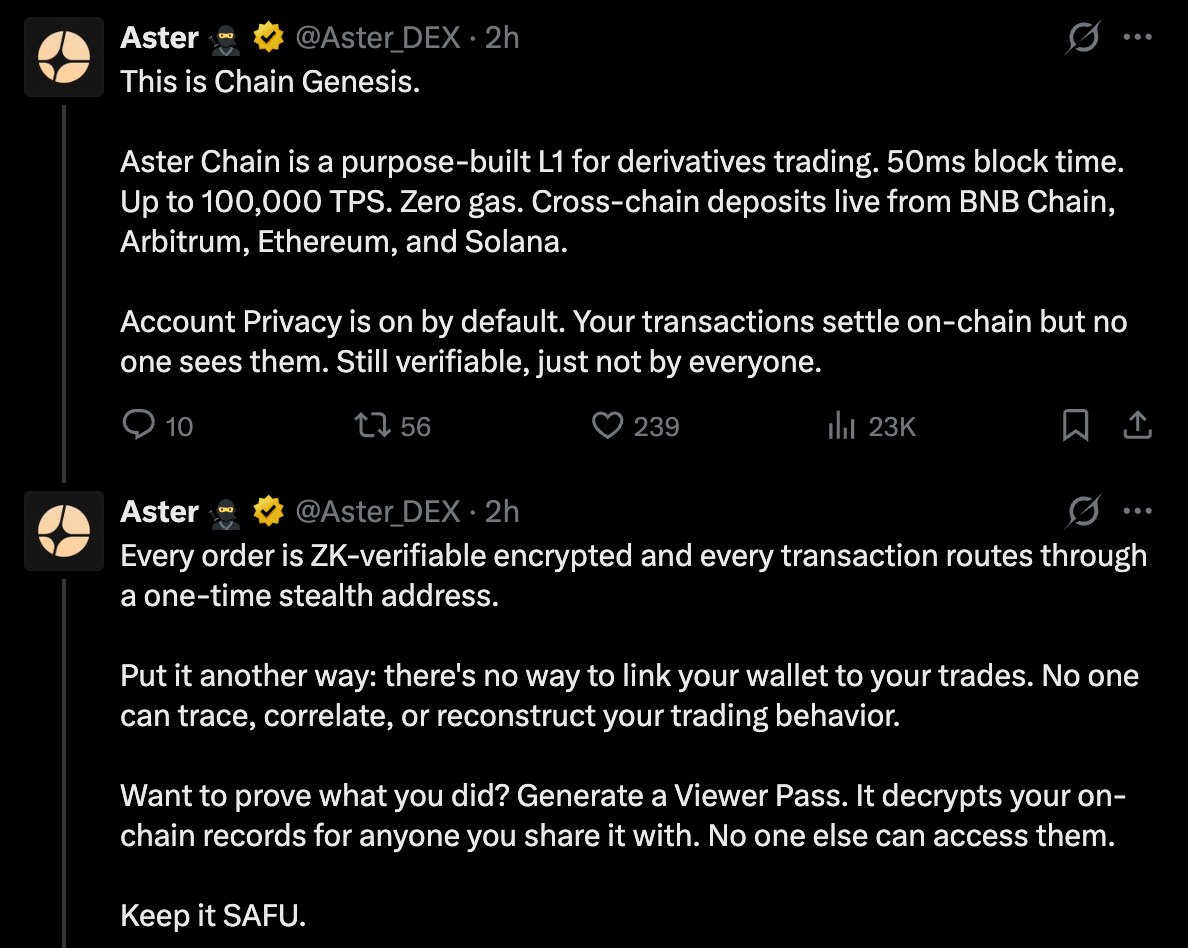
Privacy sits at the core of the design. Every trade is encrypted and routed through one-time stealth addresses, making it nearly impossible to trace activity back to a user’s primary wallet. For compliance or audit purposes, users can generate “viewer passes,” allowing selective disclosure of transaction histories without exposing data publicly.
The chain operates on a hybrid Proof-of-Staked Authority (PoSA) consensus model, blending economic incentives with validator reputation systems to balance decentralization and speed. Initially, validator participation remains limited, though Aster plans to expand this over time.
Aster Chain also launches with cross-chain interoperability, supporting deposits from Ethereum, Solana, BNB Chain, and Arbitrum. This positions it as a liquidity hub for multi-chain traders seeking both speed and discretion. In addition, public staking for ASTER holders is scheduled for release later this week, along with ecosystem expansion and an “Aster Code” partners program.
The launch of the mainnet has generated significant buzz on X with user @MoneyLord tweeting, “No one ships fast like aster.” Another user, @medonchain, said, “Finally I can stake my tokens!!! been waiting for this for so long.”
Still, the approach raises broader questions. By prioritizing privacy at the execution layer, Aster is entering a regulatory gray zone where transparency has historically been a cornerstone of blockchain trust.
If successful, Aster Chain could mark a turning point, where privacy, performance, and decentralization are no longer seen as trade-offs, but as parallel design goals.
- What problem is Aster Chain trying to solve?
Aster Chain addresses the lack of privacy in DeFi by enabling fully encrypted, verifiable trading where user activity cannot be publicly traced, while still maintaining onchain settlement. - How does Aster Chain ensure both privacy and transparency?
It uses zero-knowledge proofs and stealth addresses to hide transaction details, while allowing users to selectively reveal their activity through “viewer passes” when needed. - What makes Aster Chain suitable for high-frequency trading?
With 50ms block times, up to 100,000 TPS, and zero gas fees, the network is optimized for speed and cost efficiency, making it comparable to centralized exchanges. - How does cross-chain functionality work on Aster Chain?
Users can deposit assets from major networks like Ethereum, Solana, BNB Chain, and Arbitrum, enabling seamless liquidity access and multi-chain trading strategies within one platform.
免责声明:本文章仅代表作者个人观点,不代表本平台的立场和观点。本文章仅供信息分享,不构成对任何人的任何投资建议。用户与作者之间的任何争议,与本平台无关。如网页中刊载的文章或图片涉及侵权,请提供相关的权利证明和身份证明发送邮件到support@aicoin.com,本平台相关工作人员将会进行核查。


