Andrej Karpathy, a co-founder of OpenAI and former Tesla artificial intelligence (AI) director, released an interactive “AI Job Exposure Map” on March 15, analyzing 342 occupations drawn from the U.S. Bureau of Labor Statistics (BLS) Occupational Outlook Handbook.
The project evaluated roughly 143 million U.S. jobs by feeding job descriptions into a large language model and assigning each role an exposure score from zero to 10, measuring how much AI could theoretically reshape that work.
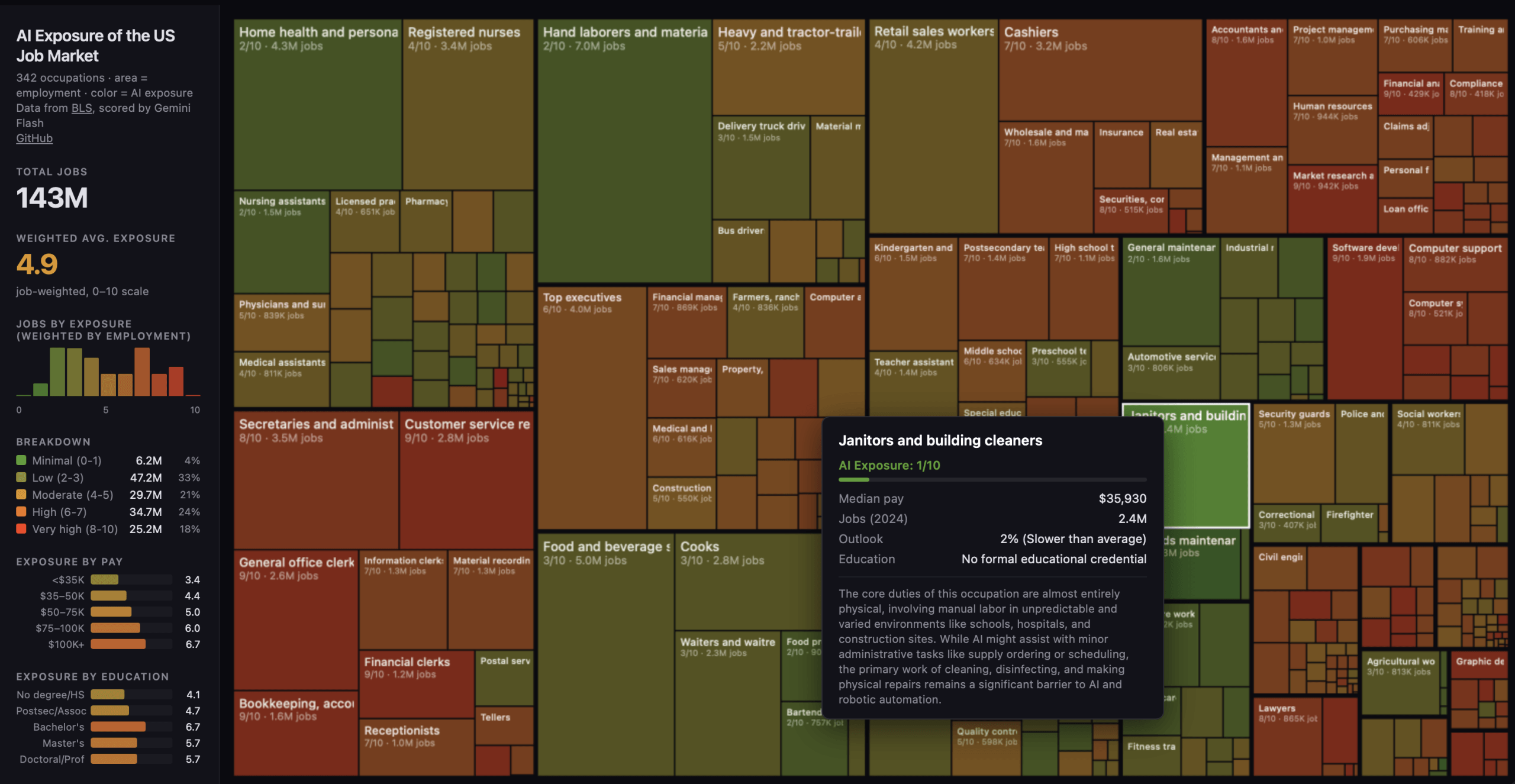
A fork of Karpathy’s map. Source: https://joshkale.github.io/jobs/
The results were displayed in a colorful treemap visualization hosted at karpathy.ai/jobs, where rectangle size reflected employment numbers and color represented exposure levels, ranging from green for minimal disruption to deep red for roles that could see extensive automation. In short: the bigger and redder the box, the more attention it demanded.
Across the entire U.S. workforce, the weighted average exposure landed around 4.9 out of 10, suggesting moderate potential for AI influence overall. But averages hide a lot of drama. Roughly 42% of American jobs—about 59.9 million workers earning an estimated $3.7 trillion in annual wages—scored seven or higher on the exposure scale.
Breaking the numbers down further, about 6.2 million jobs fell into the minimal exposure category, while 47.2 million were classified as low. Another 29.7 million landed in the moderate range. The more striking figures appeared at the top of the scale: roughly 34.7 million jobs ranked high, and 25.2 million fell into the very high exposure bracket.
Karpathy’s analysis also produced a counterintuitive twist about pay. Lower-income jobs averaging under $35,000 annually scored around 3.4 on exposure, while occupations paying more than $100,000 averaged 6.7. In other words, the higher the paycheck, the more likely the job involved tasks that artificial intelligence systems can replicate or assist with today.
Education levels showed a similar pattern. Workers without college degrees averaged an exposure score of roughly 4.1, while those with bachelor’s degrees topped the chart at about 6.7. Advanced degree holders landed somewhere in the middle, around 5.7.
Looking at individual occupations paints an even sharper picture. Medical transcriptionists scored a perfect 10, reflecting how speech recognition and automated documentation systems already perform many of those tasks. Lawyers, accountants, financial analysts and management consultants often scored around nine, largely because their work revolves around structured information, documents and research.
Software developers—ironically the people building many AI tools—also ranked high, often scoring between eight and nine. Meanwhile, roles such as administrative assistants, bookkeeping clerks and customer service representatives showed similarly elevated exposure levels due to their reliance on digital workflows.
On the opposite end of the spectrum, jobs that happen in the physical world rather than on a computer screen fared far better. Plumbers, electricians and construction laborers typically scored between zero and two, highlighting the persistent difficulty of automating unpredictable, hands-on tasks.
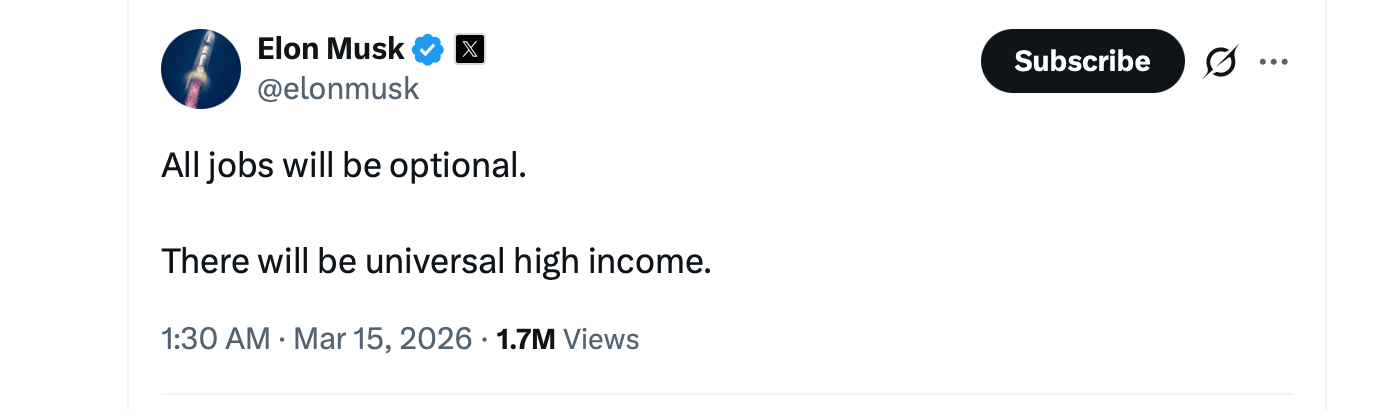
The map’s rapid spread online triggered commentary across the technology world, including a brief response from Tesla and SpaceX CEO Elon Musk. Replying to a thread about the visualization, Musk wrote: “All jobs will be optional. There will be universal high income.”
The comment echoed Musk’s long-standing argument that advanced artificial intelligence and robotics could eventually produce enough economic abundance to reduce reliance on traditional employment.
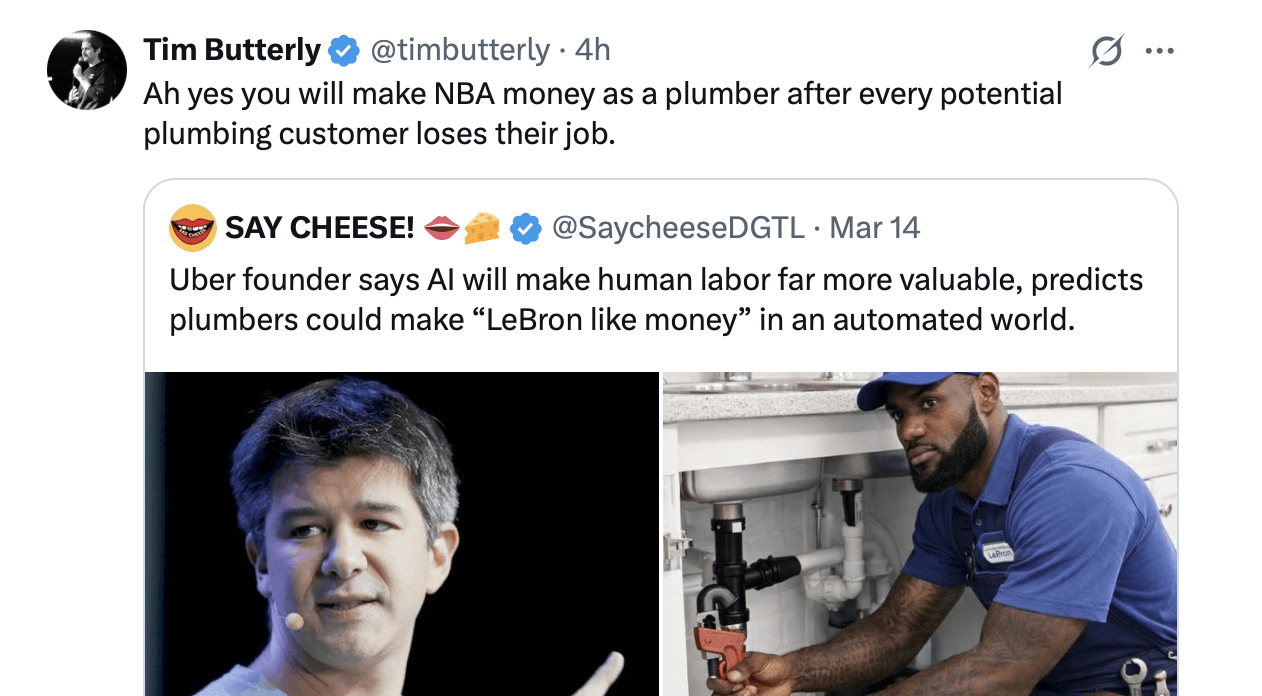
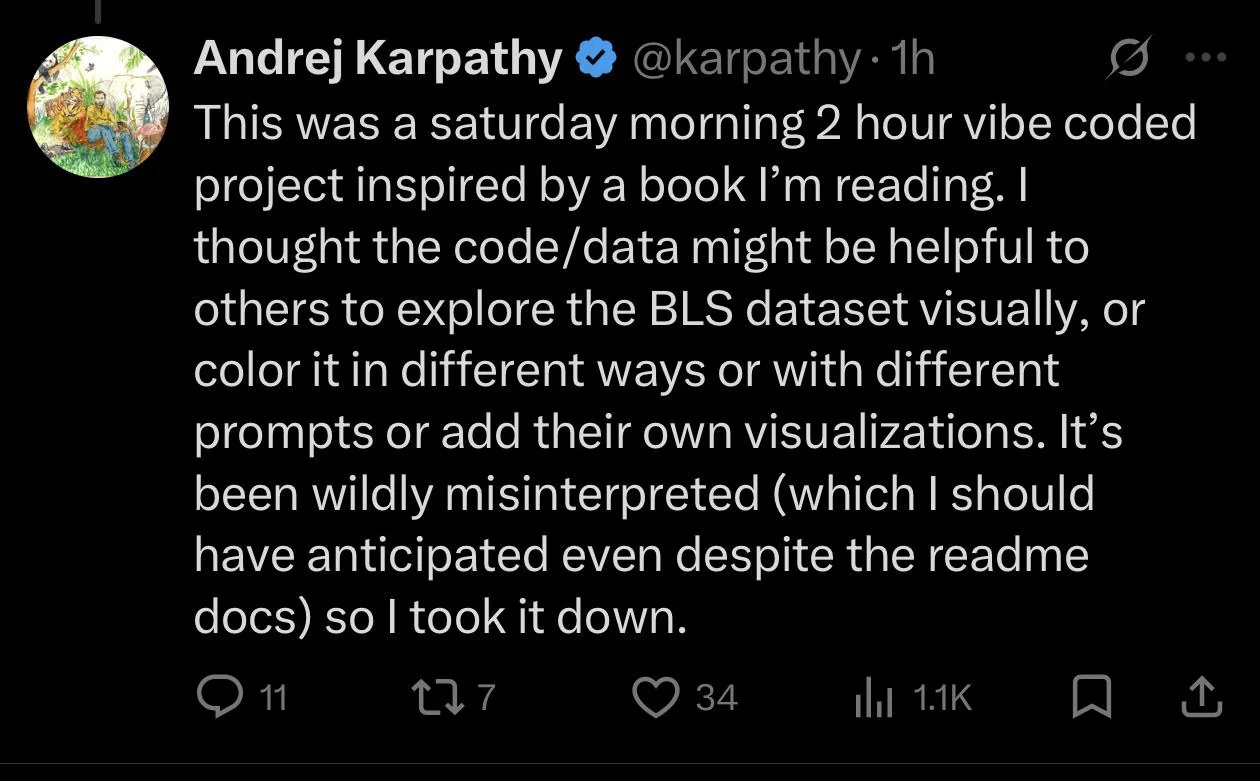
Despite the attention, Karpathy quickly removed the original website and its Github repository, explaining in a follow-up post that the project was a quick experiment—what he described as a two-hour “vibe-coded” exploration inspired by a book he was reading. According to Karpathy, the project’s exploratory nature was widely misunderstood despite clear disclaimers.
Taking the site down did little to slow its spread. Archived copies appeared almost immediately on the Wayback Machine, and the code repository was forked numerous times by developers who replicated the dataset, scoring rubric, and visualization tools.
The episode illustrates two realities of the modern internet: AI research can ignite global debates overnight, and once data escapes into the open web, it rarely disappears. For now, Karpathy’s experiment remains less a prophecy of job losses than a snapshot of how current AI systems overlap with human work.
The takeaway, if there is one, is refreshingly straightforward. If your entire job happens on a screen, artificial intelligence may soon become your co-worker—or your fiercest competitor.
- What is Andrej Karpathy’s AI Job Exposure Map?
It is a visualization analyzing 342 U.S. occupations and scoring how susceptible each job may be to AI automation. - How many U.S. jobs could be affected by AI exposure?
The analysis suggests about 42% of U.S. jobs—roughly 59.9 million workers—have high exposure scores. - Which jobs show the highest AI exposure?
Roles such as lawyers, accountants, software developers and medical transcriptionists scored among the highest. - Which occupations appear least exposed to AI automation?
Hands-on trades like plumbers, electricians and construction workers ranked among the lowest exposure categories.
免责声明:本文章仅代表作者个人观点,不代表本平台的立场和观点。本文章仅供信息分享,不构成对任何人的任何投资建议。用户与作者之间的任何争议,与本平台无关。如网页中刊载的文章或图片涉及侵权,请提供相关的权利证明和身份证明发送邮件到support@aicoin.com,本平台相关工作人员将会进行核查。


