On Monday, March 2, bitcoin ( BTC) briefly breached the $70,000 mark, signaling a potential return to its “digital gold” status. After plummeting to an intraday low of approximately $65,150, BTC launched a rally to $70,111 around 11:00 a.m. EST—a surge of $5,000 in under two hours. Although it later retreated below the $69,500 threshold, the leading cryptocurrency remained up 5% over the last 24 hours.
Bitcoin’s resilient price action stood in stark contrast to global equities, which crumbled as investors reacted to escalating hostilities between the U.S. and Israel on one side, and Iran on the other. In Asia, the Nikkei, which hit record highs in late February, closed 1.35% lower. South Korea’s KOSPI fell 1%, while the Hang Seng dropped over 570 points (2.14%). India’s Sensex also finished in the red.
In Europe, key indices closed lower across the board, reflecting widespread anxiety over the conflict’s trajectory. In U.S. markets, the Nasdaq Composite, which mirrored bitcoin’s movements for much of February, opened with a sharp drop before paring losses to sit 0.5% higher at the time of writing. At the time of writing, the S&P 500 and Dow Jones remained largely flat after reversing steep opening losses.
While the cryptocurrency market initially bore the brunt of the Feb. 28 panic, the contagion spread to traditional equities on Monday. The catalyst was a violent spike in energy futures; as oil and natural gas prices surged, investors preemptively sold off stocks in anticipation of squeezed corporate margins and diminished consumer spending.
This risk-off sentiment was further intensified by reports that major maritime carriers are rerouting vessels away from the Strait of Hormuz. As a primary artery for global energy transit, any disruption there creates a supply-side shock that reignites dormant inflation fears.
In this high- inflation, high-uncertainty environment, the narrative is shifting. While equities struggle under the weight of rising input costs, the market is pivoting toward hard assets. In the past, such systemic instability favoured bitcoin and other store-of-value assets, as they offer a hedge against the fiat-currency debasement often triggered by energy-driven inflationary cycles.
While markets attempted to stabilize, the threat of regional escalation remains the primary “fear index” driver. A joint ultimatum from Saudi Arabia and the UAE to retaliate against Iranian strikes has raised the stakes, threatening to expand a bilateral conflict into a multi-front war involving the Gulf’s largest economies.
Market observers warn that a protracted conflict could propel oil prices beyond the psychological $100-per-barrel threshold. Such a surge would likely compel the U.S. government to authorize a strategic release from the Strategic Petroleum Reserve (SPR) to stabilize domestic costs. While OPEC has signaled a willingness to ramp up production to mitigate shipping disruptions, the structural damage to global logistics remains a primary concern.
Analysts at Bitunix caution that sustained energy inflation could fundamentally derail current interest rate trajectories, forcing central banks to rethink their “soft landing” narratives as inflation expectations are recalibrated upward.
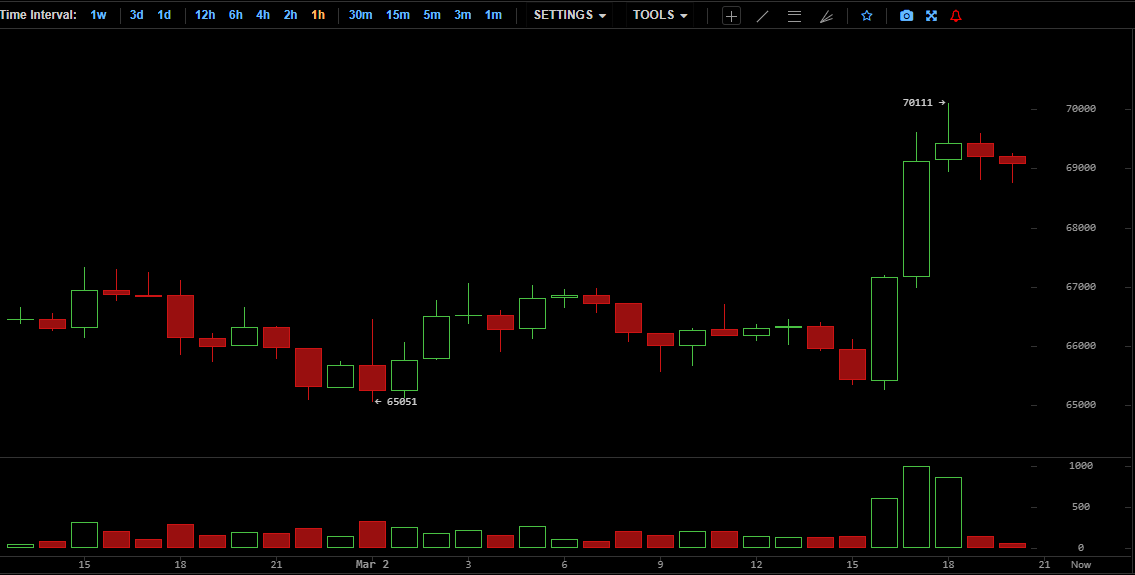
In the immediate term, global capital is rotating rapidly into traditional bastions of safety: gold and the U.S. Dollar. However, for bitcoin, the coming days represent a historic crossroad for its reputation as a safe-haven asset.
“ BTC faces a dense concentration of short positions between 67,800 and 69,500, with substantial support in the 64,000–65,000 range,” noted Bitunix analysts. “If the conflict intensifies and safe-haven demand rises, breaking through the overhead liquidation zone will determine if the market truly redefines BTC as digital gold. Conversely, a pullback toward 64,000 would reinforce its status as a high- volatility risk asset.”
- Why did bitcoin surge while Wall Street struggled? BTC rallied 5% even as Nasdaq and S&P 500 swung on energy inflation fears.
- How did Asian markets react to the conflict? Japan’s Nikkei, Korea’s KOSPI, and Hong Kong’s Hang Seng all closed lower.
- What was the impact on European equities? Major indices fell broadly as investors braced for escalation in the Gulf.
- Does this strengthen bitcoin’s digital gold narrative? Analysts say safe-haven demand could redefine BTC amid inflation and war risks.
免责声明:本文章仅代表作者个人观点,不代表本平台的立场和观点。本文章仅供信息分享,不构成对任何人的任何投资建议。用户与作者之间的任何争议,与本平台无关。如网页中刊载的文章或图片涉及侵权,请提供相关的权利证明和身份证明发送邮件到support@aicoin.com,本平台相关工作人员将会进行核查。


