Introduction: Redefining the Boundaries of Prediction Markets
Prediction markets are marketplaces that allow participants to trade on the outcomes of uncertain future events, with contract prices reflecting the market's consensus judgment on the likelihood of those events. They have demonstrated significantly greater accuracy than expert predictions and polls in areas such as political elections, macroeconomics, sports events, crypto assets, and corporate events.
The essence of prediction markets is as a tool for "information financialization" — price equals probability. In fields characterized by high uncertainty and strong subjective judgment, prediction markets have significant advantages.
The total global trading volume of prediction markets is about $50.25 billion in 2025. If maturity is defined by trading volume rather than narrative, prediction markets will truly complete their leap from [event-driven short-term curiosity] to [persistent markets] by 2025.
Kalshi has validated that the industry is not just about "trading volume," but is beginning to manifest commercial capabilities — claiming to generate about $260 million in fee revenue in its report. Nonetheless, prediction markets have not truly entered a growth phase; compared to the hundreds of trillions of dollars in annual trading volume of mature global futures markets, they resemble financial futures in 1982 rather than cryptocurrencies in 2020.
Unlike most financial innovations, prediction markets have not undergone long-tail competition but have quickly consolidated into two platforms: Kalshi and Polymarket, which together account for over 97.5% of market share, while all other platforms collectively have a trading volume of only about $1.25 billion, which is marginal in the ecosystem.
1. The Essence of Prediction Markets: An Information Production Mechanism in a Non-Attention Economy
Prediction markets are no longer merely an innovation in trading forms but are evolving into an information production mechanism in a non-attention economy.
The core difference from traditional attention economies lies in:
- Value does not depend on clicks, traffic, or popularity
- The core asset is the quality of cognition and information
- Market participants seek verifiable, tradable, and referable judgments rather than short-term attention exposure
Under this logic, the competitive landscape for prediction markets has also changed:
- Brokerage research systems
- Consulting firm judgment systems
- Media narrative rights
- Probability outputs after AI training
In other words, this is a market for pricing future cognition.
The true watershed moment for the industry at this stage is not technological, but hinges on three things: whether continuous information liquidity can be formed; whether it enters a "weakly regulated tolerance zone" rather than a gray arbitrage zone; and whether it is treated by institutions as a decision-making input rather than a retail entertainment tool. Once these three points are established, the form of prediction markets will resemble a hybrid of Bloomberg + exchanges + polling agencies, rather than a Web3 application.
Problem definition rights: the severely underestimated core asset
The vast majority of people underestimate the most core asset of prediction markets — it is not liquidity, but the ability to define problems.
Whoever masters problem definition, masters: information entry, trading context, and probability interpretation rights. This is highly similar to the power structure of index companies (such as MSCI). A well-designed market question is essentially a tradable cognitive framework.
2. Why Will the Value of Prediction Markets Suddenly Be Reassessed in the 2024–2026 Cycle?
2025 is not coincidentally the turning point; it results from the confluence of three structural factors.
2.1 Clarification of Regulatory Expectations
• In 2024, multiple states and the CFTC in the U.S. are expected to clarify their regulatory attitudes towards event contracts
• Kalshi's legitimate pathway opens traditional institutional funding avenues, resulting in a sudden amplification of institutional trading volume
• Traditional investors begin to view prediction markets as "event trading tools that can contribute to alpha," rather than gray gambling
2.2 Intensification of Trading Volume + Continuous Event Supply
• Historically, prediction market events were mostly concentrated in politics or single occurrences, with short trading cycles and high volatility
• In 2025, high-frequency events (sports, corporate KPIs, crypto market events) will emerge, allowing the market to continuously absorb funds
• Continuous events create a self-reinforcing cycle of liquidity: liquidity brings information depth → attracts more trades → makes price signals more accurate
2.3 Marginal Amplification of Information Demand
- Despite the data overload in the AI era, "probability credibility" has become a scarce asset
- Quant funds, hedge funds, and corporate decision-making departments begin to regard prediction market prices as genuine signal sources
The core logic is not about user growth in traffic but about the centralization of liquidity triggered by capital and information demand — this is the true turning point for prediction markets.
2.4 Three Structural Forces Converging
Force One: The "failure margins" of traditional research systems are becoming apparent
Over the past decade, sell-side research has significantly lagged in predicting macro turning points; buy-side firms increasingly view "the speed of consensus formation" as a source of alpha; and expert models increasingly resemble narrative engineering rather than probability discovery.
Prediction markets offer a different paradigm: it is not about "who is smarter," but "who is willing to pay for a judgment." Capital exposure itself becomes an information filter.
Force Two: After the rise of AI, human society paradoxically needs "real signal sources" more
Large models can generate judgments but cannot bear risk. The uniqueness of prediction markets lies in their irreplaceable mechanistic advantages:
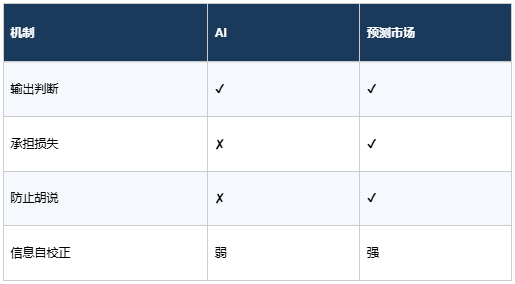
Thus, it has become one of the few systems with fact-anchoring mechanisms in the AI era, which is why more and more quantitative funds are treating prediction market prices as exogenous variables.
Force Three: Web3 has addressed a key constraint — settlement credibility
The biggest issue in early prediction markets was not the lack of predictions but: who would be the market maker? How to avoid defaults? How to enable global participation? On-chain settlement reduces trust from "trusting the operator" to "trusting code execution," allowing prediction markets for the first time to have the ability to expand across jurisdictions.
3. Head Platform Scale Comparison (Actual Size in 2025)
① Kalshi — Current Liquidity Center
• The 2025 nominal trading volume is about $23.8 billion, an increase of over 1100% year-on-year
• At one point, it accounted for 55%–60% of industry weekly trading volume, becoming the most liquid market
• During some statistical periods, global market share rose to 62.2%
• Monthly trading volume once reached the $1.3 billion level
• The growth dynamics mainly come from the opening of regulatory pathways to traditional funding, rather than from the expansion of crypto users
Kalshi chose a completely different strategy: actively entering the regulatory framework and defining the prediction market as an "event contract exchange" in an attempt to replicate the legitimacy paths of the futures market. Short-term growth is slow, but if successful, it will open the floodgates for pension/RIA/institutional fund allocations.
② Polymarket — Crypto Native Liquidity Hub
• The total trading volume in 2025 is about $22 billion
• It has maintained monthly trading levels of hundreds of millions during some months
Polymarket has taken a global permissionless liquidity approach: rapidly forming event coverage density, utilizing on-chain to reduce participation friction, and replacing compliance depth with trading activeness.
Its true value is not in trading volume but in establishing the world's first "real-time political probability curve" — such data has never existed in traditional systems.
③ Second-Tier Platforms (Total Share is Extremely Small but Represents Future Divergence Directions)
Despite the highly concentrated market, several exploratory platforms, such as Azuro and TrendleFi, have emerged. These platforms collectively contribute only about $1.25 billion in trading volume, indicating that the industry has not yet entered a stage of "a hundred flowers blooming" but is still in the phase of infrastructure rights recognition.
Augur represents the limitations of the first generation of decentralized experiments: overemphasizing "trustlessness," neglecting the real trader experience, and failing to solve issues of problem distribution and liquidity acquisition. This shows that prediction markets are not purely a technical issue but a market design issue.
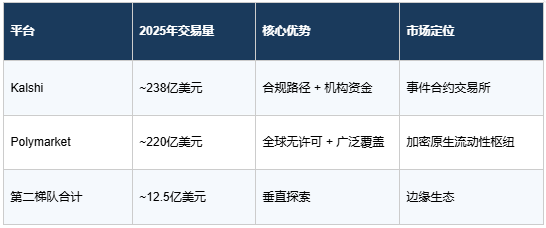
The logical conclusion is that the core of prediction markets is not technology but the compound moat of liquidity and event design ability. Low liquidity platforms struggle to win through decentralization competition.
4. Why Do Most Prediction Markets Fail?
Historically, failing platforms have not succumbed to technology but to market microstructure.
4.1 Treating Prediction Markets as "Event Casinos"
This mistake results in high-frequency noise overwhelming information traders, causing market-making capital to be unable to stay long-term, and the Sharpe Ratio becoming unsustainable. Successful prediction markets must give information-type traders a structural advantage.
4.2 Mismatch of Liquidity Sources
What prediction markets need are not retail investors but: macro traders, policy researchers, industry experts, and risk hedgers. They provide information-driven trading flow rather than gambling-driven trading flow.
4.3 Misdesign of Settlement Frequency
If the market settlement cycle is too short, it devolves into gambling; if too long, it loses capital efficiency. The optimal range is usually for events with an information half-life of 2 weeks to 6 months, which corresponds to real-world time windows that "can form disagreements but are still verifiable."
5. Vertical Track Analysis: Four High-Growth Sub-Directions
As the window for general prediction markets gradually closes, track opportunities are concentrating in a vertical direction. Sports, creator economy, AI predictions, and social Bot interactions have become the four fastest-growing sub-tracks currently.
5.1 Sports Track
Key Logic
Sports events naturally have high-frequency schedules and clear outcomes, making them easy to forecast quantitatively, while also forming highly engaged user bases. Platforms can quickly build trading markets and odds systems through middleware (e.g., Azuro Protocol), lowering technical barriers.
Representative Projects
• Football.fun: Short-term TVL exceeds $10 million, with high user activity
• Overtime: Combining community interaction with derivatives trading to form a closed-loop ecosystem
• SX Network, Azuro Protocol: Providing public chain and middleware support for sports predictions
User Behavior Characteristics
• High-frequency participation, instant betting, active trading around events
• User actions are easily influenced by community and social recommendations
• Preference for leverage tools and short cycle contracts, seeking rapid feedback
Trends and Opportunities
In the next 1-3 years, the sports track will further professionalize: high-frequency derivatives, leveraged trading, and cross-chain aggregation will become standard configurations, forming a composite growth model of "sports prediction + community economy" through community and event ecosystems.
5.2 Creator Economy Track
Key Logic
The combination of prediction markets and the creator economy directly empowers KOLs to generate market growth and revenue distribution. Users become community content producers while participating in predictions, creating a closed-loop ecosystem through creator sharing incentives that lead to viral growth.
Representative Projects
• Melee: Offers a 20% creator share to incentivize KOLs to drive market creation
• Index.fun: 30% creator revenue generates a "creator index" from prediction results, enhancing secondary trading and community participation
Trends and Opportunities
In the future, the creator track will move toward indexization and platformization: platforms can convert creator influence into tradable assets through prediction indices and NFT incentivization and sharing mechanisms.
5.3 AI Prediction Track
Key Logic
AI is upgrading from an auxiliary tool to a core product, assuming market generation, event analysis, content production, and settlement functions. Through intelligent agents and Copilot, platforms achieve zero-cost creation, infinite supply, and automated settlement, significantly lowering operational costs.
Representative Projects
• OpinionLabs: AI agents generate event markets and automatically settle prediction results
• BuzzingApp: AI-driven zero human operation, supporting rapid event iteration and settlement
Trends and Opportunities
In the next 1-3 years, AI will become a standard in prediction markets: market generation automation, intelligent settlement, event analysis, and risk control will become entirely AI-driven, while simultaneously attracting professional quantitative traders.
5.4 Social Bot Interaction Track
Key Logic
Lightweight front-end and social embedding lower user operational barriers by directly embedding prediction trading into Telegram, X platform tweets, or content wallets, forming a closed loop where "social equals trading."
Representative Projects
• Flipr, Noise: Telegram Bots simplify complex trading operations with one-click ordering
• XO Market: Aggregates orders from multiple platforms, providing leverage and stop-loss features to meet professional user needs
Trends and Opportunities
In the future, the social Bot track will deeply integrate platform aggregators and leverage tools, achieving cross-chain liquidity integration, and further expanding user coverage through social embedding, becoming the "growth engine" of prediction markets.
Summary: The rise of vertical tracks reflects the trend of prediction markets evolving from a general information tool to "derivatized + data service-oriented + AI embedded + creator/social ecosystem." Each track is forming a complete logical chain: market drives → user behavior → technical support → investment opportunities.
6. Breakthrough Points for Small Prediction Markets
Despite extremely high industry concentration, small platforms still have several types of "blue ocean" opportunities to tap into:
6.1 Vertical / Niche Markets
• Professional sports events, e-sports, industry KPIs
• Internal corporate prediction markets, professional association events
• Specific industry or regional policy events
Logic: Deep or specialized events that mainstream platforms cannot cover can form high-value but low-transaction volume markets.
6.2 Data Productization + B2B Embedding
• Not directly engaged in trading, but turning price signals into API/index products sold to funds or enterprises
• Core advantages include low regulatory risk + sustainable business models
6.3 Experience Differentiation / Information Value Addition
• Providing analytical tools for predictions and community consensus mechanisms
• Making predictions "cognitive value-add rather than pure transactions" to enhance user stickiness
The core logic is that small platforms should avoid direct competition on liquidity and focus on high-value, low-scale scenarios + data output business models.
7. Investment Perspective: Structural Infrastructure is the True Betting Direction
Potential high-value directions include:
• Prediction market data API (sold to quantitative funds)
• Enterprise-level decision market SaaS
• Market making and risk intermediation
• Probability index products (similar to the VIX Future Expectation Index)
The true moat will belong to those who control the distribution of probabilities, rather than those who merely facilitate transactions.
7.1 VC Actual Investment Direction Overview
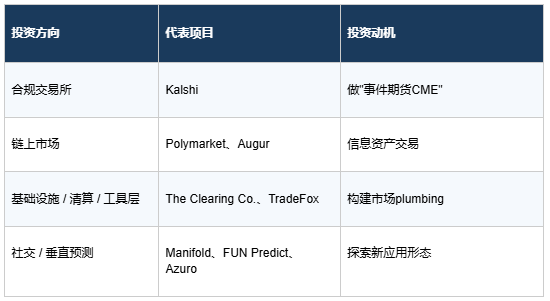
7.2 Key Financing Signal Interpretation
The Clearing Company completed about $15 million in financing, with investors including Union Square Ventures, Coinbase Ventures, Haun Ventures, and Variant. This is a very critical signal: capital is beginning to regard prediction markets as a formal asset class that requires a clearinghouse.
Kalshi’s valuation has risen to $5 billion; FanDuel and CME are also preparing to launch prediction market products to participate in competition; by 2025, institutional capital is expected to account for about 55% of prediction market capital. This indicates it is undergoing an evolutionary path similar to that of DEX in 2017 → DeFi in 2021 → prediction market tech stack in 2024.
8. Future Trends and Evolution Directions
8.1 Mechanism Evolution: Deepening Derivatization
Prediction markets will gradually move from "predicting event outcomes" to aligning with high-frequency trading, structured options, and leveraged contracts. Typical paths include:
• Short-cycle event contracts (e.g., Limitless 30-minute contracts) → high-frequency volatility trading tools
• Leveraged trading (Flipr 5x) → integration with DeFi leverage protocols, forming an on-chain derivatives ecosystem
• Interval predictions, arbitrage spreads → gradually evolving into structured options and financial derivatives
At the same time, cross-chain and cross-platform liquidity integration will become core competitiveness. Aggregators will merge order books from different platforms to provide optimal pricing and settlement solutions, similar to "prediction market 1inch."
8.2 Product Evolution: Data Service Orientation + AI Embedding
Prediction market prices will reflect "event probabilities" and will become core data sources for institutional quantification, asset allocation, and risk management. Product forms will include:
• Data subscriptions: providing real-time market probabilities, top account behaviors, and arbitrage opportunities
• Indexing: combining different prediction results into "creator indices" or "event indices," facilitating secondary trading or embedding into DeFi
• Visualization terminals: predicting market Bloomberg terminals like Polysights, directly providing strategy signals
At the same time, AI will participate in market generation, automated settlement, content parsing, and risk control: automatically generating event markets (zero human intervention), intelligent settlements and odds adjustments, and AI Agent/Copilot participating in trade predictions.
8.3 Infrastructure Evolution: Modular and Composable
Prediction markets will resemble DeFi Legos more: market generation, settlement, liquidity, oracles, AI Agents, etc., will be modular, supporting plug-and-play capabilities, lowering technical barriers, and facilitating multi-chain deployments.
• Gnosis CTF → standardized asset issuance
• Azuro Protocol → gambling middleware
• Polymarket/Kalshi → core settlement layer
Multi-chain deployment and cross-chain order aggregation are becoming standard: Base, Polygon, Solana, and other chains will serve as fundamental support for vertical tracks.
8.4 User Experience Evolution
Front-end interactions will evolve toward socialization, lightweight, and immediacy: Bots (Telegram/social platforms), one-click ordering, and leverage operations will be embedded into content ecosystems. AI + intelligent oracles will reduce manual operations and costs, while automated settlements and smart event parsing will enhance platform scalability.
In the next 1-3 years, prediction markets will experience an accelerated development trend driven by "derivatization + data service orientation + AI embedding + composable infrastructure." From a mere information aggregation tool, it will evolve into a combination of financial derivatives market + data services + AI ecosystem + creator/vertical track integration. Investment value will focus on infrastructure modules, data services, vertical track applications, AI, and innovation in interaction layers.
Conclusion: A New Social Infrastructure
Prediction markets are not a marginal innovation in finance but are attempting to solve a fundamentally basic question:
How do humans form executable consensus on uncertainty?
When information overload, AI generalization, and expert failure occur simultaneously, the importance of such a mechanism is just beginning to emerge.
It resembles a new form of social infrastructure rather than an asset class.
免责声明:本文章仅代表作者个人观点,不代表本平台的立场和观点。本文章仅供信息分享,不构成对任何人的任何投资建议。用户与作者之间的任何争议,与本平台无关。如网页中刊载的文章或图片涉及侵权,请提供相关的权利证明和身份证明发送邮件到support@aicoin.com,本平台相关工作人员将会进行核查。


