Original | Odaily Planet Daily (@OdailyChina)
Author | Dingdang (@XiaMiPP)
On February 24, Backpack CEO Armani Ferrante announced a plan for staking to exchange equity, meaning that users who stake the native tokens of the Backpack platform for at least 1 year will have the opportunity to exchange these tokens for real company equity at a fixed ratio. The company has reserved 20% of its equity for this plan.
The amount of information released in this short statement far exceeds the usual TGE narrative.
In traditional TGE narratives, users are seen as traffic or community token holders; however, in this design, Backpack attempts to elevate users from product consumers to legally recognized company owners.
The question is: can it really hold up? Is this a financial innovation or a high-risk experiment dancing on the regulatory edge? Does it change the power structure, or is it just a more sophisticated way of managing chips? To understand this, we must return to the historical trajectory of Backpack itself.
Backpack: A Company Rising from the Ashes
Backpack is an integrated “wallet + exchange” platform centered around the Solana ecosystem, founded by former FTX and Alameda Research member Armani Ferrante. It was established after the collapse of FTX, emphasizing compliance and user custody.
However, unlike centralized exchanges like Binance, which follow a “trade first, ecosystem later” development path, Backpack's approach is the reverse. It started with a wallet and NFTs, gradually building up users, community, and technical foundation before launching the exchange.
Looking back at Backpack's history: In 2022, the collapse of FTX not only tore apart the credit structure of the entire cryptocurrency industry but also severely impacted associated projects. Backpack had just completed a $20 million funding round led by FTX Ventures and Jump Crypto before the FTX collapse. But as the empire fell, about 80% of Backpack's operating funds evaporated. At that time, Backpack was positioned as a “wallet + xNFT operating system,” aimed at providing a more secure and integrated entry point for Solana users to avoid dependency on centralized platforms.
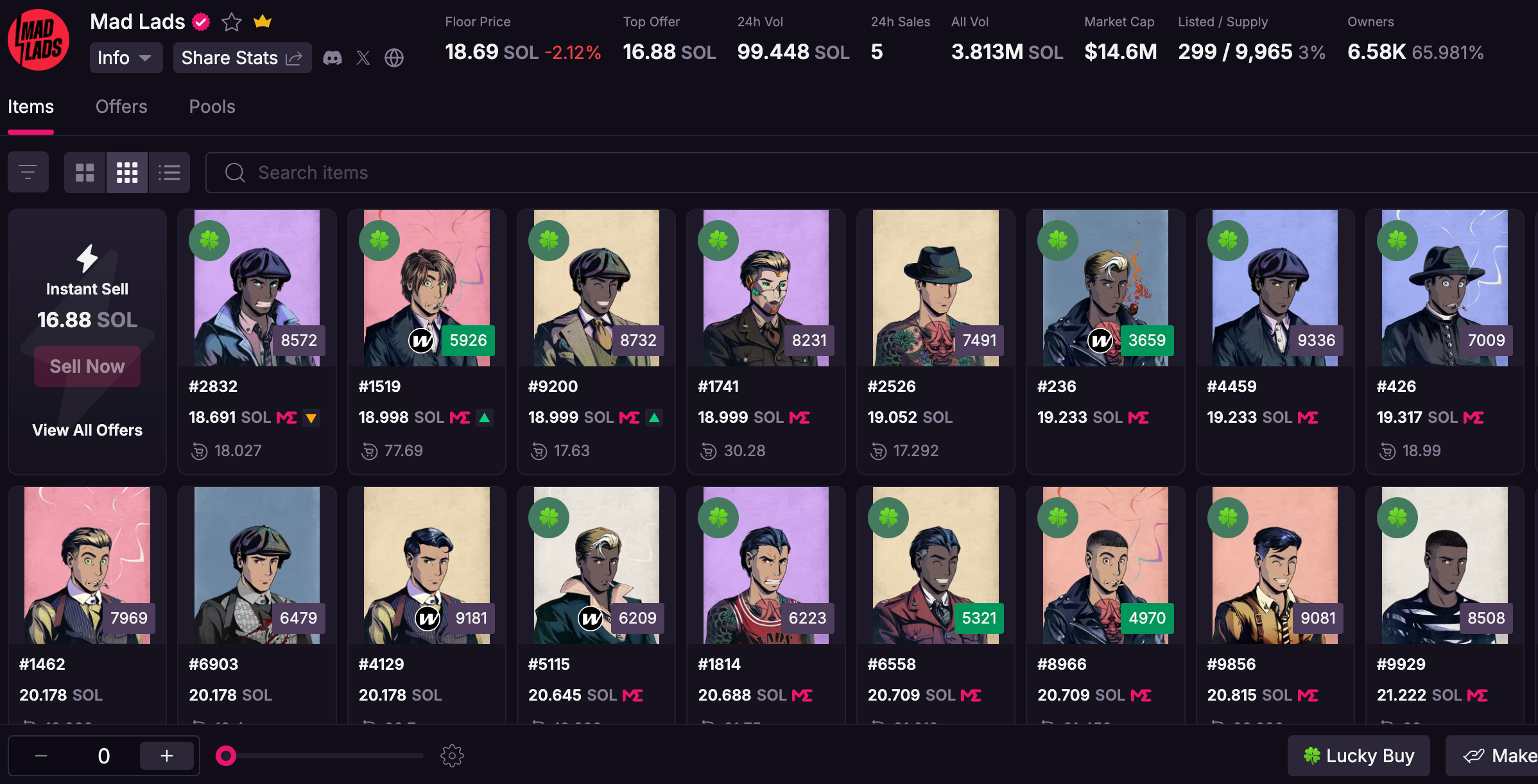
In April 2023, at the bottom of the bear market, Backpack quietly launched the Mad Lads NFT series, with a minting price of 6.9 SOL, which at one point became one of the top NFT communities on Solana, with a peak floor price reaching 229.4 SOL. In today's NFT downturn, the Mad Lads floor price maintains at 18.8 SOL, more than 2 times the minting price at that time.
In November of the same year, Backpack obtained a VARA license in Dubai and launched the Backpack Exchange (the exchange), but it was still in a small testing phase. At this point, it had built user trust through the wallet and NFT and then sought to monetize traffic through the exchange. In February 2024, Backpack completed a $17 million Series A financing round, reaching a valuation of $120 million. In January 2025, it acquired FTX Europe assets for $32.7 million, obtaining a European MiFID II license, further strengthening its compliance foundation, and committing to handle client claims from FTX EU.
Backpack was born with a silver spoon but rebuilt itself from the ruins. Over nearly 3 years, Backpack has accumulated over $400 billion in trading volume and users’ assets exceeding $350 million.
Now, it is ready for a larger leap.
Token Issuance Plan and Equity Linkage
On February 17, Backpack announced the launch of identity verification before the TGE, which is the first step for users to claim tokens.
In Backpack's announced token economic model, the total token supply is 1 billion, with 625 million available before the IPO (accounting for 62.5%), released in three stages:
- First Stage (TGE): 25% of the total supply, or 250 million tokens, will be released. Among these, 240 million tokens (24%) will be allocated to point holders, and 10 million tokens (1%) will be allocated to Mad Lads holders. This stage is 100% allocated to users, with no internal team shares.
- Second Stage (Pre-IPO): 37.5% of the total, or 375 million tokens, will be “growth-triggered unlocks,” gradually released based on key milestones (such as regulatory approval, new product launches, and regional expansions).
- Third Stage (Post-IPO): Also 37.5% of the total, or 375 million tokens, will be stored in the company's treasury, locked for one year after the IPO, for the team and investors.
From its token distribution plan, we can already see that the token issuance is tightly bound to the IPO. Backpack is negotiating the terms of a new round of $50 million financing with a valuation of $1 billion. If calculated based on this valuation, the value of the 20% equity reaches $200 million.
In the short history of the cryptocurrency industry, the act of issuing tokens has quietly evolved from an optional financing tool to an “instinctive choice” and default pathway for almost all projects. As users, we are familiar with this approach, but it also exceeds our familiar scope.
From an industry perspective, this approach fills a gap. Coinbase successfully went public in 2021 but never issued a native token; DeFi projects like Uniswap issued governance tokens but did not pursue equity listings. Backpack attempts a “dual system,” using tokens for community incentives and equity for long-term ownership, but there is no precedent for this in the cryptocurrency industry.
Is Token Issuance + IPO Feasible?
Although this plan is bold and innovative, it faces regulatory challenges.
In the U.S. regulatory context, most tokens could be viewed by the SEC as securities. If so, the company must comply with registration, disclosure, and anti-fraud rules. If it advances towards an IPO in the future, the SEC will scrutinize the token issuance history, structural design, and potential violations.
Moreover, the coexistence of equity and tokens may cause “ownership conflicts”: IPO investors worry about dilution of rights (such as voting rights, dividends), while token holders seek value capture, which may be seen as “double financing” or misleading behavior. Especially during the Gensler era from 2022 to 2024, enforcement was tightened, and many projects directly abandoned their IPOs.
In short, issuing tokens follows the “decentralized/on-chain financing” fast lane, while the IPO follows the “centralized compliance/equity financing” slow lane. Backpack is attempting to drive both vehicles at the same time, which requires strong structural design capabilities and regulatory communication abilities; otherwise, it may face delays in listing or regulatory fines.
While the cryptocurrency industry lacks a complete precedent, it is not without examples. Coinbase, as a centralized exchange, completed its IPO in 2021 but had also considered issuing tokens. Backpack co-founder Can Sun revealed in a podcast two years ago that he participated in Coinbase's listing work, helping them design the token economic model. Although Coinbase ultimately chose a pure equity listing, this experience provided valuable reference for Backpack. At that time, he was already planning to fulfill this unfinished wish at Backpack.
Can It Change the Industry?
Today, the current state of the cryptocurrency industry is that many tokens lose over 80% of their value within a year of launch, and “issuing tokens equals peak” has almost become a curse. Backpack seems to be searching for another path: allowing tokens to have the possibility of equity, driving a change in incentive mechanisms.
In the past, the familiar model was to “earn tokens through products,” meaning that project teams first produce good products and users earn token rewards through usage, such as fee-sharing, liquidity mining, airdrops, etc., with the token's value derived from the actual performance of the product. Backpack's approach, however, seems to use the expectation of tokens to feed back into company valuation, implying equity binding, IPO narratives, and rapidly gathering funds, community, and attention through the expected value of tokens, thereby raising company valuation, accelerating financing, and product iteration. Tokens are no longer just reward tools but valuation engines.
Of course, this shift is filled with uncertainty. How will regulation define this? How can rights be balanced between equity and tokens? Will the market really buy into this narrative for future shareholders? These questions have no ready answers. However, in the pessimistic moment of the cryptocurrency industry, Backpack at least attempts to offer a new tension.
Backpack has rebuilt from the ruins; this time, it aims to bridge the gaps in the system.
免责声明:本文章仅代表作者个人观点,不代表本平台的立场和观点。本文章仅供信息分享,不构成对任何人的任何投资建议。用户与作者之间的任何争议,与本平台无关。如网页中刊载的文章或图片涉及侵权,请提供相关的权利证明和身份证明发送邮件到support@aicoin.com,本平台相关工作人员将会进行核查。


