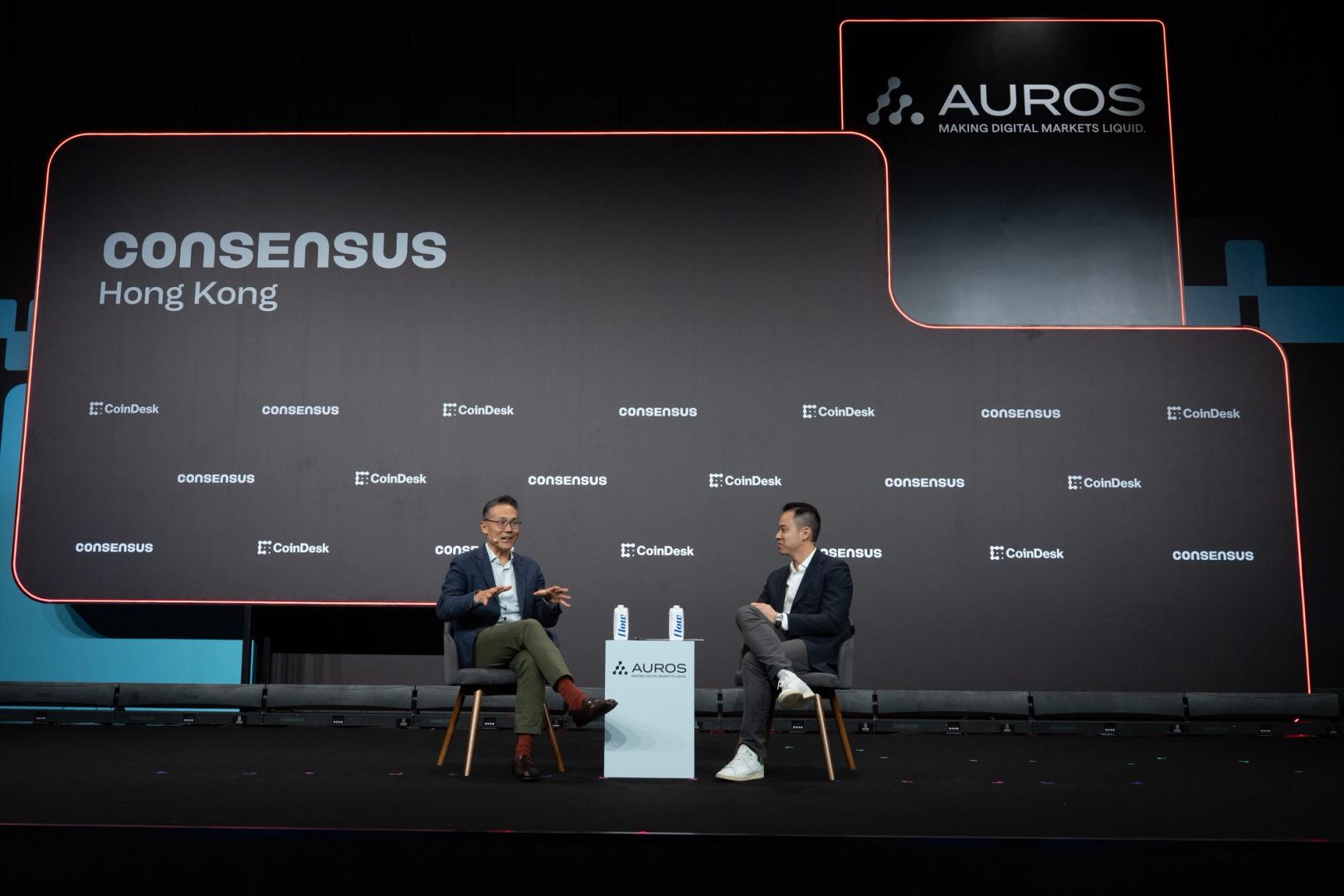
What to know : While 98% of firms are testing AI, only about 5% report bottom-line gains, McKinsey's Joe Ngai told Consensus Hong Kong on Thursday. Hierarchical structures, not technology, are slowing large-scale transformation. Companies in China are focusing on usage and embodied AI, said Ngai, who predicted a coming “robot dividend.”
Nearly every major company in the world is experimenting with artificial intelligence, but almost none are changing meaningfully as a result, McKinsey's chairman of Greater China, Joe Ngai, told Consensus Hong Kong on Thursday.
Internal surveys show 98% of corporate executives report implementing some form of AI, Ngai said. But when asked how much of that is deployed at scale, “that number drops significantly" to less than 20%, he said. When it comes to measurable profit impact, it's 5%.
The bottleneck, Ngai argued, isn’t technical capability, it's organizational design.
Modern corporations, he said, are built on “layers of people, hierarchies, managers and reporting.” In an AI-native world, that structure becomes friction.
Instead of reimagining business models, most firms are layering AI pilots onto legacy processes, seeking approvals, testing small use cases and protecting reporting lines.
“That is actually not where you get the most benefit out of AI,” Ngai said. “The bottleneck of AI implementation is actually people.”
From his vantage point in China, Ngai sees a different approach. Chinese companies have spent a decade digitizing operations around mobile and data. As a result, the “receptance … on agentic and AI is far greater,” with less resistance from labor structures and legacy governance.
Unlike Western discourse, which often centers on frontier models and artificial general intelligence, China’s focus is pragmatic: “There’s a lot less talk about the models … there’s a lot more talk around usage.”
Ngai also highlighted embodied AI, such as robotics, automation and autonomous driving, as a major frontier. Given China’s supply chain scale, he predicts a coming “robot dividend,” arguing the country may soon deploy more robots than humans, offsetting demographic decline and reshaping industrial productivity.
Ngai described 2026 as defined by two opposing forces: geopolitical uncertainty and technological acceleration. CEOs are navigating tariffs and fragmentation on one hand, and AI-driven transformation on the other. Yet corporate earnings remain resilient.
免责声明:本文章仅代表作者个人观点,不代表本平台的立场和观点。本文章仅供信息分享,不构成对任何人的任何投资建议。用户与作者之间的任何争议,与本平台无关。如网页中刊载的文章或图片涉及侵权,请提供相关的权利证明和身份证明发送邮件到support@aicoin.com,本平台相关工作人员将会进行核查。


