Original Title: "Strategic Resolve"
Author: Long Dian MrDAO
"Those who can see through the essence of things in half a second and those who cannot see the essence of things in a lifetime are destined for completely different fates."
This classic line from the movie "The Godfather" sharply delineates the divide between excellence and mediocrity with a near-cold precision. Behind this divide lies not a simple contest of talent, resources, or luck, but a more fundamental ability—strategic resolve. Strategic resolve is far from the blind persistence or stubbornness that people usually understand; it is the external manifestation of deep cognitive ability in decision-making and action. It is the core algorithm upon which an individual or even an organization relies for survival and development in a world full of uncertainties. The biggest difference between "speculators" and "entrepreneurs" lies in whether they possess the ability of strategic resolve.
Deep Cognition: The Foundation of Strategic Resolve
The foundation of strategic resolve is a person's deep cognitive ability. When a person lacks this ability, they cannot establish a truly meaningful strategy. They cannot penetrate the essence of things in an instant, cannot systematically grasp the overall situation, cannot predict the future from a cyclical perspective, and cannot form a systematic understanding of past patterns with strong inductive ability. Without strategic resolve, all learning may become "useless learning," and all efforts may turn into "monkeys moving corn" style self-consumption, which is a huge disaster for any individual pursuing long-term development.
Deep cognitive ability is primarily built on three pillars:
First is the ability to see the essence. This requires us to think using the "first principles." The ancient Greek philosopher Aristotle first proposed this concept, believing that every system contains a fundamental proposition that cannot be omitted or deleted. Elon Musk applied it in business practice, describing it as "looking at the world from a physics perspective, peeling back the layers of appearances to see the essence inside, and then building up from that essence." This way of thinking helps us penetrate the fog of phenomena and reach the core of the problem, avoiding getting lost in the complex appearances.
Second is the perspective of constructing a systemic overview. The development of things is not an isolated linear process but a complex system composed of countless interrelated and interacting elements. Those lacking systemic thinking often see only the trees and not the forest; their decisions and actions are often fragmented and contradictory, unable to form a cohesive force. In contrast, strategic thinkers with systemic thinking can connect seemingly unrelated nodes into a dynamic global network, understanding their internal transmission mechanisms and evolutionary laws.
Finally, there is the predictive ability to foresee the future. This is not a mysterious prophecy but a rigorous logical deduction based on a profound understanding of the essence of things and systemic laws. As the military strategist Sun Tzu said, "The one who wins before the battle is the one who has calculated well." This deductive ability allows strategists to foresee the future trajectory and multiple possibilities of things as they just begin to emerge, enabling them to lay out plans in advance and take the initiative. This ability is like a time traveler in a web drama, possessing a confident certainty about everything that is about to happen.
Crossing Cycles: The Magic of Strategic Resolve
This strategic resolve, based on underlying logical deductions leading to certain conclusions, has left a profound mark in human history and today's business world.
In the 1930s, faced with internal and external troubles and a stark contrast in enemy and friendly forces, a pessimistic sentiment of "how long can the red flag last" permeated the party and military. However, Mao Zedong, in "A Single Spark Can Start a Prairie Fire" and later in "On Protracted War," never wavered in his conclusion that victory was inevitable. His "terrifying" strategic resolve was not based on empty enthusiasm but stemmed from systematic deductions based on underlying logic. He deeply analyzed China's social structure, the power of the people, the fundamental weaknesses of the enemy, and the laws of historical development, ultimately arriving at a certain conclusion: the reactionaries may seem strong, but they will ultimately fail; the revolutionary forces may seem weak, but they will ultimately win. This embodies the philosophy of "underestimating the enemy strategically, but taking them seriously tactically." For those who have deduced the outcome from underlying logic, all the difficulties and obstacles along the way are merely hurdles to be crossed on the path to victory.
Bringing the focus back to the digital asset field we are in, the echoes of history are strikingly similar. In every grand cycle of Bitcoin, there is a group of speculators (jokingly referred to as "leeks") who are harvested amid the violent fluctuations. They chase the highs and lows, their emotions ruthlessly manipulated by Mr. Market. Meanwhile, another group can sit calmly at the fishing platform, viewing the towering waves before them as mere ripples on the way to their ultimate goal. Among these individuals I know, they possess an astonishing ability to use metaphors, likening Bitcoin to: "digital gold," "decentralized world bank." When faced with the complexities of difficult-to-operate wallets, their responses are enlightening: "Such complex and difficult-to-operate blockchain wallets, Bitcoin keys, and so-called smart contracts are not for humans; they are for future AIs." The time points of these metaphors and cognitions I heard were in 2017.
Their ability to cross cycles stems from their understanding of Bitcoin's essence—an uncontrollable, global value storage and transfer network based on mathematics and cryptography—just as Mao Zedong deduced the outcome of war. When a person truly establishes cognition from this height, the short-term price fluctuations become irrelevant noise. Because compared to the ultimate goal of "establishing a fairer and more transparent global financial system," the waves before them are not a big deal.
Unity of Knowledge and Action: The Operating System of Strategic Resolve
People often attribute the failure of strategy to weak execution, but this is often a misunderstanding. The truly "terrifyingly strong execution" is not fundamentally about the individual capabilities of the executors but is a necessary result of the clarity of the strategic understanding itself. Just like a painter with a clear vision, a writer with a flowing thought process, or a Tesla modeling in their mind, when you have a clear strategic understanding, path navigation, and the ability to depict details, execution is merely a joyful rehearsal.
When a path is clearly deduced and laid out by the highest decision-maker, and when the goals, resources, and risks of each step are clearly defined, a clear and certain roadmap emerges, and strong execution will naturally arise. Conversely, if a matter is not executed swiftly and effectively, the root cause almost always lies in the cognitive level of the highest decision-maker.
The "cognitive BUG" of decision-makers is the root of all evil in strategic execution, and the culprit of the "cognitive BUG" is the "self-righteous" "I got it!" (We will discuss specific solutions in the learning scale section later). Cognitive ambiguity, wavering, and contradictions inevitably lead to a lack of strategic resolve. They still need to encounter obstacles in practice and repeatedly correct themselves; this trial-and-error process is not only costly but also severely erodes the confidence and resources of the organization. It is like an artificial intelligence system; if its core algorithm (computational power) is not strong, or if the data sources it obtains are severely polluted, then the results it calculates are likely to produce "hallucinations," failing to meet people's expectations.
Every individual and enterprise needs strong "computational power" and clean "data sources" to support them. Strong "computational power" refers to the deep cognitive and systemic thinking abilities of the decision-making team; while clean "data sources" are particularly valuable in today's society.
Information Drift: The Traps of Strategic Resolve
We are in an era of extreme information chaos. The information overload and fragmentation brought by the internet are systematically eroding our ability to think deeply. We have become accustomed to relying on fragmented information on social media, viewpoints fed by algorithms, and ready-made interpretations provided by artificial intelligence to construct our understanding of the world. This model greatly reduces our willingness and ability to think independently, causing our brains to passively "unload cognition."
The result is that the sources of information we obtain have long been severely polluted. The content and resources circulating in the market are filled with numerous "cognitive traps," and most people lack the ability to discern these traps. A study by Stanford University shows that long-term information overload leads to a decline in human decision-making ability. In this situation, individuals can easily lose their strategic positioning, unable to stick to one thing, and unable to clearly execute a long-term plan. Ultimately, they find themselves shuttling back and forth among multiple complex and cumbersome connections and affairs, continuously consuming themselves, leading to strategic ambiguity and falling into a "cycle of endless consumption and no results."
To escape the frustration brought by this failure, people may even activate psychological defense mechanisms. By substituting concepts and replacing goals, they construct a false "logical wall," allowing themselves to feel a sense of "no guilt" about unfinished results. This behavior of numbing oneself by creating illusions is the ultimate manifestation of a complete strategic collapse.
This phenomenon, caused by differences in cognitive depth, is dramatically unfolding in the Web3 and RWA (Real World Assets) fields we are in. When policies show signs of change, such as regulatory agencies releasing strict signals by the end of 2025, a group of speculators immediately emerges to criticize and trample, as if the end of the industry has arrived. Conversely, when policies ease slightly or favorable interpretations arise, the same group adopts a flattering demeanor, praising as if spring has come.
Their emotions and behaviors are entirely controlled by external short-term fluctuations. The reason is that their cognitive depth only stays at the surface. They chase policy dividends rather than the waves of technology; they care about short-term prices rather than long-term value.
In contrast, teams and practitioners who truly understand the essence of Web3 and RWA react completely differently. They do not stop their steps due to temporary policy tightening, nor do they become complacent due to temporary market enthusiasm. Because they know that tokenizing hundreds of trillions of dollars of real-world assets through technology to enhance their liquidity and combinability is an inevitable trend that will change the future business landscape, a trend that cannot be blocked by any single event. Short-term policy fluctuations are merely a normal bump in this grand historical process; they will eliminate speculators but will make truly valuable builders even stronger. This determination of "not stopping in the midst of noise and doubt" is the most precious strategic resolve in our industry.
Learning Scale: The Engine of Strategic Resolve
How can we reconstruct strategic resolve amid noise and chaos? The answer ultimately returns to inner cultivation. The "unity of knowledge and action" proposed by Ming Dynasty thinker Wang Yangming provides us with profound insights. He believed that "knowing but not acting is merely not knowing." True cognition must be completed in the practice of "actually doing." Strategic resolve is forged in this continuous cycle of practice, feedback, and correction.
However, how do we measure whether we truly "know" or have truly "learned" something? Many people have heard of RWA, heard of Web3, read a couple of books, skimmed a few articles, bought a few tokens, lost a bit of money, and attended a few conferences, and then consider themselves experts.
This is precisely the root of "having heard many principles yet still failing to live well." Without a clear coordinate, we cannot determine the nodes of our learning and the depth of our absorption.
To this end, I share with you a set of "original theories" about learning that I summarized many years ago—Learning Scale. It deconstructs the learning process into nine levels (Nine Yang Divine Skill) from surface to core, forming a continuously evolving cycle.
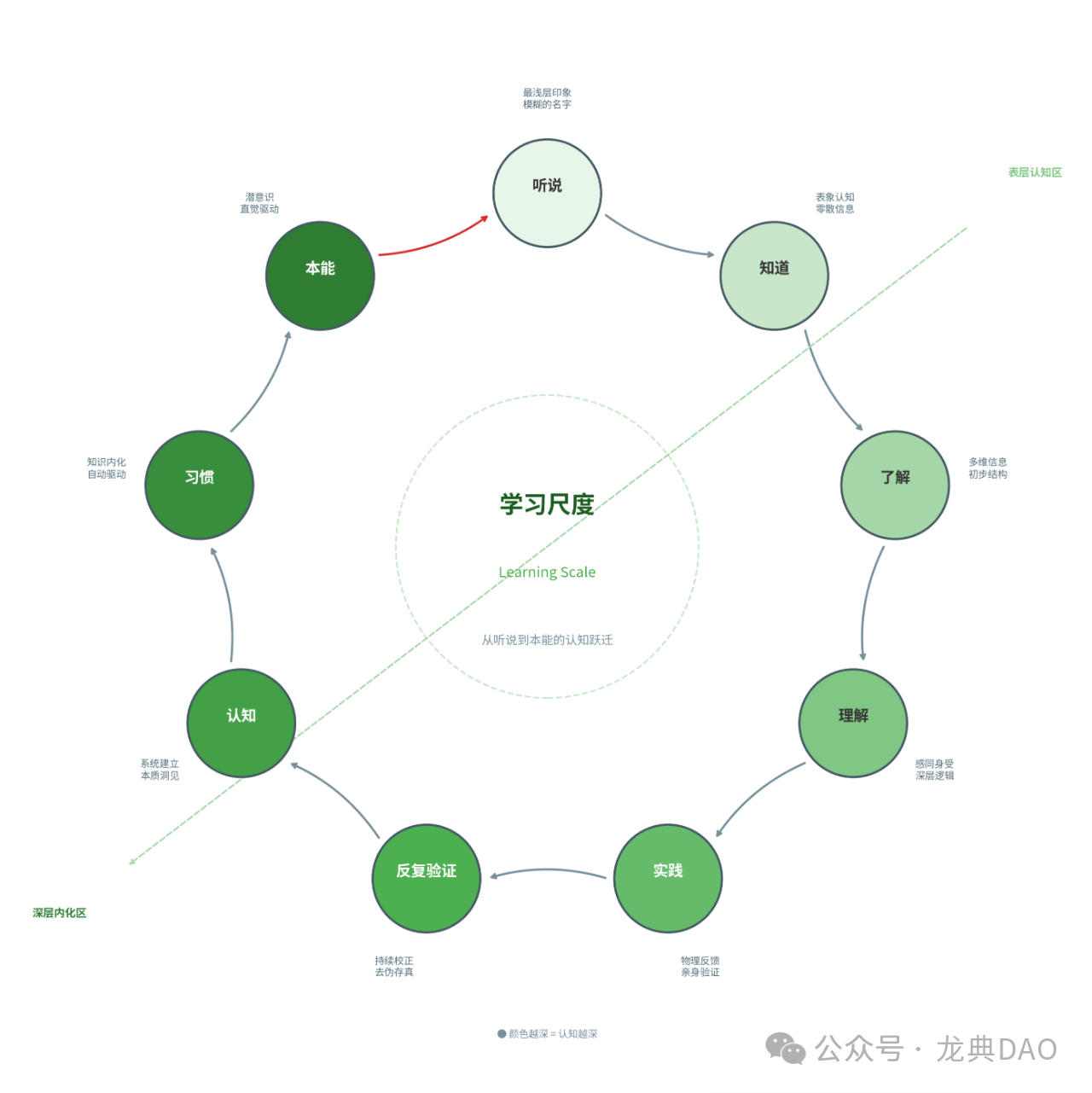
Heard of: The shallowest impression, a vague name.
Know of: Deeper than "heard of," but still superficial, knowing some scattered information.
Familiar with: A richer dimension of information, beginning to form a preliminary structure.
Understand: Able to empathize and perceive its deeper logic.
Practice: Gaining real feedback from the physical world, personally verifying.
Repeated Verification: Continuously correcting in practice, distinguishing the false from the true.
Cognition: Establishing a systematic cognitive framework, able to see the essence.
Habit: Knowledge has been internalized, becoming your default thinking pattern for analyzing problems.
Instinct: Knowledge has settled into the subconscious, driving judgment through intuition.
The vast majority of people remain at the level of "familiarity" or even "knowing," their knowledge systems are fragile and untested, and thus their beliefs are easily swayed. Strategic resolve, on the other hand, begins with the establishment of "cognition" and ultimately peaks at the level of "instinct." Unless one is a rare chosen individual, without such a structured learning path, it is difficult to draw correct conclusions in complex industries, making it easy to go astray.
The competition in the business field is akin to the duels of masters in Jin Yong's martial arts novels; true skill is not merely a superficial move but the profound inner strength cultivated over the long term. The learning scale, as a tool, allows us to abandon illusions, filter out delusions, and constantly remind ourselves, "At what level have I truly practiced the Nine Yang Divine Skill?"
Conclusion: Becoming a Long-Term Thinker with Strategic Resolve
Furthermore, we need to cultivate the skill of "remaining unperturbed." Wang Yangming's concept of "remaining unperturbed" does not refer to being numb, but rather to not being swayed by external factors, maintaining a state of high focus and extreme clarity. This is a powerful inner strength, the fundamental guarantee for resisting external noise and adhering to a predetermined strategic direction. It stems from a person's confidence in their foundational abilities and from long-term dedication in their professional field, manifesting as strong inner strength.
At the same time, we must be wary of the temptation of "only cleverness is to be pursued." The late Qing Dynasty statesman Zeng Guofan revered "clumsy sincerity" throughout his life, stating: "Only the utmost sincerity in the world can overcome the utmost deceit; only the utmost clumsiness in the world can overcome the utmost cleverness." In complex strategic games, the simplest and most fundamental principles are often the most effective. Rather than chasing fleeting techniques and trends, it is better to return to the essence of things, adhering to the correct direction with a nearly "clumsy" persistence.
Ultimately, strategic resolve is the victory of deep cognitive ability. It is the comprehensive ability to remain clear-headed amid the flood of information, to see the essence in complex changes, and to execute decisively under numerous obstacles. In this era of uncertainty, each of us, especially those at the forefront of Web3 and RWA, should strive to enhance our cognitive "computational power," purify our information "data sources," and cultivate the inner strength of "unity of knowledge and action" along the ladder of the "learning scale."
Only in this way can we break free from short-term temptations and noise, anchor ourselves to truly valuable long-term goals, and ultimately become long-term thinkers with strong strategic resolve, steadily steering our own future.
Postscript
Since 2017, when I began to understand blockchain, I have been deeply impressed by the technology, community, and governance philosophy behind it. Deep down, I silently resolved to bring this brilliant fire, still in the experimental stage, into the real business world. To this end, we launched the industry summit brand "Watching the Fire" conference, symbolizing that "watching the fire from across the shore is not as good as seeing it clearly." I believe that one day, blockchain technology will change the business world. Despite the ups and downs in this process, we have still crossed cycles, moving from marginal innovation and heretical ideas into the mainstream. Throughout this process, regardless of how the industry has changed, our confidence and beliefs have never wavered. We have always preached on the front lines of the industry, from ICOs to NFTs, from NFTs to DeFi, from DeFi to RWA, and from RWA to RDA. The digital assets based on blockchain technology have taken on countless "disguises" and "concepts," creating one round of wealth effects after another, behind which are the stigmatized fashionable terms.
To every fighter in the Web3 and RWA fields
Today, this experiment is still ongoing, and our mission of preaching will continue, and perhaps new concepts and terms will keep emerging;
I believe that one day the Web3 (the third generation of the internet) we envision will seamlessly integrate into every aspect of daily life, just like today's internet. At that time, we will no longer mention the keyword Web3; this experiment may have succeeded, and we may have ushered in a beautiful new era of digital civilization.
免责声明:本文章仅代表作者个人观点,不代表本平台的立场和观点。本文章仅供信息分享,不构成对任何人的任何投资建议。用户与作者之间的任何争议,与本平台无关。如网页中刊载的文章或图片涉及侵权,请提供相关的权利证明和身份证明发送邮件到support@aicoin.com,本平台相关工作人员将会进行核查。


