Author: Lawyer Liu Zhengyao
Introduction
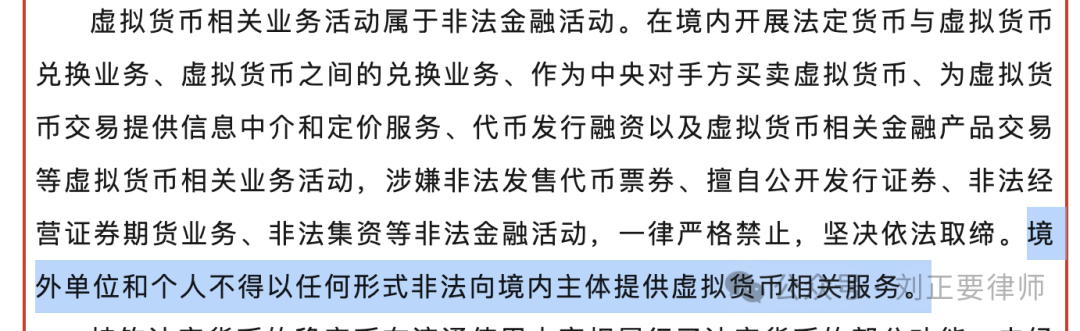
On February 6, 2026, the People's Bank of China and seven other departments jointly issued the "Notice on Further Preventing and Handling Risks Related to Virtual Currencies" (hereinafter referred to as the "2.6 Notice" or "New Regulations"). As a legal practitioner in the cryptocurrency space, Lawyer Liu believes the significance of this document is self-evident, and every compliant cryptocurrency practitioner should study it thoroughly. Among the points repeatedly mentioned in the new regulations is that "foreign entities and individuals are prohibited from illegally providing virtual currency-related services to domestic entities in any form," which has caused concern among many business owners engaged in judicial disposal of involved virtual currencies.
Friends familiar with Lawyer Liu should know that he has been researching the business of "judicial disposal of involved virtual currencies" since 2023, becoming well-acquainted with macro regulatory policies and micro operational details, and has met many practitioners in this industry. Tonight, several business owners began messaging me: Is this industry completely at an end? Can judicial disposal still be done?
My conclusion is: it can be done, but in the context of the new regulations, all parties (clients, disposal parties, intermediaries, foreign platforms, etc.) need to consider how to operate more compliantly. A detailed discussion follows:
01 The Essence of Judicial Disposal: Is it "Illegal Trading" or "Legal Duty"?
First, we need to clarify a basic legal logic. Judicial disposal of virtual currencies refers to the process by which judicial authorities (public security, prosecution, and courts) or financial departments dispose of virtual currencies seized or confiscated in criminal cases or administrative enforcement, converting them into RMB and remitting them to the national treasury (in some cases, returning them to victims).
There is a fundamental difference between judicial disposal of involved virtual currencies and ordinary citizens' speculative trading:
First, the legality of the subject. The disposing entity is the national judicial authority, based on the provisions in the Criminal Law regarding the recovery and confiscation of illegal gains.
Second, the legitimacy of the purpose. The purpose of judicial disposal is to execute criminal judgments, converting "criminal assets" into "legal currency" to be remitted to the national treasury, thereby maintaining financial security.
Therefore, even if the new regulations further lock down the financialization path of virtual currencies, judicial disposal of virtual currencies, as part of criminal enforcement, still possesses procedural justice and substantive legitimacy. Judicial authorities cannot hold thousands of bitcoins without being able to remit them to the national treasury.
02 The "Real Pressure" Brought by the 2026 New Regulations
Since judicial disposal of virtual currencies is itself legal, why do people feel panic? The reason lies in the severe characterization of "cross-border services" and "technical assistance" in the new regulations.
(1) The "Illegalization" of Foreign Service Providers
The new regulations clearly state that foreign companies or individuals are prohibited from illegally providing virtual currency-related services to domestic entities. Currently, the vast majority of judicial disposal paths in China are completed through a model of "domestic disposal companies + foreign compliant trading for liquidation."
Under the high pressure of the new regulations, if foreign disposal entities have not obtained "legal and regulatory consent" from relevant domestic departments, then domestic companies providing connections and undertaking judicial disposal business for them are likely to be classified as "providing assistance knowing or should have known that foreign entities are illegally providing services," thus incurring criminal liability.
(2) Strict Control over "Intermediary" and "Technical" Services
The new regulations mention that intermediaries and technical institutions providing services for cross-border related businesses must be approved or filed (although this is mainly to regulate domestic RWA businesses, it may be "policy penetrated" and referenced in the judicial disposal field). This means that the previously rampant growth model of "signing a commission agreement and privately finding a water room or exchange to liquidate the currency" will face significant administrative and even criminal penetration risks.

03 Re-exploring Compliant Paths for Judicial Disposal
In light of the current complex regulatory environment, although China has not officially unified the recognition (or regulation) of any specific disposal model, the feasibility of these paths has become more important under the context of the 2026 new regulations:
(1) Shifting from "Private Commission" to "Official Admission"
The new regulations repeatedly mention "with the legal and regulatory consent of the business competent department" (the same consideration applies: although this is mainly to regulate domestic RWA businesses, it may be "policy penetrated" in the judicial disposal field). Future judicial disposal must break away from private operations. Disposal companies cannot rely solely on a commission contract from public security, prosecution, and courts to feel secure; they also need to pay attention to their filing or compliance qualifications with financial regulatory departments (such as the central bank, securities regulatory commission), financial departments, and tax departments.
(2) Relying on "Specific Financial Infrastructure"
The new regulations mention in the RWA section: "related business activities conducted relying on specific financial infrastructure are exempt." This actually has certain reference significance for judicial disposal businesses. For example, in the future, state-owned banks, licensed exchanges (foreign subsidiaries), or officially designated digital asset management platforms may be considered as corresponding disposal entities domestically and abroad, potentially being included in decision-making considerations.
(3) Transparent Fund Flows and Cross-border Currency Exchange
The past pain point was how to bring back the money (USD, offshore RMB) after the liquidation of virtual currencies. The common current practice is for qualified institutions to use formal foreign exchange management channels to convert confiscated funds from foreign currency accounts and remit them to the non-tax revenue account of the treasury. The 2026 new regulations have strengthened the coordination of the foreign exchange administration in the regulation of virtual currencies, which further indicates that certain "underground bank" style currency exchanges will undoubtedly perish.
04 Industry Restructuring, Only "Compliant" Entities Will Survive
Returning to the initial question: Can judicial disposal still be done? The answer is: Yes, but the era of "scattered soldiers" and "gray intermediaries" is over.
The 2026 new regulations are not aimed at eliminating judicial disposal but at eliminating illegal financial activities masquerading as judicial disposal. With the Supreme Court and the Supreme People's Procuratorate having initiated (and possibly concluded) research on the judicial disposal of involved virtual currencies, along with the joint issuance of this new regulation, it is highly likely that specific judicial interpretations or operational procedures targeting "disposal of involved virtual currencies" will be introduced in the future.
Guidelines for Business Owners Engaged in Judicial Disposal of Virtual Currencies:
First, cease all illegal cross-border matchmaking. Especially businesses from unlicensed foreign small exchanges.
Second, strengthen technical support attributes. Shift the business focus from "liquidation trading" to "technical assistance (tracking, freezing, seizing, storing)."
Third, closely follow official guidelines. Pay attention to the implementation details of localized disposal mechanisms by provincial governments.
In the cryptocurrency space of 2026, the rules have been completely reshaped. The judicial disposal industry is undergoing a painful transition from the "wild zone" back to the "walled area." Only teams that truly understand the policy's original intent and possess high compliance professionalism can survive in this changing landscape. Lawyer Liu also welcomes everyone to contact him to discuss disposal business.
免责声明:本文章仅代表作者个人观点,不代表本平台的立场和观点。本文章仅供信息分享,不构成对任何人的任何投资建议。用户与作者之间的任何争议,与本平台无关。如网页中刊载的文章或图片涉及侵权,请提供相关的权利证明和身份证明发送邮件到support@aicoin.com,本平台相关工作人员将会进行核查。