Written by: Yangz, Techub News
Unlike the sluggish market conditions, the prediction market sector has experienced a unique "surge" since the beginning of February.
On one side, the crypto-native world is accelerating rapidly, with Hyperliquid planning to build new infrastructure for prediction markets through HIP-4, while Crypto.com is targeting the "American Spring Festival" Super Bowl traffic, gearing up to launch its prediction platform OG; on the other side, traditional financial giants are also taking action, with the Chicago Board Options Exchange (CBOE) planning to restart binary options and officially join the fray.
However, when everyone thought the competition would remain at the technical and licensing levels, the most unexpected conflict ignited on the streets of New York.
Two major prediction market giants, Kalshi and Polymarket, coincidentally engaged in a "community experiment": distributing free groceries to New Yorkers. Against the backdrop of the newly elected Mayor of New York, Zohran Mamdani, promising to establish a "municipal supermarket" to address food issues, these two companies, which thrive on "predicting the future," staged a brand showdown with the most tangible "bread and milk" in the cold winter.
Competing on-chain for technology, winning hearts on the streets. The competitive dimension of prediction markets is quietly extending from data contracts to real-life scenarios.
Kalshi's "Viral Flash" and Polymarket's "Million Dollar Donation"
At noon on February 3, local time, Kalshi kicked off a three-hour free grocery distribution event worth $50 in the West Side Market of New York, showcasing a unique youthful and viral marketing strategy.
According to Barron's, various banners containing predictive information were hung inside the pop-up store. Questions typical of prediction markets, such as "Will the economy recession occur this year?" and "Will gas prices in New York exceed $3.3 this year?" created a subtle dialogue with the warm bread on the shelves and fresh milk in the coolers, embedding financial uncertainty into the certainty of daily consumption.
Meanwhile, Morris Gindi, an employee wearing a striking green hoodie with "$YES" printed on it, moved through the crowd distributing stickers featuring a cat holding bread and milk, with the caption "Kalshi loves free markets." This slogan cleverly plays on the concept of "free markets" in economics while resonating with the "free food" scene, becoming a memorable anchor for the entire event. The long lines visible in on-site photos indicate a strong response, with many ordinary citizens who had never heard of Kalshi among them, representing the incremental users Kalshi hopes to reach.
The brilliance of Kalshi's free pop-up event lies in its simultaneous achievement of three goals: providing immediate relief to those in need, creating viral content for the brand, and wrapping the controversial financial innovation of prediction markets in a warm "community care" cloak. As Kalshi CEO Tarek Mansour stated on social media here — "New York has treated us well. We should also treat New York well" — this forms a typical narrative of tech elite philanthropy.
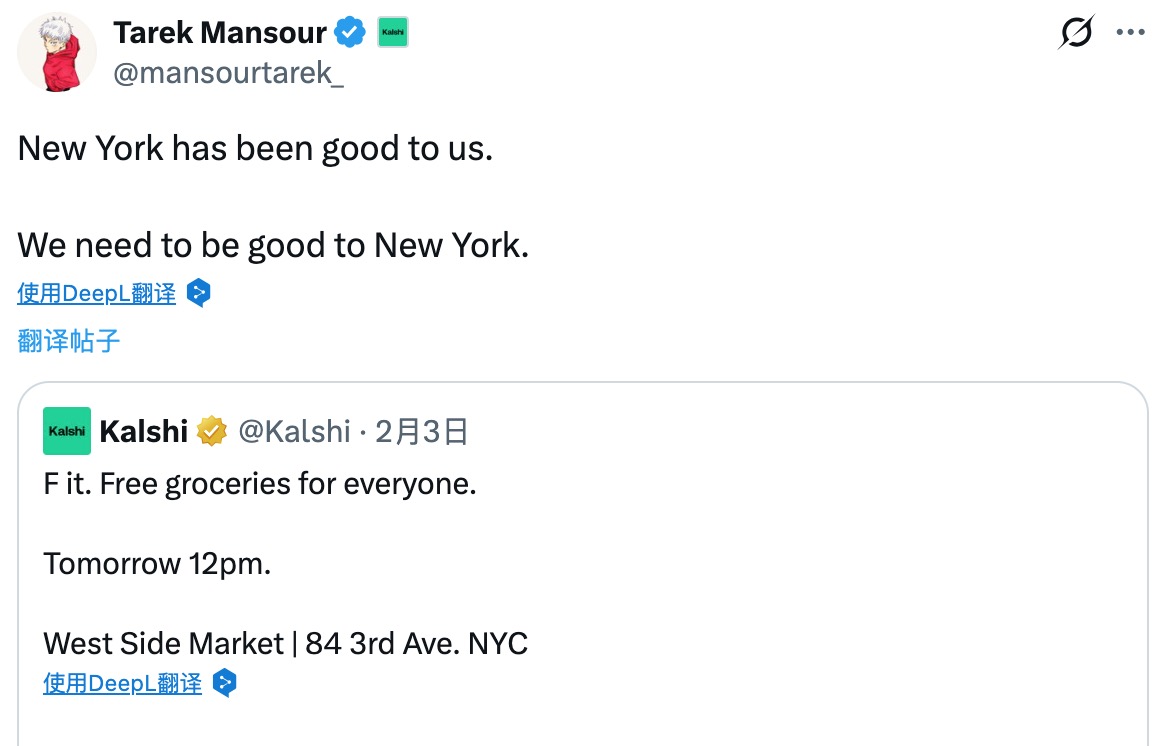
In response to Kalshi's street assault, Polymarket chose a more "sustainable" counter-strategy.
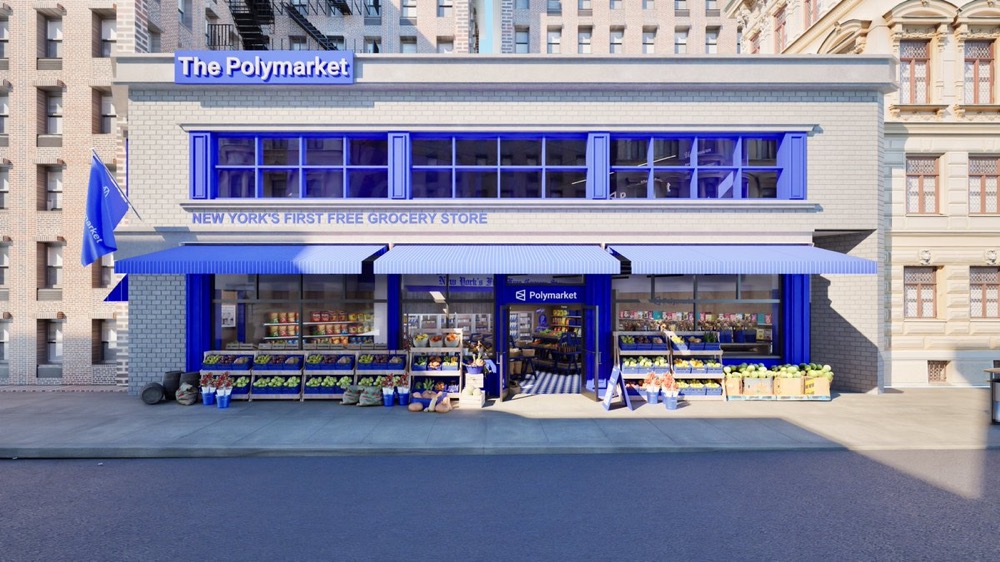
The company announced it would open "New York's first free grocery store," The Polymarket, from February 12 to 15, emphasizing that this is not a temporary pop-up stall but an exclusive retail space "built from scratch after months of planning and obtaining permits." This statement implicitly critiques Kalshi's pop-up model: we are making a physical investment, not just temporary marketing.
A more substantial move was Polymarket's announcement of a $1 million donation to the Food Bank For NYC. This confirmed donation acts like hard currency deposited into the brand's reputation account, conveying a clear message: we care not just about one-time events but are willing to systematically respond to community needs and fulfill our commitment to "give back to our hometown."
Although the two events appeared to operate independently, there were undercurrents at play. Kalshi cleverly stated in response to Polymarket's follow-up: "We are honored to have inspired other companies to join this charitable effort," maintaining grace while hinting at its leadership in action. Interestingly, while Kalshi's event was ongoing, Gemini launched a street challenge right next to the line: download the Gemini Prediction app and leave the Kalshi line to receive $100. This sudden "undermining" action escalated the free grocery war on the streets of New York into a blatant user acquisition battle.
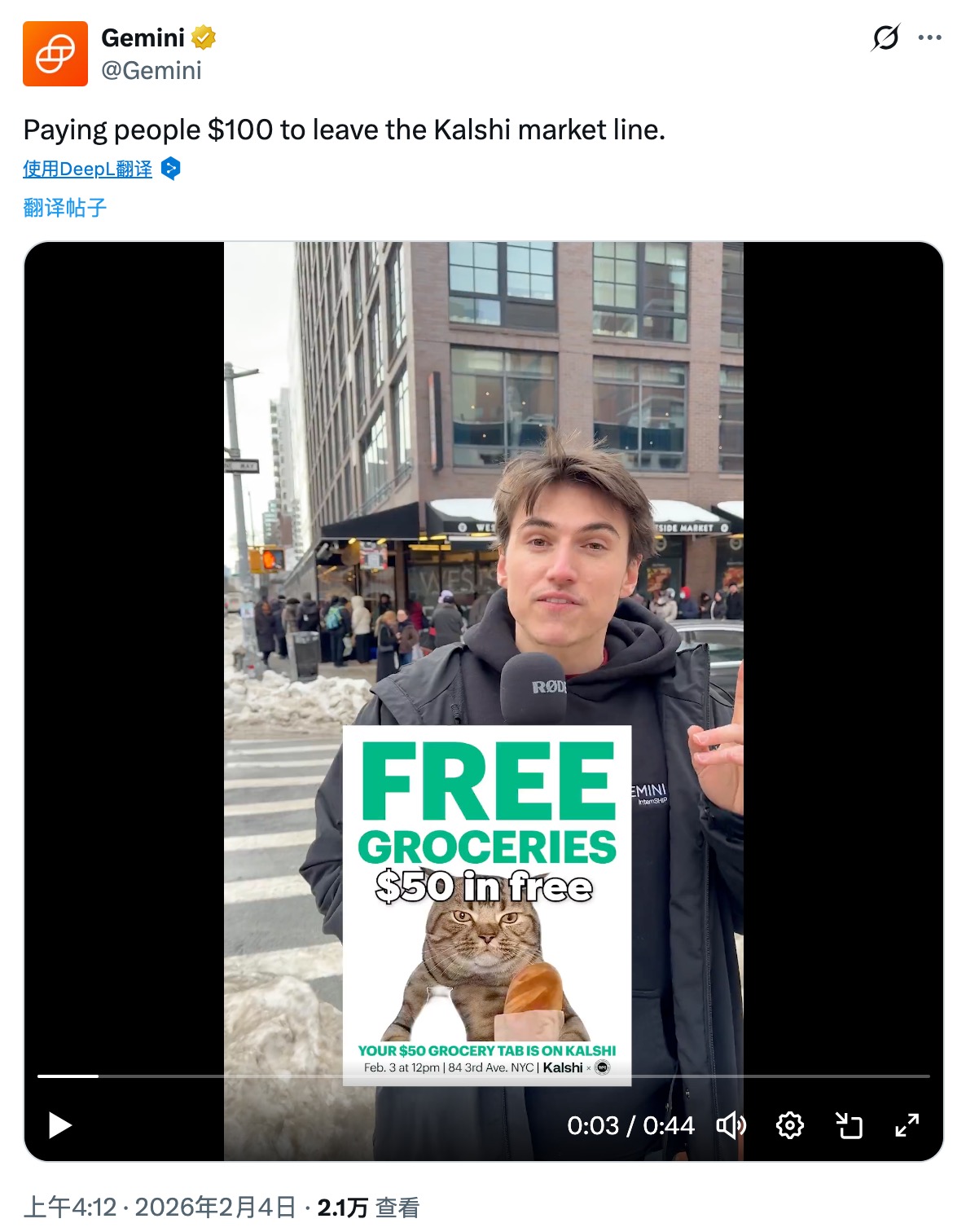
The Deep Strategy Behind the Competitive Landscape
The free grocery war on the streets of New York superficially appears to be a brand marketing showdown, but it actually reflects the common challenges and strategic choices facing the prediction market industry at a critical development juncture. When Kalshi and Polymarket persuade the public with "bread and milk" instead of "returns," it signifies a deeper game about the future direction of the industry.
After a year of explosive growth, the prediction market industry is facing dual pressures of user growth bottlenecks and regulatory crossroads. The early adopter market is nearing saturation, and platforms must penetrate a broader mainstream audience; meanwhile, the uncertainty of the regulatory environment looms like a Damocles sword over the industry — although both Polymarket and Kalshi have obtained licenses from the Commodity Futures Trading Commission (CFTC), state-level regulatory hurdles still exist. Additionally, previous cases of anonymous traders profiting hundreds of thousands of dollars on Polymarket from Venezuelan political events have raised widespread concerns about insider trading and market manipulation in prediction markets.
In this complex context, what seems like a simple free goods distribution event is, in fact, a carefully designed multidimensional strategic layout. By positioning themselves as "community contributors" and "responders to real issues," these two platforms are simultaneously addressing multiple key challenges.
For the public, this is an efficient means of user education and brand penetration. Real material subsidies often reach potential users' emotional needs more directly than any advertisement; for regulators, this builds a positive corporate citizen image. When platforms demonstrate concern for social issues, they are essentially accumulating "social trust capital," which may translate into important buffer space in future regulatory dialogues.
This street experiment reveals that when technological innovation faces dual tests of social acceptance and regulatory compliance, building empathy in offline scenarios may be more urgent than iterating online functionalities. While Kalshi and Polymarket appear to be distributing food, they are actually laying the groundwork for the long-term survival of the entire sector by establishing the social recognition infrastructure — allowing people to feel that "these platforms are doing good" before they ponder "whether these platforms should exist."
The lines on the streets of New York will eventually disperse, but everything that happened in the February cold has quietly changed some things.
Beyond the competition between Kalshi and Polymarket, every bag of bread collected is accumulating warmth for the industry; every bottle of milk taken away is diluting the public's unfamiliarity and doubts about financial innovation.
免责声明:本文章仅代表作者个人观点,不代表本平台的立场和观点。本文章仅供信息分享,不构成对任何人的任何投资建议。用户与作者之间的任何争议,与本平台无关。如网页中刊载的文章或图片涉及侵权,请提供相关的权利证明和身份证明发送邮件到support@aicoin.com,本平台相关工作人员将会进行核查。