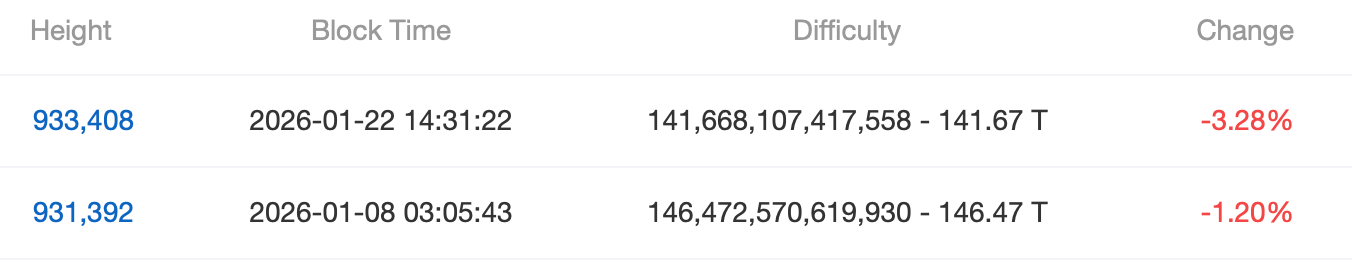
At block height 933408, Bitcoin’s mining difficulty setting slipped by 3.28%, and for the next two weeks—or precisely 2,016 blocks—it will sit at 141.67 trillion, a quieter dial setting that gives miners a brief moment to catch their breath.
Basically, Bitcoin’s mining difficulty is a native network setting that recalibrates about every two weeks, keeping new blocks arriving at roughly ten-minute intervals, no matter how much computing muscle is vying for the prize.
As miners and hashpower flood in, block intervals speed up and the difficulty tightens; when that power recedes, the difficulty parameter loosens when block times are slower, preserving Bitcoin’s issuance schedule as steady, predictable, and stubbornly resistant to gamesmanship.

So far, 2026 has seen two difficulty changes, and both of them were reductions. The last difficulty change was a drop of 1.20% which was preceded by a modest 0.04% increase last year on Dec. 24.
The last time the difficulty was in this same range was 18,144 blocks prior to block height 933408, when the difficulty change led to 142.34 trillion for two weeks on Sept. 18, 2025. The latest difficulty dip offers bitcoin miners a modest reprieve, arriving as revenue has been sliding steadily over the past eight days.
Also read: 11 EH/s: Bitmain Eyes a New Bitcoin Mining Proxy? – Miner Weekly
On Jan. 14, hashrateindex.com stats show the estimated value of a single petahash per second (PH/s), known as hashprice, was $42.20, and by Jan. 22 it had slid to $39.90—down 5.45% over the week, a tidy reminder that mining can turn unfriendly in a hurry.
For miners, the window ahead offers a narrow but meaningful chance to steady operations while margins remain under pressure, even as the broader economics of securing the network continue to shift beneath their feet.
- What caused Bitcoin’s latest mining difficulty change?
Bitcoin’s difficulty adjusted lower after a decline in network hashpower, triggering an automatic recalibration at block 933,408. - How much did Bitcoin’s mining difficulty drop?
The difficulty fell by 3.28%, setting the new level at 141.67 trillion for the next 2,016 blocks. - Why does Bitcoin adjust mining difficulty every two weeks?
The network recalibrates difficulty roughly every two weeks to keep block times near 10 minutes regardless of hashpower changes. - Does the difficulty drop help bitcoin miners right now?
Yes, the reduction offers short-term relief as miner revenue per petahash has declined over the past week.
免责声明:本文章仅代表作者个人观点,不代表本平台的立场和观点。本文章仅供信息分享,不构成对任何人的任何投资建议。用户与作者之间的任何争议,与本平台无关。如网页中刊载的文章或图片涉及侵权,请提供相关的权利证明和身份证明发送邮件到support@aicoin.com,本平台相关工作人员将会进行核查。