Elon Musk Tells Davos AI, Robots, and Space Will Redefine the Global Economy

CN
1 hour ago

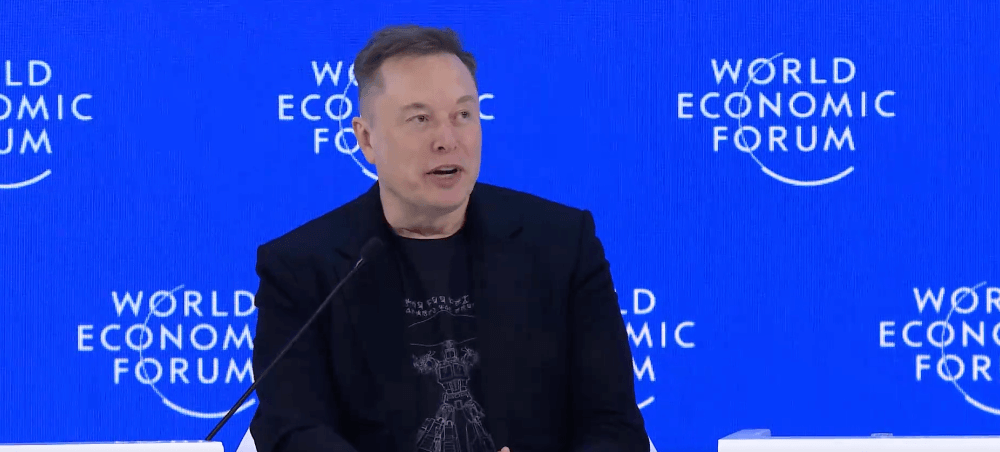
Speaking before a packed audience at the World Economic Forum (WEF) in Switzerland, Elon Musk framed his sprawling portfolio of companies as parts of a single engineering mission: maximizing the probability that civilization not only survives, but thrives. From AI models and humanoid robots to rockets and solar power, Musk argued that each effort is aimed at extending human consciousness and creating material abundance on a planetary—and eventually interplanetary—scale.

Fink opened the conversation by praising Musk’s execution record, contrasting long-term returns at Blackrock with the compounded gains generated since Tesla went public. Musk deflected the praise, crediting Tesla’s engineering teams, but quickly pivoted to what he described as the deeper question facing humanity: how to ensure civilization does not extinguish itself.

Elon Musk Tells Davos AI, Robots, and Space Will Redefine the Global Economy

Elon Musk at Davos speaking with Blackrock’s Larry Fink on Thursday.

According to Musk, the fragility of life is often underestimated. With no confirmed evidence of extraterrestrial civilizations, he said humanity should assume consciousness is rare and worth protecting. That belief underpins SpaceX, which he described as an effort to make life multiplanetary so that a single natural or man-made catastrophe on Earth does not end human consciousness altogether.

The discussion then turned to artificial intelligence (AI) and robotics, which Musk characterized as the only plausible solution to global poverty. In his view, universal abundance cannot exist in a world where essential labor remains scarce. AI systems paired with billions of humanoid robots, he said, would allow economic output to expand beyond historical limits, eventually saturating all human needs.

“If you have ubiquitous AI that is essentially free or close to it, and ubiquitous robotics, then you will have an explosion in the global economy,” Musk remarked. “There will be such an abundance of goods and services that you won’t even be able to think of something to ask the robot for at a certain point.”

Musk predicted that, in a benign scenario, there will be more robots than people, with each household eventually owning one. He cited elder care, child supervision, and basic domestic tasks as early use cases, arguing that demographic realities—aging populations and shrinking workforces—make automation unavoidable. The challenge, he acknowledged, will be redefining human purpose once work is no longer economically necessary.

On the timeline for that future, Musk was unusually specific. He said Tesla’s Optimus humanoid robots are already performing simple factory tasks and should handle more complex industrial work by the end of the year. Public sales of humanoid robots, he added, could begin as early as next year, once safety and reliability thresholds are met.

Autonomous vehicles followed a similar arc. Musk said full self-driving technology is now effectively solved, noting that Tesla updates its driving software weekly. He added that some insurance providers are offering discounted premiums to drivers who use Tesla’s autonomous systems, and predicted widespread robotaxi deployments across the United States before year’s end, pending regulatory approvals.

Energy, not computing hardware, emerged as the central constraint on AI growth. While AI chip production is increasing rapidly, Musk warned that electricity generation is not keeping pace. He contrasted sluggish power expansion in the United States and Europe with China’s aggressive buildout of solar and nuclear capacity, noting that China now deploys more than 1,000 gigawatts of solar annually.

Musk argued that solar power is already the dominant global energy source when viewed at scale, pointing out that the sun accounts for virtually all energy in the solar system. A relatively small land area—roughly 100 miles by 100 miles of solar panels—could theoretically power the entire United States, he said, though tariffs and policy barriers continue to slow deployment.

To bypass terrestrial constraints altogether, Musk revealed plans to deploy solar-powered AI infrastructure in space. Space-based solar arrays, he explained, operate continuously without weather or seasonal interruptions and deliver significantly higher efficiency than ground-based systems. In orbit, excess heat can be dissipated naturally into the cold vacuum of space, making it an ideal environment for energy-intensive AI data centers.

Musk said:

“I think the case, it’s a no-brainer for building AI solar power, AI data centers in space… it’s always sunny, so you don’t have a day-night cycle or seasonality or weather, and you get about 30% more power in space because you don’t have atmospheric attenuation. Any given solar panel will do five times more energy in space than on the ground.”

That vision depends on a major breakthrough SpaceX hopes to achieve this year: full rocket reusability. Musk said that while Falcon 9 has demonstrated partial reuse by landing its first stage, the true cost reduction will come when both stages of the Starship rocket can be reused. Achieving that, he said, could cut the cost of access to space by a factor of 100.

Also read: Is Quantum Computing Casting a Shadow Over Bitcoin’s Price?

Looking ahead, Musk predicted AI systems could surpass the intelligence of any individual human by the end of this year, and exceed the combined intelligence of all humanity within five years. While he acknowledged the risks, he maintained that cautious optimism is preferable to paralysis, arguing that most quality-of-life improvements come from betting on progress rather than fearing it.

The session closed on a personal note, with Musk crediting science fiction, curiosity, and a lifelong desire to understand the universe as his guiding motivations. He reiterated his belief that optimism—while sometimes wrong—is ultimately more constructive than pessimism. “It is better to err on the side of being optimistic and wrong,” he said, “than pessimistic and right.”

  • What did Elon Musk say about AI at Davos?
    Musk said AI paired with robotics is the only realistic path to global abundance.
  • What limits AI growth, according to Musk?
    He identified electrical power generation, not chips, as the main bottleneck.
  • When could humanoid robots reach consumers?
    Musk suggested public sales could begin as early as next year.
  • Why does Musk want AI infrastructure in space?
    Space offers continuous solar power, efficient cooling, and massive scalability.

免责声明:本文章仅代表作者个人观点,不代表本平台的立场和观点。本文章仅供信息分享,不构成对任何人的任何投资建议。用户与作者之间的任何争议,与本平台无关。如网页中刊载的文章或图片涉及侵权,请提供相关的权利证明和身份证明发送邮件到support@aicoin.com,本平台相关工作人员将会进行核查。

Share To
APP

X

Telegram

Facebook

Reddit

CopyLink