The agreement is not dead, a new operation is born: Lens and Farcaster complete a key "handover"

CN
1 hour ago

Written by: Yangz, Techub News

If the last cycle was a blueprint competition for decentralized social "protocol utopia," then the two announcements at the beginning of 2026 mark the "handoff" from builders to operators.

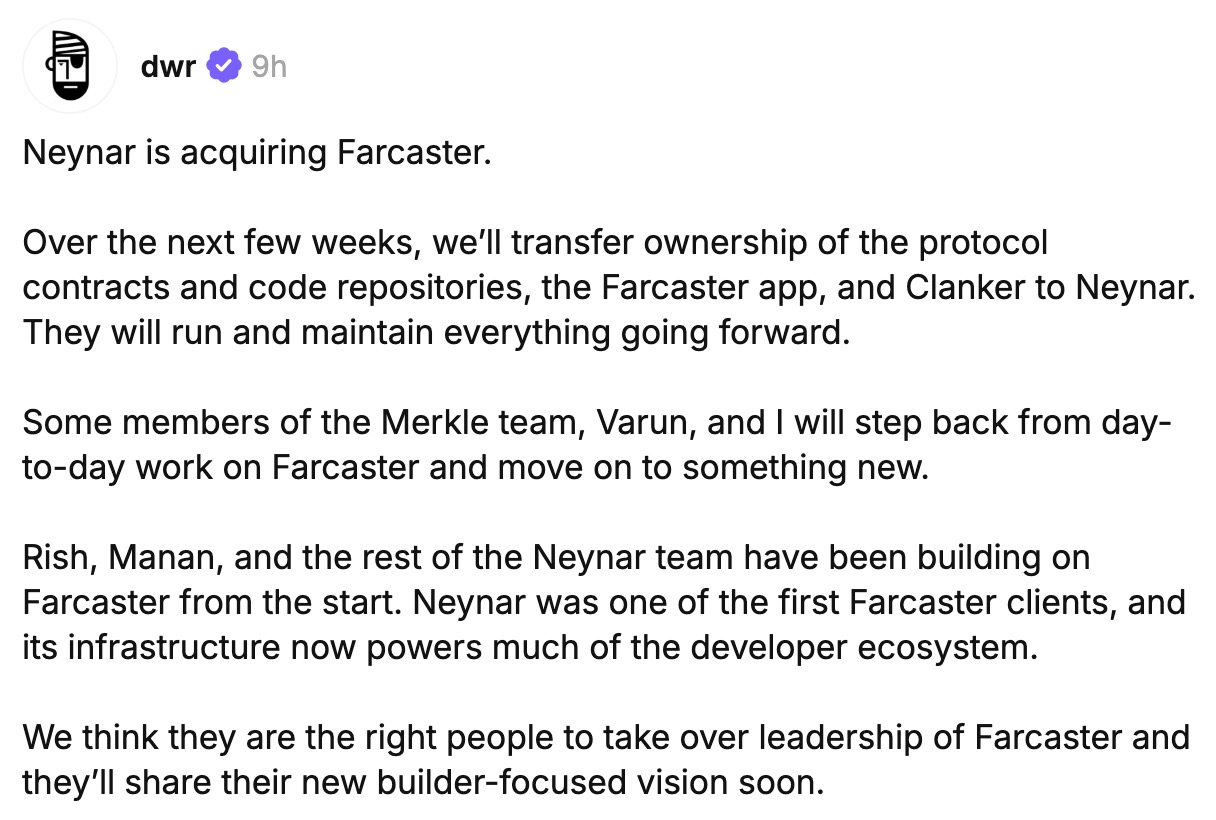
On January 20, Mask Network announced that it has become the "new steward" of Lens Protocol, stating, "The next phase is not more protocols, but creating products that people actually use." Today, Farcaster co-founder Dan Romero, in an honest long article, announced that the project is being handed over to an important infrastructure player in the ecosystem, Neynar, with the clear reasoning: "After five years, it is evident that Farcaster needs new methods and leadership to realize its full potential."

In just two days, the sequential "handoff" of the two major mainstream protocols in the decentralized social track outlines a clear turning point in the industry: when a well-developed technical architecture cools due to dismal user growth, a transformation from "protocol supremacy" to "product survival" has become an unavoidable collective proposition for the entire track. Of course, this is not the disillusionment of ideals, but a necessary "landing" process.

The "Handoff": From Builders to Operators

The two "handoff" events, on the surface, represent a transfer of management rights, but underneath lie two clear paths to breaking the deadlock, pointing to the inevitability of specialized division of labor.

Handing Lens over to Mask Network is an injection of "productization" capability aimed at the mainstream market. As emphasized in Mask Network's official announcement: "For nearly a decade, the Mask team has been building the bridge from Web2 to Web3, operating Mastodon instances, and learning the true requirements for running decentralized social networks at scale." This is not an empty statement; according to Rootdata, Mask has already built a relatively complete product matrix: from the underlying identity aggregation protocol Next.ID, to the user identity recognition entry Web3.Bio, and the consumer-facing social aggregation application Firefly. This series of layouts indicates that Mask's role has long surpassed that of a mere product developer, resembling a "system operator" well-versed in user growth and ecosystem operation.

The Aave team, as outstanding "protocol architects," laid down the "open, permissionless infrastructure tracks" for Lens. However, when the train needs to carry passengers to distant places, what is required is a "conductor" skilled in scheduling, service, and experience. Mask's mission statement—"to make decentralized social easy to access, intuitive, and ready for everyday users"—is precisely the declaration of this shift from "product thinking" to "user thinking."

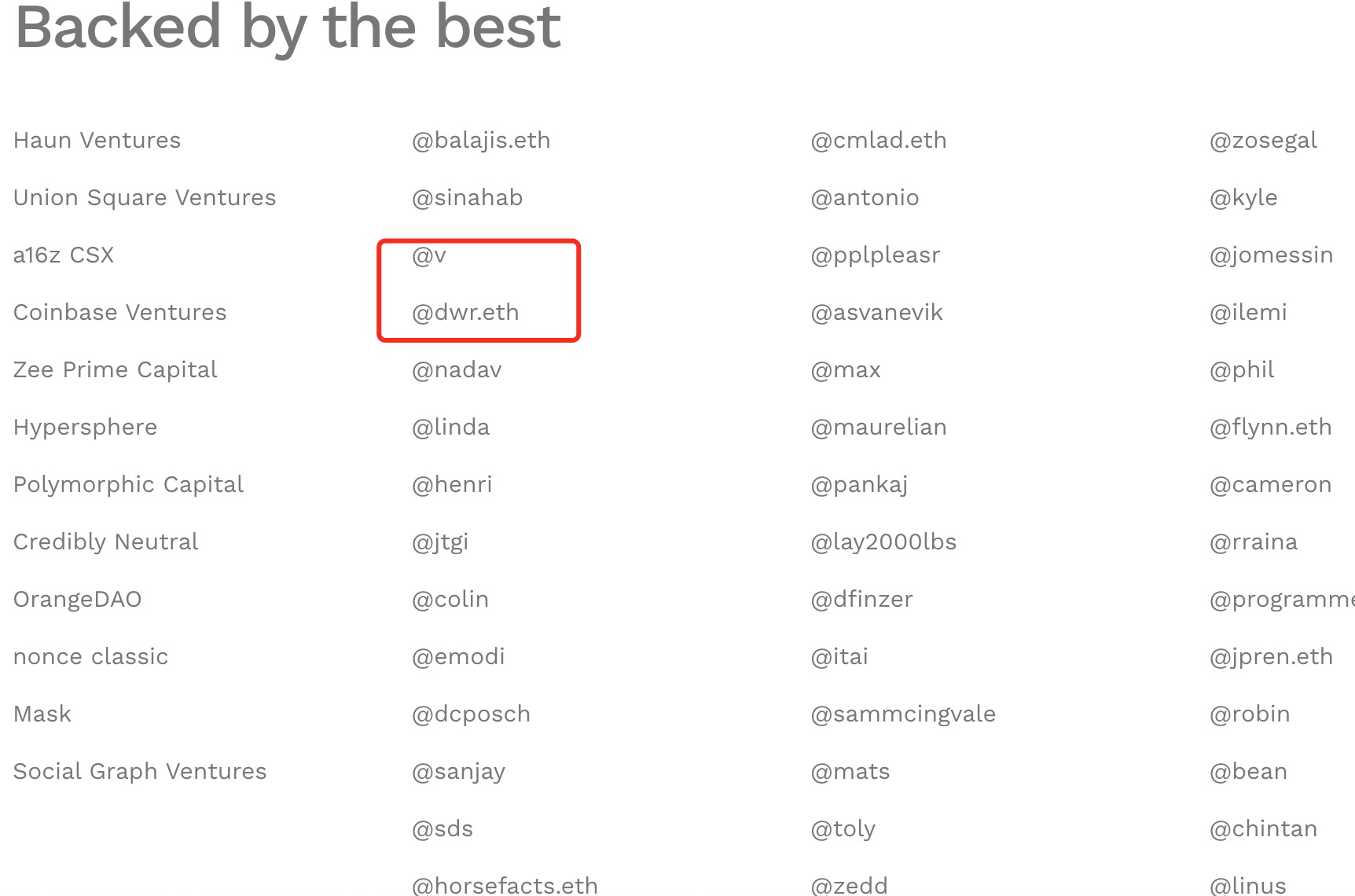
In contrast, Farcaster's choice of Neynar seems more like a natural continuation of ecological genes and a strategic entrustment of infrastructure. The essence of this handover can be glimpsed from the details in Dan Romero's statement—he emphasized that Neynar's CEO Rish and CTO Manan "have been building on Farcaster from the very beginning," and Neynar itself, as one of the earliest Farcaster clients, has supported "most of the developer ecosystem." This is not just a commercial acquisition; it resembles an intrinsic inheritance of technical routes and ecological governance. Notably, Farcaster's two founders, Dan Romero and Varun Srinivasan, appear on Neynar's early supporter list, forming a closed loop from protocol creators to ecosystem builders.

Such a background essentially makes Neynar the most core "enabler" in the Farcaster ecosystem. When the client growth of the protocol itself faces bottlenecks, a more pragmatic path may be to turn to the B-side, that is, by consolidating and expanding the developer ecosystem, providing robust data APIs and infrastructure services for third-party applications, thereby building a growth flywheel of "ecosystem prosperity driving protocol value." This is akin to entrusting the future of a city to the infrastructure operators most familiar with its underground networks and traffic arteries. They may not directly serve every citizen, but they determine whether the entire city can breathe smoothly and grow organically.

The "handoff" is not a retreat, but a deepening of strategy. When the founding team completes the protocol innovation from 0 to 1, proving the feasibility of the technology, then the ecological prosperity from 1 to 10 requires more professional and focused product operation and ecosystem building capabilities. This handover can be seen as a necessary rite of passage for these two decentralized social protocols from adolescence to adulthood.

Market Reaction: When the "Handoff" is Misread as the "End"

When the news of Lens and Farcaster successively changing "stewards" broke, a natural and direct inference began to spread in the market: has the experiment of decentralized social reached its end?

This reaction is almost instinctive in the current market environment. After several rounds of protocol innovation and conceptual fervor, the decentralized social field has consistently failed to deliver a convincing "mainstream adoption" report card to the outside world. User growth curves are flat, and breakout products are few. Therefore, when two iconic protocols simultaneously undergo significant management rights transfers, it is easy for the outside world to interpret this as the "exit" of the founding team and the "tide receding" of idealism, leading to a pessimistic conclusion that "this path may not work."

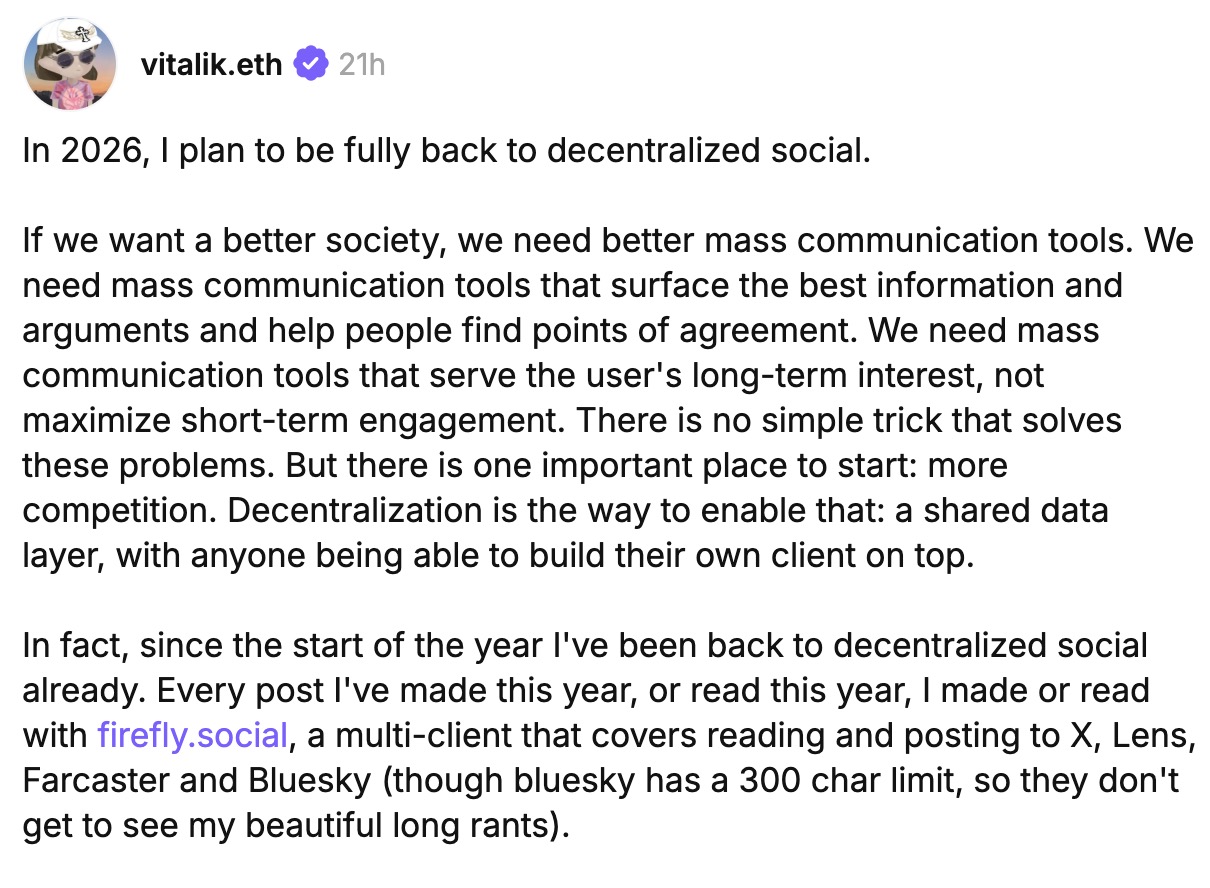
However, this "end conclusion" based on surface phenomena may precisely misunderstand the essence of decentralized protocols and the deeper meaning of this "handoff." Amidst this doubt, Ethereum co-founder Vitalik Buterin announced: "In 2026, I plan to fully return to decentralized social." At the same time, veteran investor and Union Square Ventures co-founder Fred Wilson clearly pointed out: "Protocols will not easily disappear. They have strong resilience."

Conclusion

In explaining why he is returning to decentralized social, Vitalik offered a calm critique of the developments over the past few years: "Crypto social projects often go astray. We often think that simply inserting a speculative token is equivalent to 'innovation' and pushes the world forward." Indeed, this reflects how too many Socialfi projects in recent years have become overly obsessed with the financial narrative of "Fi," forgetting "Social" as the essence of social products.

The landing from "protocol blueprint" to "product reality" is a necessary demystification process and a rebirth aimed at real needs. When the halo fades, and we move forward pragmatically, decentralized social can truly step out of the laboratory and into the everyday connections of human life. The tracks have already been laid, and the deeper significance of these two "handoffs" lies in handing the steering wheel of the train to those builders who "truly believe in the essence of social."

免责声明:本文章仅代表作者个人观点,不代表本平台的立场和观点。本文章仅供信息分享,不构成对任何人的任何投资建议。用户与作者之间的任何争议,与本平台无关。如网页中刊载的文章或图片涉及侵权,请提供相关的权利证明和身份证明发送邮件到support@aicoin.com,本平台相关工作人员将会进行核查。

Share To
APP

X

Telegram

Facebook

Reddit

CopyLink