Written by: Frank, Maitong MSX Research Institute
From Silicon Valley giants to the "White House AI and Crypto Czar," a comprehensive judgment on business, politics, and technology in 2026 has been provided.
At the beginning of 2026, the world stands at an extremely divided crossroads.
On one side is falling inflation, accelerated AI penetration, and a capital market that is stirring; on the other side are rising geopolitical frictions, increasing institutional uncertainty, and widespread skepticism about whether "the next round of growth truly exists." Against this backdrop, the globally influential tech business podcast "All-In Podcast" released its annual ultimate predictions:
Hosted by well-known Silicon Valley angel investor (early investor in Uber and Robinhood) Jason Calacanis, it invited heavyweight guests including "SPAC King" Chamath, "Science Sultan" David Friedberg, and David Sacks, who is referred to as the first "AI and cryptocurrency czar" of the White House.
This group of top minds, controlling hundreds of billions of dollars and deeply understanding the logic of power and capital operations, engaged in a fiery debate around politics, technology, investment, and geopolitical patterns—from California's wealth tax crisis to a 6% GDP growth expectation, from optimism about Huawei/predictive markets to the astonishing hypothesis that SpaceX may merge with Tesla, and more.
Maitong MSX Research Institute has distilled the core viewpoints from their intellectual collision for readers.
"11 Major Predictions" from 4 Giants
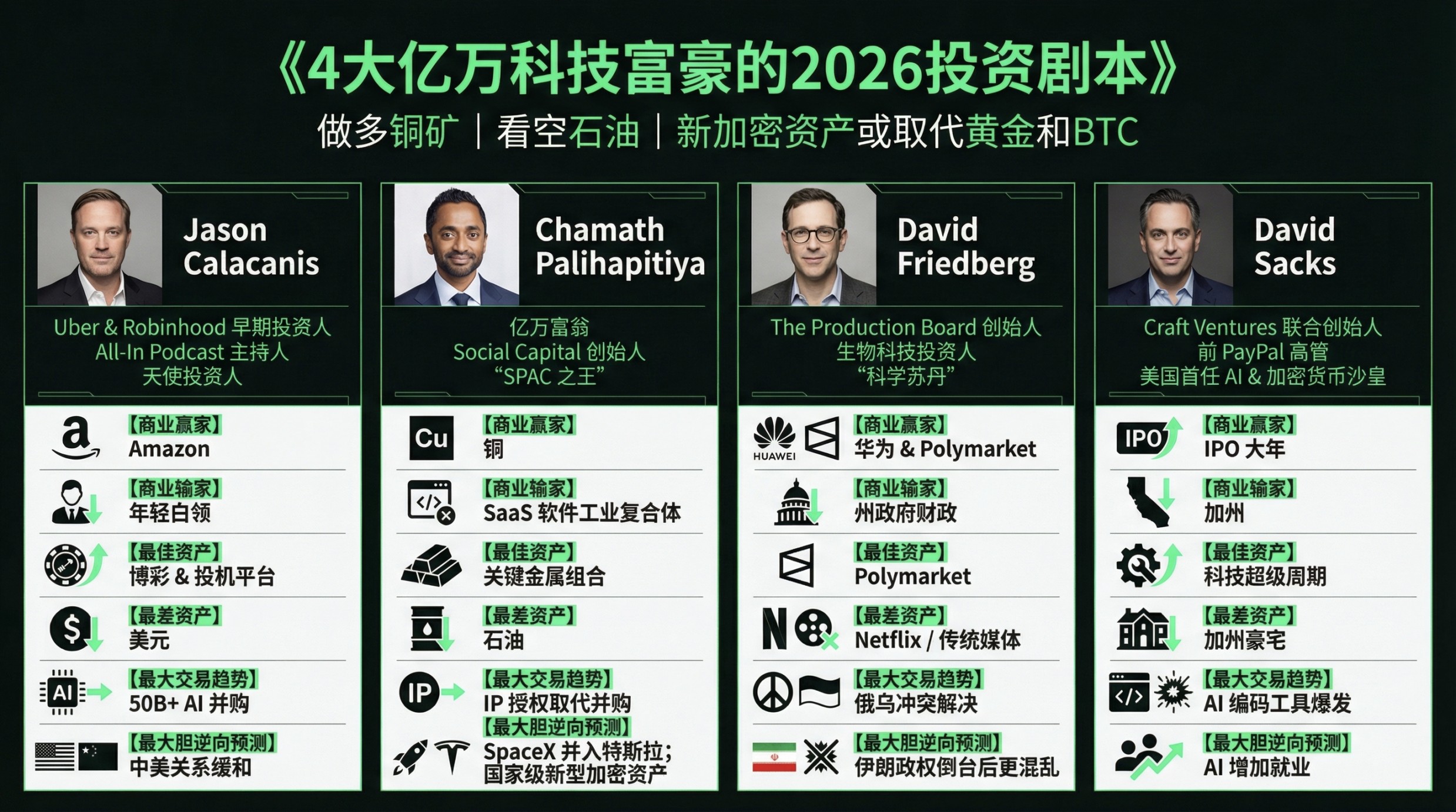
Source: Organized by AI from raw images
Regarding California's wealth tax and capital outflow risks, they believe:
- Chamath Palihapitiya: The circle that has clearly chosen to leave California has a combined net worth of hundreds of billions of dollars, which poses a substantial impact on California's long-term finances;
- David Friedberg: This proposal is unlikely to be truly implemented, but it has exposed structural pressures on local finances;
- David Sacks: The wealth tax is the direct reason I left California; even if it doesn't pass in 2026, everyone expects some version to return in 2028;
Regarding the biggest business winners in 2026, they believe:
- Jason Calacanis: Optimistic about Amazon, which will be the first to reach the "enterprise singularity," becoming the first company where robots contribute more profit than humans; its automated warehouses and logistics network have built a very high moat;
- Chamath Palihapitiya: Choosing copper, as geopolitical and supply chain security will lead to long-term supply-demand imbalances; at the current rate, by 2040, there will be about a 70% gap in global copper supply;
- David Friedberg: Optimistic about Huawei and predictive markets (PM); the former continues to break through in technology systems, while the latter is evolving from a niche product into a new type of infrastructure for information and price discovery, which may see an explosion this year;
- David Sacks: 2026 will be a big year for IPOs, as "Trump prosperity" restarts the capital market expansion cycle, with many companies successfully going public, creating trillions of dollars in new market value; he also agrees with Jason Calacanis's assessment of Amazon, but for different reasons (not elaborated);
Regarding the biggest business losers in 2026, they believe:
- Jason Calacanis: The most impacted will be young white-collar workers in the U.S., as entry-level positions will be prioritized for replacement by AI and automation;
- Chamath Palihapitiya: The "maintenance and migration" revenue model of enterprise-level SaaS will be systematically compressed under the impact of AI;
- David Friedberg: State government finances, pension liabilities, and solvency issues will be prominently exposed;
- David Sacks: California, as regulatory and tax uncertainties will continue to squeeze out capital and businesses;
Regarding the most significant transaction forms in 2026, they believe:
- Jason Calacanis: There will be an acquisition of an AI giant exceeding $50 billion;
- Chamath Palihapitiya: Traditional mergers and acquisitions will give way to large-scale IP licensing collaborations, which will become more common and mature in 2026;
- David Friedberg: Conflict resolution at the geopolitical level will be the "biggest deal," with the Russia-Ukraine conflict possibly being resolved this year;
- David Sacks: Optimistic about the explosion of coding assistants and tool use sectors;
Regarding the boldest reverse predictions for 2026, they believe:
- Jason Calacanis: U.S.-China relations will see substantial easing, with both sides reaching a win-win working relationship;
- Chamath Palihapitiya: Two reverse predictions: first, SpaceX will not IPO but may reverse merge with Tesla; second, central banks will build a new paradigm of sovereign cryptocurrencies (different from BTC);
- David Friedberg: If the turmoil in Iran continues to deepen, it may instead exacerbate instability in the Middle East;
- David Sacks: AI will become an employment expander rather than a job destroyer, and we are likely to see job growth;
Regarding the best-performing assets in 2026, they believe:
- Jason Calacanis: Optimistic about speculative and platform-based assets, in an environment where the economy is about to take off, interest rates may be lowered, and people will have more disposable income to bet and speculate;
- Chamath Palihapitiya: Continuing to bet on a basket of key metals, including copper;
- David Friedberg: Predictive markets are replacing the functions of traditional media and markets, with huge potential;
- David Sacks: Choosing the tech expansion supercycle;
Regarding the worst-performing assets in 2026, they believe:
- Jason Calacanis: The dollar will continue to be under pressure;
- Chamath Palihapitiya: Judging that oil is entering a long-term downward channel, possibly falling to $45 per barrel;
- David Friedberg: Bearish on Netflix and traditional media stocks;
- David Sacks: Bearish on high-end real estate in California;
Regarding the most anticipated trends in 2026, they believe:
- Jason Calacanis: The IPO market will see a comeback, with at least two giants among SpaceX, Anthropic, or OpenAI likely to submit listing applications this year;
- Chamath Palihapitiya: Anticipating the expansion of "Trumpism," unilateralism, and economic resilience, which is a huge trend that will result in significant GDP growth;
- David Friedberg: The deepening situation in Iran will lead to a reshaping of the Middle Eastern landscape;
- David Sacks: Auditing government spending at all levels, normalizing the "decentralized DOGE (Department of Government Efficiency)" to let the public see where the money is being spent;
Regarding the biggest political winners in 2026:
- Jason Calacanis: Young leftist political figures;
- Chamath Palihapitiya: Anti-waste, anti-bureaucratic political forces;
- David Friedberg: Democratic Socialists (DSA) are taking over the Democratic Party, and this trend will be solidified in 2026;
- David Sacks: "Trump prosperity," predicting a 75 to 100 basis point rate cut in June;
Regarding the biggest political losers in 2026:
- Jason Calacanis: Centrist Democrats;
- Chamath Palihapitiya: Monroe Doctrine—because Trumpism has surpassed it;
- David Friedberg: The tech industry is becoming a common target for populism from both the left and right;
- David Sacks: Centrist Democrats;
Predictions for the U.S. GDP growth rate in 2026:
- Chamath Palihapitiya: The lower limit is 5%, and the upper limit is 6.2%;
- David Friedberg: 4.6%;
- David Sacks: 5%;
In Conclusion
Today, China also announced its national economic performance for 2025, with a GDP size of 140.19 trillion yuan, a year-on-year growth of 5.0%, achieving its target as expected.
If we broaden our perspective to the global coordinate system and consider exchange rate factors for the next one to two years, we will find that the GDP gap between China and the U.S. (measured in dollars), which was once widened in the first two years, seems to be showing subtle signs of narrowing significantly at this point.
This reflection is quite thought-provoking: on one side is China, seeking high-quality growth amid structural adjustments; on the other side is the U.S., which, as described by the "All-In Podcast," is attempting to forcibly break out of a period of mediocre growth through "Trump prosperity + AI singularity."
It can be said that the only two major economies in the world are simultaneously entering a re-competition phase centered on productivity and structural efficiency. It is against this backdrop that Chamath Palihapitiya's remark in the program becomes particularly provocative: "Do not short the U.S. economy; it is ready to take off, and 6% GDP growth is not a fantasy."
But the premise is that in this year of accelerated reshuffling, you must stand on the side of productivity, not on the side of being eliminated.
Perhaps this is the most important question in this cycle.
Let us encourage each other.
免责声明:本文章仅代表作者个人观点,不代表本平台的立场和观点。本文章仅供信息分享,不构成对任何人的任何投资建议。用户与作者之间的任何争议,与本平台无关。如网页中刊载的文章或图片涉及侵权,请提供相关的权利证明和身份证明发送邮件到support@aicoin.com,本平台相关工作人员将会进行核查。


