Before the lawsuit was restarted, former CEO Chen Lei of Xunlei misappropriated public funds to trade cryptocurrencies. What happened that year?

CN
2 hours ago

Editor's Note: This article was first published on October 10, 2020. At that time, Xunlei was publicly breaking with former CEO Chen Lei, accusing him of embezzling tens of millions of company funds to trade cryptocurrencies and fleeing overseas.

Years have passed, and the aftermath of this internal struggle has surged again. Today, Xunlei announced the resumption of litigation against Chen Lei and his core team, accusing them of harming the company's interests, with the amount in question rising to 200 million yuan. Looking back at the dramatic events of 2020 surrounding "fabricated contracts, profit transfer, and taking a lover abroad," there are still many details worth revisiting. The following is the original content:

On the last day of the National Day holiday, the U.S.-listed company Xunlei released an announcement accusing former CEO Chen Lei of embezzling tens of millions of company funds to trade cryptocurrencies and arranging for relatives to fabricate contracts within the company to siphon off company funds. The Shenzhen Public Security Bureau has already initiated an investigation into Chen Lei and others suspected of embezzlement.

At the same time, Chen Lei, who claims to be innocent, was abroad with his lover and has not returned since the "Xunlei palace intrigue" began in April this year.

The rapid development of streaming media has nearly faded Xunlei from the sight of internet users, but it cannot be denied that Xunlei is indeed a product of an era.

From a download software used by 100 million people daily to firing the CEO who propelled the company to success, from a U.S.-listed company to being suspected of illegal fundraising in blockchain, what has Xunlei experienced in these 20 years?

The First in the Download Business

At the end of the last century, there were very few families with computers and internet access; it was still the era of dial-up internet. The download function of computers was quite limited, often interrupted by phone calls or network fluctuations, causing downloads to fail halfway.

There was an urgent need for technology that could continue downloading files that had been interrupted, known as resuming downloads. This led to the emergence of NetAnts in 1998, FlashGet in 2001, and Xunlei, founded by Zou Shenglong in 2003.

Interestingly, all three of these download software were developed by Chinese people. FlashGet added multi-threading capabilities and a Chinese interface on the basis of NetAnts, making it more popular among Chinese users.

However, just as FlashGet was thriving in the Chinese market and Xunlei was still a small player, Blizzard's "World of Warcraft" was in open beta.

"World of Warcraft" truly influenced many people; Ethereum founder Vitalik Buterin was inspired to focus on decentralization because of it. Xunlei also benefited significantly from this game: "World of Warcraft" was so enjoyable that FlashGet's developer, Hou Yantang, paused updates for over a year to play the game.

This was a golden opportunity for Xunlei, which was established in 2002.

Xunlei took all the features of FlashGet, added numerous new functions, and enabled high-speed downloads of rare resources, instantly making Xunlei a staple on Chinese internet users' computers. Subsequently, Xunlei upgraded its anti-dead link feature to P2SP, incorporating resources from users' computers and servers not belonging to Xunlei into its download network, accelerating downloads through multiple sources.

Although this approach is debatable, product experience was paramount, and at that time, Xunlei's download speed was unmatched.

Thus, by "smartly" utilizing Chinese users' computer resources and internet bandwidth, Xunlei successfully became China's number one download software. In Xunlei's first IPO prospectus, it claimed a market share of 73% in 2008; everyone knew Xunlei, and no one could do without it. In the capital market, Xunlei also gained favor, securing over $30 million in funding.

Logically, Xunlei should have been able to become a company like Tencent, making money effortlessly with traffic support; however, the reality was that aside from its download business, the company was a mess.

A Messy Business

In 2007, Xunlei launched Xunlei Kan Kan for online video playback, which even Youku had not attempted, reducing it to a subpar player; in 2008, it acquired PhotoMagic to enter the photo processing market, the same year Meitu Xiuxiu was launched. Today, Meitu Xiuxiu is well-known, while PhotoMagic quietly shut down in 2014.

According to Nan Qidao's description in "The Power Games Behind Xunlei's Palace Intrigue," during Zou Shenglong's management, the company lost money on everything it did, resulting in the demise of dozens of products. All features were launched at the best market opportunities, only to die due to various institutional and management constraints within the company.

After years of financing, Xunlei was nearing the point of going public when it encountered the "short-selling trend." At the end of 2010, capital institutions began shorting U.S.-listed Chinese stocks, and many Chinese companies accused of financial fraud saw their stocks plummet, with 42 Chinese stocks suspended or delisted within a year. The U.S. capital market began to question the Chinese companies listing in the U.S.

Against this backdrop, in June 2011, Xunlei submitted its application for a U.S. IPO.

Not only was the timing for the IPO poor, but the prospectus also revealed that the company was burdened with a total of $21.8 million in copyright lawsuits. This was a fatal issue for Xunlei, as the Motion Picture Association of America had publicly stated that Xunlei helped users download pirated movies, harming film copyrights.

With external pressures compounded by internal issues, Xunlei's IPO journey in 2011 failed. Even after multiple attempts to lower the offering price and reduce the financing scale, it still failed to attract the capital market's attention, leading to a suspension of its IPO.

Looking back at that period, it coincided with the rise of mobile internet, as China's internet shifted from home computers to smartphones, making it increasingly difficult for Xunlei, which started with computer downloads.

Xiaomi's Rescue

In 2014, mobile internet newcomer Lei Jun invested $310 million in Xunlei (including $200 million from Xiaomi and $90 million from Kingsoft), becoming Xunlei's largest shareholder, with Xiaomi holding 27.95% and Kingsoft 11.19%, giving Lei Jun a total of 39% ownership, while founder Zou Shenglong's share dropped to only 9.5%, losing control of the company.

In Xiaomi's eyes, Xunlei was a cloud service provider that could enhance Xiaomi's ecosystem with video playback, download, and other functional experiences, potentially squeezing the last bit of value from public computers. With Lei Jun's help, Xunlei finally went public on NASDAQ in June 2014. Just when everyone thought Xunlei might have emerged from its low point and was on the rise, Xunlei's actions slapped everyone in the face.

During the years from 2014 to 2017, Xunlei was as quiet as a dead chicken. Next door, Baofeng Video was developing VR glasses, LeEco was making smartphones, TVs, and cars, Baidu was working on artificial intelligence, and Didi had become a dominant player, while Xunlei did not chase any hot trends.

However, after three years of silence, in October 2017, Xunlei's stock experienced an unprecedented surge, becoming a star company in the entire internet world. Did their business undergo a qualitative leap? Not really; the reason was simple: as Bitcoin surged towards its historical peak, Xunlei jumped on the bandwagon and directly issued its own cryptocurrency.

Xunlei Issues Cryptocurrency

As early as the beginning of 2014, Zou Shenglong personally oversaw a new business called the "Crystal Plan," which sold the idle bandwidth and storage resources of Xunlei users to internet companies in need, such as video sites, music sites, and download sites, essentially forming a CDN network from users' computers at a very low and competitive price. They even launched the Xunlei router product to provide hardware support.

However, during Zou Shenglong's tenure, the product experience was not ideal, and it was gradually shelved, even not appearing in Xunlei's own introductions.

At the end of 2014, Chen Lei, head of Tencent's cloud business, was persuaded by Lei Jun to join Xunlei as CTO, taking over the cloud service business and the Xunlei subsidiary, Wangxin Technology, which had been established in September 2013.

Chen Lei Source: Internet

From then on, Xunlei's main focus shifted to Wangxin Technology, and the download business of Xunlei Group saw little new content.

After taking over Wangxin Technology, Chen Lei began to revive the Crystal Plan, creating the "Zhuanqianbao," which focused on making money from idle bandwidth and storage. Starting in April 2015, they began selling Zhuanqianbao boxes and successfully launched this CDN service for sale, providing cheap CDN services for live streaming sites a year later, which many platforms still use today, such as Bilibili live streaming. By August 2016, Zhuanqianbao users exceeded 4 million.

4 million may seem small today, but imagine 4 million households choosing to plug their internet lines into Zhuanqianbao, using their hard drives and bandwidth to accelerate video sites nationwide, effectively adding 4 million servers across the country—this was an absolute innovation at the time.

However, great achievements come with sacrifices. Initially, to encourage users to buy Zhuanqianbao and participate in this network, Xunlei adopted a cash buyback model for users' bandwidth and storage. The more Zhuanqianbao sold, the more Xunlei lost, which was not a phenomenon any company would want to see.

In 2017, the trend of speculating on virtual currencies began to emerge in China, with Bitcoin's price skyrocketing from $1,000. This gave Chen Lei new ideas. In June of the same year, Chen Lei was appointed CEO of Xunlei Group, and a month later, Zhuanqianbao was renamed Wangke Cloud and issued the Wangke Coin cryptocurrency.

Once the cryptocurrency was issued, things changed.

Xunlei transformed its cash subsidy model into a system where users earned virtual currency based on the amount of resources they shared. The 4 million Zhuanqianbao players became Wangke Cloud miners, with some earning dozens or even hundreds of Wangke Coins in a day, while others could still earn a few. The price of Wangke Coin on exchanges skyrocketed from 1 cent to over ten yuan, allowing some to break even in a day.

Under the trend of profit, the entire network scrambled to buy Wangke Cloud machines, with the original price of 399 yuan being sold for 2,000 or 3,000 yuan on second-hand platforms; buying one was considered a profit. At that time, Xunlei could generate 100 million yuan in revenue just from selling Wangke Cloud, marking one of the few high points in Xunlei's history.

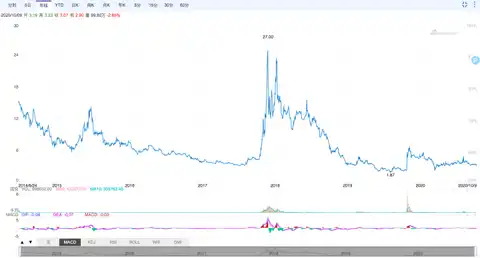
As Chinese speculators frantically traded Wangke Cloud and Wangke Coin, Xunlei's stock soared to an unprecedented $27, a staggering 900% increase.

A 9-fold increase; even in today's environment of excessive liquidity, few U.S. stocks have seen such a rise from their lows, making Xunlei's stock a "diamond" in the eyes of all U.S. stock traders.

Xunlei Stock Price

By November 2017, Chen Lei seemed to be intoxicated by the results and began to cut off Xunlei's unprofitable old businesses. At the end of November 2017, Xunlei announced the cancellation of brand and trademark licenses for Xunlei Big Data, Xunlei Finance, Xunlei Mini Games, and others.

However, this move undermined the interests of Xunlei's veterans, leading to infighting within Xunlei's management. The most significant uproar came from Xunlei Big Data, whose actual controller, Yu Fei, was a former senior vice president of Xunlei. She publicly accused Wangke Coin of being a scam and illegal fundraising, even starting to report Wangxin Technology.

The same company reports itself.

The good days ended quickly. In January 2018, the virtual currency market crashed, national regulations continued to roll in, Wangke Cloud collapsed, and Xunlei's stock also plummeted. In 2019, Xunlei Group's losses continued to expand, and the CDN business that Xunlei was proud of began to face challenges from companies like Alibaba Cloud, Tencent Cloud, and Wangsu Technology. The once-promoted blockchain business showed little improvement.

All of this was the prelude to this "palace intrigue."

Cleaning House

In January 2014, Xunlei's CTO Li Jinbo left the company and founded the Zuiyou APP in July of the same year, which has been doing quite well. In April 2019, Xiaomi invested $80 million in Zuiyou, and Zuiyou reached an agreement with various investors to exchange its shares in Xunlei for shares in Zuiyou. Through this method, Zuiyou transformed into Xunlei's largest shareholder, holding 39.8% of the shares, and the old Xunlei team represented by Li Jinbo was about to return to take over Xunlei.

The first thing they did upon returning was to clean house.

In early April 2020, Xunlei announced personnel adjustments, with Chen Lei no longer serving as CEO of Xunlei or its affiliated companies, and Li Jinbo took over. Shortly after, Wangxin Technology was physically taken over by bodyguards.

Faced with this sudden loss of power, Chen Lei expressed regret for accepting Lei Jun's invitation to join Xunlei in 2014, stating that he had committed many taboos of professional managers: first, he offended some people, and second, he was too naive.

However, the veterans of Xunlei did not share this view.

In the details of the investigation released by Xunlei, a broadband supplier named Xingronghe was discovered, a company personally controlled by Chen Lei, through which he transferred huge amounts of money using various illegal means.

During Chen Lei's tenure, there had always been external doubts about his relationship with Xunlei's senior vice president and Wangxin Technology's vice president, Dong Xue. There were rumors that the two were in a romantic relationship, and during a board meeting, the board confronted Chen Lei, who guaranteed, based on his Christian reputation, that there was no relationship beyond colleagues.

However, after leaving the company, Xunlei discovered that the two had a child during their tenure, and Chen Lei had also recruited a group of fellow townsmen and friends from Hegang, Heilongjiang, to key positions in the company through Dong Xue. They siphoned off company funds through fabricated transactions, devalued false contracts, and were even found to have embezzled tens of millions of funds for cryptocurrency trading.

Xunlei could no longer tolerate this. On October 8, Xunlei announced that former CEO Chen Lei and others were suspected of embezzlement, and the Shenzhen Public Security Bureau had initiated an investigation into Chen Lei's case of embezzlement, calling for him to return to the country as soon as possible to cooperate with the investigation.

Although Chen Lei expressed a different viewpoint in an interview with the Daily Economic News, since a case had already been filed, everything would be subject to police judgment. This "Xunlei palace intrigue," which began in April of this year, also came to a close. Regardless of whether Chen Lei truly regretted coming to Xunlei, the six-year relationship was declared broken in this palace intrigue.

Compared to the palace intrigue, the business of Xunlei itself deserves more of our attention. With the core download function no longer a high-frequency application for people and the stock price having dropped nearly 90% from its peak, how will Xunlei find its former glory?

Original link

免责声明:本文章仅代表作者个人观点,不代表本平台的立场和观点。本文章仅供信息分享,不构成对任何人的任何投资建议。用户与作者之间的任何争议,与本平台无关。如网页中刊载的文章或图片涉及侵权,请提供相关的权利证明和身份证明发送邮件到support@aicoin.com,本平台相关工作人员将会进行核查。

Share To
APP

X

Telegram

Facebook

Reddit

CopyLink