Original | Odaily Planet Daily (@OdailyChina)

Following yesterday's strong breakout of BTC above the key resistance level of $95,000, BTC continued its upward momentum early this morning, reaching a high of $97,924, and is currently reported at $96,484; ETH broke through $3,400 and is currently reported at $3,330; SOL's price rose to a high of $148 and is currently reported at $145. Compared to BTC, ETH and SOL are still hovering in the key resistance zone and have not formed a clear trend breakout.
In terms of derivatives, according to Coinglass data, the total liquidation across the network yesterday reached $680 million, with short positions liquidated at $578 million and long positions at $101 million; Glassnode stated that the market rebound led to the scale of short liquidations reaching a new high since the "1011 crash."
According to msx.com data, the three major U.S. stock indices closed lower, but cryptocurrency concept stocks rose overall, with ALTS up over 30.94% and BNC up over 11.81%. This situation is rare; what is the driving force behind such a strong rise in the crypto market?
ETF Fund Shift
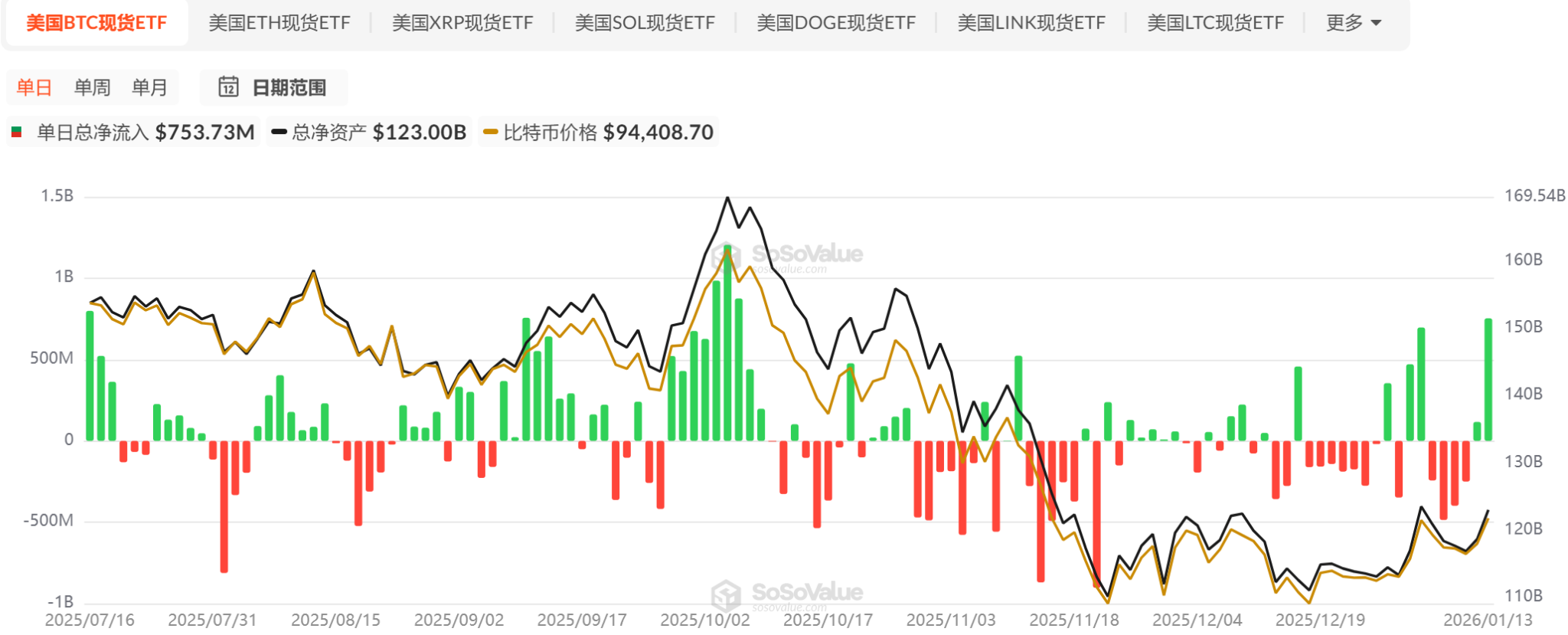
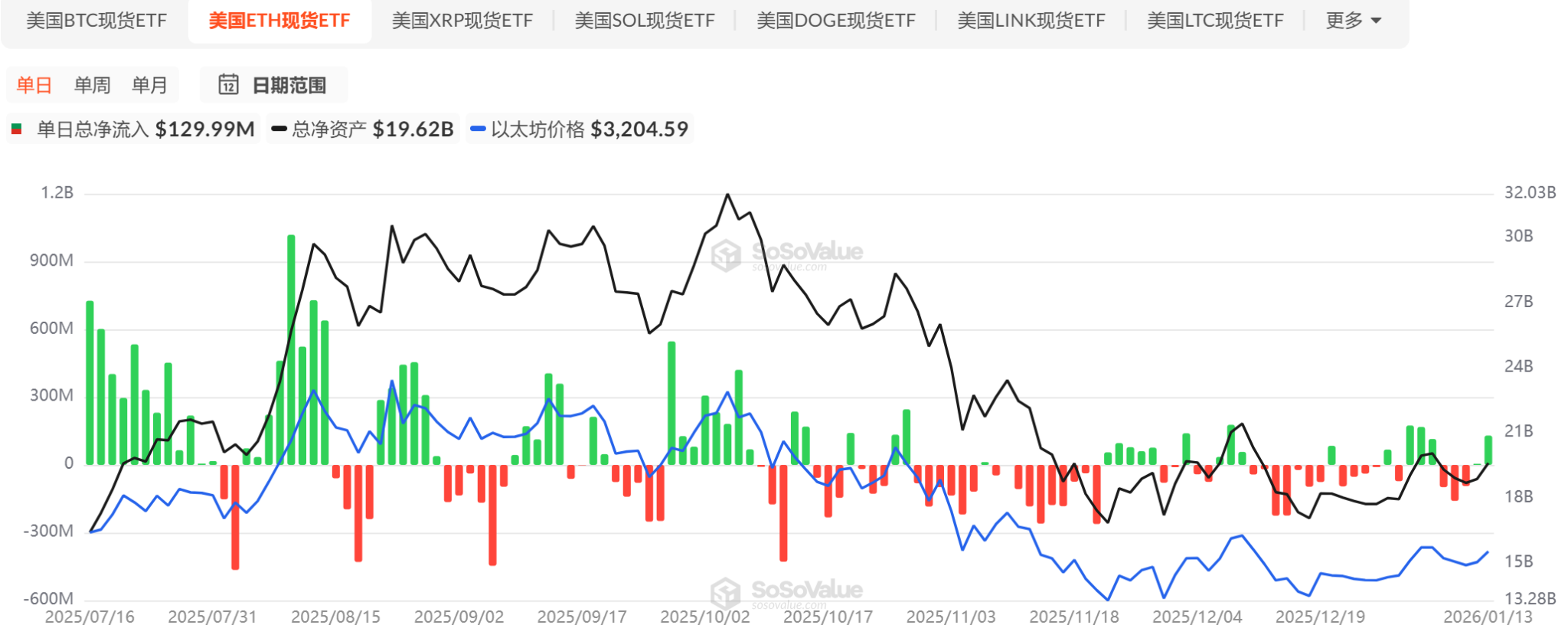
From a funding perspective, since mid-October 2025, BTC spot ETFs have been in a state of net outflow or small-scale net inflow, indicating a lack of clear incremental funding signals in the market. However, in the past week, after four consecutive trading days of net outflow, BTC spot ETFs have turned to two consecutive days of net inflow, with a single-day net inflow of as much as $750 million on January 13, marking an important signal for this phase. In contrast, ETH spot ETFs are still showing weak performance.


From a price behavior perspective, a noteworthy change is occurring. Bitcoin's cumulative return during North American trading hours is about 8%, while the European session recorded only about 3% moderate gains, and the Asian trading session even dragged down the overall performance.
This phenomenon sharply contrasts with the end of 2025. At that time, Bitcoin's cumulative decline during North American hours reached as high as 20%, with prices once falling to around $80,000. The fourth quarter often sees selling pressure during U.S. market opening hours, while spot Bitcoin ETFs faced capital outflows almost daily.
Now, the strongest returns are appearing shortly after the U.S. stock market opens, a period that has been the weakest for Bitcoin over the past six months.
Macroeconomic Data: No Bad News, but Lack of Easing Catalysts
On the macro level, the December CPI year-on-year released this week remained at 2.7% (unchanged from the previous value and in line with market expectations), while the core CPI year-on-year slightly rose to 2.7% (previous value 2.6%, slightly higher than some expectations), indicating that inflationary pressures still have a certain stickiness; however, the November PPI year-on-year unexpectedly rose to 3.0% (higher than the expected 2.7%), and retail sales month-on-month also recorded strong growth (exceeding market expectations), with consumer data performing strongly, supporting the view that economic growth still has resilience.
Although the December CPI data is overall relatively mild (month-on-month 0.3% in line with expectations, annual rate not further accelerating), inflation has not yet significantly retreated to the Federal Reserve's comfort zone. Combined with previous employment reports showing resilience in the labor market, the market generally believes that the Federal Reserve is highly likely to maintain interest rates at the end of January's meeting, with almost no expectations for rate cuts. This also means that there is still a lack of catalysts for policy easing in the short term. According to CME's "FedWatch," the probability of the Federal Reserve maintaining interest rates in January has reached 95%.
However, the expectation for rate cuts in 2026 is worth looking forward to, as Federal Reserve Governor Milan reiterated the need for a 150 basis point rate cut this year.
Regulatory Legislative Progress: CLARITY Act Becomes the Focus
Beyond the short-term market, the most noteworthy medium to long-term variable recently is the legislative progress of the CLARITY Act. This bill aims to establish a comprehensive regulatory framework for the U.S. crypto market, with main goals including:
- Clarifying the regulatory boundaries between the SEC (securities-type assets) and CFTC (commodity-type digital assets);
- Defining digital asset classifications (securities, commodities, stablecoins, etc.);
- Introducing stricter information disclosure, anti-money laundering, and investor protection requirements while leaving room for innovation.
With the Senate Banking Committee revising and voting scheduled for January 15, U.S. crypto legislation has officially entered the "sprint phase." Committee Chairman Tim Scott (Republican) released a 278-page revised text on January 13, which had undergone months of bipartisan closed-door negotiations and quickly sparked over 70 (some statistics indicate 137) proposed amendments, with disagreements over stablecoin yields and DeFi regulation heating up, leading to full engagement from the crypto industry, banking lobby groups, and consumer protection organizations.
Moreover, there has not been a unified stance within the crypto industry. On January 14, Coinbase CEO Brian Armstrong publicly announced the withdrawal of support, stating that after reviewing the text, he believes the bill has "too many issues regarding DeFi bans, stablecoin reward mechanisms stifling, and excessive government surveillance, making it worse than the current situation." He emphasized that Stand With Crypto will score the revised vote on Thursday, testing whether senators are "on the side of bank profits or consumer/innovation rewards." Industry insiders believe that Coinbase's public opposition "has significant impact" and may influence the fate of the bill.
After Coinbase publicly expressed opposition, several leading institutions and associations, including a16z, Circle, Kraken, Digital Chamber, Ripple, and Coin Center, publicly expressed support for the Senate Republican version, believing that "any clear rules are better than the current situation," which can inject long-term certainty into the market and position the U.S. as the "global crypto capital." (Recommended reading: Why is there such a serious divergence in the industry after the CLARITY review was unexpectedly postponed?)
Other Observations: Strengthening Ethereum Staking Demand and Continued Accumulation by Strategy
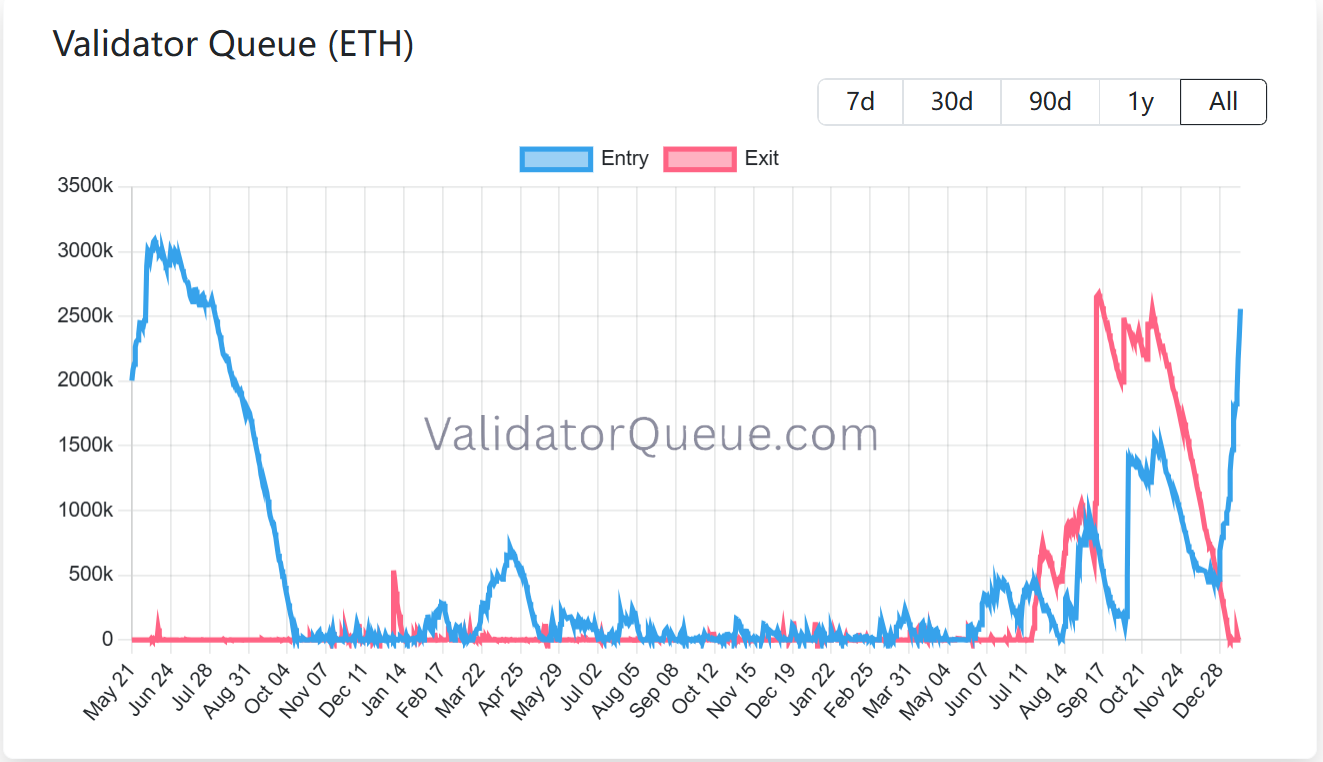
The demand for Ethereum staking continues to strengthen. Currently, the amount of ETH locked in the Beacon Chain has exceeded 36 million, accounting for nearly 30% of the network's circulating supply, corresponding to a staking market value of over $118 billion, continuously setting new historical highs. The previous highest proportion was 29.54%, which occurred in July 2025. The Ethereum network currently has about 900,000 active validators, while approximately 2.55 million ETH are still queued for staking. This indicates that, at least from an on-chain behavior perspective, the short-term selling willingness of existing stakers remains limited, and the network overall tends to "lock rather than release." 
In addition, developer activity on Ethereum and stablecoin trading volume have both reached historical highs. Recommended reading: ETH Staking Data Reversal: Exit Zero vs. Entry Surge of 1.3 Million, When to Buy the Dip?
Bitcoin reserve company Strategy (formerly MicroStrategy) continued to execute its long-term accumulation strategy this week, spending approximately $1.25 billion to purchase 13,627 BTC at an average price of about $91,519. As a result, its total Bitcoin holdings have increased to 687,410 BTC, valued at approximately $65.89 billion, with an overall holding cost average of about $75,353.
Investment bank TD Cowen recently lowered its one-year target price from $500 to $440, citing the dilution effect from the continued issuance of common and preferred stock, which weakens Bitcoin yield expectations. Analysts expect that Strategy may increase its holdings by about 155,000 BTC in the 2026 fiscal year, higher than previous forecasts, but a higher equity financing ratio will suppress the growth rate of Bitcoin holdings per share.
TD Cowen also pointed out that although short-term yields are under pressure, as Bitcoin prices recover, relevant indicators in the 2027 fiscal year are expected to improve. The report also emphasized that Strategy chose to continue accumulating during the recent Bitcoin price correction phase, and most of the financing proceeds were directly used to purchase Bitcoin, indicating that its strategic goals have not wavered. Overall, analysts remain relatively positive about Strategy's long-term value as a "Bitcoin exposure tool" and believe that some of its preferred shares have certain attractiveness in terms of yield and capital appreciation. As for the issue of index inclusion, MSCI has not yet removed Bitcoin reserve companies from the index system, which is seen as a favorable factor in the short term, but there remains uncertainty in the medium to long term.
Arthur Hayes also stated that his core trading strategy this quarter is to go long on Strategy (MSTR) and Metaplanet (3350), using this as a leveraged bet on BTC returning to an upward trend.
Market Outlook: Structural Changes and Rebound Conditions
In summary, the crypto market is at an important turning point, and whether the traditional "four-year cycle" remains effective will be revealed in the coming months.
Crypto market maker Wintermute analyzed in its latest review of the digital asset over-the-counter market that in 2025, Bitcoin did not exhibit the strong characteristics typical of a four-year cycle, while the altcoin cycle has almost disappeared. In its view, this phenomenon is not a short-term fluctuation or rhythm misalignment, but a deeper structural change.
Under this premise, Wintermute believes that for a truly strong rebound to occur in 2026, the triggering conditions will be significantly higher than in previous cycles and will no longer rely on a single variable. Specifically, at least one of the following three outcomes needs to be validated.
First, the scope of allocation for ETFs and crypto treasury (DAT) companies must be expanded beyond Bitcoin and Ethereum. Currently, U.S. spot BTC and ETH ETFs objectively concentrate a significant amount of new liquidity on a few large-cap assets, which, while enhancing the stability of leading assets, has also significantly compressed market breadth, leading to severe performance divergence overall. Only when more crypto assets are included in ETF products or corporate balance sheets can the market potentially regain broader participation and a liquidity foundation.
Second, core assets such as BTC, ETH, BNB, and SOL need to experience a sustained strong rise again and recreate a sufficiently noticeable wealth effect. In 2025, the traditional mechanism of "Bitcoin rising—funds flowing into altcoins" essentially failed, with the average rising cycle for altcoins compressed to about 20 days (compared to about 60 days the previous year), and many tokens continued to weaken under unlocking selling pressure. In the absence of sustained upward momentum from leading assets, it is difficult for funds to generate downward overflow, making it naturally challenging to activate the altcoin market.
Third, and most decisively, retail attention needs to genuinely flow back into the crypto market. Although retail investors have not completely exited, their new funds are currently more directed towards high-growth themes such as the S&P 500, AI, robotics, and quantum computing. The extreme drawdowns, platform bankruptcies, and forced liquidations of 2022-2023, combined with the reality that crypto assets overall underperformed traditional stock markets in 2025, have significantly weakened the narrative that "crypto equals getting rich." Only when retail investors regain confidence in the crypto market's potential for excess returns and return on a large scale can the market potentially regain the highly emotional and almost frenzied upward momentum of the past.
In other words, against the backdrop of structural changes that have already occurred, future rebounds will no longer be about "whether they will come," but rather "under what conditions and through which paths they will be reignited."
免责声明:本文章仅代表作者个人观点,不代表本平台的立场和观点。本文章仅供信息分享,不构成对任何人的任何投资建议。用户与作者之间的任何争议,与本平台无关。如网页中刊载的文章或图片涉及侵权,请提供相关的权利证明和身份证明发送邮件到support@aicoin.com,本平台相关工作人员将会进行核查。