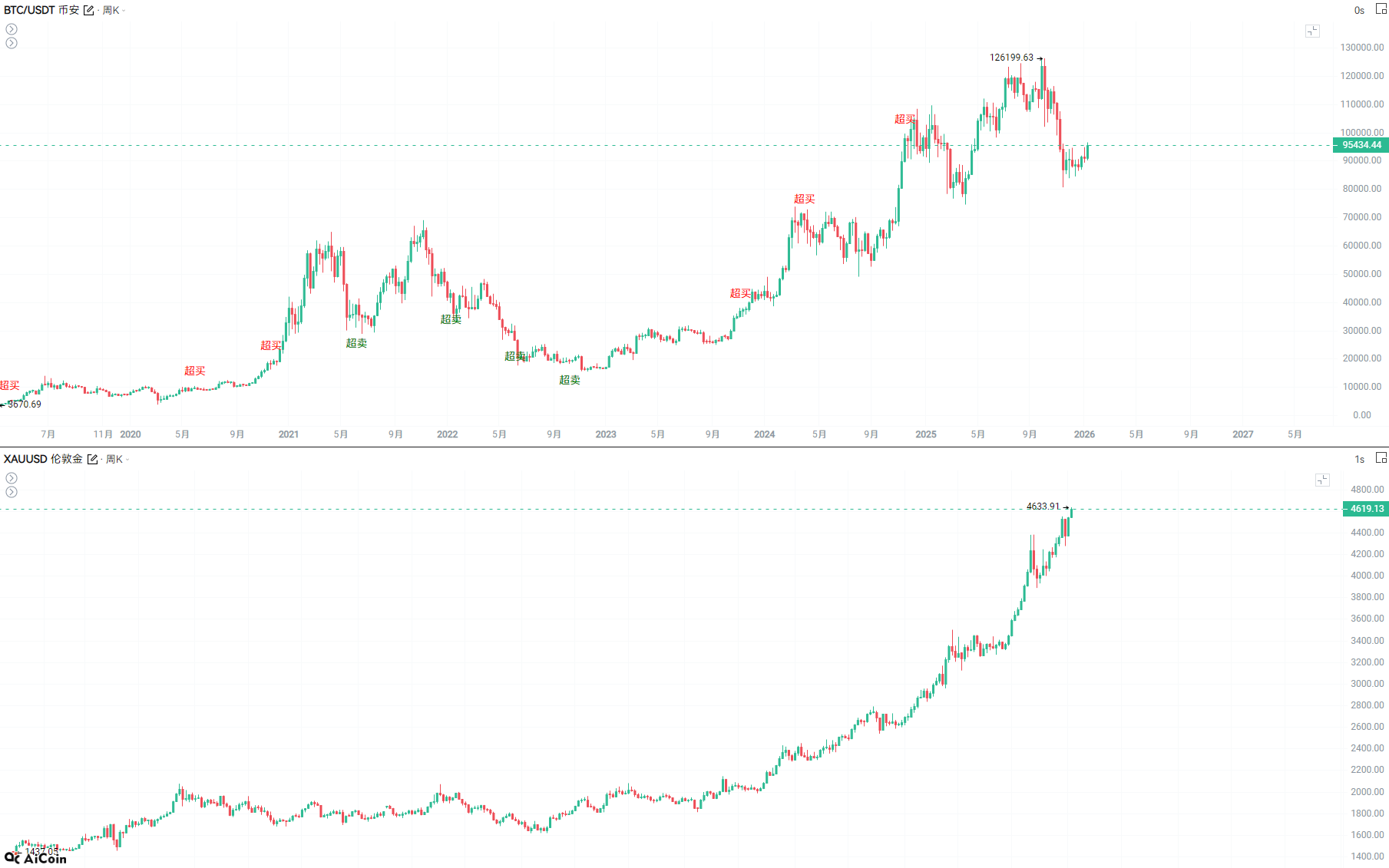
The correlation between Bitcoin and gold over 52 weeks has dropped to zero, and market analysts have turned to historical charts, discovering a pattern of an average increase of 56% is re-emerging. The 52-week correlation between Bitcoin and gold has fallen to zero for the first time since mid-2022 and may turn negative by the end of January 2026. This change has attracted widespread attention in the market.
Historically, when Bitcoin and gold show a similar divergence, Bitcoin typically experiences an average increase of 56% within about two months. The corresponding price range is approximately $144,000 to $150,000.

1. Market Signals
● Data from January 2026 shows that the 52-week correlation between Bitcoin and gold has dropped to zero, marking the first time since mid-2022. This change is not just a statistical fluctuation but may signal an important turning point in the cryptocurrency market.
● Analysts point out that this declining correlation is likely to turn negative before the end of January. Historical data indicates that a divergence in the trends of Bitcoin and gold often foreshadows a strong upward trend for Bitcoin.
● When the correlation between two assets weakens, capital flows begin to diverge. Gold, as a traditional safe-haven asset, reflects market concerns about economic uncertainty; meanwhile, the increasing independence of Bitcoin's trend may indicate a reassessment of its value storage and growth potential.
2. Historical Patterns
Looking back at historical moments when the correlation between Bitcoin and gold turned negative, a clear pattern emerges. In similar situations, Bitcoin typically achieves significant gains within about two months. Specific data shows that this increase averages 56%, corresponding to a price range of approximately $144,000 to $150,000.
● This historical pattern is not coincidental. When Bitcoin and gold diverge, it often signifies an increase in risk appetite in the cryptocurrency market, with funds flowing from traditional safe-haven assets to high-risk, high-reward digital assets.
● This shift in market sentiment reflects a renewed recognition of Bitcoin's independent value proposition, especially when the global liquidity environment changes.
3. Macroeconomic Environment
● The current global macroeconomic environment is creating multiple favorable conditions for Bitcoin. Global liquidity is on the rise, and M2 growth indicates an expansion trend in money supply. The Federal Reserve's quantitative tightening policy is nearing completion, and the shift in monetary policy creates a more favorable environment for risk assets.
● Matt Hougan, research director at Bitwise, points out that a new round of global monetary easing has begun, and this trend may continue to drive Bitcoin prices upward in 2026. The improvement in the liquidity environment supports all risk assets, and Bitcoin, as an emerging asset class, is particularly sensitive to such changes.
● Delphi Digital also expressed a similar view in its 2026 market outlook report, stating that the global macro environment is shifting from divergence to convergence, with major central banks moving towards interest rate cuts, and fiscal deficits driving an increase in liquidity demand.
4. Cycle Comparison
● From a cyclical structure analysis, Bitcoin's trend appears to be replicating the path of the bull market from 2020-2021. The market has transitioned from a long-term consolidation phase to the early stage of a "quasi-parabolic" rise. If this historical fractal continues, Bitcoin's target price for this round of increase may point to around $150,000.
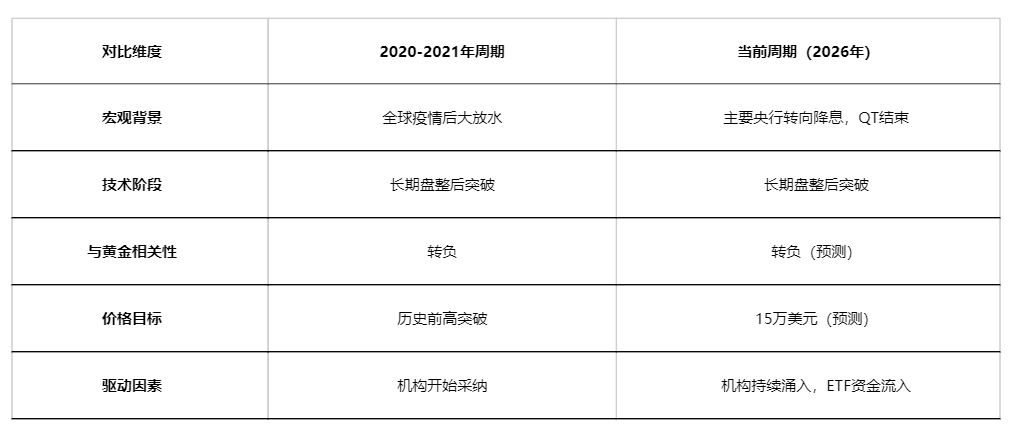
● A close examination of the current market structure reveals similarities with the 2020-2021 cycle: both broke through key resistance levels after long-term consolidation, both experienced a decline in correlation with gold, and both occurred against a backdrop of a global liquidity shift towards easing.
● Analysts believe that this cyclical repetition is not coincidental but rather a result of Bitcoin's unique market dynamics and external macroeconomic conditions.
Table: Comparison of Current Bitcoin Cycle with 2020-2021 Cycle Characteristics
5. Institutional Predictions
● Several well-known institutions and analysts have made optimistic predictions for Bitcoin's performance in 2026. Bernstein analyst Gautam Chhugani predicts that Bitcoin will reach $150,000 in 2026, with a peak potentially hitting $200,000 in 2027.
● Haseeb Qureshi, a partner at Dragonfly Capital, also predicts that Bitcoin will reach $150,000 by the end of 2026. A common theme in these institutional predictions is the belief that Bitcoin will benefit from increasing institutional adoption and a favorable macro liquidity environment.
● Matt Hougan, Chief Investment Officer at Bitwise, presents a noteworthy perspective: although historical halving cycles typically indicate that 2026 will enter a bear market, a massive influx of institutional and retail funds may drive Bitcoin into a bull market in 2026.
● This viewpoint challenges the traditional four-year cycle theory, suggesting that the Bitcoin market has matured enough to transcend its original intrinsic rhythm.
6. Contrasting Views
● There are also differing predictions regarding Bitcoin's performance in 2026. Supporters of the traditional four-year halving cycle theory believe that, according to historical patterns, 2026 could become a bear market year for Bitcoin. This view is based on Bitcoin's price performance following previous halvings: typically, a bull market follows a halving, followed by a period of adjustment.
● Jeff Mei, Chief Operating Officer of BTSE, proposed a conditional prediction: if the Federal Reserve maintains interest rates in the first quarter of 2026, Bitcoin could drop to $70,000. This prediction serves as a reminder to investors that Bitcoin's price remains significantly influenced by the traditional monetary policy environment.
● An analysis article presented an interesting perspective: Bitcoin may be transitioning from its halving cycle to a broader macroeconomic cycle. The article notes that both the Benner cycle and the 18-year real estate cycle, which are historically older models, mark 2026 as a market peak rather than a low point.
7. Risk Warning
Despite multiple signals indicating that Bitcoin may be on the verge of an upward trend, investors should remain rational. The cryptocurrency market is highly volatile, and past performance does not guarantee future results.
● Market analyst Cas Abbé outlined seven potential policy catalysts that could drive a super cycle in the crypto market, including four interest rate cuts by the third quarter of 2026, the end of quantitative tightening, and the passage of crypto market structure legislation. The realization of these predictions will directly impact market direction.
● Delphi Digital also pointed out in its report that the market may not receive as much liquidity as it did in 2020, but it has established conditions for a clearer and more predictable easing rhythm. This relatively restrained expectation reminds us that improvements in the macro environment may be gradual rather than abrupt.
● The Federal Reserve ended quantitative tightening on December 1, 2025, and initiated a "reserve management purchase" program, buying about $40 billion in short-term government bonds each month. This policy, viewed by some analysts as "invisible quantitative easing," will continue to affect market liquidity in the first quarter of 2026.
Bitcoin's price has recently hovered around the $90,000 mark, and market observers are engaged in a critical debate: will 2026 follow the familiar four-year halving model into a period of adjustment, or will a broader economic cycle framework reshape the trajectory of cryptocurrencies?
Two historical models—the Benner cycle and the 18-year real estate cycle—both point to 2026 potentially being a market peak, directly contradicting the downward trend expected from Bitcoin's traditional halving cycle.
As traditional institutions heavily invest in digital assets, and macro economic forces gradually influence price direction, the Bitcoin market is witnessing a fundamental evolution. In the coming months, the market will reveal whether Bitcoin adheres to the traditional cycles of century-old wisdom or forges a new path amid global liquidity waves.
Join our community to discuss and grow stronger together!
Official Telegram community: https://t.me/aicoincn
AiCoin Chinese Twitter: https://x.com/AiCoinzh
OKX benefits group: https://aicoin.com/link/chat?cid=l61eM4owQ
Binance benefits group: https://aicoin.com/link/chat?cid=ynr7d1P6Z
免责声明:本文章仅代表作者个人观点,不代表本平台的立场和观点。本文章仅供信息分享,不构成对任何人的任何投资建议。用户与作者之间的任何争议,与本平台无关。如网页中刊载的文章或图片涉及侵权,请提供相关的权利证明和身份证明发送邮件到support@aicoin.com,本平台相关工作人员将会进行核查。


