Fed and Powell Under Fire, but Some Argue Independence Was Always an Illusion

CN
2 hours ago

Plenty of people think U.S. President Donald Trump’s verbal shots at the central bank, complete with name-calling aimed at Powell, amount to pressure on the Fed’s independence. According to a Fox Business report, Sen. Elizabeth Warren, D-Mass., the top Democrat on the Senate Banking Committee, said Trump’s plan was to “install another sock puppet to complete his corrupt takeover of America’s central bank.”

Still, some voices are cutting through the noise, arguing that the idea of an independent U.S. Federal Reserve is merely fiction. Speaking with Bloomberg’s Eric Balchunas and Scarlet Fu, prominent American investment manager Rob Arnott made that point during an episode of ETF IQ.

“Fed independence, I’ve always thought, was somewhat of a myth,” Arnott said. “The governors are appointed by the President on a rolling basis, so you get this slow takeover of the Fed with your chosen people. So the Fed’s independence disappears reasonably quickly during any Presidential term. The result is the Fed has always been political.”

Shapeshift and Venice AI founder Erik Voorhees echoed the claim that the Fed’s independence is fiction—and he did so with far less restraint. “Fed ‘independence’ is a myth, a story,” Voorhees wrote on X. “It is the moral cover which justifies its grotesque state-sanctioned near-monopoly power over the most important market in the world: money. The Fed is never ‘independent’ of the banking establishment. It is of, by, and for the banks. The Fed is the banking establishment’s greatest accomplishment.”

Voorhees added:

“And because modern banking is an appendage of the state, so too is the Fed its most potent tentacle. Nobody should really care about how much the Fed spent on its building renovations. What a distraction!”

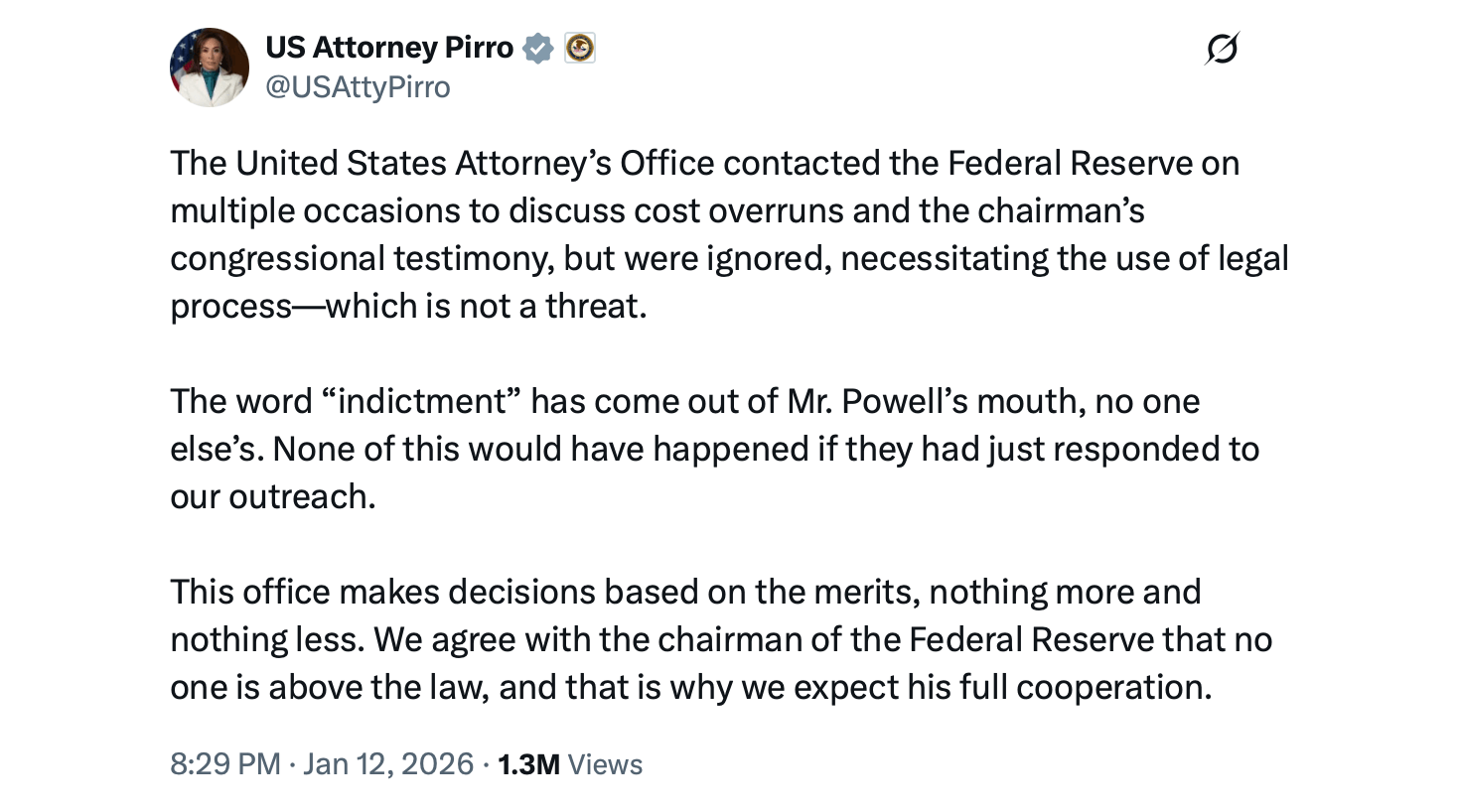
Wellington-Altus Private Wealth Chief Market Strategist James E. Thorne says Chair Powell dressed up a routine Justice Department oversight review as something far more dramatic—a supposed threat to Federal Reserve independence. In his telling, the DOJ simply asked questions about cost overruns and congressional testimony after informal outreach went nowhere, while the idea of a looming criminal case came straight from Powell’s own framing.

“In what looked like a scripted response, all of the Fed acolytes on Wall St cried foul; they bought in hook, line, and sinker,” Thorne stressed. “All of this does not meet the smell test. Is the Fed above the US Constitution? Why did Powell go public and choose the framing that he did? Why did MSM and so-called objective pundits not do any objective analysis? Smells like elements of a Russia Russia Russia hoax strategy to me.”

A stack of studies and analyses bolster the case that the Fed’s independence looks better on paper than it does in real life. A 2025 policy note from the Levy Economics Institute flatly describes the Fed as a “creature of Congress,” not a truly autonomous institution. Research published in Econofact last year tracks the global slide in central bank independence, with the U.S. very much part of the story.

Also read: Federal Reserve Gets Probed by DOJ, Chair Powell Alleges Fed’s Independence Is at Stake

Adding to that, a 2020 study in Economics & Politics, with updates through 2024, places the United States in the bottom quartile worldwide when it comes to central bank independence. Going further back, in The Case Against the Fed and across his broader body of work, Austrian economist Murray Rothbard argued that the Federal Reserve, rather than standing apart, is tightly woven into the machinery of the state.

Fed and Powell Under Fire, but Some Argue Independence Was Always an Illusion

Rothbard’s analyses—along with that of many other Austrian economists—flatly maintains that any claim of Federal Reserve “independence” amounts to polished public relations, not an honest description of reality. For instance, the Fed’s very origin tells the story: created by Congress in 1913, it operates under statutory authority that effectively grants it a government-backed monopoly over issuing legal tender.

Historically—especially in wartime and during financial crises—the Fed has worked hand in glove with the U.S. Treasury to monetize government debt and steer macroeconomic policy. On top of that, the President selects the Fed chair and the Board of Governors, with Senate confirmation sealing the deal. In this light, “independence” clouds accountability and props up a technocratic veneer, while the Fed, in practice, operates as a tool of state power and wealth redistribution.

Even during its creation, President Woodrow Wilson pushed for government control while simultaneously working in lockstep with the Money Trust—a tight-knit circle of powerful Wall Street financiers and institutions that ruled U.S. finance in the early 20th century, as laid bare by the Pujo Committee, a House subcommittee investigation. One could easily argue that from its very inception, the Fed was built by the state alongside a closed circle of bankers who, so far, have delivered an extremely dismal track record and hardly qualify as independent.

The renovation probe and the political theater around it appear to have reopened a much older argument rather than revealing anything new. Critics across academia, economics and philosophy have long contended that the Federal Reserve’s structure, appointment process and historical behavior place it firmly within the orbit of government power. From that perspective, the current dispute says less about a sudden erosion of independence and more about a system functioning as it always has—subject to political incentives, institutional alliances and shifting priorities inside Washington.

  • Why is the Federal Reserve’s independence being questioned now?
    A Justice Department probe and renewed political criticism have revived longstanding debates about whether the Fed truly operates independently of government power.
  • What role does the president play in Federal Reserve leadership?
    The president appoints the Fed chair and Board of Governors, with Senate confirmation, giving elected officials significant influence over the central bank.
  • What do critics say about the Fed’s origins?
    Critics argue the Fed was created by Congress in 1913 alongside powerful banking interests, embedding political and financial influence from the start.
  • Why do some economists call Fed independence a myth?
    They point to its legal structure, crisis-era coordination with the Treasury and historical ties to government policy as evidence it is not fully autonomous.

免责声明:本文章仅代表作者个人观点,不代表本平台的立场和观点。本文章仅供信息分享,不构成对任何人的任何投资建议。用户与作者之间的任何争议,与本平台无关。如网页中刊载的文章或图片涉及侵权,请提供相关的权利证明和身份证明发送邮件到support@aicoin.com,本平台相关工作人员将会进行核查。

Share To
APP

X

Telegram

Facebook

Reddit

CopyLink