Author: Our Crypto Talk
Translated by: Yuliya, PANews
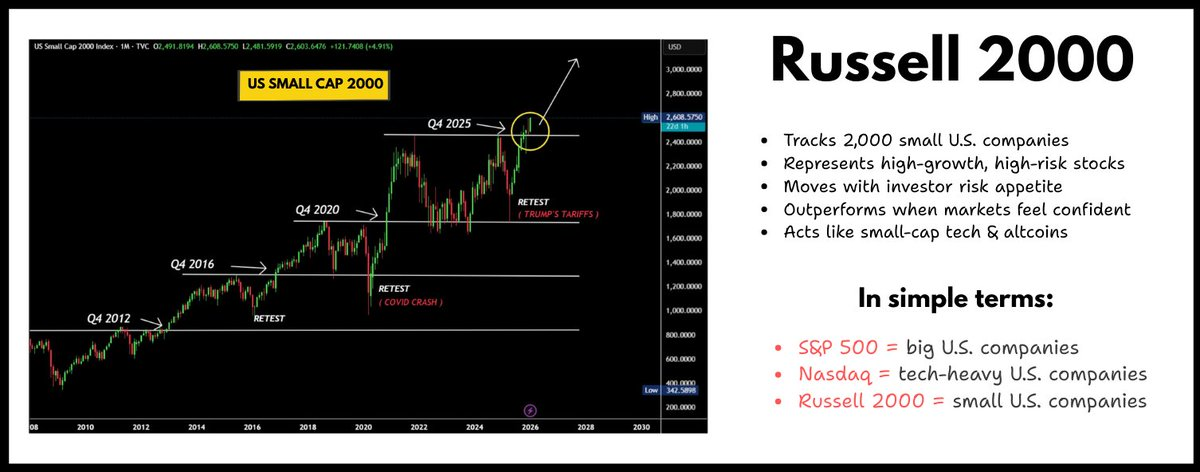
What this article will discuss is not a cryptocurrency chart, nor a narrative about some meme coin, and it is even temporarily unrelated to Bitcoin. We will focus on the Russell 2000 Index, which is quietly achieving a feat that has only occurred twice in its history: a breakout that is driving a return of risk appetite.
If you have been in the market long enough, you have seen this "movie" more than once.
A Pattern Continually Ignored by Most
History always repeats itself, and even if you don't believe in cycles, you should respect this repetitiveness.
In 2017, the Russell 2000 Index broke out, and then the "altcoin season" arrived.
In 2021, the Russell 2000 Index broke out again, and the "altcoin season" played out once more.
Although each market narrative is different and the popular tokens vary, the underlying driving mechanisms are the same.
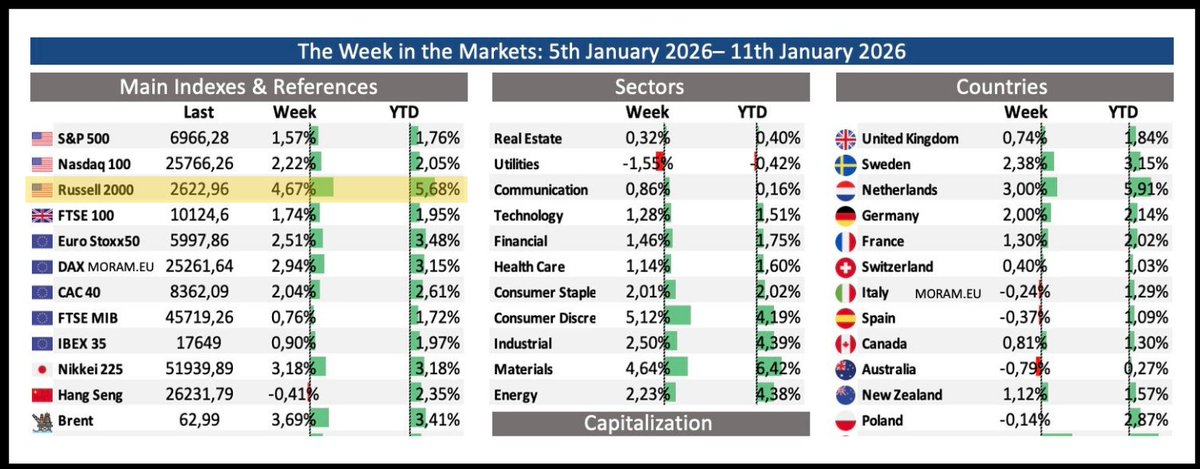
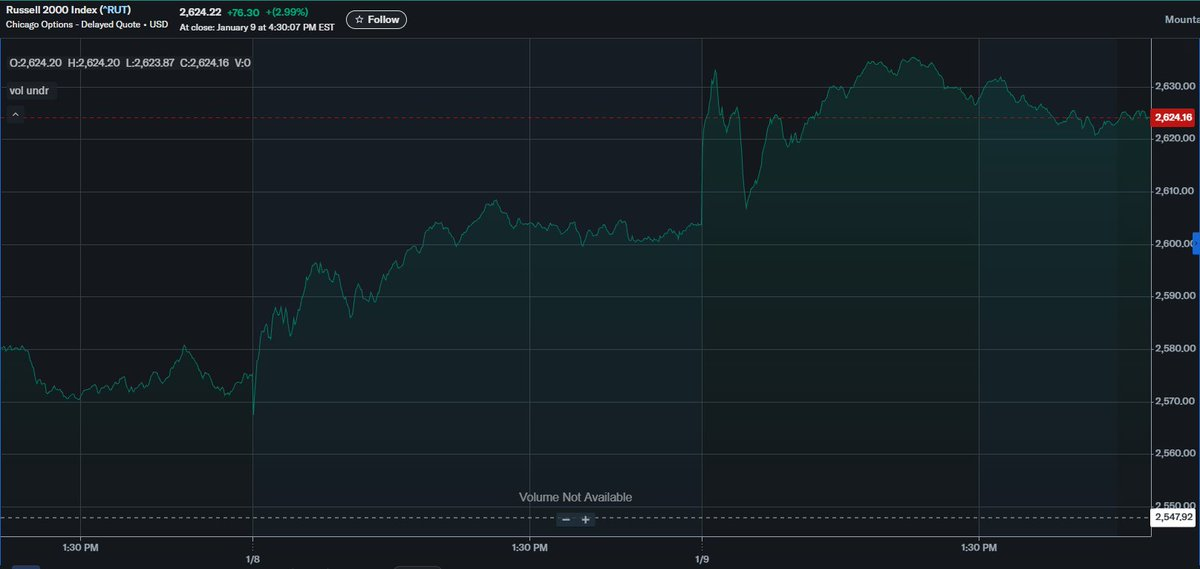
Now, in January 2026, the Russell Index has broken through 2600 points for the first time in its history.

This breakout is not an illusion, nor a false fluctuation caused by thin trading during the holiday period, but a comprehensive breakout with huge trading volume and broad fundamentals, with the index having risen about 15% since the beginning of the year.
What Does the Russell Index Truly Represent?
Trading in small caps is not based on market sentiment or feelings, but is a liquidity trade.
The Russell Index tracks about 2000 smaller U.S. companies, including regional banks, industrial firms, biotech companies, and more. The survival and development of these companies are closely related to the lending environment and growth expectations.
When liquidity tightens, these companies suffer severe blows.
When liquidity eases, they lead the entire market.
This is why the Russell Index never leads in defensive markets; however, it often becomes a leader when risk appetite returns. Therefore, the breakout of this index is not a simple technical phenomenon; it is a clear signal: capital is moving down the risk curve in search of higher returns.
This is Not an Isolated Event: Support from the Macro Background
Zooming out, you will find that the current macro background aligns disturbingly with this trend.

The Federal Reserve is quietly providing support to the market by purchasing Treasury bills. While this is not comprehensive quantitative easing (QE), it is enough to alleviate funding pressure and inject lubricant into the credit market.
The U.S. Treasury is reducing the balance of its General Account (TGA), which means pushing cash back into market circulation rather than pulling it out.
Fiscal policy is gradually easing at the margins, such as larger tax refunds, potential consumer subsidies, and lowering interest rates by purchasing mortgage-backed securities, thereby releasing household and business balance sheets.
Individually, any one of these measures does not constitute a strong "stimulus" signal. But when they come together, they form a powerful liquidity waterfall. And liquidity is never stagnant.
The True Transmission Path of Liquidity
This is often a misunderstood part. Liquidity does not "transfer" from cash to altcoins out of thin air; it flows in a certain order and hierarchy:
First, it stabilizes the bond and financing markets.
Then, it pushes up the stock market.
Next, it seeks higher beta (high risk, high return) assets within the stock market.
Only after that does it overflow into alternative asset classes.
Small caps are in the middle of this chain. They are riskier than mega caps, but for institutional investors, their logic is clear and easy to understand. When small caps start to outperform the market, it usually means that capital's gaze has shifted from "safety" to "growth."
This is why the breakout of the Russell Index historically always signals a broader expansion of risk assets. This is not a coincidence, but a mechanical and inevitable transmission process.
The Position of Cryptocurrency Within This
The cryptocurrency market is not the leader of the liquidity cycle but rather an amplifier.
When the Russell Index enters a sustained upward trend, higher beta assets often lag behind. Historical data has repeatedly shown that ETH and altcoins typically respond one to three months later.

This is not because traders are staring at the Russell Index on trading software (like TradingView), but because the same liquidity that drives capital into small caps will eventually seek assets with higher "convexity" (the potential for large returns with relatively low risk).
And cryptocurrencies, especially those that have experienced capitulation sell-offs, thin order books, and exhausted selling power, are precisely the endpoint of this search. This is exactly the landscape facing the crypto market at the beginning of 2026.
Why Does This Feel Different, Yet the Essence Remains the Same?
Every cycle has its reasons for "this time being different."
In 2017, it was the excessive bubble of ICOs.
In 2021, it was excessive leverage and market bubbles.
In 2026, it is regulatory uncertainty, macroeconomic concerns, and market fatigue.
These superficial explanations change, but the laws of capital flow do not.
What is different this time is that the current market "pipeline system" (i.e., infrastructure) has greatly improved: clearer regulatory frameworks, institutional-level custody standards, spot ETFs continuously absorbing market supply, and reduced excessive speculative leverage at the market's edges.
Even industry insiders are beginning to openly discuss previously secretive viewpoints. When CZ talks about a potential "super cycle," he is not referring to hype but to the synergy of multiple factors: liquidity, regulation, and market structure finally beginning to move in the same direction. This synergy is extremely rare.

The Mistakes Being Made by Native Crypto Traders
Most cryptocurrency traders are still fixated on crypto charts, waiting for confirmation signals from the market itself. But this is often too late.
When altcoins start to soar in price, the rotation of capital has already been completed in other markets. The signals of returning risk appetite first appear in those markets that can rise without relying on hype. Small caps are one such market. They are not driven by memes but are rising because borrowing has become easier and capital has regained confidence.
Therefore, if you ignore the breakout of the Russell Index because "this has nothing to do with crypto," you completely miss the point.
The True Meaning of a "Super Cycle"
A "super cycle" does not mean that all assets will rise forever. It means:
Structural support: The duration of the rise will be longer than people expect because it is driven by market structure rather than fleeting euphoric sentiment.
Pullbacks are absorbed: Market pullbacks will be absorbed by buying pressure and will not evolve into a chain reaction of crashes.
Capital rotation rather than exit: Capital will rotate between different sectors rather than completely exiting the market.
High beta assets gain vitality: After years of suppression, high-risk, high-return assets finally gain breathing room and upward space.
This is precisely the environment in which altcoins historically stop "bleeding" and begin to be revalued. Not all altcoins will rise, and the extent of the rise will not be uniform, but the trend will be decisive.
The Signals Are on the Table
The Russell Index breaking through historical highs is no coincidence. When it happens, it is inevitably accompanied by easing liquidity, a return of risk tolerance, and capital deciding to move again.
It did this in 2017.
It did this in 2021.
It is doing this now.
You do not need to predict specific target price levels, nor do you need to precisely grasp the exact timing of rotations. You only need to recognize that when small caps lead the market, it is telling you what will happen next.
The crypto market has previously overlooked this signal and usually regrets it months later.
免责声明:本文章仅代表作者个人观点,不代表本平台的立场和观点。本文章仅供信息分享,不构成对任何人的任何投资建议。用户与作者之间的任何争议,与本平台无关。如网页中刊载的文章或图片涉及侵权,请提供相关的权利证明和身份证明发送邮件到support@aicoin.com,本平台相关工作人员将会进行核查。