Author: Lawyer Lv Yinghui
Introduction
In recent years, China's financial regulatory "Card Cutting Action" has been continuously upgraded, aiming to sever the financial chain of telecom fraud and cross-border gambling, which has profoundly affected the account security of ordinary people.
In this context, a seemingly ordinary transfer note can lead to an instant freeze of a bank card—Ms. Yu from Dalian had her account banned by China Construction Bank simply because she wrote the words "Dogecoin" in a transfer of 250 yuan, and was asked to "prove her innocence."

This case is not an isolated incident. As regulatory pressure is transmitted to banks, risk control systems have become highly sensitive, and any words related to "virtual currency" may trigger alarms. Especially after seven associations jointly reiterated on December 5 that "participation in virtual currency trading is prohibited," bank controls have tightened further, creating a tense situation of "any mention of currency-related words leads to card locking."
When the anonymous flow of the crypto world collides with the strict regulations of real finance, we can't help but ask: while preventing crime, how can we avoid harming ordinary users? This account turmoil triggered by "three words" reflects the delicate balance between financial security and personal rights at present.
High-Risk Behavior Profile Triggering Freezes
To more accurately identify the risk of bank card freezing, we need to profile the high-risk behaviors that lead to freezes. Based on Lawyer Lv Yinghui's practical case experience, the following high-risk behaviors have been summarized, reflecting the logic behind the connection of black and gray industry funds to virtual currency sellers leading to card freezes.
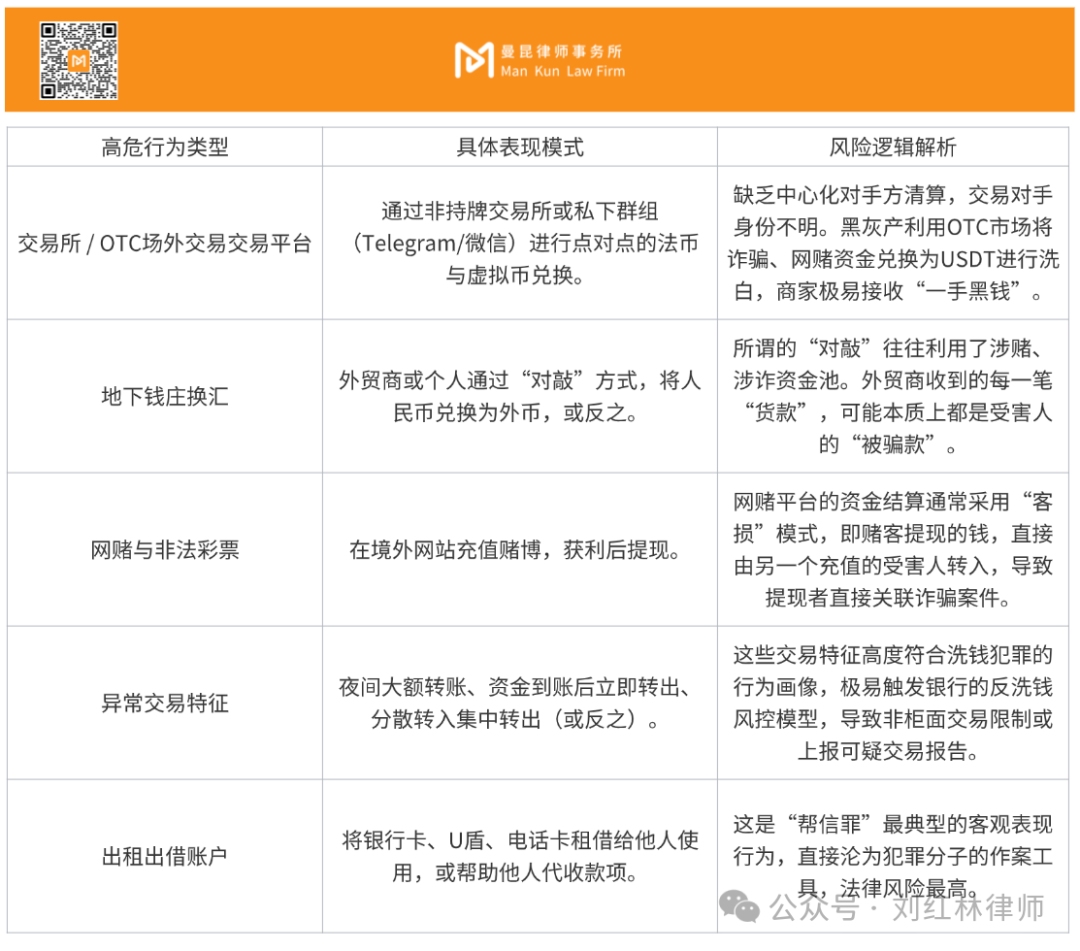
The core of judicial freezing lies in "fund penetration."
Once the fraud proceeds enter the fraudster's account, they are quickly dispersed into countless cards. In order to recover the stolen funds, the police will freeze all associated accounts along the financial path. This leads to a phenomenon: even if you only receive a problematic payment, the entire card may be frozen, commonly referred to as "fund pollution"—like a drop of dirty water contaminating an entire cup of water.
Typically, when your account has issues, there are three possible situations:
Judicial Freeze (most severe): First, a stop payment for 48 hours; if the account is involved in a case, it may turn into a formal freeze lasting up to 6 months or longer.
Bank Risk Control: The bank deems your transaction suspicious, disabling your online banking and payment functions, requiring you to explain proactively.
Administrative Freeze: Other law enforcement agencies freeze the account due to investigation needs.
Reconstructing Legal Facts Through Evidence
(1) How to Exclude "Subjective Knowledge"
In cases of card freezing caused by virtual currency trading, the most commonly considered charges by judicial authorities are "aiding information network criminal activities" (aiding crime) and "concealing or disguising criminal proceeds" (concealment crime). The core difference between the two lies in the subjective awareness of the perpetrator regarding the criminal activity.
1. Presumption Logic of the Investigating Agency
Investigators often infer that the perpetrator "should have known" the funds were involved in fraud through a series of objective behaviors, such as:
Transaction prices significantly deviating from normal market ranges;
Using foreign or concealed communication tools for contact;
After the account is risk-controlled, still frequently attempting small transfers to "test" the account status.
For a pure virtual currency seller, judicial authorities easily form a "presumption of guilt," believing that engaging in this industry should foresee risks. Therefore, the key to effective defense lies in constructing a complete "unawareness" evidence chain.
2. Effective Defense Strategies
The parties involved must actively prove that they have fulfilled reasonable review obligations and that the transaction is entirely normal, such as:
Review Obligations: Verifying the real-name identity information of the trading counterpart;
Reasonable Pricing: Proving that the transaction price is within the normal fluctuation range of the public market;
Behavioral Boundaries: If only completing the basic transaction of "settling the currency," without assisting the counterpart in cash withdrawals, face recognition, or other in-depth operations, it is more favorable to assert the legality and neutrality of one's actions.
(2) How to Prove "Good Faith Acquisition"
For most innocently frozen cardholders, the core goal is to preserve the legitimate funds in the account. This involves the conflict between "recovering stolen funds" in criminal cases and the "good faith acquisition" system in civil law.
1. The Forcefulness of Recovery
According to legal provisions, criminal proceeds should be recovered. In practice, law enforcement agencies can sometimes return frozen funds directly to fraud victims without a court ruling. At this point, the cardholder's only legal shield is "good faith acquisition."
2. Constitutive Elements of Good Faith Acquisition
To claim good faith acquisition, the following three points must be satisfied simultaneously:
Subjective Good Faith: Not knowing and not being expected to know that the funds originated from a crime;
Payment of Reasonable Consideration: Paying a value equivalent to obtain the funds;
Transaction Completion: The transaction has been completed, and the funds have been obtained.
3. Core Disputes and Defenses in Virtual Currency Transactions
The focal point of disputes often lies in whether using virtual currency for payment counts as "reasonable consideration." Some investigating agencies believe that virtual currency is not legal tender and therefore does not constitute valid consideration.
In response, a strong defense can be made from the following legal perspectives:
Judicial Practice Recognizes Its Property Attributes: In criminal cases involving the theft or robbery of virtual currency, courts have recognized its property value and convicted accordingly. Since its value is acknowledged during conviction, its legitimacy as consideration should not be denied during the recovery phase.
Civil Code Protects Virtual Property: The Civil Code has clearly stated that online virtual property is protected by law. The sale of virtual currency between individuals constitutes a legal disposition of one's own property.
Action Recommendations: Once an account is found to be frozen but funds have not been withdrawn, immediately submit a written legal opinion to the investigating agency, clearly stating the claim of "good faith acquisition." This is a critical window period to prevent forced deductions.
(3) The Logic of Legal Transactions
Under the inertia of presumption of guilt, the only way for cardholders to prove their innocence is to reconstruct the entire transaction. This requires the integration of the flow of funds, information, and business for verification.
Flow of Funds: Provide complete bank statements, clearly explaining the source and destination of each payment.
Flow of Information: Retain complete chat records, transaction platform order screenshots, counterpart real-name information, etc., to prove that the transaction was based on voluntary negotiation and that the party fulfilled their identity verification obligations.
Business Flow (Key Evidence): Provide corresponding evidence of virtual currency circulation, including exchange withdrawal records, on-chain transfer hashes (Transaction Hash), and blockchain browser query screenshots, to conclusively prove that: at a time close to receiving the counterpart's transfer, an equivalent virtual asset had already been transferred to an address controlled by the counterpart, achieving "settlement of currency."
Understanding the transaction logic is simple; just know the following four points:
"Who am I": Attach work proof, tax records, and establish an image of a law-abiding citizen with a legitimate profession and clean background, dispelling suspicions of "professional money laundering or car teams."
"Why do the transaction": Explain the motivation for investing in virtual currency (such as optimism about blockchain technology, earning price differences), giving the behavior commercial rationality.
"How the transaction was done": Describe your KYC risk control standards in detail, demonstrating how you screen trading counterparts, proving that you are more cautious than the average person.
"Why I am innocent": Combine the aforementioned evidence to argue that you are completely unaware of the nature of the funds involved and have paid reasonable consideration, thus being a good faith third party.
Why is there a world of difference between "having MSB" and "not having MSB" in crypto payments?
Practical Operations for Unfreezing and Compliance Survival
In the face of account freezes, targeted steps and risk prevention strategies should be adopted. If in a temporary stop payment phase (usually within 72 hours), it is advisable not to take proactive action; once it turns into a formal freeze lasting 6 months, immediate action is required.
1. Steps for Unfreezing
First, inquire with the bank about the freezing unit and contact information; prioritize submitting a written explanation and relevant evidence to the investigating agency via mail, which leaves a formal record and avoids risks in direct communication.
If asked for a refund, be sure to clarify that the nature of the refund is "cooperation with the investigation" or "humanitarian assistance," rather than "returning stolen funds," to avoid being deemed as admitting guilt; at the same time, strive to only handle the amount involved in the case, requesting the lifting of the freeze on the remaining funds in the account.
2. Issues Remaining After Unfreezing
Even if the funds are unfrozen, the account may still be subject to restrictions from the "total-to-total" control system or be listed on a joint punishment list. At this point, it is necessary to submit a proof of non-involvement to the anti-fraud center in the freezing location and apply step by step to lift the restrictions, a process that often takes a long time.
3. Compliance is the Fundamental Bottom Line
In the current context of "Card Cutting" and anti-money laundering regulations, any transaction that deviates from compliance processes faces extremely high risks. As investigative technologies continue to upgrade, the importance of objective evidence becomes increasingly prominent. It is recommended that relevant practitioners and traders:
Establish and strictly implement a transaction evidence retention mechanism;
Seek professional legal support promptly when encountering freezes;
Safeguard personal assets and transaction security within a compliance framework.
免责声明:本文章仅代表作者个人观点,不代表本平台的立场和观点。本文章仅供信息分享,不构成对任何人的任何投资建议。用户与作者之间的任何争议,与本平台无关。如网页中刊载的文章或图片涉及侵权,请提供相关的权利证明和身份证明发送邮件到support@aicoin.com,本平台相关工作人员将会进行核查。


