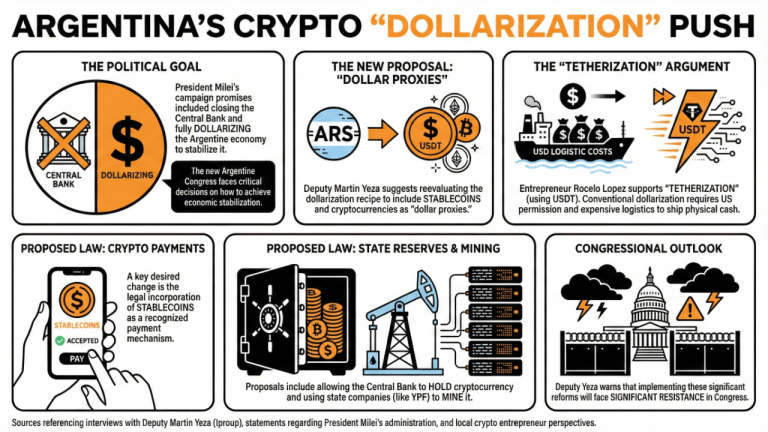
The new Argentine Congress will have to deal with several critical cryptocurrency and stablecoin-related issues this new year.
According to Deputy Martin Yeza, the government will reevaluate the recipe for dollarization to stabilize the economy this year, with the inclusion of stablecoins and cryptocurrencies as dollar proxies.
Talking with Iproup, he stated:
If a series of reforms are implemented, we will face significant resistance, and those kinds of sessions will certainly not be well-received in Congress.
However, one of the changes he would like to see is the incorporation of stablecoins as a payment mechanism. He also considers that allowing the central bank to hold cryptocurrency and mine it through state companies, such as YPF, even if the government doesn’t take advantage of these possibilities immediately.

One of the key campaign promises of President Milei was to close the central bank and dollarize the economy to bring inflation numbers down.
Rocelo Lopez, a local crypto entrepreneur, supported a “tetherization” of the Argentine economy, referring to Tether, the issuer of USDT, the largest stablecoin by market capitalization.
For a conventional dollarization of the Argentine economy, the U.S would have to greenlight it, and associated shipping and logistics costs for bringing U.S. cash to Argentina would have to be considered.
A “tetherization” would offer benefits compared to a regular dollarization process without involving the U.S. government. Operations would be traceable and with low-cost transactions, Lopez stressed.
Recent reports reveal that Argentine banks are prepared to offer crypto services to their customers, and that the central bank is drafting a special measure to open the cryptocurrency market to private banks.
Read more: Central Bank of Argentina Mulls Allowing Banks to Offer Crypto Services
What key issues will the new Argentine Congress address regarding cryptocurrency?
The Congress will reevaluate the use of stablecoins and cryptocurrencies as dollar proxies to help stabilize the economy in 2026.What reforms does Deputy Martin Yeza advocate for cryptocurrency adoption?
Yeza supports incorporating stablecoins as a payment mechanism and allowing the central bank to hold and mine cryptocurrency through state companies.How does Rocelo Lopez view the idea of “tetherization” for Argentina?
Lopez advocates for “tetherization” as a flexible alternative to traditional dollarization, providing benefits like traceability and low-cost transactions without needing U.S. permission.What developments are happening with Argentine banks regarding cryptocurrencies?
Reports indicate that Argentine banks are preparing to offer crypto services and that the central bank is working on measures to open the crypto market to private banks.
免责声明:本文章仅代表作者个人观点,不代表本平台的立场和观点。本文章仅供信息分享,不构成对任何人的任何投资建议。用户与作者之间的任何争议,与本平台无关。如网页中刊载的文章或图片涉及侵权,请提供相关的权利证明和身份证明发送邮件到support@aicoin.com,本平台相关工作人员将会进行核查。