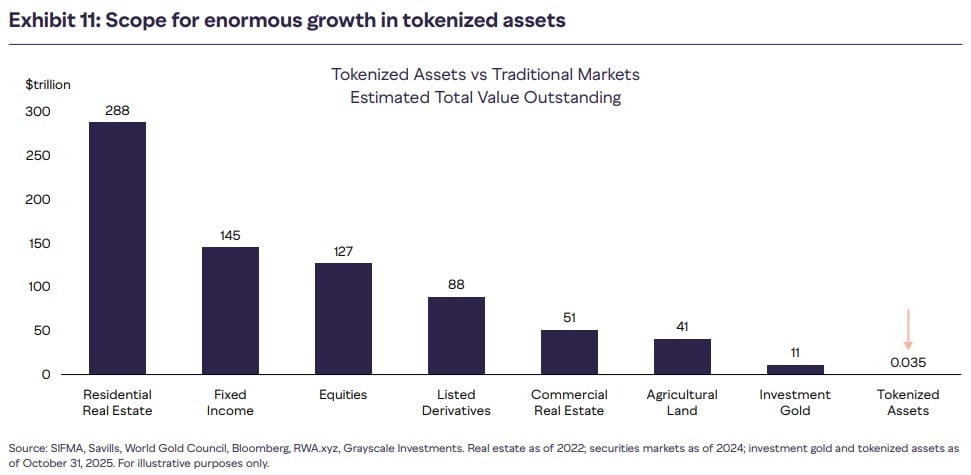
Asset tokenization is emerging as a structural shift in digital finance as institutional participation deepens, with growth expectations far exceeding its current footprint. Grayscale Investments released its 2026 Digital Asset Outlook last week, identifying asset tokenization as reaching an inflection point and projecting the sector could expand by roughly 1,000 times by 2030 as it becomes more integrated into global capital markets.
Grayscale framed asset tokenization as a market still in its early stages but entering a period of accelerated expansion as infrastructure and policy conditions improve. “Grayscale expects rapid growth in asset tokenization over the coming years, facilitated by more mature blockchain technology and improved regulatory clarity,” the report states.
The outlook also outlines a long-term growth trajectory that could materially reshape capital markets, stating:
By 2030, it would not be surprising to see tokenized assets grow by ~1,000x, in our view. This growth will likely drive value to the blockchains that process transactions in tokenized assets, as well as a variety of supporting applications.
The firm emphasized that tokenization’s minimal share of global equity and bond markets today reflects early adoption rather than limited potential, as institutions increasingly evaluate on-chain issuance, settlement, and asset management.
These dynamics connect tokenization directly to broader themes shaping digital assets, including regulatory harmonization, stablecoin adoption, and deeper integration between traditional finance and public blockchains.
Read more: Grayscale Files IPO With SEC for NYSE Listing Targeting Ticker GRAY
Grayscale’s research also identifies infrastructure positioned to benefit as adoption accelerates. The report details:
The leading blockchains for tokenized assets today are Ethereum ( ETH), BNB Chain ( BNB), and Solana ( SOL), although this list will likely evolve over time.
These networks currently support the largest share of distributed tokenized assets, underpinned by liquidity, developer activity, and operational resilience. Beyond base-layer networks, middleware, and data providers are viewed as critical to scalable and compliant tokenization.
“In terms of supporting applications, Chainlink (LINK) looks especially well placed, given its unique suite of software technologies,” Grayscale added.
Overall, the outlook presents asset tokenization as a practical pathway for blockchain adoption rather than a speculative narrative. Efficiencies such as fractional ownership, faster settlement, and reduced reconciliation costs align closely with institutional priorities, positioning tokenization as a cornerstone of the emerging institutional era for digital assets despite ongoing legal and jurisdictional challenges.
- Why does Grayscale see asset tokenization at an inflection point?
Institutional participation, regulatory clarity, and mature blockchain infrastructure are converging to drive real-world adoption. - How fast could the asset tokenization market grow?
Grayscale projects tokenized assets could expand by roughly 1,000x by 2030. - Which blockchains lead tokenized asset issuance today?
Ethereum, BNB Chain, and Solana currently support the largest share of tokenized assets. - Why is Chainlink important to asset tokenization?
Chainlink provides critical middleware enabling compliant, scalable, and data-driven tokenized assets.
免责声明:本文章仅代表作者个人观点,不代表本平台的立场和观点。本文章仅供信息分享,不构成对任何人的任何投资建议。用户与作者之间的任何争议,与本平台无关。如网页中刊载的文章或图片涉及侵权,请提供相关的权利证明和身份证明发送邮件到support@aicoin.com,本平台相关工作人员将会进行核查。


