Cutting Edge | Web3 Lawyer Interprets the Latest Changes in Tokenization of US Stocks

CN
3 hours ago

On December 15, 2025, U.S. time, Nasdaq officially submitted Form 19b-4 to the SEC, applying to extend the trading hours for U.S. stocks and exchange products to 23/5 (trading 23 hours a day, 5 days a week).

However, the trading hours applied for by Nasdaq are not simply an extension; they are a change to two formal trading periods:

Daytime trading period (Eastern Time 4:00-20:00) and nighttime trading period (Eastern Time 21:00-4:00 the next day). Trading is paused from 20:00 to 21:00, and all unexecuted orders will be uniformly canceled during the pause.

Many readers were excited upon hearing the news, wondering if this was the U.S. preparing for 24/7 tokenized trading of U.S. stocks. However, after a careful study of the document, Crypto Salad wants to say, don't rush to conclusions, because Nasdaq stated in the document that many traditional securities trading rules and complex orders are not applicable to the nighttime trading period, and some functions will also be limited.

We have always been very concerned about the tokenization of U.S. stocks, believing it to be one of the most important targets for the tokenization of real-world assets, especially with the various official actions from the U.S. SEC (Securities and Exchange Commission) that have been emerging recently.

This application document has rekindled expectations for the tokenization of U.S. stocks because the U.S. wants to bring the securities trading period closer to the 24/7 digital asset market. However, upon closer inspection:

Nasdaq's document does not mention anything about tokenization; it is merely a reform of the traditional securities system.

If everyone wants a deeper understanding of Nasdaq's actions, Crypto Salad can write a detailed article on it. But today, we want to discuss news that is genuinely related to the tokenization of U.S. stocks—

The SEC has officially "allowed" major U.S. securities custodians to attempt to provide tokenization services.

On December 11, 2025, U.S. time, SEC staff from the Division of Trading and Markets issued a No-Action Letter (NAL) to DTCC, which was subsequently made public on the SEC's official website. The letter clearly states that under specific conditions, the SEC will not take enforcement action against DTC for conducting tokenization services related to its custodial securities.

At first glance, many readers feel that the SEC has officially announced an "exemption" for the use of tokenization technology in U.S. stocks. However, upon closer examination, the actual situation is quite different.

So, what exactly does this letter say? What is the latest development in the tokenization of U.S. stocks? Let's start with the main characters of the letter:

1. Who are DTCC and DTC?

DTCC, short for Depository Trust & Clearing Corporation, is a U.S. group company that includes different institutions responsible for custody, stock clearing, and bond clearing.

DTC, short for Depository Trust Company, is a subsidiary of DTCC and the largest centralized securities custodian in the U.S., responsible for the unified custody of stocks, bonds, and other securities, as well as settlement and transfer. Currently, it manages and records securities assets exceeding $100 trillion, which can be understood as the bookkeeper for the entire U.S. stock market.

2. What is the relationship between DTC and the tokenization of U.S. stocks?

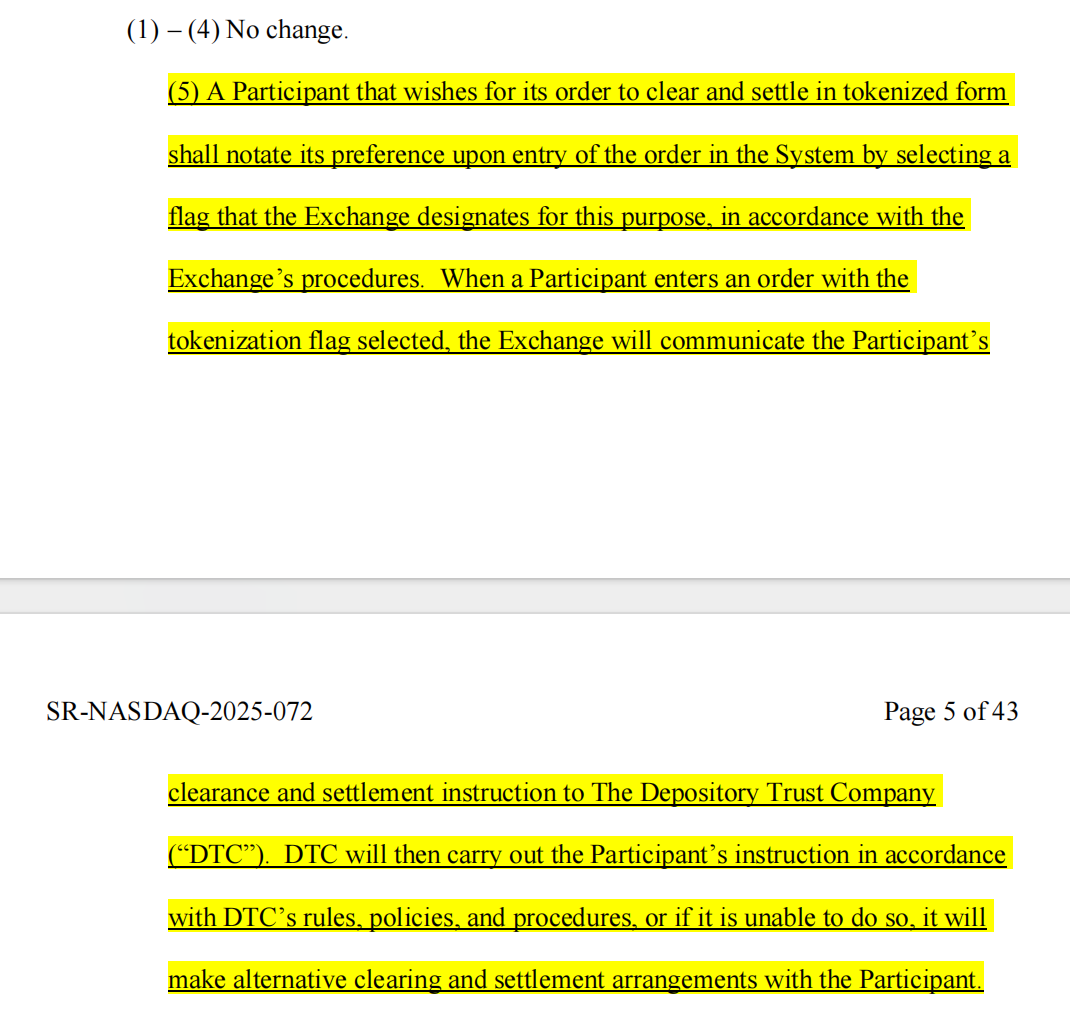
In early September 2025, Nasdaq applied to the SEC to issue stocks in a tokenized form. In that application, DTC was already mentioned.

Nasdaq stated that the only difference between tokenized stocks and traditional stocks lies in the clearing and settlement of orders by DTC.

(The above image is taken from Nasdaq's application proposal)

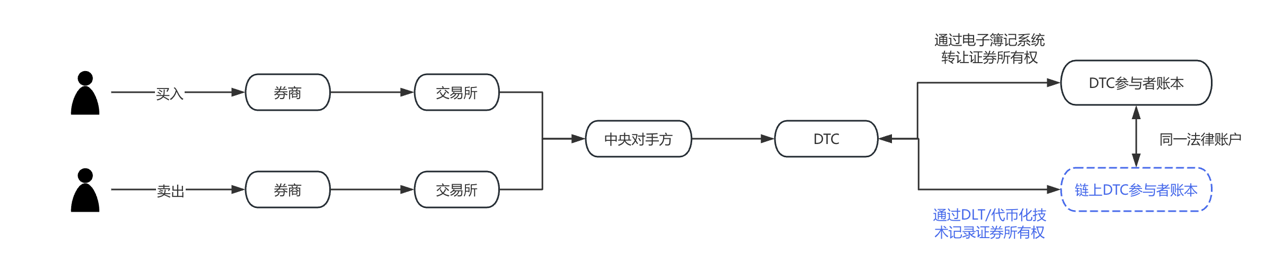
To make this matter more understandable, we created a flowchart, where the blue part represents the changes Nasdaq applied for in its proposal this September. It is clear that DTC is the key implementation and operational institution for the tokenization of U.S. stocks.

3. What does the newly released No-Action Letter say?

Many people equate this document with the SEC agreeing to allow DTC to use blockchain for U.S. stock bookkeeping, which is not entirely accurate. To correctly understand this matter, one must recognize a provision in the U.S. Securities Exchange Act:

Section 19(b) of the Securities Exchange Act of 1934 stipulates that any self-regulatory organization (including clearing agencies) must submit a rule change application to the SEC and obtain approval when changing rules or making significant business arrangements.

Both of Nasdaq's proposals were submitted based on this provision.

However, the rule filing process is usually lengthy, potentially taking months, with a maximum of 240 days. If every step of the change requires a new application and approval, the time cost would be too high. Therefore, to ensure that its pilot activities for securities tokenization can proceed smoothly, DTC applied for an exemption from fully complying with the 19b filing process during the pilot period, and the SEC granted this consent.

In other words, the SEC has only temporarily exempted DTC from certain procedural filing obligations, and it has not substantively permitted the application of tokenization technology in the securities market.

So, what will happen next in the development of U.S. stock tokenization? We need to clarify the following two questions:

(1) What pilot activities can DTC conduct without filing?

Currently, the custody bookkeeping of U.S. stocks operates in this manner: assuming a broker has an account with DTC, DTC uses a centralized system to record every buy and sell transaction of stocks and shares. This time, DTC proposed whether it could provide brokers with an option to record these stock holdings again using blockchain tokens.

In practice, participants would first register a qualified, DTC-approved registered wallet. When participants issue a tokenization instruction to DTC, DTC will do three things:

a) Move this portion of stocks from the original account to a general ledger pool;

b) Mint tokens on the blockchain;

c) Transfer the tokens to the participant's wallet, representing the participant's rights to these securities.

After this, these tokens can be directly transferred between these brokers without needing to go through DTC's centralized ledger for each transfer. However, all token transfers will be monitored and recorded in real-time by DTC through an off-chain system called LedgerScan, and the records from LedgerScan will constitute DTC's official ledger. If a participant wishes to exit the tokenized state, they can issue a "de-tokenization" instruction to DTC at any time, and DTC will destroy the tokens and revert the securities rights back to the traditional account.

The NAL also details the technical and risk control limitations, including: tokens can only be transferred between wallets approved by DTC, so DTC even has the authority to forcibly transfer or destroy tokens in a wallet under specific circumstances, and the token system is strictly isolated from DTC's core clearing system, etc.

(2) What is the significance of this letter?

From a legal perspective, Crypto Salad needs to emphasize that the NAL is not equivalent to legal authorization or rule modification; it does not have universally applicable legal effect and only represents the enforcement attitude of SEC staff under established facts and hypothetical conditions.

There is no separate provision in the U.S. securities law system that "prohibits the use of blockchain bookkeeping." Regulators are more concerned with whether existing market structures, custodial responsibilities, risk control, and filing obligations are still met after adopting new technologies.

Additionally, in the U.S. securities regulatory system, letters like the NAL have long been viewed as important indicators of regulatory stance, especially when the subject is a systemically important financial institution like DTC, whose symbolic significance actually outweighs the specific business itself.

From the disclosed content, the conditions for the SEC's exemption are very clear: DTC is not directly issuing or trading securities on-chain but is providing a tokenized representation of existing securities rights within its custodial system.

These tokens are essentially a form of "rights mapping" or "ledger expression," used to enhance backend processing efficiency, rather than changing the legal attributes or ownership structure of the securities. The related services operate in a controlled environment and on a permissioned blockchain, with participants, usage scope, and technical architecture all subject to strict limitations.

Crypto Salad believes that this regulatory attitude is very reasonable. The most common issues with on-chain assets are financial crimes such as money laundering and illegal fundraising; tokenization technology is new, but it cannot become an accomplice to crime. Regulation needs to affirm the potential application of blockchain in securities infrastructure while adhering to the boundaries of existing securities laws and custodial systems.

4. The latest development progress of U.S. stock tokenization

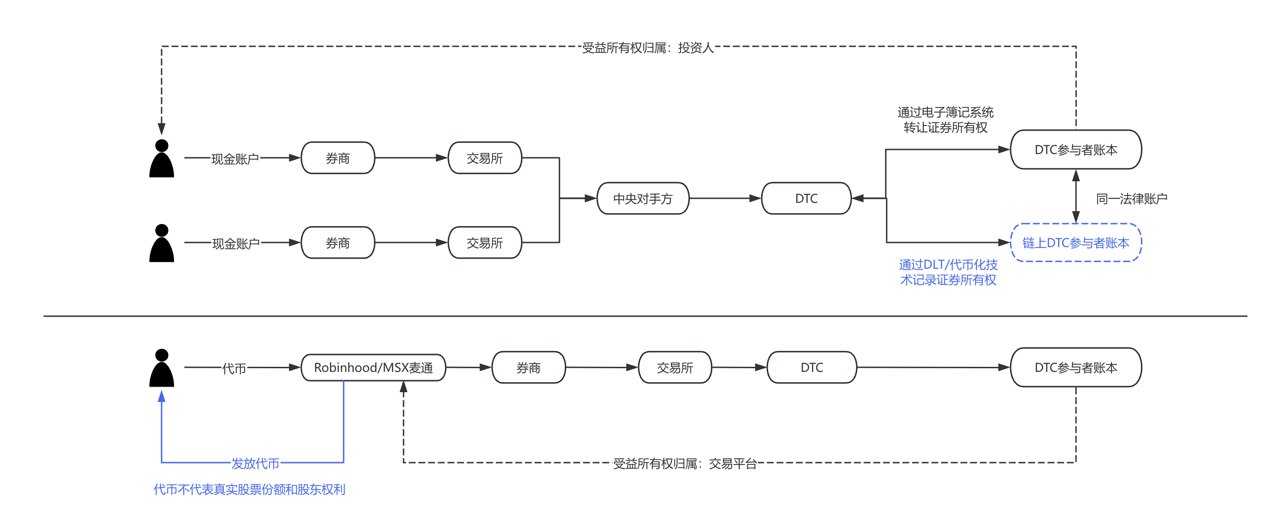
The discussion of U.S. stock tokenization has begun to shift from "whether it is compliant" to "how to achieve it." If we break down the current practices in the market, we can see that at least two parallel but logically different paths are forming:

  • Represented by DTCC and DTC, there is a tokenization path led by official opinions, with the core goal of improving settlement, reconciliation, and asset transfer efficiency, primarily serving institutional and wholesale market participants. In this model, tokenization is almost "invisible"; for end investors, stocks remain stocks, only the backend system has undergone a technical upgrade.
  • In contrast, there is the potential front-end role of brokers and trading platforms. For example, Robinhood and MSX have been continuously exploring product innovations in areas such as crypto assets, fractional stock trading, and extended trading hours in recent years. If U.S. stock tokenization gradually matures on the compliance level, these platforms naturally have the advantage of becoming user entry points. For them, tokenization does not mean reshaping the business model but is more likely a technical extension of the existing investment experience, such as closer to real-time settlement, more flexible asset splitting, and the integration of cross-market product forms. Of course, all of this still hinges on the gradual clarification of the regulatory framework. Such explorations often tread close to regulatory boundaries, with risks and innovations coexisting; their value lies not in short-term scale but in validating the next generation of securities market forms. From a practical perspective, they are more like samples for institutional evolution rather than directly replacing the existing U.S. stock market.

To make it more intuitive for everyone to understand, please see the following comparison chart:

5. Crypto Salad's viewpoint

From a broader perspective, the real problem that U.S. stock tokenization is trying to solve is not to "turn stocks into tokens," but how to enhance asset transfer efficiency and reduce operational costs while maintaining legal certainty and system security, and to reserve interfaces for future cross-market collaboration. In this process, compliance, technology, and market structure will engage in a long-term parallel game, and the evolution path will inevitably be gradual rather than radical.

It can be expected that U.S. stock tokenization will not fundamentally change the way Wall Street operates in the short term, but it has already become an important item on the agenda of U.S. financial infrastructure. The interaction between the SEC and DTCC is more like a "trial" at the institutional level, setting preliminary boundaries for broader explorations to come. For market participants, this may not be the endpoint, but a truly worthwhile starting point for continued observation.

Special Statement: This article is an original work by the Crypto Salad team, representing only the personal views of the author and does not constitute legal advice or consultation on specific matters. If you need to reprint the article, please contact us privately to discuss authorization matters: shajunlvshi.

免责声明:本文章仅代表作者个人观点,不代表本平台的立场和观点。本文章仅供信息分享,不构成对任何人的任何投资建议。用户与作者之间的任何争议,与本平台无关。如网页中刊载的文章或图片涉及侵权,请提供相关的权利证明和身份证明发送邮件到support@aicoin.com,本平台相关工作人员将会进行核查。

Share To
APP

X

Telegram

Facebook

Reddit

CopyLink