Original Title: State of Crypto Q4 2025: Younger investors are rewriting the investing playbook
Original Source: Coinbase
Original Translation: Chopper, Foresight News
For decades, the path to wealth accumulation for Americans has remained largely unchanged: find a good job, buy property, invest in stocks, and then wait for time to bring compound returns. However, our latest "Cryptocurrency Industry Report" shows that the younger generation of investors no longer believes in this traditional path and is adjusting their investment behavior.
To understand the market response strategies of different generational groups and the role of cryptocurrency in their portfolios, Coinbase collaborated with Ipsos to conduct a special survey, interviewing 4,350 American adults, including 2,005 investors with investment accounts. The core conclusions of the survey are as follows: Generation Z and younger investors, such as Millennials, are more inclined than any previous generation to actively manage their investments, more willing to embrace non-traditional assets, and more likely to view cryptocurrency as a core component of their personal financial future.
A Generation Rejected by the Traditional Wealth Ladder
Young investors are far more optimistic about the economy than older generations, but they believe the existing financial system is not designed for them. Survey data shows that nearly seven in ten (73%) young people feel that their generation faces greater challenges in accumulating wealth through traditional means compared to their parents' generation; this view is shared by only 57% of older respondents.
They have witnessed skyrocketing housing costs, insurmountable student debt, and sluggish wage growth. Against this backdrop, more and more young people are seeking alternative wealth accumulation methods that go beyond the traditional model of "home equity + stock portfolio."
Non-Traditional Asset Allocation Three Times That of Older Generations
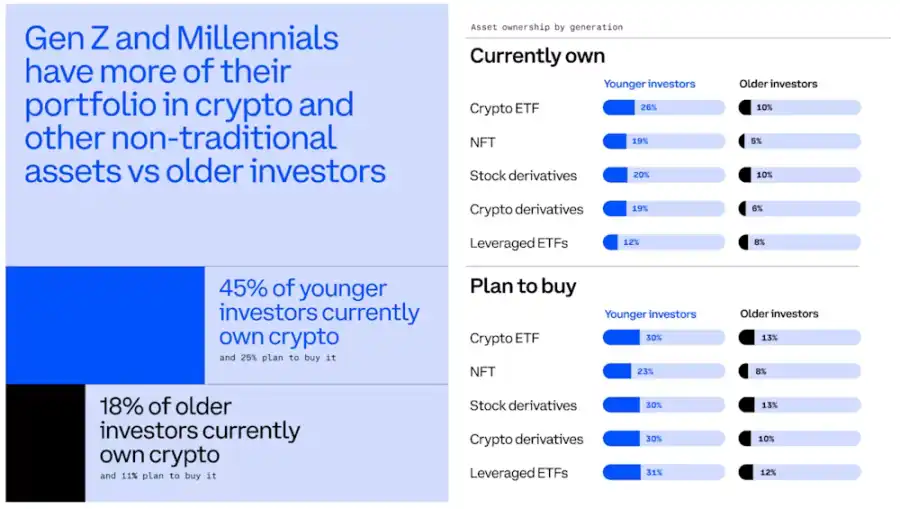
This anxiety is directly reflected in their asset allocation strategies. The survey shows that young investors allocate 25% of their investment portfolios to non-traditional asset classes such as cryptocurrency, financial derivatives, non-fungible tokens (NFTs), and other emerging products. This proportion is three times that of older investors, who allocate only 8% to non-traditional assets.
The proportion of stock holdings is roughly similar across different generational groups, with the core difference being that young investors have added more diverse allocations beyond stocks. They are more actively seeking income opportunities outside of traditional stock dividends and are more willing to experiment with various new investment tools and emerging markets to narrow the wealth gap.
Cryptocurrency is Not a Side Investment, but a Core Allocation
This generational shift in investment philosophy is most vividly reflected in the acceptance of cryptocurrency. The report shows that 45% of young investors currently hold cryptocurrency, while this figure is only 18% among older investors. Additionally, nearly half (47%) of young investors wish to get ahead of the general market and be the first to engage with new crypto assets; in contrast, only 16% of older investors share this desire.
In the eyes of the younger generation, cryptocurrency is not merely speculative trading but an important avenue for them to catch up in wealth. Eighty percent of young people believe that cryptocurrency offers their generation more financial opportunities outside the traditional financial system; at the same time, another eighty percent are confident that the status of cryptocurrency in the future financial system will significantly increase. Among older investors, only about sixty percent agree with this view.
The younger generation's enthusiasm for exploring emerging markets extends beyond spot cryptocurrency; they also desire to engage with more non-traditional assets. Data shows that eighty percent of young investors are willing to take the lead in trying new investment opportunities, while this attitude is held by less than half of older respondents. Young investors maintain a strong interest in emerging non-traditional products such as cryptocurrency derivatives, prediction markets, 24/7 stock trading, initial token offerings, altcoins, and decentralized finance lending.
The Impact of This Trend on Future Markets
The young investor group has exhibited distinctly different characteristics: they trade more frequently, are willing to take on greater risks in pursuit of higher returns, and are shifting a significant portion of their investment portfolios toward non-traditional assets centered around cryptocurrency. At the same time, they are driving the entire financial industry to transform in a direction that better meets the needs of the internet-native generation, creating platforms that operate around the clock and support multi-asset trading.
免责声明:本文章仅代表作者个人观点,不代表本平台的立场和观点。本文章仅供信息分享,不构成对任何人的任何投资建议。用户与作者之间的任何争议,与本平台无关。如网页中刊载的文章或图片涉及侵权,请提供相关的权利证明和身份证明发送邮件到support@aicoin.com,本平台相关工作人员将会进行核查。


