Written by: Ashrith Rao
Translated by: Baihua Blockchain

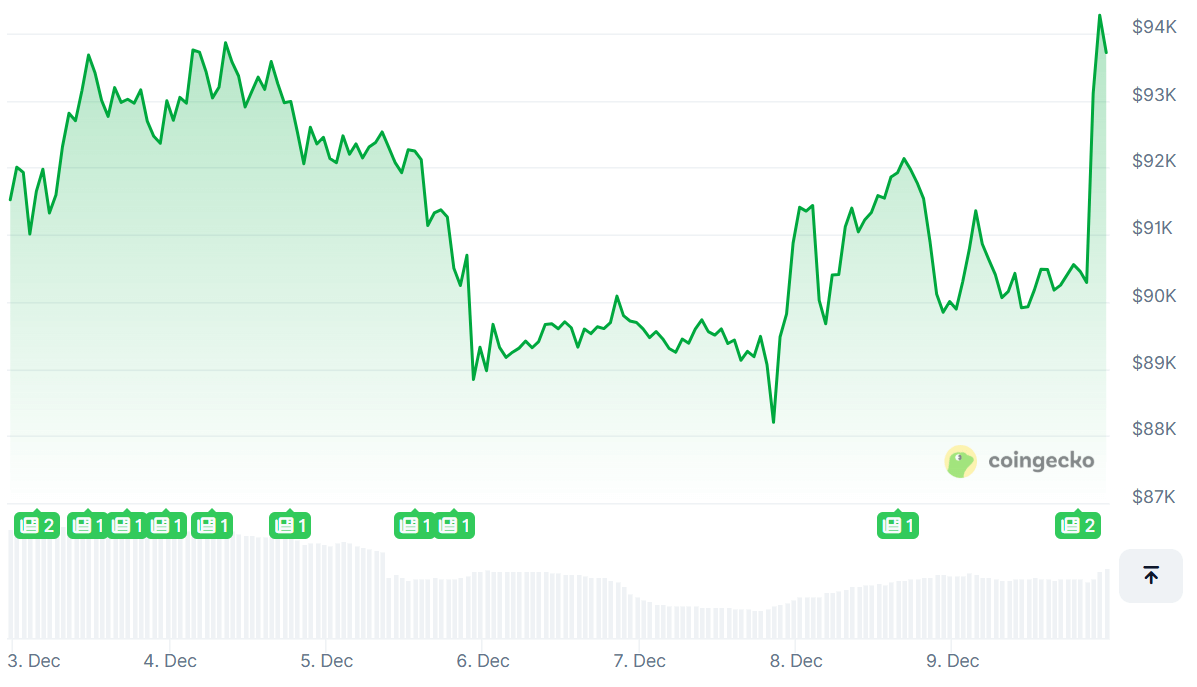
After experiencing negative growth, Bitcoin officially rose by more than 1.2% in 2025, as investors re-entered the market after a significant drop from its all-time high.
Bitcoin rebounded to $94,000 and later retraced some of its gains ahead of the Federal Reserve Bank meeting today.

Source: CoinGecko
Despite widespread predictions that the Federal Reserve will cut interest rates for the third consecutive time and hint at further policy easing, other risks loom over cryptocurrencies.
One widely discussed point online is that investors may face a situation similar to August 5, 2024, when Japan's rise led to the unwinding of yen carry trades.
Another concerning potential development is that Japanese investors may wish to repatriate funds for large-scale selling.
In response to Bank of Japan Governor Kazuo Ueda's comments that policymakers will assess the perception of tightening at this month's meeting, Japan's two-year bonds have surpassed 1% for the first time, reaching a 17-year high.
This has led to increased demand for the yen, as leveraged traders unwound risk positions funded by yen carry bets, which had bolstered global risk assets in 2025.
Due to the Bitcoin market's quick response to changes in liquidity, this had an immediate impact.
The financing conditions related to the foreign exchange market may deteriorate, and the high leverage of Bitcoin on offshore platforms is particularly concerning.
Additionally, the average yield on Japan's 20-year government bonds has reached 2.947%, the highest level observed since 1998.
Due to its reserves and rising interest rates, Japan may need to withdraw hundreds of billions of dollars. If this occurs, it could impact Bitcoin, Tether, and U.S. Treasuries.
Earlier last month, lawmakers passed a Japanese economic stimulus plan worth approximately 21.3 trillion yen ($136 billion).
Spending and the Bank of Japan's easing of regulations in the government bond market are key components of the new selective relationship with the high market economy policy.
Due to the spending plan, Japan's interest in sleeping is not high.
According to the International Monetary Fund, Japan's government debt is currently more than double its GDP compared to other countries. In contrast, U.S. debt is nearly twelve times its GDP.
Experts indicate that if Japanese bond prices remain above 2.9%, Bitcoin could be expected to drop by 5-8%.
Japan's debt weighs in at 263% of GDP, approximately $10.2 trillion. On the other hand, interest rates have remained at zero for a long time, allowing them to maintain this level.
As the Bank of Japan raises short-term interest rates to 0.5% and inflation remains above 2%, the cost of debt servicing is skyrocketing.
At the current rate, Japan's debt payments could soar from $162 billion to $280 billion over the next decade. This means that national debt servicing will consume about 38% of tax revenue. For any major country, managing such a massive debt is unprecedented.
Why Japan's finances matter
Japan is the largest foreign holder of U.S. debt, with an investment portfolio exceeding $1.13 trillion in U.S. Treasuries. However, considering currency risks, U.S. bonds are no longer available due to the rise in Japanese bonds.
As a result, domestic investors will begin to funnel funds back into the Japanese market.
If experts' predictions hold true, even if the Federal Reserve does not raise interest rates, the cost of borrowing in the U.S. may rise, as up to $500 billion could break into the global market in the next 18 months.
At that point, Japan's increasing debt will no longer be just a domestic issue; it will severely impact global financial markets.
How will cryptocurrencies be affected?
For years, investors have been taking advantage of so-called yen carry trades: earning interest in yen while investing in risk assets or U.S. dollars for higher returns. However, with cuts, this trading seems to be diminishing.
UAE investors have long utilized Japan's low-interest loans, investing approximately $1.2 trillion into stocks, cryptocurrencies, and other financial opportunities.
Now, Japan's decision to sell its U.S. bonds may trigger a ripple effect in other countries, potentially setting a precedent.
If U.S. bond prices fall, Bitcoin could be severely impacted.
We have encountered similar situations in the past; for example, in July 2024, due to the Bank of Japan's interest rate hike, Bitcoin's value dropped by 18% to $53,000, affecting the crypto market by about $3 billion.
Recently, after the Bank of Japan hinted at a possible rate hike, Bitcoin fell from $92,000 to $83,832. This boosted the yen and accelerated the unwinding of carry trades, sparking a wave in the crypto market during a period of low liquidity.
If Japanese interest rates remain above 2.9%, the support level of $87,000 will be a potential downside target for Bitcoin. However, due to Trump's positive stance on cryptocurrency ETFs and Bitcoin, there may be some safety net, limiting losses to 5-8%.
Nevertheless, if Japan experiences a rise, it could lead to a significant downturn in cryptocurrencies, as investors may seek safer havens in the global market.
As Japanese bonds break through, the U.S. faces challenges, as the Federal Reserve eases quantitative tightening. With major creditor nations adjusting their capital allocations, the U.S. will further threaten external issuance demand, deciding how to address its $1.8 trillion deficit.
The current characteristics of central banks are highly broad approaches and groundbreaking low interest rates, which have proven beneficial for Bitcoin and various other digital currencies.
Cryptocurrency liquidity is under pressure
If liquidity flows back to Japan, the capital available for investment opportunities in the crypto market will decrease.
Experts indicate that if there are significant changes in the global bond market, a stampede towards safer assets may occur. This could lead to massive sell-offs of all risk-related investments, as investors prioritize cash and liquidity.
The overall scale of yen carry trades is difficult to determine, but according to many Wall Street analysts and portfolio managers, the overall macroeconomic impact of this trading has already fractured.
Some also suggest that the rise in Japanese government bonds could trigger a global stock market crash after reaching a certain level, a viewpoint that seems quite implausible.
Large Japanese investors, such as government funds, typically announce their asset allocation plans at least a year in advance. Therefore, the decision for foreigners to sell held assets may be a gradual process that takes years.
Japan believes that the risk of liquidity reduction brought by further potential rises still looms over cryptocurrencies.
免责声明:本文章仅代表作者个人观点,不代表本平台的立场和观点。本文章仅供信息分享,不构成对任何人的任何投资建议。用户与作者之间的任何争议,与本平台无关。如网页中刊载的文章或图片涉及侵权,请提供相关的权利证明和身份证明发送邮件到support@aicoin.com,本平台相关工作人员将会进行核查。


