Original Title: Hyperliquid Growth Situation
Original Author: @esprisi0
Translated by: Peggy, BlockBeats
Editor's Note: Hyperliquid once dominated the decentralized derivatives space, but its market share plummeted sharply in the second half of 2025, raising industry concerns: has it peaked, or is it laying the groundwork for the next phase? This article reviews the three stages of Hyperliquid: from an extreme dominance with a market share of up to 80%, to a strategic shift and accelerated competition leading to a loss of momentum down to 20%, and finally to a resurgence centered around HIP-3 and Builder Codes.
The following is the original text:
In recent weeks, concerns about Hyperliquid's future have intensified. The loss of market share, rapidly rising competitors, and an increasingly crowded derivatives space have raised a key question: what is really happening beneath the surface? Has Hyperliquid already peaked, or is the current narrative overlooking deeper structural signals?
This article will break it down step by step.
Stage One: Extreme Dominance
From early 2023 to mid-2025, Hyperliquid consistently set historical highs in key metrics and steadily increased its market share, thanks to several structural advantages:
A points-based incentive mechanism attracted a large amount of liquidity; its first-mover advantage in launching new perpetual contracts (such as $TRUMP, $BERA) made Hyperliquid the most liquid venue for new trading pairs and the preferred platform for pre-listing trading (such as $PUMP, $WLFI, XPL). To not miss emerging trends, traders were compelled to flock to Hyperliquid, pushing its competitive advantage to its peak; it offered the best UI/UX experience among all perpetual contract DEXs; transaction fees were lower than centralized exchanges (CEX); it introduced spot trading, unlocking new use cases; Builder Codes, HIP-2, and HyperEVM integration; and it achieved zero downtime even during major market crashes.
As a result, Hyperliquid's market share grew continuously for over a year, peaking at 80% in May 2025.
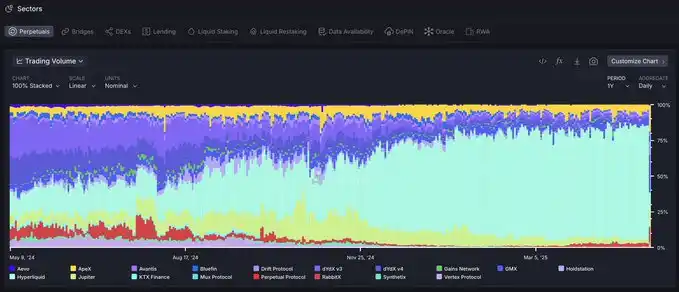
Based on perpetual contract trading volume market share data provided by @artemis
During that phase, the Hyperliquid team was clearly ahead of the entire market in innovation and execution speed, with no truly comparable products in the ecosystem.
Stage Two: The Rise of "Liquidity's AWS" and Accelerated Competition
Since May 2025, Hyperliquid's market share has plummeted sharply, dropping from about 80% to nearly 20% in early December.
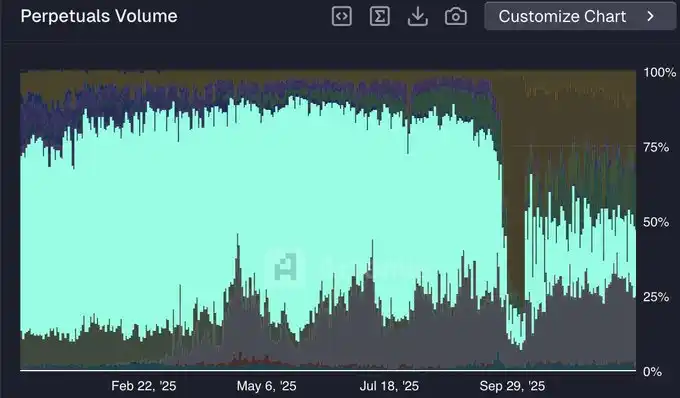
@HyperliquidX market share (data source: @artemis)
This relative loss of momentum compared to competitors can be attributed to several factors:
Strategic Shift from B2C to B2B
Hyperliquid did not double down on a pure B2C model, such as launching its own mobile app or continuously rolling out new perpetual contract products, but instead chose to pivot to a B2B strategy, positioning itself as "Liquidity's AWS."
This strategy focuses on building core infrastructure for external developers, such as Builder Codes for the frontend and HIP-3 for launching new perpetual markets. However, this transformation essentially handed over the initiative for product deployment to third parties.
In the short term, this strategy has not been ideal for attracting and retaining liquidity. The infrastructure is still in its early stages, adoption takes time, and external developers do not yet possess the distribution capabilities and trust that Hyperliquid's core team has accumulated over the long term.
Competitors Seizing Opportunities During Hyperliquid's Transition
Unlike Hyperliquid's new B2B model, competitors remain fully vertically integrated, allowing them to significantly accelerate the launch of new products.
Since they do not need to delegate execution, these platforms maintain complete control over product releases while rapidly expanding by leveraging their established user trust. As a result, they are more competitive than during the first stage.
This directly translates into market share growth. Competitors now not only offer all the products available on Hyperliquid but also launch features that HL has not yet rolled out (such as Lighter's introduction of spot markets, perpetual stocks, and forex).
Incentives and "Hired Liquidity"
Hyperliquid has not conducted any official incentive programs for over a year, while its main competitors are still actively engaging. Recently, Lighter, which leads in trading volume market share (around 25%), is still in the points season before its TGE.
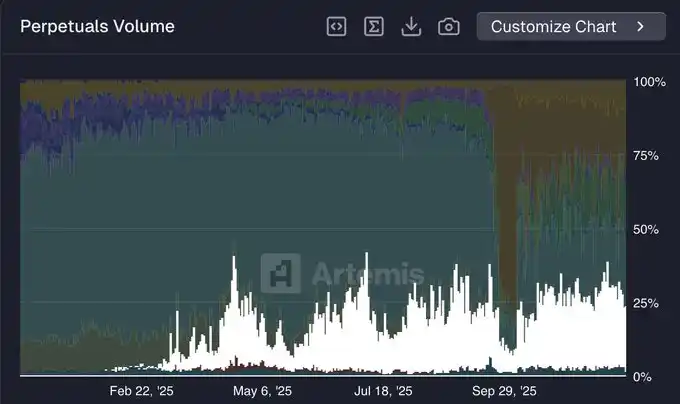
@Lighter_xyz market share (data source: @artemis)
In the DeFi space, liquidity is more "hired" than anywhere else. A significant portion of the trading volume flowing from Hyperliquid to Lighter (and other platforms) is likely driven by incentives related to airdrop score farming. Like most perpetual DEXs running points seasons, Lighter's market share is expected to decline after the TGE.
Stage Three: The Rise of HIP-3 and Builder Codes
As mentioned earlier, building "Liquidity's AWS" is not the optimal short-term strategy. However, in the long run, this model positions Hyperliquid to potentially become a core hub of global finance.
Although competitors have replicated most of Hyperliquid's current features, true innovation still originates from Hyperliquid. Developers building on Hyperliquid benefit from domain specialization, allowing them to formulate more targeted product development strategies on an evolving infrastructure. In contrast, protocols like Lighter that maintain complete vertical integration will face limitations when optimizing the development of multiple product lines simultaneously.
HIP-3 is still in its early stages, but its long-term impact is beginning to show. Key participants include:
@tradexyz has launched perpetual stocks
@hyenatrade recently deployed a trading terminal for USDe
More experimental markets are emerging, such as @ventuals offering pre-IPO exposure and @trovemarkets targeting niche speculative markets like Pokémon or CS:GO assets.
By 2026, the HIP-3 market is expected to account for a significant share of Hyperliquid's total trading volume.
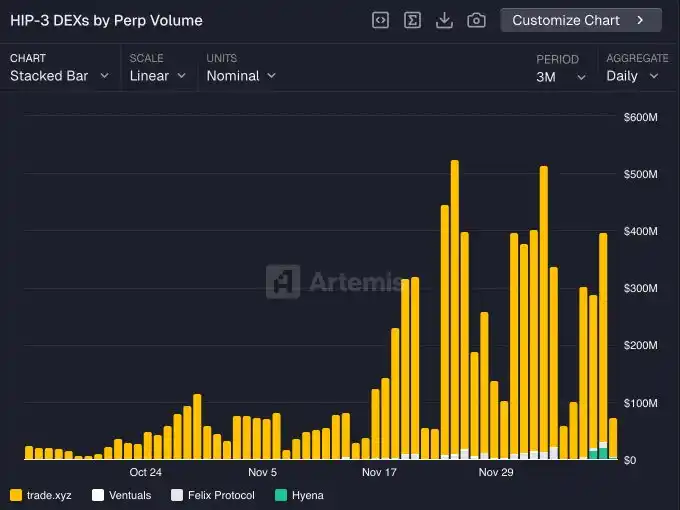
HIP-3 trading volume (broken down by Builder)
The key driver that will ultimately restore Hyperliquid's dominant position is the synergy between HIP-3 and Builder Codes. Any frontend that integrates Hyperliquid can immediately access the full HIP-3 market, providing users with unique products.
Therefore, developers have a strong incentive to launch markets through HIP-3, as these markets can be distributed across any compatible frontend (such as Phantom, MetaMask, etc.) and tap into new sources of liquidity. This creates a perfect virtuous cycle.
The ongoing development of Builder Codes makes me more optimistic about the future, both in terms of revenue growth and active user growth.
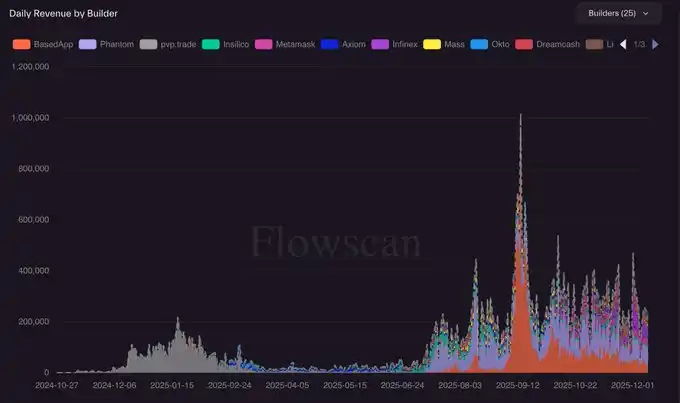
Builder Codes revenue (data source: @hydromancerxyz)
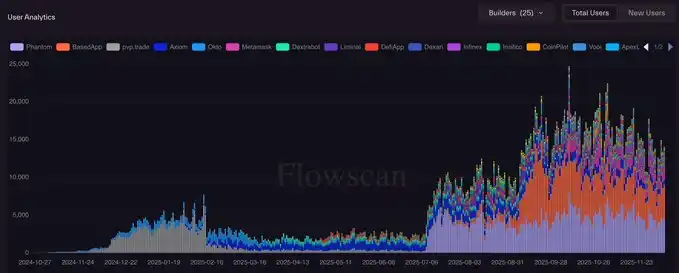
Builder Codes daily active users (data source: @hydromancerxyz)
Currently, Builder Codes are primarily used by crypto-native applications (such as Phantom, MetaMask, BasedApp, etc.). However, I anticipate the emergence of a new class of super applications built on Hyperliquid, aimed at attracting entirely non-crypto-native user groups.
This is likely to become a key pathway for Hyperliquid to scale into the next phase, and it will be the focus of my next article.
免责声明:本文章仅代表作者个人观点,不代表本平台的立场和观点。本文章仅供信息分享,不构成对任何人的任何投资建议。用户与作者之间的任何争议,与本平台无关。如网页中刊载的文章或图片涉及侵权,请提供相关的权利证明和身份证明发送邮件到support@aicoin.com,本平台相关工作人员将会进行核查。


