Bitcoin’s recent rebound is no accident, according to new data from Cryptoquant and its researchers, who point to sharply lower exchange inflows as a sign that sellers are finally taking a breather.
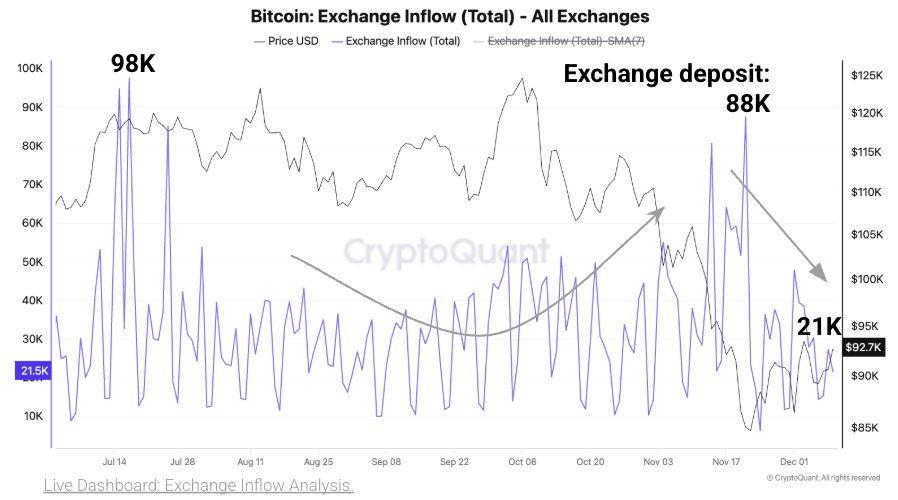
After sliding to $80,000 on Nov. 21, bitcoin has pushed back toward $94,000 as selling pressure cooled across key onchain metrics. The research team notes that bitcoins flowing into exchanges have plunged from 88,000 on Nov. 21 to just 21,000 today, a shift that has historically helped stabilize prices in the short term.

Cryptoquant’s analysts link much of this moderation to large holders pulling back from active distribution. The firm’s latest report shows that whales once accounted for nearly half of all deposits—47% in mid-Nov.—but now contribute just 21%.
The average deposit size followed the same downtrend, falling 36% from 1.1 BTC on Nov. 22 to 0.7 BTC today. This retreat, the report’s authors argue, removes a major source of spot-market friction. The firm’s researchers also highlight the role of capitulation.
On Nov. 13, as bitcoin slipped below $100,000, new and old whales realized $646 million in losses—the largest since July. Those losses did not stop there: whales have absorbed roughly $3.2 billion in realized net losses since mid-November, according to Cryptoquant’s modeling of investor cohorts.
Short-term holders aren’t faring much better. The analytics company reports that their spent output profit ratio (SOPR) has been below 1 for weeks, with the low hitting –7%, suggesting that capitulation is widespread among fast-moving market participants. Historically, Cryptoquant researchers say this kind of pain tends to exhaust sellers and cool off downside momentum.
With the Federal Reserve meeting on deck, the firm describes the current structure as a “calm before the volatility.” If selling pressure stays muted, the analysts see room for a relief rally that could lift bitcoin to $99,000—the lower band of Cryptoquant’s Trader On-chain Realized Price model, which often acts as resistance during bearish phases.
Read more: Europeans Tap Crypto for Groceries, Cafes and Bills, WhiteBIT Report Finds
Above that level, the market strategists flag two additional battlegrounds: $102,000, representing the one-year moving average, and $112,000, the Trader Realized Price. Both thresholds have historically acted as sentiment pivots and could determine whether momentum extends or stalls.
Charts reinforce these dynamics. Exchange inflow charts show a clear downtrend from the post-ATH spike through the late-Nov. cooldown, while the Realized Price bands outline the three major resistance zones Cryptoquant researchers tracked. The data supports the firm’s view that the rally may have more room—assuming sellers stay on the sidelines.
Still, Cryptoquant keeps a cautious tone. The researchers stress that while the setup looks constructive for a bounce, macro conditions, whale behavior, and exchange-level flows can shift rapidly. For now, bitcoin appears calmer—but calm has a habit of ending abruptly in this market.
- What does Cryptoquant see as the main reason bitcoin stabilized?
Cryptoquant attributes the stabilization to a sharp drop in exchange deposits from whales and short-term holders. - Why are whales important in Cryptoquant’s analysis?
Whale deposit behavior is a key signal because, according to Cryptoquant, it directly influences short-term sell-side pressure. - What price levels is Cryptoquant watching next?
The report highlights $99K, $102K, and $112K as the next major resistance zones. - How much in losses have large holders realized?
The analysis calculates about $3.2 billion in realized losses from whales since mid-November.
免责声明:本文章仅代表作者个人观点,不代表本平台的立场和观点。本文章仅供信息分享,不构成对任何人的任何投资建议。用户与作者之间的任何争议,与本平台无关。如网页中刊载的文章或图片涉及侵权,请提供相关的权利证明和身份证明发送邮件到support@aicoin.com,本平台相关工作人员将会进行核查。