The financialization of Web3 truly has no creative bottlenecks.
Written by: Eric, Foresight News
After the emergence of Pendle, which allows for the splitting of underlying assets and yields, I once thought that there was nothing left on-chain that could be tokenized. After all, the boom in RWA tokenization might have contributed to the scarcity of assets available for on-chain tokenization. However, it turns out my perspective was too narrow, as a team has set its sights on SOL staked to validators and the staking rewards.
On the evening of December 8, Pye announced the completion of a $5 million funding round, led by Variant and Coinbase Ventures, with participation from Solana Labs, Nascent, Gemini, and notable individual investors including Solana Labs co-founder Toly and LayerZero Labs co-founder Bryan Pellegrino.
Pye is incubated by Solana Labs' incubator, Solana Incubator, and previously won an award in the DeFi track at a hackathon held by Colosseum. The mechanism itself is not difficult to understand, but Pye's ultimate goal has indeed broadened the landscape.
Pendle for Validators
What Pye is doing can be summed up in one sentence: it splits the SOL staked with validators into an underlying asset token PT, which is SOL itself, and a yield token RT, representing the inflation yield of SOL and MEV rewards, among others.
In the Solana ecosystem, validators can "up their game" to attract external stakers. For example, they can offer a higher proportion of inflation and MEV rewards to attract more stakers, or allow stakers to lock their stakes for a longer period, providing greater certainty for the validators. This certainty essentially means that validators are willing to sacrifice their own yield to gain longer-term stable returns, rather than being overly greedy at the outset, which could lead to no one wanting to stake with them later.
In such an ecosystem, there exists a dynamic game between stakers and validators. I might just stake with Validator A today, but tomorrow I find that Validator B offers higher returns, and I could switch the next day. What Pye aims to do is reduce the friction this game creates for both parties and the Solana network itself.
In addition to the splitting mechanism similar to Pendle mentioned above, Pye will add a time lock for users staking through its platform. This means that once you choose a validator, you cannot withdraw your stake within the agreed timeframe. Although you cannot withdraw, PT can be freely traded on the market, allowing stakers to maintain a certain level of redemption capability while stabilizing the staking situation for validators.
Pye itself states that while the mechanism is indeed similar to Pendle, the two have different purposes. At the validator level, Pye can promote diversification among validators, allowing different validators to offer their own yield strategies for stakers to choose from, thus providing a platform for many potentially smaller validators to showcase themselves.
At the staker level, the secondary market trading of YT and PT tokens, DeFi combination strategies, and future price discovery of staking rewards are all relatively easy to conceive, as Pendle does the same. Beyond that, Pye offers a new possibility: fixed income from SOL staking.
For stakers, after obtaining YT and RT post-staking, they can directly sell RT at market price in the secondary market, allowing them to realize their earnings from the staking period in advance. I personally believe this could be a good application scenario for institutions, as compared to existing LSD protocols or independent validators, Pye provides institutions (like ETF issuers) with an opportunity to choose a fixed yield.
Ethereum Developers Transitioning to Solana
The two founders of Pye have very different backgrounds. According to LinkedIn, Erik Ashdown only truly entered the Web3 industry in 2020 when he served as the head of blockchain infrastructure at Covalent, with a prior background mainly in consulting.
The other co-founder, Alberto Cevallos, has quite an impressive background. As early as 2018, Alberto designed the token economic model for Travala.com, which was mentioned by Zhao Changpeng in a tweet at the end of last year, a crypto-friendly travel booking platform he had invested in. Notably, Alberto has been an Ethereum developer and independent researcher since 2017 and helped launch BadgerDAO. He has published several articles and tutorials related to Ethereum on platforms like Medium and Hacker Noon, covering DeFi, Web3, and blockchain certification frameworks.
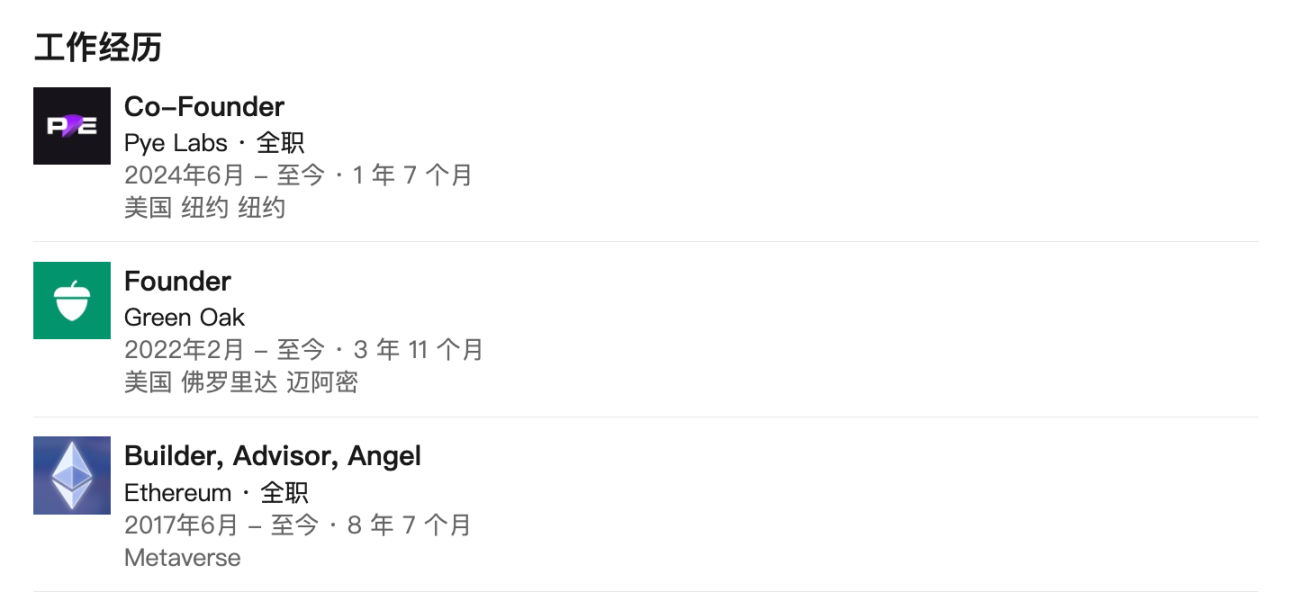
Products like Pye could be fully realized on Ethereum as well, and it is unclear why this team ultimately chose Solana. It can only be said that the issue of Ethereum ecosystem developers leaving continues.
Becoming the Main Entry Point for SOL Staking
Pye's ultimate goal is quite ambitious: to provide an alternative staking account solution.
Pye hopes that in the future, its product will become the main entry point for the Solana ecosystem, allowing validators to better control their relationships with stakers. Pye states in its product documentation that it has observed validators willing to share more rewards, including inflation and MEV rewards, in exchange for longer lock-up times, but this kind of internal competition is not beneficial for the Solana network in the long run.
The reason is simple: when competition reaches a certain level, smaller validators cannot survive, and larger ones also struggle to maintain, leading to a situation where validators are few and centralized. Pye's solution essentially shifts some of the pressure on validators caused by stakers' pursuit of yields to the secondary market. PT and RT can be operated by stakers as they see fit, but validators genuinely obtain SOL locked for a fixed period, making future costs and yields easier to calculate.
On the other hand, Pye also hopes to establish a DeFi ecosystem centered around validators, allowing DeFi products such as lending and yield strategies to incorporate this layer of validators. The tokenization and financialization of underlying assets like gas, block space, and staking rewards have been better executed in Ethereum's ecosystem. This time, Ethereum developers have brought new product thinking to Solana, and users with SOL staking positions might want to give it a try.
免责声明:本文章仅代表作者个人观点,不代表本平台的立场和观点。本文章仅供信息分享,不构成对任何人的任何投资建议。用户与作者之间的任何争议,与本平台无关。如网页中刊载的文章或图片涉及侵权,请提供相关的权利证明和身份证明发送邮件到support@aicoin.com,本平台相关工作人员将会进行核查。


