The U.S. banking system is on the brink of liquidity tightening, a signal that is largely overlooked by the market and may reveal the Federal Reserve's future policy direction more than the interest rate cuts themselves.
On December 1, the Federal Reserve officially ended its years-long process of balance sheet reduction. At this point, the reserves in the U.S. banking system have fallen to historically low levels associated with financing stress, and overnight financing rates have begun to periodically test the upper limit of the policy interest rate corridor.
The market's focus is almost entirely on the magnitude of the federal funds rate cut, with a general expectation of a 25 basis point reduction. However, the core signal from this meeting may lie in a widely underestimated area—the new balance sheet strategy that the Federal Reserve is about to disclose.

1. Policy Turning Point
The three-year quantitative tightening policy has officially come to an end as of December 1. This decision marks the formal conclusion of the aggressive tightening cycle that began after the COVID-19 pandemic.
● If quantitative easing is likened to "blood transfusions" for the market, then quantitative tightening is akin to "bloodletting." Stopping quantitative tightening means the Federal Reserve has ceased "bloodletting," attempting to maintain the balance sheet at a relatively stable level.
● As of last month, the Federal Reserve's balance sheet size has shrunk from a peak of nearly $9 trillion in 2022 to $6.6 trillion. Although this size is still about $2.5 trillion higher than pre-pandemic levels, years of tightening have significantly reduced the reserves in the banking system.
● Behind this policy shift is the complex situation facing the U.S. economy. While the inflation rate has retreated from its highs, it still hovers above the 2% target. Meanwhile, signs of cooling in the job market have begun to emerge, with the latest data showing the unemployment rate has climbed to 4.3%.
2. Liquidity Red Light
Why has the Federal Reserve chosen to stop "bloodletting" at this moment? Various signs indicate that the U.S. financial system has lit up a liquidity red light.
● On one hand, the level of bank reserves continues to decline, now reaching historically low levels associated with financing stress. On the other hand, the secured overnight financing rate, which reflects short-term financing conditions, has begun to periodically test the upper limit of the policy interest rate corridor. These developments indicate that the U.S. banking system is gradually entering a state of liquidity tightening.
● The U.S. banking sector has even seen instances of temporarily borrowing $1.5 billion to meet quarterly funding needs. Data shows that at that time, the Treasury needed to collect about $78 billion in tax payments and settle new debt issuance, leading to the U.S. Treasury's cash balance exceeding $870 billion.
3. Balance Sheet Expansion Plan Emerges
● Against this backdrop, the market's focus has begun to shift from interest rate adjustments to balance sheet strategy. The Federal Reserve is expected to clarify or outline how to transition to a reserve management purchase program through an implementation statement.
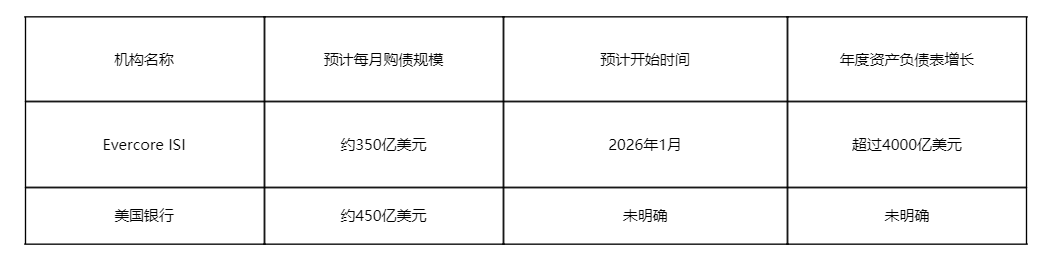
● This program could potentially begin in January 2026, with approximately $35 billion allocated monthly for purchasing Treasury bills, resulting in an annual growth of the balance sheet exceeding $400 billion.
● More aggressive predictions come from Bank of America, which anticipates that the Federal Reserve will announce a monthly "reserve management purchase" plan of about $45 billion at the conclusion of this week's meeting. This scale even exceeds Wall Street's general expectations. Federal Reserve Governor Waller recently stated that this move is crucial for maintaining order in the repurchase market and ensuring the smooth transmission of Federal Reserve monetary policy.
4. Internal Divisions and External Pressures
There are significant divisions within the Federal Reserve regarding the direction of monetary policy. Some members are concerned about the potential intensification of inflation, while others are more focused on preventing a possible economic recession.
● Deutsche Bank's chief economist Lucchetti predicts that this meeting may mark the first time since 1988 that three governors express dissenting opinions. More notably, this could also be the first meeting since September 2019 to feature "dual dissent."
● Analysts point out that external political pressures may prompt Federal Reserve members to unite more closely. Former senior advisor to Powell, Bonfien, believes that "external pressures will encourage people to rally around the institution."
● This internal division reflects the dual dilemma facing the Federal Reserve: to address inflationary pressures while guarding against economic downturn risks.
5. Market Has Already Reacted
● Although the Federal Reserve meeting has yet to take place, the market has already reacted to the potential policy shift. The cryptocurrency market has rebounded broadly, with Bitcoin briefly surpassing $94,500, a 24-hour increase of 2.48%.
● Traditional financial markets have also shown active performance. U.S. stocks related to cryptocurrency have all risen, with BitMine Immersion increasing by 9.32% and Circle by 5.93%.
● Different institutions have varying predictions regarding the Federal Reserve's balance sheet expansion plan, as shown in the table below:

● Market expectations are clearly divided, but there is a basic consensus on the Federal Reserve's impending shift towards a more accommodative balance sheet policy. This expectation partly stems from recent statements by Federal Reserve officials, including Powell, who indicated in a speech on October 14 that quantitative tightening "may end in the coming months."
6. Risks and Opportunities Coexist
● The long-term impact of the Federal Reserve's policy shift remains complex. In the short term, halting "balance sheet reduction" is beneficial for improving liquidity in the U.S. banking system, stabilizing overnight repurchase rates and other short-term rates, supporting U.S. stocks and bond markets, and reducing market financing costs.
● For global markets and emerging economies, improved liquidity means that capital outflow pressures may ease, and capital may even flow back into stock and bond markets, driving asset prices higher.
● However, risks should not be overlooked. Some analysts point out that the Federal Reserve may subsequently turn to a technical "balance sheet expansion," involving small-scale, regular, and predictable asset purchases, including short-term U.S. Treasury securities. But expanding the balance sheet amid high fiscal deficits and overheated asset prices could effectively monetize debt, potentially fueling asset bubbles.
For emerging economies, the "tide effect" of cross-border capital could trigger localized bubbles or debt risks, exacerbating market volatility.
As the Federal Reserve officially ends quantitative tightening, market attention turns to the upcoming announcement of the new balance sheet strategy. In the global financial landscape, every increase in U.S. Treasury purchases signifies a redistribution of global liquidity.
As plans for an annual balance sheet growth potentially exceeding $400 billion come to light, not only Wall Street traders but also central bank officials from Frankfurt to Singapore are recalculating their domestic monetary policy space.
Join our community to discuss and grow stronger together!
Official Telegram community: https://t.me/aicoincn
AiCoin Chinese Twitter: https://x.com/AiCoinzh
OKX benefits group: https://aicoin.com/link/chat?cid=l61eM4owQ
Binance benefits group: https://aicoin.com/link/chat?cid=ynr7d1P6Z
免责声明:本文章仅代表作者个人观点,不代表本平台的立场和观点。本文章仅供信息分享,不构成对任何人的任何投资建议。用户与作者之间的任何争议,与本平台无关。如网页中刊载的文章或图片涉及侵权,请提供相关的权利证明和身份证明发送邮件到support@aicoin.com,本平台相关工作人员将会进行核查。