Financing Rates Are Losing Growth Momentum
In the past week, Bitcoin's short-term trend has shifted from positive to noticeably weak, and the changes in funding rates best reflect this transition. At first glance, funding rates remain slightly positive—7-day funding rate at 0.1008%, 1-day at 0.0144%, and the current reading sliding to 0.0048%. Typically, this indicates that long positions still dominate. However, trends are more important than static snapshots. Every time frame shows a clear deceleration, indicating that bullish sentiment is weakening rather than strengthening.
This change in momentum does not necessarily mean the market has turned bearish; rather, it suggests that bullish strength has weakened while bearish enthusiasm has not correspondingly increased. To understand whether this decline in enthusiasm is structural or temporary, one must pay attention to the second key indicator: open interest.
Open Interest Shows Lack of Market Direction
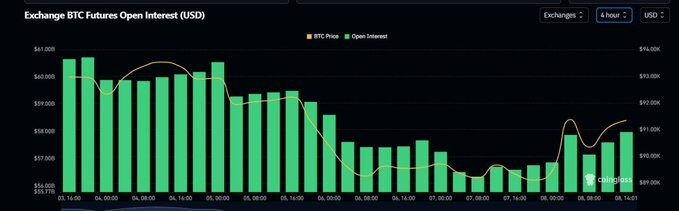
Open interest (OI) directly reflects how much capital remains active in the market, whether in long or short positions. Recent charts show a downward trend in open interest as both bulls and bears gradually close their positions. After the recent drop, there was only a slight replenishment of positions, far from signaling new directional bets.
This pattern resembles a market that lacks sufficient confidence to chase upward while also being uncertain about taking on new downside risks. When the actions of both sides are indistinguishable, it becomes nearly impossible to discern who is dominating the market.
This indecision is precisely what open interest reflects: the market is waiting for a catalyst, unwilling to commit, and currently choosing to reduce risk rather than take on risk.

ETF Fund Flows Fail to Provide Support
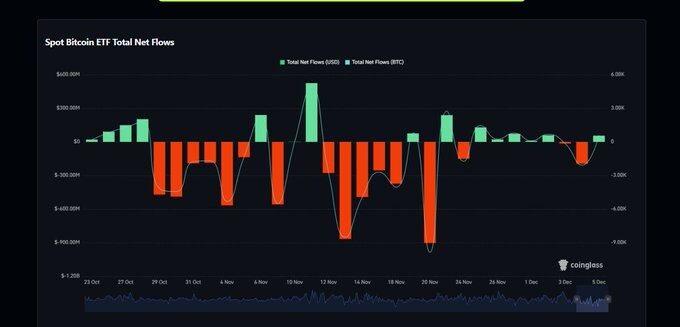
If there is any indicator that could change the short-term trend, it would be ETF fund flows. These products have consistently influenced Bitcoin's mid-term trend, and daily net inflows and outflows often serve as responsive short-term signals.
However, data from the past week shows that ETF fund flows have been nearly zero. Although technically the inflows remain positive, the scale is too small to constitute real support. In fact, ETFs have not participated in the price formation process.
During periods of unclear market directional judgment, the lack of new demand is particularly significant. When funds decrease, open interest stagnates, and ETFs exit the market, price movements will primarily be influenced by the order book rather than new capital. This shift explains why intraday price fluctuations increasingly resemble liquidity-driven volatility rather than trend-driven rallies.

DXY Provides Support, But Not Strong Enough
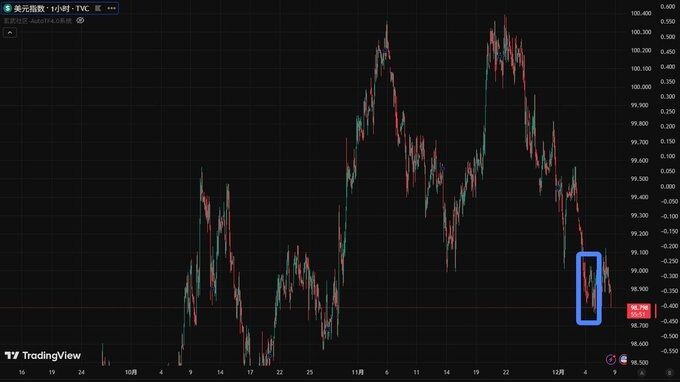
The recent movement of the Dollar Index (DXY) is generally favorable for Bitcoin. When the dollar weakens or consolidates at low levels, Bitcoin often benefits from this inverse relationship. In fact, part of Bitcoin's strength earlier this week was due to this.
However, even a strong dollar cannot offset the internal weakness of cryptocurrency-related indicators. After December 5, the Dollar Index (DXY) entered a consolidation phase, weakening the clarity of the inverse signals. Meanwhile, the deterioration of funds, positions, and ETF fund flows has a far greater impact on market sentiment than any slight macroeconomic positives.
Therefore, while the Dollar Index explains why Bitcoin has not seen a significant drop, it alone cannot reverse the increasingly mild bearish structure in the short term.

Order Book Liquidity Shows Excessive Selling Pressure
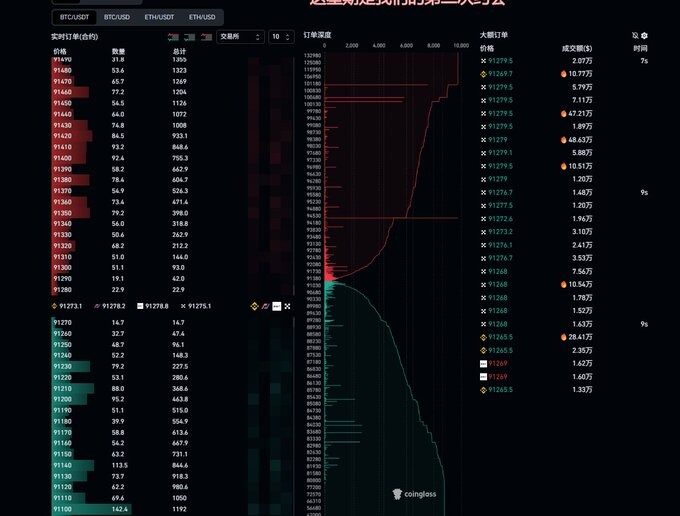
The next key information comes from the dynamics of the order book. Real-time liquidity shows that buyer depth is relatively weak; there are no significant clusters of strong buy orders at the current price level providing effective support. Meanwhile, selling pressure is more pronounced.
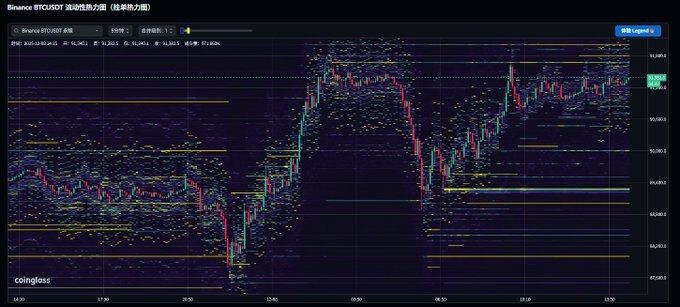
In the heat map data, this imbalance is even more evident. The dense selling liquidity zones at 91,800 and 92,200 create a clear upper barrier. In contrast, the areas of concentrated buying interest are significantly lower—around 89,400, where a massive liquidity barrier appears.
This formation creates a clear trading channel: resistance above and support below, and without new capital injection, the market has little momentum to break through these two boundaries. With bullish funds decreasing and ETFs not intervening, the likelihood of an upward breakout diminishes. Conversely, the strong liquidity around 89,400 increases the chances of demand absorption, and if prices drop, a rebound may occur in the short term.

Short-Term Structure: Bullish Weakness, Bearish Passivity
Taking all signals into account—funding rates, open interest, ETF fund flows, the Dollar Index, order book depth, and heat map positions—Bitcoin's current trend structure can be summarized as:
"Upward pressure is limited, downward support exists, but the short-term bias remains bearish."
This is neither a crash nor the beginning of a sharp trend reversal. Instead, it reflects the market's difficulty in sustaining upward momentum. Bullish strength is insufficient to push prices higher, while bearish strength is also inadequate to trigger a decisive crash. The absence of ETF fund inflows is particularly significant, as sustainable upward trends in this cycle have almost always required ongoing institutional demand.
In other words, the market is weak, indecisive, and increasingly mechanical—driven not by narratives or capital flows, but by liquidity gaps and passive order behavior.

Why the Next Macro Catalyst Is Crucial
The upcoming interest rate cut meeting may bring some short-term volatility to Bitcoin, but even its potential upward impact should be interpreted cautiously. Liquidity remains tight, and market sentiment seems somewhat fatigued.
Even if dovish signals provide temporary relief, the overall environment will not change overnight; structural demand still needs to reassert itself. A more interesting scenario arises if the market finds the outcome disappointing. In this case, market sentiment could shift rapidly, breaking the current stalemate and leading to a clearer direction—perhaps downward, as the path of least resistance currently points downwards.
Ironically, a failed "good news" event could very well end the recent consolidation phase.
Building a Structured Rating Model
Given the current dispersion of signals, it becomes increasingly important to construct a systematic scoring model for short-term, mid-term, and long-term indicators. Each indicator—funding rates, open interest, ETF fund flows, macro factors, liquidity concentration, heat map levels—has different weights depending on the time span.
In a 7-day outlook, short-term structural indicators, such as heat map liquidity or intraday open interest changes, should carry more significant weight. Mid-term analysis must rely more on ETF positions and macro trends. Long-term forecasts need to consider structural demand, clarity of regulatory policies, and supply-side factors such as halving and broader applications.
Through a reasonable scoring distribution, Bitcoin's behavior can shift from subjective interpretation to quantitative analysis. The current configuration scores slightly lower on a short-term scale: not entirely bearish, but due to weakened bullish interest, extremely low ETF participation, and clear liquidity resistance, the overall trend is slightly downward.
免责声明:本文章仅代表作者个人观点,不代表本平台的立场和观点。本文章仅供信息分享,不构成对任何人的任何投资建议。用户与作者之间的任何争议,与本平台无关。如网页中刊载的文章或图片涉及侵权,请提供相关的权利证明和身份证明发送邮件到support@aicoin.com,本平台相关工作人员将会进行核查。